
Climate Migration in Serbia: Quantification Using a Difference-in-Differences Approach
Bočna strana članka
Glavni sadržaj članka
Apstrakt
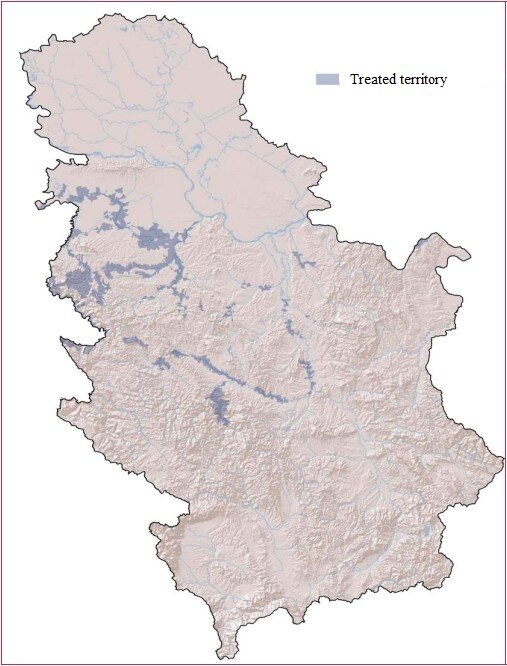
This study examines whether the municipalities classified as flood-affected during the May 2014 floods experienced a differential change in formally registered internal out-migration relative to non-flooded municipalities. The analysis uses a balanced municipality-year panel for 2009–2018, comprising 40 flood-affected and 125 non-flooded municipalities, with municipality and calendar-year fixed effects. The primary estimate is positive but imprecise (0.239 per 1,000 residents; 95% CI: −0.423 to 0.901). A restricted matched-sample estimate is larger but also imprecise, while a specification allowing NUTS2 region-specific annual shocks produces a larger positive estimate. Event-study and placebo diagnostics provide no statistical evidence of differential pre-treatment changes, although their confidence intervals are wide. Exploratory analyses suggest that estimated responses may vary by selected pre-flood municipal characteristics, but they do not identify household-level mechanisms. The findings do not support a single specification-invariant estimate of a positive average flood effect; they show that the estimated municipality-level association is sensitive to the comparison group and the treatment of regional annual shocks.
Puni tekst članka je dostupan za ovaj lokalitet: English.
Detalji članka
Centar za demografska istraživanja Instituta društvenih nauka




Reference
Berlemann, M., & Tran, T. X. (2020). Climate-related hazards and internal migration: Empirical evidence for rural Vietnam. Economics of Disasters and Climate Change, 4, 385-409. https://doi.org/10.1007/s41885-020-00062-3
Birkmann, J., Schüttrumpf, H., Handmer, J., Thieken, A., Kuhlicke, C., Truedinger, A., Sauter, H., Klopries, E.-M., Greiving, S., Jamshed, A., Merz, B., Solecki, W., & Kirschbauer, L. (2023). Strengthening resilience in reconstruction after extreme events - Insights from flood affected communities in Germany. International Journal of Disaster Risk Reduction, 96(103965). https://doi.org/10.1016/j.ijdrr.2023.103965
Black, R., & Collyer, M. (2014). Populations “trapped” at times of crisis. Forced Migration Review, 45, 52-56. https://pure-oai.bham.ac.uk/ws/files/109384827/black_collyer_English.pdf
Black, R., Bennett, S. R. G., Thomas, S. M., & Beddington, J. R. (2011). Climate change: Migration as adaptation. Nature, 478(7370), 447-449. https://doi.org/10.1038/478477a
Bubeck, P., Berghäuser, L., Hudson, P., & Thieken, A. H. (2020). Using panel data to understand the dynamics of human behavior in response to flooding. Risk Analysis, 40(11), 2340-2359. https://doi.org/10.1111/risa.13548
Carling, J. (2002). Migration in the age of involuntary immobility: Theoretical reflections and Cape Verdean experiences. Journal of Ethnic and Migration Studies, 28(1), 5-42. https://doi.org/10.1080/13691830120103912
Carling, J., & Schewel, K. (2018). Revisiting aspiration and ability in international migration. Journal of Ethnic and Migration Studies, 44(6), 945-963. https://doi.org/10.1080/1369183X.2017.1384146
Cattaneo, C., Beine, M., Fröhlich, C. J., Kniveton, D., Martinez-Zarzoso, I., Mastrorillo, M., Millock, K., Piguet, E., & Schraven, B. (2019). Human migration in the era of climate change. Review of Environmental Economics and Policy, 13(2), 189-206. https://doi.org/10.1093/reep/rez008
De Haas, H. (2021). A theory of migration: The aspirations-capabilities framework. Comparative Migration Studies, 9(1). https://doi.org/10.1186/s40878-020-00210-4
De Sherbinin, A., Grace, K., McDermid, S., Van der Geest, K., Puma, M. J., & Bell, A. (2022). Migration theory in climate mobility research. Frontiers in Climate, 4(82343). https://doi.org/10.3389/fclim.2022.882343
Dillenardt, L., Hudson, P., & Thieken, A. H. (2022). Urban pluvial flood adaptation: Results of a household survey across four German municipalities. Journal of Flood Risk Management, 15(3), e12748. https://doi.org/10.1111/jfr3.12748
Foresight. (2011). Migration and global environmental change: Final project report. The Government Office for Science. https://www.un.org/development/desa/pd/sites/www.un.org.development.desa.pd/files/unpd-cm10201202-11-1116-migration-and-global-environmental-change.pdf
Gligorijević, V., & Bakić, D. (2025). Proceedings of the Twelfth scientific-expert meeting with international participation "Planned and normative protection of space and environment", 275-282, Vršac (D. Filipović, V. Šečerov, D. Ristić, & M. Ilić, Eds.). https://scindeks-clanci.ceon.rs/data/pdf/proc-0044/2025/proc-00442502275G.pdf
Hoffmann, R., Abel, G., Malpede, M., Muttarak, R., & Percoco, M. (2024). Drought and aridity influence internal migration worldwide. Nature Climate Change, 14(12), 1245-1253. https://doi.org/10.1038/s41558-024-02165-1
Intergovernmental Panel on Climate Change (IPCC). (2023). Climate change 2022: Impacts, adaptation and vulnerability. Cambridge University Press. https://doi.org/10.1017/9781009325844
Karymshakov, K., Aseinov, D., & Azhgaliyeva, D. (2024). Drought and Migration: Evidence from the Kyrgyz Republic. Asian Development Bank Institute. https://doi.org/10.56506/ilsu5435
Kleemans, M. (2015). Migration choice under risk and liquidity constraints. Unknown. https://doi.org/10.22004/ag.econ.200702
Lee, E., Kim, H., & Song, J. (2018). The impacts of natural disasters on population outflow: Focusing on the flood. Journal of the Korean Society of Hazard Mitigation, 18(7), 137-147. https://doi.org/10.9798/kosham.2018.18.7.137
Marchiori, L., Maystadt, J.-F., & Schumacher, I. (2017). Is environmentally induced income variability a driver of human migration?. Migration and Development, 6(1), 33-59. https://doi.org/10.1080/21632324.2015.1020106
Mata-Codesal, D. (2014). From “mud” to “migration”: Internal migration aspirations and immobility in highland Ecuador. Population. REMHU: Revista Interdisciplinar DaMobilidade Humana, 22(42), 263-280. https://doi.org/10.1590/s1980-85852014000100016
McLeman, R., & Smit, B. (2006). Migration as an adaptation to climate change. Climatic Change, 76(1-2), 31-53. https://doi.org/10.1007/s10584-005-9000-7
Niva, V., Kallio, M., Muttarak, R., Taka, M., Varis, O., & Kummu, M. (2021). Global migration is driven by the complex interplay between environmental and social factors. Environmental Research Letters, 16(11), 114019. https://doi.org/10.1088/1748-9326/ac2e86
Oskorouchi, H. R., & Sousa-Poza, A. (2021). Floods, food security, and coping strategies: Evidence from Afghanistan. Agricultural Economics, 52(1), 123-140. https://doi.org/10.1111/agec.12610
Piguet, E. (2022). Linking climate change, environmental degradation, and migration: An update after 10 years. WIREs Climate Change, 13(1), e746. https://doi.org/10.1002/wcc.746
Sakdapolrak, P., Borderon, M., & Sterly, H. (2024). The limits of migration as adaptation: A conceptual approach towards the role of immobility, disconnectedness and simultaneous exposure in translocal livelihoods systems. Climate and Development, 16(2), 87-96. https://doi.org/10.1080/17565529.2023.2180318
Schewel, K. (2020). Understanding immobility: Moving beyond the mobility bias in migration studies. International Migration Review, 54(2), 328-355. https://doi.org/10.1177/0197918319831952
Sengupta, M. (2025). Environmental immobility: A systematic review of empirical research. Ambio, 54(11), 1729-1756. https://doi.org/10.1007/s13280-025-02195-9
Sheldon, T. L., & Zhan, C. (2022). The impact of hurricanes and floods on domestic migration. Journal of Environmental Economics and Management, 115(102726). https://doi.org/10.1016/j.jeem.2022.102726
Stanković, J., Tomić, Z., & Stanković, J. (2020). Socio-economic impact of natural disasters in the Republic of Serbia. Economic Analysis, 53(2), 20-38. https://doi.org/10.28934/ea.20.53.2.pp20-38
Statistical Office of the Republic of Serbia. (2015). Opštine i regioni u Republici Srbiji 2015 [Municipalities and regions in the Republic of Serbia 2015]. https://publikacije.stat.gov.rs/G2015/PdfE/G20152017.pdf
Statistical Office of the Republic of Serbia. (2023). Metadata. Internal Migrations of the Population. https://data.stat.gov.rs/Home/Result/180602?languageCode=sr-Cyrl
Stojanov, R., Rosengaertner, S., de Sherbinin, A., & Nawrotzki, R. (2021). Climate mobility and development cooperation. Population and Environment, 43(2), 209-231. https://doi.org/10.1007/s11111-021-00387-5
Vasić, P. (2026). Izveštaj o projekciji stanovništva pod uticajem izazova životne sredine u Republici Srbiji, [Report on population projection under the influence of environmental challenges in the Republic of Serbia], (Project POPENVIROS - Research report D8.1). University of Belgrade - Faculty of Geography. https://rs.popenviros-prizma.com/biblioteka-2/izvestaji/#
Wooldridge, J. M. (2010). Econometric analysis of cross section and panel data. MIT Press. https://ipcid.org/evaluation/apoio/Wooldridge%20-%20Cross-section%20and%20Panel%20Data.pdf
Yao, L., Tan, S., Lv, C., Wang, N., Yoshida, Y., & Long, Y. (2026). Climate change adaptation must consider older people. Nature Human Behaviour, 10(3), 443-446. https://doi.org/10.1038/s41562-026-02402-x
Zander, K. K., Nguyen, D., Mirbabaie, M., & Garnett, S. T. (2023). Aware but not prepared: Understanding situational awareness during the century flood in Germany in 2021. International Journal of Disaster Risk Reduction, 96(103936). https://doi.org/10.1016/j.ijdrr.2023.103936
Zickgraf, C. (2021). Climate change, slow onset events and human mobility: Reviewing the evidence. Current Opinion in Environmental Sustainability, 50, 21-30. https://doi.org/10.1016/j.cosust.2020.11.007
Đorđević, L., & Stanković, V. (2015). Analiza uticaja šteta od elementarnih nepogoda na rezultate popisa [Analysis of the impact of damage from natural disasters on census results]. Statistical Office of the Republic of Serbia. https://publikacije.stat.gov.rs/G2015/Pdf/G20154008.pdf