
Employment Policy Measures to Improve the Economic Opportunities of Women in Serbia
Article Sidebar
Main Article Content
Abstract
The aim of the paper is to analyze the performance of women in the Serbian labor market. The research topic is gaining importance as Serbia is in a mature phase of implementing its strategic framework for employment policy. This paper applies an approach that focuses on analyzing the impact of labor market policies aimed at improving the economic position of women. It analyses labor market statistics, as well as relevant policy documents, previous studies and research findings that show how women are progressing on the scale of measurable indicators of gender equality and whether they are ready to take advantage of economic opportunities in the face of demographic challenges. While women still lag behind men, their labor force participation and employment rates show relative and absolute improvement. The differences in the basic labor market indicators in the population category with tertiary education have narrowed since 2023. The pay gap persists and has been closing slowly, despite the regulations and efforts to help women in the labor market through active measures. The main findings for Serbia are compared with other relevant research findings to derive conclusions based on a comparative analysis supported by recommendations.
1 INTRODUCTION
It is well known that women and men have unequal economic opportunities, but it is less well known how the situation evolves when the right influencing factors are targeted. This paper provides an overview of the current situation on the Serbian labor market. Many previous policies were aimed at empowering women and improving their position in the labor market (Government of the Republic of Serbia 2021a, 2021b). Nevertheless, women still have poorer prospects on the labor market and are more affected by poverty despite being employed (Ognjenović and Pavlović 2021). The gender gap in employment initially widened slightly to 14.8 percentage points in 2021, and then narrowed to 13.1 percentage points in 2024, while the difference in labor force participation rate between men and women in 2021 and 2024 was 15.5 and 14.1 percentage points, respectively (Statistical Office of the Republic of Serbia 2025a, 2025b). At the same time, the uncorrected gender pay gap for full-time and part-time employees was 12.1% in 2022 (Statistical Office of the Republic of Serbia 2024), making Serbia one of the countries with a relatively high, but still growing wage gap (Eurostat 2025a).
This paper analyzes the performance of women in the Serbian labor market after the introduction of the Employment Strategy for the period from 2021 to 2026. The general objective guiding this strategy paper refers to stable and sustainable employment growth (Government of the Republic of Serbia 2021a). The specific objective of the Employment Strategy, which refers to improving the situation of the unemployed, highlights hard-to-place women as one of the main groups to be incentivized. Therefore, this paper applies an approach that focuses mainly on analyzing the impact of the policy measures integrated in the Serbian Employment Strategy and the two specifically developed implementation plans (Government of the Republic of Serbia 2021b, 2024). This paper pursues at least two objectives. Firstly, to explain the gender-specific differences in labor market status. And, secondly, to analyze the gender pay gap from a more recent perspective. The two main objectives are considered in the context of the opportunities offered to women through a range of labor market policies.
A number of previous studies for Serbia have focused on key indicators of labor market participation, the gender pay gap and the promotion of the right to equal pay for work of equal value (Vladisavljević, Avlijaš and Vujić 2015; Ognjenović 2021, 2024), while another strand of research has examined the economic resilience of women entrepreneurs (Ognjenović, Pavlović and Bodroža 2022;Babović and Kočović De Santo 2023), and, more generally, the vulnerability of entrepreneurs in times of crises (Ognjenović and Đukić 2023). Compared to previous studies, the novelty of this paper is a comprehensive overview of the main labor market indicators, focusing on the results of the implementation of the existing employment strategies and their implementation plans. Therefore, this paper also presents a situation analysis, focusing on women’s achievements in terms of gender equality in the workplace and the exercise of employment-related rights. The realization of the objectives of this paper is guided by the answers to the following questions. What do the main labor market indicators show? Are inequalities between men and women in the labor market decreasing? Is the pay gap widening and how is it distributed across economic sectors, indicating the hidden effects of occupation choice? Are labor market policies having the expected effect by including unemployed and hard-to-place women in active measures?
In the continuation of these efforts, the public policy framework for the labor market in Serbia is presented with a comparison to the institutional context of the EU. The theoretical-methodological part presents the theoretical framework developed based on the review of the relevant literature and the results of recent studies, while the methodological part explains the research concept, describes the data sources, defines the indicators and justifies their selection. The results of the descriptive data analysis and their discussion are provided in two separate sections. Finally, the conclusions of the paper are presented with the most important recommendations.
2 FRAMEWORK OF EMPLOYMENT POLICIES
The scope of public labor and employment policies set out in the Employment Strategy of the Republic of Serbia until 2026 (Government of the Republic of Serbia 2021a), is largely based on the Employment Guidelines for EU Member States with regard to cross-sectoral measures to achieve the objectives of improving the quality of labor supply, stimulating labor demand and increasing participation in the labor market. The European Pillar of Social Rights, which essentially comprises 20 key factors, promotes the realization of these rights in practice by creating more and better jobs, improving skills and equal opportunities, as well as better health and social protection and inclusion. The European Pillar of Social Rights Action Plan sets three main measurable targets by 2030, aiming to increase the employment rate of the population aged 20–64 to 78%, increase the annual education rate of the adult population by at least 60% and reduce the number of Europeans at risk of poverty by at least 15 million, including five million children (European Commission 2021). The Employment Guidelines for the EU Member States were amended twice. Firstly, in 2020 due to the consequences of the COVID-19 crisis (Council Decision (EU) No. 2020/1512 2020) and secondly in 2022, to support the integration of Ukrainian refugees of working age into the European labor market (Council Decision (EU) No. 2022/2296 2022). The revision of the Employment Guidelines builds on the Porto Summit held in May 2021, which emphasized that the European Pillar for the Realization of Social Rights (European Commission 2021) should enable an easier transition (digital, green and fair, inclusive) for the members of the Union and contribute to social and economic convergence, recognizing the importance of demographic changes due to the aging of the population. The key points of the 2022 revision relate to (i) strengthening the demand for labor, (ii) improving labor supply and access to employment, lifelong learning and skills development to facilitate the transition resulting from technological, demographic and environmental change, (iii) improving the functioning of the labor market and strengthening social dialogue, (iv) promoting equal opportunities, social inclusion and combating poverty, with the aim of taking measures that effectively prevent all forms of discrimination and promote equal opportunities and gender equality, in particular the promotion of disadvantaged groups in the labor market, including women and young people, with a focus on regional and territorial coverage (Council Decision (EU) No. 2022/2296 2022).
The Employment Strategy of the Republic of Serbia for the 2021–2026 period has as a general goal the creation of conditions for stable and sustainable employment growth with continuous improvement of the level of knowledge and promotion of decent work, which is to be achieved through three main objectives: (i) employment growth through cross-sectoral measures to improve supply and stimulate demand for labor, (ii) improving opportunities for the unemployed through fair integration into the labor market, (iii) improving the legal framework for the implementation of employment policies and increasing the capacity of employment service providers (public and private sector) and raising the level of social dialogue between the parties concerned (Government of the Republic of Serbia 2021a). Compared to the previous strategic framework, this document focuses on achieving a smaller number of strategic objectives, but requires cross-sectoral measures to improve labor supply and demand, targets vulnerable groups of labor market participants and provides for a number of measures to improve the economic position of women. In the implementation plans for achieving the Strategy’s goals by 2026, activities to improve the position of women in the labor market are proposed as a part of the measures to promote women’s employment (Ministry of Labor, Employment, Veteran and Social Affairs of the Republic of Serbia 2022, 2023, 2024). The less favorable economic position of women stems from the observed imbalances resulting from lower labor force participation and employment rates and lower average wages compared to men, which perpetuate gender gaps in employment, occupation and income.
The objectives of the Strategy in terms of improving the environment for creating equal opportunities for all are realized through the implementation of the Law on Gender Equality (2021), which replaces the former Equality Act (2009) in the domain of preventing discrimination and promoting gender equality through equal treatment of men and women, with the aim of realizing the rights in the areas of work, employment and self-employment. The legal framework implemented in Serbia to promote gender equality is based on the principles of the European Directive on equal opportunities and equal treatment of men and women in employment and occupation (Directive 2006/54/EC 2006). This regulation focuses on the employer and other parties whose actions may restrict access to employment, career development and promotion, and place a disadvantaged group in an unfavorable position. The practical implementation of the principle of equal pay for equal work or work of equal value is the fundamental starting point of the EU directive to achieve greater equality in the labor market, as gender pay gaps and gender segregation are common practice in European countries (European Commission 2020a). The application of this principle was further emphasized in the European legal area by the introduction of the Directive on pay records and pay transparency (Directive 2023/970/EC 2023). The European Strategy for Gender Equality by 2025 is a response to the green and digital transitions, fair inclusion and demographic change, which are all priority actions in the field of labor and employment and form a part of the European Pillar of Social Rights (European Commission 2020b). In this way, it promotes the concept that gender equality favors the creation of more jobs and supports productivity growth.
3 THEORETICAL AND METHODOLOGICAL FRAMEWORK
3.1 THEORETICAL BACKGROUND
Given the low participation of women in the labor market, the fundamental question has long been how to optimally allocate time between domestic responsibilities and investment in human capital, in order to raise women’s market wages to a level that is acceptable if they decide to participate in the labor market in greater numbers (Mincer and Polachek 1974). The main theoretical concept to which the empirical research refers, assumes that gender pay gaps are the result of differences in the individual characteristics of men and women and that the elimination of these differences would lead to a correction of the pay gap, which is one of the central problems of gender equality (Blau and Kahn 2003). Therefore, gender equality policies are mainly based on improving the female labor supply so that the differences between men and women can be attributed to the dissimilarities in their observed characteristics (Rubery, Grimshaw and Figueiredo 2005). Studies conducted in Eastern European countries show that men and women perceive their roles in the household and outside the household differently, with women valuing a fair distribution of household tasks more than men (Fodor and Balogh 2010).
Women’s financial vulnerability is largely the result of income inequality between men and women and is therefore reflected in women’s everyday lives and career progression (Schneebaum et al. 2018; Ognjenović and Pavlović 2021). Regarding women in Eastern European countries, the results of empirical studies also show that less than a third of women hold responsible decision-making positions in political and social life, and that violence against women is disproportionately high, which is illustrated by the finding that one in four women is exposed to violence by the partner (Cuberes, Munoz-Boudet and Teignier 2019).
Company-level research and literature based on public policy analysis in the EU show that pay transparency and pay gap are inversely proportional, confirming the fact that more transparency reduces the gender pay gap (Bennedsen, Larsen and Wei 2023). However, there are also opponents of this hypothesis who point out that pay transparency can affect human freedoms and reduce productivity at company level (Bennedsen et al. 2022). Transparency of wage setting in the EU is a mechanism introduced to encourage companies to reduce the pay gap between women and men, which in turn contributes to the promotion of gender equality (Rubery, Grimshaw and Figueiredo 2005). Although the influence of unionization has declined in the EU, data from women’s unions suggest that the secrecy of workers’ pay has a significant impact on the pay gap due to the payment of lower wages to women (Bennedsen et al. 2022). Thanks to pay transparency, women may prefer to seek employment in the companies where the pay gap is low. Legislative solutions to promote equal opportunities have helped to change the climate in European companies in favor of women when filling high-paying positions, which in turn helps to reduce the pay gap (Bennedsen, Larsen and Wei 2023). There is empirical evidence of a statistically significant correlation between the appointment of women to management positions and the pay gap (Theodoropoulos, Forth and Bryson 2022). New studies investigating the impact of robotization on pay gap are also essential. The results do not argue for a reduction in the pay gap, but show that increasing robotization in countries with already high inequalities would likely lead to widening of the pay gap. More precisely, a 10% increase in robotization would enlarge the pay gap by 1.8% on average (Aksoy, Özcan and Philipp 2021: 10).
Empirical research does not lead to a uniform conclusion when it comes to how much of the difference in earnings between men and women can be explained by job-related characteristics or personal traits, and how much is due to gender discrimination. In the Western Balkans (WB), including Serbia, men earn on average up to one fifth more than women, and the evolution of the pay gap depends on numerous factors, such as the observation period, the type of microdata and the methods of analysis used (Ognjenović 2021, 2024). The pay gap falls below 10% if characteristics of an employee, the workplace and the employer are considered (Vladisavljević Avlijaš and Vujić 2015). The intensity of gender inequality changes over the course of working life and is usually negatively correlated over time.
Empirical results from the comparison of gender inequality in the labor markets of the WB, Turkey and the EU show that the largest gender gap is in the labor force participation rate (twice as high as in the Union countries), while the gender gap in self-employment is close to the Union average. Using the occupational choice model, Cuberes, Munoz-Boudet and Teignier (2019: 87) show that the loss of average income due to current gender inequalities would be up to 20%, and 6% only due to the gender gap in self-employment. When analyzed by age cohort, the largest gender differences in labor force participation rates are found among older people, the largest differences among employers are found with middle-aged people, while the self-employed differ significantly when looking at young cohorts. Forecasts on the development of skills supply and demand in WB labor markets until 2030 indicate that the current trend of simultaneous skills shortages and skills obsolescence will change direction (Leitner 2022), inducing a negative impact on the pay gap if there is no response from companies and policy makers.
3.2 METHODS
The paper analyses synthetic indicators of the labor market status, as they capture and represent the changes most fully. As emphasized at the beginning of the paper, the aim is to place the entire analysis of labor market participation by sex in the context of the implementation of the Employment Strategy in Serbia, and evaluate its potential impact on the employment of women, especially from vulnerable groups, which is included in the paper through participation in active labor market policy measures. The time frame of the analysis for most of the selected indicators is limited to the period 2021–2024. Another explanation for the choice of this time frame are the changes in the methodology of the EU Labor Force Survey (EU-LFS) conducted by Eurostat (2021), which were also adopted by the Statistical Office of the Republic of Serbia (SORS). In 2021, the EU-LFS methodology was adapted to the recommendations of the EU bodies, to align with international labor standards. From 2023, the weights used for the Serbian Labor Force Survey (LFS) data are estimated using demographic trends in population growth based on the 2022 Census. For reasons of comparability, the figures analyzed in this paper therefore refer to the data after the 2021 revision (Statistical Office of the Republic of Serbia 2021).
The paper uses the standard method for calculating the indicators of labor force dynamics segregated by sex. Three groups of harmonized synthetic labor market indicators are used for the analysis of differences between men and women: (i) the labor force participation rate for men and women (the share of male and female labor force in the corresponding subset of the working age population), (ii) the employment rate for men and women (the share of employed men and women in the corresponding subset of the working age population), and (iii) the unemployment rate for men and women (the share of unemployed men and women in the corresponding subset of the labor force).
The population framework used in connection with the calculation of selected indicators comprises the population aged 15 to 64, i.e. the working age population. An additional methodological explanation for the choice of the working age contingent as a statistical framework for the calculation of standard labor market indicators is the fact that it is particularly relevant in the context of countries where the activity level of the post-employment contingent is low, as is the case in Serbia.
On the basis of these indicators, the differences between the indicators calculated for men and women are presented as gender-specific differences in labor force participation, employment and unemployment rates, and interpreted as changes in percentage points. The analysis is extended by two important characteristics of men and women, which are embodied in their age and level of education. Thus, a tripartite division is made in each segment, dividing the participants into three age groups (15–24; 25–54 and 55–64). In order to systematize educational attainment into comparable groups, the ISCED levels of the International Standard Classification of Education (ISCED) from 2011 are grouped, expressing primary and lower education, secondary (general and vocational) and tertiary education. Additional explanations are provided further in the paper.
Several data sources were used to derive the research results presented in this paper. First, as already mentioned, the data from the continuous, regularly conducted surveys of the SORS, including the LFS, the Structure of Earnings Survey (SES) and other publicly available data on labor market trends were used (Statistical Office of the Republic of Serbia 2020, 2025a, 2025b, 2024). These data were combined with the Eurostat labor market statistics to make comparisons more meaningful (Eurostat 2025a). Finally, data from the register of unemployed persons and recipients of active labor market policy measures published by the National Employment Service (NES) in its annual reports were used (National Employment Service 2023a). The Employment Strategy for Serbia promotes active labor market policies that would lead to greater equality in performance between men and women and creates the basis for a critical review of what has been achieved so far.
4 DESCRIPTIVE DATA ANALYSIS
4.1 GENDER DIFFERENCES IN LABOR MARKET STATUS
The starting point for defining the framework for employment policy measures is the existence of significant inequalities in the labor market, which are primarily identified by statistically examining the differences in measurable outcome indicators for men and women. Therefore, regulatory and incentive measures have been envisaged, that are primarily aimed at improving the economic situation of women. The economic status of women has not improved significantly since the start of the transitional reforms. Given the significant economic backwardness of women, which was due to the restructuring of the real sector and the decline of industrial enterprises where many women worked, as well as the fact that new jobs required skilled labor and workers who are in productive age, many women retired rather than returned to work. The focus of the real sector, on the other hand, was on conquering the market and increasing competitiveness, which was foreseen by systemic changes and the new legal framework (Ognjenović 2015). Technological progress has facilitated the return of younger female cohorts to the labor market, as their educational structure has also visibly improved (Gligorijević and Bakić 2022). Nevertheless, the employment rate of women is significantly lower than that of men, and women from the so-called “disadvantaged” groups are more likely to work in the informal sector and as contributing members of households and family businesses. This picture is unique across the WB region and is slowing the countries’ convergence towards the EU average (Atoyan and Rahman 2017). At the same time, each “global” crisis, including the last one caused by the COVID-19 pandemic, slows them down further. Poorer countries are less generous in terms of all forms of aid and need more time to return to their previous economic path (Ognjenović and Đukić 2023).
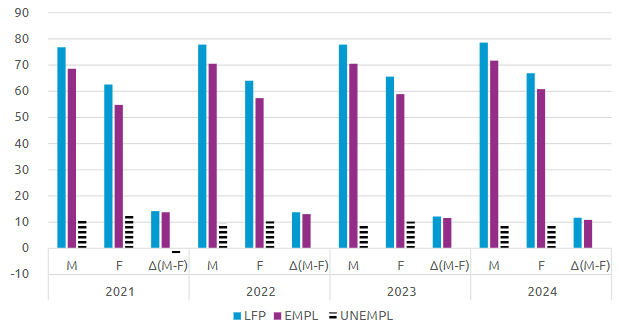
Figure 1 shows that men and women in Serbia differ in terms of their economic activity and that these differences persist. Based on the LFS data in a short time span, it is not possible to determine whether anything significant has changed between 2021 and 2024 and whether the impact of employment policies has influenced the reduction of the gender gap. In fact, the difference in the labor force participation rate (population 15–64) in 2024 is slightly smaller than in 2021, which is because men have entered the labor market in greater numbers than women. In relative terms, the labor force participation rate of men increased by 1.8 percentage points in 2024 compared to 2021 and that of women by 4.3 percentage points, so that the gap is still high at 11.7 percentage points, but is decreasing. In the EU-27, this difference is smaller and amounts to 9.3 percentage points with a female labor force participation rate of 70.7% in 2024. A similar trend can be observed in the development of gender differences in employment. For women in Serbia, there is a slight upward trend in the employment rate of 60.8% in 2024, compared to 54.8% in 2021, while the employment rate for men is 71.7% (narrowing the gender gap by 2.9 percentage points compared to 2021). For the same age population in the EU-27, the employment rates for men and women in 2024 were 75.3% and 66.2% respectively, resulting in a gender gap of 9.1 percentage points (Eurostat 2025a). The unemployment rates of men and women have ”converged“ in recent years, so that the gender gap in 2024 was 0.3 percentage points, which is due to the higher unemployment rates of women. According to EU-LFS data (Eurostat 2025a), the gender gap in the unemployment rate in 2024 at EU-27 level was 0.5 percentage points, with unemployment rates for men (5.8%) and women (6.3%) being lower on average than in Serbia (8.8% and 9.1% respectively).
Figure 1. Labor force participation (LFP), employment (EMPL) and unemployment (UNEMPL) rates for men and women in Serbia, 2021–2024
Notes: M stands for “male”, F for “female”, while Δ(M-F) denotes the difference in the values of the indicators for men and women. Working age population 15–64 years.Source: Eurostat (2025a) and Statistical Office of the Republic of Serbia (2021, 2025a, 2025b).
The bigger gender differences in the labor force participation rate of young people (15–24 years) result from the age structure of activity among the working age population, so they are likely to be larger among those characterized by low levels of economic activity due to pursuing education. In addition, census data show that the gender differences in labor force participation can be observed through different patterns of behavior of girls and boys in relation to education. General trends show that girls are more oriented towards higher education than their male peers, so they are likely to enter the labor market only after completing their education (Devedžić and Šobot 2025).
The gender differences in the labor force participation rates of the prime-age population (25–54 years) are the smallest, which is supported by the fact that women are present in the labor market at this age and most of them are employed. The labor force participation rate of women decreases faster with age than that of men, with the largest gap in the 54+ age group (Figure 2). In 2021, the difference in the labor force participation rate between men and women in the 55–64 age group was 21.4 percentage points, i.e. 5.2 percentage points more than in 2024, indicating a slight tendency for the gap to narrow, which is a sign that women are present in the labor market for longer due to, among other things, the postponement of the retirement age and the expected higher returns to work experience.
Figure 2. Differences in labor force participation (LFP), employment (EMPL) and unemployment (UNEMPL) rates by sex and age groups in Serbia, 2021–2024
Notes: Working age population 15–64 years.Source: Eurostat (2025a) and Statistical Office of the Republic of Serbia (2021, 2025a, 2025b).
The gender gap in the employment rate of young men and women (15–24 years) is decreasing (it was 15.7 percentage points in 2024) and is approaching the difference between the employment rates of workers at the upper end of the age distribution (55–64 years), which was 15.1 percentage points in 2024. In the 25–54 age group, the gender gap in employment is primarily determined by the employment rate of women, which increases during the observed period. The time frame of this study is too short to adequately explain the existing divergence in the employment rate by sex.
The gender gap in the unemployment rate of the oldest group of workers decreases over the years, but the unemployment rates of young women and men still differ significantly, confirming that young women have less chance of finding employment than men immediately after leaving school, even if their educational attainment improves. The exception is the year 2024, in which the unemployment rates of young men (23.0%) and women (23.1%) have equalized, narrowing the gap. However, these data are not consistent with the NES data for 2024 on the duration of unemployment among young women, which show that three-fifths of all women registered as unemployed are looking for their first job. The difference is caused by the NES only keeping data on registered unemployed persons. However, the higher unemployment rates of women in the 25–54 age group are present throughout the period analyzed, which certainly slows down the decline in the gender gap among people of the most productive working age (National Employment Service 2025). While this finding is worrying, it is not possible to obtain more precise answers on the basis of observing developments over a period of four years.
The economic activity of the working age population in Serbia by education level is shown in Figure 3 for the male population and in Figure 4 for the female working age population. In order to obtain a more comprehensive structure for the needs of the analysis, a methodological tripartite division was made according to the highest completed school level (primary, secondary and tertiary education). The labor force participation and employment rates of women with the primary school qualification are the lowest compared to other levels of education, but they are also lower than the labor force participation rates of men, which contributes to the gap in their status in the labor market. As illustrated in Figures 3 and 4, in 2024, the labor force participation and employment rates of women and men at this level of education were 34.6% and 29.5% (women) and 50.9% and 43.9% (men), respectively. The gender gap in labor force participation (16.3 percentage points) and employment rates (14.4 percentage points) is therefore also the greatest among those with primary education or less, indicating that either the supply of low-skilled women is thin, or that these women have left the labor market because the demand (supply of jobs) is low. Women are also less likely than men to take part in in-company trainings to acquire the qualifications they lack on the labor market and ensure employment stability (Ognjenović 2023).
Figure 3. Male labor force participation (LFP), employment (EMPL) and unemployment (UNEMPL) rates by educational attainment in Serbia, 2021–2024
Notes: Male working age population 15–64 years.Source: Eurostat (2025a) and Statistical Office of the Republic of Serbia (2021, 2025a, 2025b).
Figure 4. Female labor force participation (LFP), employment (EMPL) and unemployment (UNEMPL) rates by educational attainment in Serbia, 2021–2024
Notes: Female working age population 15–64 years.Source: Eurostat (2025a) and Statistical Office of the Republic of Serbia (2021, 2025a, 2025b).
Although the labor force participation and employment rates of women with secondary school qualifications are higher, they are not yet sufficient to significantly reduce the gender gap. A high percentage of women with a tertiary education make up the female labor force. Nevertheless, there is still a difference in the employment rate of men and women with tertiary education, which amounted to 15.3 and 14.6 percentage points respectively in 2024. The employment rates of women with a tertiary education are rising faster. In the period 2021–2024, the rate has increased by 4.3 percentage points (women) and 2.5 percentage points (men), respectively. The difference between the rates will turn into an advantage for women in the coming years, in the sense that the employment rates of women with tertiary education will exceed those of men. This can also be explained to a certain extent by slight differences in the current unemployment rates, which in 2024 were 6.8% for women and 6.3% for men with tertiary education.
Of particular concern are the high rates and significant differences in early school leaving indicators among 18–24 year olds and young people (15–24 years) not in education, employment or training (NEET), as shown in Table 1. Young men drop out of education more often than young women, which is confirmed by the better long-term educational structure of women, despite the differences in the main labor market indicators. The LFS data in Table 1 do not indicate that young people of this age drop out of school to find a job, but there are other reasons as well, and when they do find a job, they usually work in the informal sector, in jobs that offer a low level of security (Ministry of Labor, Employment, Veteran and Social Affairs of the Republic of Serbia 2022, 2023, 2024). Table 1 do not indicate that young people of this age drop out of school to find a job, but there are other reasons as well, and when they do find a job, they usually work in the informal sector, in jobs that offer a low level of security (Ministry of Labor, Employment, Veteran and Social Affairs of the Republic of Serbia 2022, 2023, 2024).
| Year | Indicator | Men | Women |
|---|---|---|---|
| 2021 | Early school leavers (18–24), % | 8.7 | 6.6 |
| NEETs (15–24), % | 17.1 | 17.0 | |
| 2022 | Early school leavers (18–24), % | 6.5 | 5.0 |
| NEETs (15–24), % | 13.4 | 13.3 | |
| 2023 | Early school leavers (18–24), % | 5.8 | 5.9 |
| NEETs (15–24), % | 12.7 | 12.2 | |
| 2024 | Early school leavers (18–24), % | 6.8 | 5.7 |
| NEETs (15–24), % | 13.1 | 12.6 | |
| Source: Eurostat (2025a) and Statistical Office of the Republic of Serbia (2021, 2025a, 2025b). | |||
The NEET indicator is almost equally unfavorable for young men and women. Due to the volatility, no clear downward trend can be identified over the years. The rates of 13.1% for men and 12.6% for women, which represented a difference of 0.9 percentage points in 2024, suggest that young men need more support to be successful in the labor market (Table 1). Both groups of young people belong to a particularly vulnerable group that is entitled to combined support measures to help them integrate into the labor market, including training to improve their skills. In 2024, the NES launched the “Youth Guarantee” pilot program (National Employment Service 2023b), which has aimed to improve the situation of young people at risk. This group of labor market participants usually forms the category of self-employed out of necessity, whose survival rate on the market is lower compared to other entrepreneurs (Ognjenović, Pavlović and Bodroža 2022).
Countries with high unemployment rates at almost all levels of education demonstrate the need to integrate the unemployed into active labor market policies through additional education and training measures or subsidized employment. Above all, however, they show that the labor market and the demand for occupations cannot keep the pace with the current supply. This means that the labor market is functioning inadequately, partly due to an insufficient supply of skills, and partly because the pool of unemployed people who cannot find work is generally stacked up in long-term unemployment. NES data show that more than three-fifths of the registered jobseekers are long-term unemployed (National Employment Service 2025). Another current problem is overqualification, which in Serbia stood at 23.2% (22.6% for women) in 2024 (Eurostat 2025b).
In the EU-27, the structure of unemployment by level of education is similar to that in Serbia, although the unemployment shares and the differences in the rates for men and women are greater in Serbia (Figure 5). This is particularly evident in the differences in unemployment rates by sex among those who finished primary school. Another curiosity is the unemployment rates of both sexes at the secondary vocational education level (5.2% for men and 6.1% for women in EU-27), which are half as low, probably due to the practical skills acquired during schooling to get people into the labor market after leaving school. In Serbia, the highest unemployment rates are recorded among people with primary education, while the unemployment trend is similar for people with general and vocational secondary education. In the group of people with general secondary education, the unemployment rate is slightly higher for men (10.3%) than for women (9.8%) (Eurostat 2025c), even though a higher percentage of girls (33.5%) than boys complete grammar schools in 2024 (22.9%) (Statistical Office of the Republic of Serbia 2025c). Their unemployment rate can be partly explained by the fact that they have not been trained for vocations at grammar schools. When they fail to continue their education or to accept the jobs on offer, they remain unemployed. The problem of overqualification, on the other hand, is partly a consequence of unemployment in the group of people with tertiary education, which places the burden on them to work in professions for which they have not been trained.
Figure 5. Unemployment rates of men and women by level of education in %, Serbia and EU-27, 2024. Note: Working age population 15–64 years. The ISCED level stands for the International Standard Classification of Education from 2011. Source: Eurostat (2025a).
4.2 THE GENDER PAY GAP AND ACTIVE EMPLOYMENT POLICY
The uncorrected gender pay gap in Serbia, derived from the 2022 Structure of Earnings Survey data, is 12.1% (8.8% in 2018) (Statistical Office of the Republic of Serbia 2024). The gender pay gap is calculated for employees in companies with ten or more employees and does not refer to the activities of households as employers and non-territorial organizations and entities, which characterizes Serbia as a country with a ”persistent“ and ”increasing“ gender pay gap. This rate is higher than in North Macedonia (8.3%, 2014), Slovenia (6.5%, 2022) and Croatia (7.3%, 2022), while the EU-27 average in 2022 was 12.0%, excluding public administration, defense and statutory social security (Eurostat 2025a).
Figure 6 shows the uncorrected pay gap between women and men by economic sector in Serbia, calculated from the 2018 and 2022 Structure of Earnings Survey data. The finance and insurance sector is the extreme with the highest pay gap, while the construction sector is the other extreme with the lowest pay gap. Activities with a higher proportion of working men, including manufacturing (19.2% in 2018 and 19.6% in 2022) and energy supply (15.1% in 2018 and 11.2% in 2022), also show larger pay gaps. In these sectors, there are major differences in the level of average earnings. In the finance and insurance sector, where wages are above average, the pay gap (20.1% in 2018 and 20.6% in 2022) is due to the high wages of people in management positions, which are more commonly men and whose total income includes not only the basic salary but also management bonuses. The pay gap is also above average in other service sectors, such as healthcare, information and property. A surprising increase in the pay gap in the information and communication sector was estimated at 20.3% in 2022. In contrast, construction (-10.9%), transport (-6.0%), administration (-0.7%), mining (-0.5%) and water supply (-0.3%), showed a reverse unadjusted pay gap. These sectors account for a smaller share of total employment; the dispersion of wages around the average is denser and consists mainly of low wages. However, considering that the start of the Employment Strategy measures almost coincided with the implementation of the 2022 Structure of Earning Survey, the interpretation of the results and the conclusions drawn from them regarding the effectiveness of the measures in the area of wages, are limited, while only a new cycle of research based on the Survey will be able to shed light on the pay gap trends.
Figure 6. The unadjusted pay gap by economic activity in Serbia in %, 2018, 2022
Source: Statistical Office of the Republic of Serbia (2024).
The focus of active labor market policy (ALMP) measures is on the hard-to-place categories of unemployed people. Women in this group are considered more difficult to place in the labor market and have been allocated special measures in the Strategy’s Implementation Plan.
The proportion of women participating in active job search measures is high both in the group of all beneficiaries and in the particularly vulnerable groups. This allows flexibility in women’s job search, but the intention to complete training to pursue an entrepreneurial activity is less pronounced. As men are more likely to choose an entrepreneurial career, it is to be expected that women are more likely to participate in subsidized entrepreneurial training. The proportion of women receiving financial measures for self-employment is 51.7%, with the proportion of women from vulnerable groups falling to 42.9% (National Employment Service 2023a).
Only two-fifths of women took part in further training at the request of the employer in 2022. Although this measure is relatively modest, it is still significant, as it offers a high probability that a participant will be hired by the employer. The same applies to the unemployed people who have taken advantage of the practical skills training program – only 42.3% of women who were difficult to place took advantage of this program. In the ”My first salary“ program, young women have been represented above average in all categories. This program aims to make the transition to their first job easier for young people. The employment of people with disabilities via the wage subsidy measure for people without work experience has been realized with an equal participation of women and men. In 2022, however, only 39.8% of particularly vulnerable women with disabilities took advantage of this measure.
5 DISCUSSION
The aim of this paper is to examine the economic opportunities of women and men, to identify the differences in selected indicators of labor market status and to determine the pay gap. The analysis was developed around several research questions. The first two were discussed through a comprehensive descriptive analysis of selected summary indicators of labor market development with a focus on gender differences. In response to the questions raised, it has been shown that trends in labor market indicators are converging, leading to a narrowing of the gap, but that new challenges such as overqualification have also been emerging. Statistically at least, the position of women in the labor market is improving, but the persistence of the pay gap points to latent factors that still prevent a significant improvement in a financial sense. This observation is significant in that the market needs labor and the increase in women’s economic activity is precisely the channel that could replace the shortage of labor in the long term, given the increasingly pressing demographic challenges. Studies on women’s education highlight various economic and societal challenges, as well as the impact on the family (De Hauw, Grow and Van Bavel 2017;Gligorijević and Bakić 2022).
Over the years, women have attained the educational structure that, for a long time, enabled men to choose an adequately paid job in line with their qualifications and occupations. Thus, the educational structures of women and men no longer differ to the extent that could determine unequal employment opportunities, and education and work experience can no longer be blamed for the unequal pay of women’s work compared to men’s (Blau and Kahn 2003). In addition to the entrenched gender pay gap, the differences in the structure of full-time and part-time employment between men and women are becoming increasingly apparent. The literature suggests this as one of the factors influencing the extent of the pay gap (Rubery, Grimshaw and Figueiredo 2005;Atoyan and Rahman 2017;Theodoropoulos, Forth and Bryson 2022). In Serbia, there is a similar pattern of correlation between women’s education and their participation in the labor market as in other European countries. Flexibility in choosing different forms of employment, including part-time, remains insignificant.
Empirical studies have moved away from the standard patterns and introduced new perspectives as possible causes for the existence of the pay gap, despite the institutional context that protects women’s rights and opens up new economic opportunities. For Serbia, either no gender-disaggregated data are available or no such measures have yet been taken. In response to one of the questions around which the structure of this paper was developed, it can be stated that the pay gap has widened. In the 2022 Structure of Earnings Survey, the gender pay gap was estimated at 12.1% (8.8% in 2018) (Statistical Office of the Republic of Serbia 2024). However, in the context of the implementation of the new strategic framework, it is still too early to draw conclusions about the impact of the measures in the area of wages on the economic position of women.
In addition, comparative studies show that the correlation between the type of labor contract, the employment rate and the degree of trade union participation has different effects on employment outcomes and the pay gap (Bertola, Blau and Kahn 2007). The Scandinavian countries have the highest membership rates in trade union organizations, indicating a strong culture of social dialogue. Although the data for Serbia go back quite far, i.e. to 2010, it shows that one third of employees are members of a trade union. In the EU, it is 26.9% in Slovenia (2016) and 20.8% in Croatia (2018), while in the other countries of the region it is highest in Albania (36.8%, 2017) and Bosnia and Herzegovina (30.0%, 2012), and lowest in Montenegro (25.8%, 2012) and North Macedonia (16.7%, 2019) (International Labor Organization 2023). The data do not include the trade union participation rates of women. Recent studies analyzing the (positive) impact of the legislation introducing transparency in wage setting in EU countries (Directive 2023/970/EC 2023) show that greater transparency of pay policies at company level contributes to reducing the pay gap (Bennedsen, Larsen and Wei 2023).
In 2022, 46.1% of unemployed women from the NES register were employed, which was below the planned rate (49%). However, the annual rate of participation of women in ALMP measures (56.3%) exceeds the share from the strategy’s implementation plan by 0.3 percentage points (Ministry of Labor, Employment, Veteran and Social Affairs of the Republic of Serbia 2023). This is a positive signal, indicating that women’s employment could increase if the implementation of the ALMP measures continues from one year to the next. Considering that women are more likely to be unemployed than men, this dynamic of implementing the ALMP measures would also increase employment from the NES register.
6 CONCLUSION
This paper complements existing labor market studies by analyzing gender differences in the statistical indicators created to monitor the status of women, examining the pay gap and assessing the potential impact of active labor market policies. Equally important is the assessment of the potential representation of (in)active women in future policies, but also of women who are discouraged and whose reintegration into the labor market should be of particular interest for policy planning. The paper applies an approach that focuses on the implementation of employment policies integrated into the framework of the Employment Strategy of the Republic of Serbia for the period 2021–2026. Statistical methods of analysis are applied to data from recent studies and other available data sources, and the situation of women in Serbia is compared with the countries in the region and the EU using harmonized indicators. The present economic situation of women is less favorable than that of men, due to lower average wages and difficulties in exercising other social rights, but is improving.
Due to the gender gaps in labor force participation and employment rates, Serbia is one of the countries with persistent inequalities between men and women. All employment policies to date are aimed at equalizing the participation and employment rates of women and men, but the differences persist, and each subsequent crisis has a deeper negative impact on the economic system and the performance in the business sector, and affects the functioning of the labor market. If one were to generalize the recommendations for the three segments of the analysis presented in this paper, they would be as follows: it is necessary to promote and establish a coherent economic and social policy approach, to set up mechanisms that allow timely monitoring of the impact of the employment policies implemented, to improve measures to attract discouraged people and people who leave the education system without qualifications and whose prospects in the labor market are modest, and to increase their economic independence.
The paper has its limitations. First, the short time frame in which the dynamics of labor market indicators have been analyzed has a limited impact on the analysis of gender differences. In addition, the uncorrected pay gap has been used as a measure of pay for work of equal value and the results of the Structure of Earnings Survey, which was last conducted in 2022, have been used. In the context of monitoring the impact of the implementation of the Employment Strategy up to 2026, a much better insight would be gained by extending the time horizon and possibly adding a quantitative dimension to the analysis of inequality in the realization of economic opportunities, which is still the subject of further research. All in all, this work is part of the medium-term assessment of the results of the current employment policies.
The pay gap between men and women persists even when differences in the characteristics of human capital, workplace and employer are considered, as numerous studies cited in this paper show (Ognjenović 2021, 2024; Vladisavljević, Avlijaš and Vujić 2015). However, the differences in the former features have a negative impact on the pay gap and lead to its reduction, which means that the causes of the persistent pay gap are to be found in other characteristics that are beyond women’s control. As the legislative framework in this area evolves, one of the ways to improve the economic position of women is to further promote gender equality and pay transparency.
The research presented in this article was funded by the Ministry of Science, Technological Development and Innovation of the Republic of Serbia on the basis of Contract No. 451-03-47/2023-01/200005.
References
- Aksoy, C.G., Özcan, B., & Philipp, J. (2021). Robots and the gender pay gap in Europe. European Economic Review, 134, 103693. https://doi.org/10.1016/j.euroecorev.2021.103693
- Atoyan, R., & Rahman, J. (2017). Western Balkans: Increasing Women’s Role in the Economy. IMF Working Paper No. 194, 2017. https://www.elibrary.imf.org/downloadpdf/journals/001/2017/194/article-A001-en.xml . Accessed 15 May 2025.
- Babović, D. & Kočović De Santo, M. (2023). Female entrepreneurship in the creative economy. Journal of Women’s Entrepreneurship and Education, Special Issue: Strengthening opportunities and solutions for women entrepreneurs in Asia and Europe, 109–127. https://doi.org/10.28934/jwee23.pp109-127
- Bennedsen, M., Larsen, B., & Wei, J. (2023). Gender wage transparency and the gender pay gap: A survey. Journal of Economic Surveys, 37(5), 1743–1777. https://doi.org/10.1111/joes.12545
- Bennedsen, M., Simintzi, E., Tsoutsoura, M., & Wolfenzon, D. (2022). Do firms respond to gender pay gap transparency? The Journal of Finance, 77(4), 2051–2091. https://doi.org/10.1111/jofi.13136
- Bertola, G., Blau, F., & Kahn, L. (2007). Labor market institutions and demographic employment patterns. Journal of Population Economics, 20(4), 833–867. https://doi.org/10.1007/s00148-007-0137-8
- Blau, F., & Kahn, L. (2003). Understanding international differences in the gender pay gap. Journal of Labor Economics, 21(1), 106–144. https://doi.org/10.1086/344125
- Council Decision (EU) No. 2020/1512 of 13 October 2020 on guidelines for the employment policies of the Member States. (2020, October 13). Official Journal of the EU, L 344: 22–28. https://eur-lex.europa.eu/legal-content/EN/TXT/PDF/?uri=CELEX:32020D1512 . Accessed 15 May 2025.
- Council Decision (EU) No. 2022/2296 of 21 November 2022 on guidelines for the employment policies of the Member States. (2022, November 21). Official Journal of the EU, L 304: 67–77. https://eur-lex.europa.eu/legal-content/EN/TXT/PDF/?uri=CELEX:32022D2296&qid=1693510259184 . Accessed 15 May 2025.
- Cuberes, D., Munoz-Boudet, A.M., & Teignier, M. (2019). How costly are labor gender gaps? Estimates by age group for the Balkans and Turkey. Eastern European Economics, 57(1), 86–101. https://doi.org/10.1080/00128775.2018.1486715
- De Hauw, Y., Grow, A., & Van Bavel, J. (2017). The reversed gender gap in education and assortative mating in Europe. European Journal of Population, 33(4), 445–474. https://doi.org/10.1007/s10680-016-9407-z
- Devedžić, M., & Šobot, A. (2025). Demografski profil mladog stanovništva Srbije [Demographic Profile of the Young Population in Serbia]. Statistical Office of the Republic of Serbia. https://publikacije.stat.gov.rs/G2025/Pdf/G20254003.pdf
- Directive 2006/54/EC of the European Parliament and of the Council of 5 July 2006 on the implementation of the principle of equal opportunities and equal treatment of men and women in matters of employment and occupation (recast). (2006, July 5). Official Journal of the EU, L 204: 23–36. https://eur-lex.europa.eu/LexUriServ/LexUriServ.do?uri=OJ:L:2006:204:0023:0036:en:PDF . Accessed 15 May 2025.
- Directive 2023/970/EC of the European Parliament and of the Council of 10 May 2023 to strengthen the application of the principle of equal pay for equal work or work of equal value between men and women through pay transparency and enforcement mechanisms. (2023, May 10). Official Journal of the EU, L 132: 21–44. https://eur-lex.europa.eu/legal-content/EN/TXT/PDF/?uri=CELEX:32023L0970 . Accessed 25 July 2025.
- Equality Act. (2009). Official Gazette of the Republic of Serbia no. 104/2009. https://www.paragraf.rs/propisi_download/zakon_o_ravnopravnosti_polova.pdf . Accessed 15 May 2025.
- European Commission. (2020a). Evaluation of the relevant provisions in the Directive 2006/54/EC implementing the Treaty principle on ‘equal pay for equal work or work of equal value’ (SWD(2020) 50 final). https://eur-lex.europa.eu/legal-content/EN/TXT/PDF/?uri=CELEX:52020SC0050 . Accessed 15 May 2025.
- European Commission. (2020b). Communication from the Commission to the European Parliament, the Council and the European Economic and Social Committee and the Committee of the Regions - A Union of Equality: Gender Equality Strategy 2020–2025 (COM(2020) 152 final). https://eur-lex.europa.eu/legal-content/EN/TXT/PDF/?uri=CELEX:52020DC0152 . Accessed 15 May 2025.
- European Commission. (2021). The European Pillar of Social Rights Action Plan. Luxembourg: Publications Office of the European Union. https://op.europa.eu/webpub/empl/european-pillar-of-social-rights/downloads/KE0921008ENN.pdf . Accessed 15 May 2025.
- Eurostat. (2021). EU Labor Force Survey - new methodology from 2021 onwards. https://ec.europa.eu/eurostat/statistics-explained/index.php?title=EU_Labour_Force_Survey_-_new_methodology_from_2021_onwards . Accessed 25 July 2025.
- Eurostat. (2025a). Labor Market. Statistical Database. https://ec.europa.eu/eurostat/data/database. Accessed 25 July 2025.
- Eurostat. (2025b). Over-qualification rates by citizenship. Statistical Database. https://ec.europa.eu/eurostat/databrowser/view/lfsa_eoqgan/default/table?lang=en&category=sks.sks_mis.sks_mis_lfsa . Accessed 25 July 2025.
- Eurostat. (2025c). Unemployment rates by educational attainment level. Statistical Database. https://ec.europa.eu/eurostat/databrowser/view/lfsa_urgaed__custom_17853263/default/table . Accessed 25 July 2025.
- Fodor, E., & Balogh, A. (2010). Back to the kitchen? Gender role attitudes in 13 East European countries. Zeitschrift für Familienforschung, 22(3), 289–307. https://doi.org/10.20377/jfr-259
- Gligorijević, V., & Bakić, D. (2022). The decline of educational hypergamy in the former Yugoslav republics. Stanovništvo, 60(1), 69–96. https://doi.org/10.2298/STNV2201069G
- Government of the Republic of Serbia. (2021a). Employment Strategy in the Republic of Serbia for the Period 2021–2026. Official Gazette of the Republic of Serbia no. 18/21 and 36/21 – correction. https://www.minrzs.gov.rs/sites/default/files/2021-04/Strategija%20zaposljavanja%20u%20RS%202021-2026.docx. Accessed 15 May 2025.
- Government of the Republic of Serbia. (2021b). Action Plan for the Period 2021–2023 for the Implementation of the Employment Strategy in the Republic of Serbia 2021–2026. Official Gazette of the Republic of Serbia no. 30/21. https://www.minrzs.gov.rs/sites/default/files/2025-01/Action%20plan%20for%20implementation%20of%20ES%20for%202021.%20do%202023%20.pdf . Accessed 15 May 2025.
- Government of the Republic of Serbia. (2024). Action Plan for the Period 2024–2026 for the Implementation of the Employment Strategy in the Republic of Serbia 2021–2026. Official Gazette of the Republic of Serbia no. 22/24. https://www.minrzs.gov.rs/sites/default/files/2024-07/Action%20Plan%202024%E2%80%932026%20for%20the%20Implementation%20of%20the%20Employment%20Strategy%20....pdf . Accessed 15 May 2025.
- International Labor Organization. (2023). Statistics on Social Dialogue. Database. https://ilostat.ilo.org/topics/industrial-relations/# . Accessed 15 May 2025.
- Law on Gender Equality. (2021). Official Gazette of the Republic of Serbia no. 52/2021. https://www.paragraf.rs/propisi/zakon-o-rodnoj-ravnopravnosti.html . Accessed 15 May 2025.
- Leitner, S.M. (2022). A skill-specific dynamic labor supply and labor demand framework: A scenario analysis for the Western Balkan countries to 2030. Labour, 36(4), 471–504. https://doi.org/10.1111/labr.12231
- Mincer, J., & Polachek, P. (1974). Family investments in human capital: earnings of women. Journal of Political Economy, 82(2), Part 2: Marriage, Family, Human Capital, and Fertility, S76-S108. https://doi.org/10.1086/260293
- Ministry of Labor, Employment, Veteran and Social Affairs of the Republic of Serbia. (2022). Annual implementation report Action Plan for 2021. https://www.minrzs.gov.rs/sites/default/files/2023-06/Annual%20report%20on%20the%20implementation%20of%20the%20Action%20Plan%20for%202021.pdf . Accessed 15 May 2025.
- Ministry of Labor, Employment, Veteran and Social Affairs of the Republic of Serbia. (2023). Annual implementation report Action Plan for 2022. https://www.minrzs.gov.rs/sites/default/files/2023-07/Annual%20report%20on%20the%20implementation%20of%20the%20Action%20Plan%20for%202022.pdf . Accessed 15 May 2025.
- Ministry of Labor, Employment, Veteran and Social Affairs of the Republic of Serbia. (2024). Annual implementation report Action Plan for 2024 (Godišnji izveštaj o sprovođenju Akcionog plana za 2024. godinu). https://www.minrzs.gov.rs/sites/default/files/2025-06/%D0%93%D0%BE%D0%B4%D0%B8%D1%88%D1%9A%D0%B8%20%D0%B8%D0%B7%D0%B2%D0%B5%D1%88%D1%82%D0%B0%D1%98%20%D0%BE%20%D1%81%D0%BF%D1%80%D0%BE%D0%B2%D0%BE%D1%92%D0%B5%D1%9A%D1%83%20a%D0%BA%D1%86%D0%B8%D0%BE%D0%BD%D0%BE%D0%B3%20%D0%BF%D0%BB%D0%B0%D0%BD%D0%B0%20%D0%B7%D0%B0%202024.%20%D0%B3%D0%BE%D0%B4%D0%B8%D0%BD%D1%83.pdf . Accessed 15 May 2025.
- National Employment Service. (2023a). Izveštaj o radu nacionalne službe za zapošljavanje za 2022. godinu. https://nsz.gov.rs/filemanager/Files/Dokumenta/Izve%C5%A1taj%20i%20program%20rada%20NSZ/Izve%C5%A1taj%20o%20radu%20I%20-%20%20XII%202022%20godine.pdf . Accessed 15 May 2025.
- National Employment Service. (2023b). Youth Guarantee Implementation Plan 2023–2026. Official Gazette of the Republic of Serbia no. 120/2023. https://nsz.gov.rs/filemanager/Files/Dokumenta/Garancija%20za%20mlade/Youth%20Guarantee%20Implementation%20Plan%202023-2026.pdf . Accessed 15 May 2025.
- National Employment Service. (2025). Monthly Statistical Bulletin no. 274. (June 2025). https://www.nsz.gov.rs/filemanager/Files/Dokumenta/Statisti%C4%8Dki%20bilteni/2025/Bilten%20NSZ%20-%20Jun%202025.pdf . Accessed 15 May 2025.
- Ognjenović, K. (2015). On-the-job training and human resource management: How to improve the competitive advantage of an organization? Organization, 48(1), 57–70. https://doi.org/10.1515/orga-2015-0005
- Ognjenović, K. (2021). Gender wage gap in Serbia: Inheritance and sources of the wage gap. Stanovništvo, 59(2), 123–141. https://doi.org/10.2298/STNV2102123O
- Ognjenović, K. (2023). Impact of continuing education on stable employment and wages of men and women in Serbia. Economic Analysis, 56(1), 69–84. https://doi.org/10.28934/ea.23.56.1.pp69-84
- Ognjenović, K. (2024). Equal pay and employment in Serbia during the COVID-19 pandemic. Management: Journal of Sustainable Business and Management Solutions in Emerging Economies, 29(2), 37–50. https://doi.org/10.7595/management.fon.2023.0018
- Ognjenović, K., & Đukić, M. (2023). Response of the Economic System to COVID-19: A Review of Evaluation Methods Applied in Assessing Economic Policy Effects in Serbia. In: E. Azukas & M. Kim (Eds.) Reimagining Systems Thinking in a Post-Pandemic World (pp. 121–142). Hershey, PA, USA: I GI Global. https://doi.org/10.4018/978-1-6684-7285-9.ch006
- Ognjenović, K., & Pavlović, D. (2021). SILC in the Republic of Serbia: Methodological Framework and Analysis of Selected Indicators of Poverty and Inequality. Belgrade: Institute of Economic Sciences.
- Ognjenović, K., Pavlović, D., & Bodroža, D. (2022). Are the self-employed at a higher poverty risk? Empirical evidence from Serbian SILC data. Serbian Journal of Management, 17(2), 389–401. https://doi.org/10.5937/sjm17-40150
- Rubery, J., Grimshaw, D., & Figueiredo, H. (2005). How to close the gender pay gap in Europe: Towards the gender mainstreaming of pay policy. Industrial Relations Journal, 36(3), 184–213. https://doi.org/10.1111/j.1468-2338.2005.00353.x
- Schneebaum, A., Rehm, M., Mader, K., & Hollan, K. (2018). The gender wealth gap across European countries. Review of Income and Wealth, 64(2), 295–331. https://doi.org/10.1111/roiw.12281
- Statistical Office of the Republic of Serbia. (2020). Women and Men in the Republic of Serbia. Belgrade: Statistical Office of the Republic of Serbia. https://www.stat.gov.rs/media/5806/zim-u-rs-2020_webopt.pdf . Accessed 15 May 2025.
- Statistical Office of the Republic of Serbia. (2021). Labor Force Survey – Data from 2021. Meta Data. https://data.stat.gov.rs/Metadata/24_Zarade/Html/240003_ESMS_G0_2021_2.html . Accessed 15 May 2025.
- Statistical Office of the Republic of Serbia. (2024). Structure of Earnings Survey in the Republic of Serbia 2022. Bulletin no. 712. Belgrade: Statistical Office of the Republic of Serbia. https://publikacije.stat.gov.rs/G2024/Pdf/G20245712.pdf . Accessed 15 May 2025.
- Statistical Office of the Republic of Serbia. (2025a). Labor Market - Annual Data. Database. https://data.stat.gov.rs/?caller=SDDB&languageCode=sr-Latn. Accessed 15 May 2025.
- Statistical Office of the Republic of Serbia. (2025b). Labor Force Survey in the Republic of Serbia 2024. Bulletin no. 720. Belgrade: Statistical Office of the Republic of Serbia. https://publikacije.stat.gov.rs/G2025/Pdf/G20255720.pdf . Accessed 15 May 2025.
- Statistical Office of the Republic of Serbia. (2025c). Education – Secondary Education. Communication of 30.01.2025. Belgrade: Statistical Office of the Republic of Serbia. https://www.stat.gov.rs/sr-latn/vesti/statisticalrelease/?p=16831&a=11&s=1103?s=1103 . Accessed 25 July 2025.
- Theodoropoulos, N., Forth, J., & Bryson, A. (2022). Are women doing it for themselves? Female managers and the gender wage gap. Oxford Bulletin of Economics and Statistics, 84(6), 1329–1355. https://doi.org/10.1111/obes.12509
- Vladisavljević, M., Avlijaš, S., & Vujić, S. (2015). Gender Wage Inequality in the Western Balkans. In: In C. Perugini & F. Pompei (Eds.) Inequalities During and After Transition in Central and Eastern Europe. Studies in Economic Transition (pp. 222–243). London: Palgrave Macmillan. https://doi.org/10.1057/9781137460981_10
Article Details
Published by the Institute of Social Sciences - Center for Demographic Research




References
Aksoy, C.G., Özcan, B., & Philipp, J. (2021). Robots and the gender pay gap in Europe. European Economic Review, 134, 103693. https://doi.org/10.1016/j.euroecorev.2021.103693 DOI: https://doi.org/10.1016/j.euroecorev.2021.103693
Atoyan, R., & Rahman, J. (2017). Western Balkans: Increasing Women’s Role in the Economy. IMF Working Paper No. 194, 2017. https://www.elibrary.imf.org/downloadpdf/journals/001/2017/194/article-A001-en.xml Accessed 15 May 2025.
Babović, D. & Kočović De Santo, M. (2023). Female entrepreneurship in the creative economy. Journal of Women’s Entrepreneurship and Education, Special Issue: Strengthening opportunities and solutions for women entrepreneurs in Asia and Europe, 109-127. https://doi.org/10.28934/jwee23.pp109-127 DOI: https://doi.org/10.28934/jwee23.pp109-127
Bennedsen, M., Larsen, B., & Wei, J. (2023). Gender wage transparency and the gender pay gap: A survey. Journal of Economic Surveys, 37(5), 1 743-1777. https://doi.org/10.1111/joes.12545 DOI: https://doi.org/10.1111/joes.12545
Bennedsen, M., Simintzi, E., Tsoutsoura, M., & Wolfenzon, D. (2022). Do firms respond to gender pay gap transparency? The Journal of Finance, 77(4), 2051-2091. https://doi.org/10.1111/jofi.13136 DOI: https://doi.org/10.1111/jofi.13136
Bertola, G., Blau, F., & Kahn, L. (2007). Labor market institutions and demographic employment patterns. Journal of Population Economics, 20(4), 833–867. https://doi.org/10.1007/s00148-007-0137-8 DOI: https://doi.org/10.1007/s00148-007-0137-8
Blau, F., & Kahn, L. (2003). Understanding international differences in the gender pay gap. Journal of Labor Economics, 21(1), 106-144. https://doi.org/10.1086/344125 DOI: https://doi.org/10.1086/344125
Council Decision (EU) No. 2020/1512 of 13 October 2020 on guidelines for the employment policies of the Member States. (2020, October 13). Official Journal of the EU, L 344: 22-28. https://eur-lex.europa.eu/legal-content/EN/TXT/PDF/?uri=CELEX:32020D1512. Accessed 15 May 2025.
Council Decision (EU) No. 2022/2296 of 21 November 2022 on guidelines for the employment policies of the Member States. (2022, November 21). Official Journal of the EU, L 304: 67-77. https://eur-lex.europa.eu/legal-content/EN/TXT/PDF/?uri=CELEX:32022D2296&qid=1693510259184. Accessed 15 May 2025.
Cuberes, D., Munoz-Boudet, A.M., & Teignier, M. (2019). How costly are labor gender gaps? Estimates by age group for the Balkans and Turkey. Eastern European Economics, 57(1), 86–101. https://doi.org/10.1080/00128775.2018.1486715 DOI: https://doi.org/10.1080/00128775.2018.1486715
De Hauw, Y., Grow, A., & Van Bavel, J. (2017). The reversed gender gap in education and assortative mating in Europe. European Journal of Population, 33(4), 445–474. https://doi.org/10.1007/s10680-016-9407-z DOI: https://doi.org/10.1007/s10680-016-9407-z
Devedžić, M., & Šobot, A. (2025). Demografski profil mladog stanovništva Srbije [Demographic Profile of the Young Population in Serbia]. Statistical Office of the Republic of Serbia. https://publikacije.stat.gov.rs/G2025/Pdf/G20254003.pdf
Directive 2006/54/EC of the European Parliament and of the Council of 5 July 2006 on the implementation of the principle of equal opportunities and equal treatment of men and women in matters of employment and occupation (recast). (2006, July 5). Official Journal of the EU, L 204: 23-36. https://eur-lex.europa.eu/LexUriServ/LexUriServ.do?uri=OJ:L:2006:204:0023:0036:en:PDF. Accessed 15 May 2025.
Directive 2023/970/EC of the European Parliament and of the Council of 10 May 2023 to strengthen the application of the principle of equal pay for equal work or work of equal value between men and women through pay transparency and enforcement mechanisms. (2023, May 10). Official Journal of the EU, L 132: 21-44. https://eur-lex.europa.eu/legal-content/EN/TXT/PDF/?uri=CELEX:32023L0970. Accessed 25 July 2025. DOI: https://doi.org/10.53373/VULS.2024.44.2.051
Equality Act. (2009). Official Gazette of the Republic of Serbia no. 104/2009. https://www.paragraf.rs/propisi_download/zakon_o_ravnopravnosti_polova.pdf. Accessed 15 May 2025.
European Commission. (2020a). Evaluation of the relevant provisions in the Directive 2006/54/EC implementing the Treaty principle on ‘equal pay for equal work or work of equal value’ (SWD(2020) 50 final). https://eur-lex.europa.eu/legal-content/EN/TXT/PDF/?uri=CELEX:52020SC0050. Accessed 15 May 2025.
European Commission. (2020b). Communication from the Commission to the European Parliament, the Council and the European Economic and Social Committee and the Committee of the Regions - A Union of Equality: Gender Equality Strategy 2020-2025 (COM(2020) 152 final). https://eur-lex.europa.eu/legal-content/EN/TXT/PDF/?uri=CELEX:52020DC0152. Accessed 15 May 2025.
European Commission. (2021). The European Pillar of Social Rights Action Plan. Luxembourg: Publications Office of the European Union. https://op.europa.eu/webpub/empl/european-pillar-of-social-rights/downloads/KE0921008ENN.pdf. Accessed 15 May 2025.
Eurostat. (2021). EU Labor Force Survey - new methodology from 2021 onwards. https://ec.europa.eu/eurostat/statistics-explained/index.php?title=EU_Labour_Force_Survey_-_new_methodology_from_2021_onwards. Accessed 25 July 2025.
Eurostat. (2025a). Labor Market. Statistical Database. https://ec.europa.eu/eurostat/data/database. Accessed 25 July 2025.
Eurostat. (2025b). Over-qualification rates by citizenship. Statistical Database. https://ec.europa.eu/eurostat/databrowser/view/lfsa_eoqgan/default/table?lang=en&category=sks.sks_mis.sks_mis_lfsa. Accessed 25 July 2025.
Eurostat. (2025c). Unemployment rates by educational attainment level. Statistical Database. https://ec.europa.eu/eurostat/databrowser/view/lfsa_urgaed__custom_17853263/default/table. Accessed 25 July 2025.
Fodor, E., & Balogh, A. (2010). Back to the kitchen? Gender role attitudes in 13 East European countries. Zeitschrift für Familienforschung, 22(3), 289–307. https://doi.org/10.20377/jfr-259 DOI: https://doi.org/10.20377/jfr-259
Gligorijević, V., & Bakić, D. (2022). The decline of educational hypergamy in the former Yugoslav republics. Stanovništvo, 60(1), 69–96. https://doi.org/10.2298/STNV2201069G DOI: https://doi.org/10.2298/STNV2201069G
Government of the Republic of Serbia. (2021a). Employment Strategy in the Republic of Serbia for the Period 2021-2026. Official Gazette of the Republic of Serbia no. 18/21 and 36/21 – correction. https://www.minrzs.gov.rs/sites/default/files/2021-04/Strategija%20zaposljavanja%20u%20RS%202021-2026.docx. Accessed 15 May 2025.
Government of the Republic of Serbia. (2021b). Action Plan for the Period 2021-2023 for the Implementation of the Employment Strategy in the Republic of Serbia 2021-2026. Official Gazette of the Republic of Serbia no. 30/21. https://www.minrzs.gov.rs/sites/default/files/2025-01/Action%20plan%20for%20implementation%20of%20ES%20for%202021.%20do%202023%20.pdf. Accessed 15 May 2025.
Government of the Republic of Serbia. (2024). Action Plan for the Period 2024-2026 for the Implementation of the Employment Strategy in the Republic of Serbia 2021-2026. Official Gazette of the Republic of Serbia no. 22/24. https://www.minrzs.gov.rs/sites/default/files/2024-07/Action%20Plan%202024%E2%80%932026%20for%20the%20Implementation%20of%20the%20Employment%20Strategy%20....pdf. Accessed 15 May 2025.
International Labor Organization. (2023). Statistics on Social Dialogue. Database. https://ilostat.ilo.org/topics/industrial-relations/#. Accessed 15 May 2025.
Law on Gender Equality. (2021). Official Gazette of the Republic of Serbia no. 52/2021. https://www.paragraf.rs/propisi/zakon-o-rodnoj-ravnopravnosti.html. Accessed 15 May 2025.
Leitner, S.M. (2022). A skill-specific dynamic labor supply and labor demand framework: A scenario analysis for the Western Balkan countries to 2030. Labour, 36(4), 471–504. https://doi.org/10.1111/labr.12231 DOI: https://doi.org/10.1111/labr.12231
Mincer, J., & Polachek, P. (1974). Family investments in human capital: earnings of women. Journal of Political Economy, 82(2), Part 2: Marriage, Family, Human Capital, and Fertility, S76-S108. https://doi.org/10.1086/260293 DOI: https://doi.org/10.1086/260293
Ministry of Labor, Employment, Veteran and Social Affairs of the Republic of Serbia. (2022). Annual implementation report Action Plan for 2021. https://www.minrzs.gov.rs/sites/default/files/2023-06/Annual%20report%20on%20the%20implementation%20of%20the%20Action%20Plan%20for%202021.pdf. Accessed 15 May 2025.
Ministry of Labor, Employment, Veteran and Social Affairs of the Republic of Serbia. (2023). Annual implementation report Action Plan for 2022. https://www.minrzs.gov.rs/sites/default/files/2023-07/Annual%20report%20on%20the%20implementation%20of%20the%20Action%20Plan%20for%202022.pdf Accessed 15 May 2025.
Ministry of Labor, Employment, Veteran and Social Affairs of the Republic of Serbia. (2024). Annual implementation report Action Plan for 2024 (Godišnji izveštaj o sprovođenju Akcionog plana za 2024. godinu). https://www.minrzs.gov.rs/sites/default/files/2025-06/%D0%93%D0%BE%D0%B4%D0%B8%D1%88%D1%9A%D0%B8%20%D0%B8%D0%B7%D0%B2%D0%B5%D1%88%D1%82%D0%B0%D1%98%20%D0%BE%20%D1%81%D0%BF%D1%80%D0%BE%D0%B2%D0%BE%D1%92%D0%B5%D1%9A%D1%83%20a%D0%BA%D1%86%D0%B8%D0%BE%D0%BD%D0%BE%D0%B3%20%D0%BF%D0%BB%D0%B0%D0%BD%D0%B0%20%D0%B7%D0%B0%202024.%20%D0%B3%D0%BE%D0%B4%D0%B8%D0%BD%D1%83.pdf Accessed 15 May 2025.
National Employment Service. (2023a). Izveštaj o radu nacionalne službe za zapošljavanje za 2022. godinu. https://nsz.gov.rs/filemanager/Files/Dokumenta/Izve%C5%A1taj%20i%20program%20rada%20NSZ/Izve%C5%A1taj%20o%20radu%20I%20-%20%20XII%202022%20godine.pdf. Accessed 15 May 2025.
National Employment Service. (2023b). Youth Guarantee Implementation Plan 2023-2026. Official Gazette of the Republic of Serbia no. 120/2023. https://nsz.gov.rs/filemanager/Files/Dokumenta/Garancija%20za%20mlade/Youth%20Guarantee%20Implementation%20Plan%202023-2026.pdf. Accessed 15 May 2025.
National Employment Service. (2025). Monthly Statistical Bulletin no. 274. (June 2025). https://www.nsz.gov.rs/filemanager/Files/Dokumenta/Statisti%C4%8Dki%20bilteni/2025/Bilten%20NSZ%20-%20Jun%202025.pdf. Accessed 15 May 2025.
Ognjenović, K. (2015). On-the-job training and human resource management: How to improve the competitive advantage of an organization? Organization, 48(1), 57-70. https://doi.org/10.1515/orga-2015-0005 DOI: https://doi.org/10.1515/orga-2015-0005
Ognjenović, K. (2021). Gender wage gap in Serbia: Inheritance and sources of the wage gap. Stanovništvo, 59(2), 123-141. https://doi.org/10.2298/STNV2102123O DOI: https://doi.org/10.2298/STNV2102123O
Ognjenović, K. (2023). Impact of continuing education on stable employment and wages of men and women in Serbia. Economic Analysis, 56(1), 69-84. https://doi.org/10.28934/ea.23.56.1.pp69-84 DOI: https://doi.org/10.28934/ea.23.56.1.pp69-84
Ognjenović, K. (2024). Equal pay and employment in Serbia during the COVID-19 pandemic. Management: Journal of Sustainable Business and Management Solutions in Emerging Economies, 29(2), 37-50. https://doi.org/10.7595/management.fon.2023.0018 DOI: https://doi.org/10.7595/management.fon.2023.0018
Ognjenović, K., & Đukić, M. (2023). Response of the Economic System to COVID-19: A Review of Evaluation Methods Applied in Assessing Economic Policy Effects in Serbia. In: E. Azukas & M. Kim (Eds.) Reimagining Systems Thinking in a Post-Pandemic World (pp. 121-142). Hershey, PA, USA: I GI Global. https://doi.org/10.4018/978-1-6684-7285-9.ch006 DOI: https://doi.org/10.4018/978-1-6684-7285-9.ch006
Ognjenović, K., & Pavlović, D. (2021). SILC in the Republic of Serbia: Methodological Framework and Analysis of Selected Indicators of Poverty and Inequality. Belgrade: Institute of Economic Sciences.
Ognjenović, K., Pavlović, D., & Bodroža, D. (2022). Are the self-employed at a higher poverty risk? Empirical evidence from Serbian SILC data. Serbian Journal of Management, 17(2), 389-401. https://doi.org/10.5937/sjm17-40150 DOI: https://doi.org/10.5937/sjm17-40150
Rubery, J., Grimshaw, D., & Figueiredo, H. (2005). How to close the gender pay gap in Europe: Towards the gender mainstreaming of pay policy. Industrial Relations Journal, 36(3), 184–213. https://doi.org/10.1111/j.1468-2338.2005.00353.x DOI: https://doi.org/10.1111/j.1468-2338.2005.00353.x
Schneebaum, A., Rehm, M., Mader, K., & Hollan, K. (2018). The gender wealth gap across European countries. Review of Income and Wealth, 64(2), 295-331. https://doi.org/10.1111/roiw.12281 DOI: https://doi.org/10.1111/roiw.12281
Statistical Office of the Republic of Serbia. (2020). Women and Men in the Republic of Serbia. Belgrade: Statistical Office of the Republic of Serbia. https://www.stat.gov.rs/media/5806/zim-u-rs-2020_webopt.pdf. Accessed 15 May 2025.
Statistical Office of the Republic of Serbia. (2021). Labor Force Survey – Data from 2021. Meta Data. https://data.stat.gov.rs/Metadata/24_Zarade/Html/240003_ESMS_G0_2021_2.html. Accessed 15 May 2025.
Statistical Office of the Republic of Serbia. (2024). Structure of Earnings Survey in the Republic of Serbia 2022. Bulletin no. 712. Belgrade: Statistical Office of the Republic of Serbia. https://publikacije.stat.gov.rs/G2024/Pdf/G20245712.pdf. Accessed 15 May 2025.
Statistical Office of the Republic of Serbia. (2025a). Labor Market - Annual Data. Database. https://data.stat.gov.rs/?caller=SDDB&languageCode=sr-Latn. Accessed 15 May 2025.
Statistical Office of the Republic of Serbia. (2025b). Labor Force Survey in the Republic of Serbia 2024. Bulletin no. 720. Belgrade: Statistical Office of the Republic of Serbia. https://publikacije.stat.gov.rs/G2025/Pdf/G20255720.pdf. Accessed 15 May 2025.
Statistical Office of the Republic of Serbia. (2025c). Education – Secondary Education. Communication of 30.01.2025. Belgrade: Statistical Office of the Republic of Serbia. https://www.stat.gov.rs/sr-latn/vesti/statisticalrelease/?p=16831&a=11&s=1103?s=1103. Accessed 25 July 2025.
Theodoropoulos, N., Forth, J., & Bryson, A. (2022). Are women doing it for themselves? Female managers and the gender wage gap. Oxford Bulletin of Economics and Statistics, 84(6), 1329-1355. https://doi.org/10.1111/obes.12509 DOI: https://doi.org/10.1111/obes.12509
Vladisavljević, M., Avlijaš, S., & Vujić, S. (2015). Gender Wage Inequality in the Western Balkans. In: In C. Perugini & F. Pompei (Eds.) Inequalities During and After Transition in Central and Eastern Europe. Studies in Economic Transition (pp. 222–243). London: Palgrave Macmillan. https://doi.org/10.1057/9781137460981_10 DOI: https://doi.org/10.1057/9781137460981_10