
Between Crime and Solidarity: The Treatment of Refugees in Montenegro During the 1990s
Article Sidebar
Main Article Content
Abstract
This paper examines the status, treatment, and public representation of refugees in Montenegro during the 1990s, a period marked by political upheaval and humanitarian crises following the dissolution of the Socialist Federal Republic of Yugoslavia (SFRY). It focuses on multiple refugee waves, including those generated by the Bosnian War (1992–1995), the influx from Croatia after Operation Storm in 1995, and the displacement from Kosovo during and after the NATO bombing of 1999. Drawing on archival records, government documents, and contemporary media, the study highlights the complex and often contradictory experiences of displaced populations. Serb refugees received broad public and institutional support, facilitated by historical kinship, civic engagement, and favorable political alignment. Bosniak/Muslim refugees, while receiving solidarity and assistance, were also at times subject to deportation, police intervention, and arbitrary detention, reflecting perceived political and security concerns. Albanian refugees were generally welcomed in Albanian- and Bosniak-majority municipalities, but their stay was politically sensitive, including the killings in Kaluđerski Laz. By situating these experiences within theoretical frameworks of forced migration, the study addresses a significant gap in research on post-Yugoslav refugee reception, illustrating how small, conflict-affected states balance moral obligation, political calculation, and ethnicized social dynamics.
1 INTRODUCTION
At the beginning of the 1990s, Montenegro faced the challenge of receiving and protecting a significant number of refugees from war-torn areas following the dissolution of the Socialist Federal Republic of Yugoslavia (SFRY). During the wars in the territory of the former SFRY, the total number of refugees and internally displaced persons was 3,725,300, or 15.83% of the total population of the SFRY in 1991 (Opačić, Vidaković and Vujadinović 2005: 13). The conflicts in Croatia, followed by those in Bosnia and Herzegovina, led an increasing number of people, primarily of Serbian nationality but also from other ethnic groups, to seek safe refuge in Serbia and Montenegro (the Federal Republic of Yugoslavia, FRY) to preserve their lives.
As early as October 1991, during the initial days of the conflict in Croatia, Yugoslavia faced a massive influx of refugees, with 300,000 people being displaced from their homes (Borba 1991: 4). Of this number, it is estimated that nearly 50% sought refuge in Serbia. This indicates that a substantial number sought shelter in Montenegro, particularly when considering the total population of Montenegro at the time about 615,000 (Federal Statistical Office 1993: 9).
Moreover, the Borba newspaper in Belgrade reported that 350 million dinars were allocated from the federal budget to assist refugees and vulnerable populations in conflict-affected areas. Additionally, over 100 million dinars were collected in food, clothing, medicine, and medical supplies through the Red Cross of Yugoslavia. International support included 7.8 million Swiss francs from the International Red Cross and two million ECUs from the European Community. Appeals were made for further support from international humanitarian and other organizations, alongside calls for an end to the conflicts to enable aid delivery.
The direction of displacement during the war was largely shaped by which ethnic group held control over specific areas. Bosniaks tended to concentrate in the regions under the Army of Bosnia and Herzegovina, Croats in the areas governed by the Croatian Defense Council, and Serbs in the territories controlled by the Army of the Republika Srpska. This ethno-religious pattern also influenced migration routes to neighboring countries, as displaced individuals generally sought refuge in areas aligned with their ethnic and religious identities (Nenadić et al. 2005).
Beyond this “refugee crisis”, which peaked between 1992 and 1995, Montenegro faced another refugee wave in 1999 due to the NATO bombing of Kosovo and Metohija (KiM). Unlike earlier waves, which predominantly brought Serbian and some Bosniak (Muslim) refugees from Croatia and Bosnia and Herzegovina, the 1999 wave primarily consisted of Albanian and Serbian refugees, with a smaller number of Roma. These two refugee waves, therefore, offer a valuable lens for understanding the national-ethnic dimensions and the Montenegrin authorities’ treatment of refugees during this period. Moreover, the need for this research is underscored by the fact that, despite the scale of these displacements, scholarly and professional studies on the topic remain limited. Most existing studies focus on the numbers, status, and integration of refugees in Western Europe, the United States, and Canada (Palmer 2018;Coughlan and Owens-Manley 2006;Karamehic-Oates and Karamehic-Muratovic 2020;Kopinak 1999;Halilovich et al. 2018;Karabegović 2024). In contrast, relatively few papers address the reception, emigration, and integration of refugees in other former Yugoslav republics, including Montenegro, which hosted displaced populations from both Bosnia and Herzegovina and Kosovo (Bojović 1992;Nenadić et al. 2005; Lukic and Nikitovic 2004;Dimitrijević 2001;Raduški 2011;Radević 2005).
A search of the COBISS+ (2025) library database, encompassing fifty-one Montenegrin libraries, revealed only a limited number of papers on displaced persons and refugees from Bosnia and Herzegovina and Kosovo. Most of the available material consists of governmental documents, strategic reports from the Montenegrin Commissariat for Displaced Persons (MUP 2003, 2004), and a small number of academic publications. Detailed analyses of refugee flows into Montenegro, as well as studies of the legal, economic, and social dimensions of these crises, remain largely scarce.
Existing scholarship—such as Hamović (1995), Raduški (2011), and Valenta and Strabac (2013)—offers analyses of displacement causes, demographic and socio-economic characteristics of refugee populations, migration patterns, and durable solutions, including repatriation, local integration, and resettlement. These studies are, however, mainly related to the Serbian context. The only paper that explicitly focuses on Montenegro is Radević (2005), which examines the broader issue of refugees and internally displaced persons in the country, with particular attention to vulnerable groups such as the Roma community. Despite this contribution, comprehensive studies addressing Montenegro’s overall management of refugee reception and integration during the 1990s remain very limited, highlighting a significant gap in the literature.
In light of this gap, the central research question of this study is: How did Montenegro, as part of the FRY, manage the reception, accommodation, and integration of refugees between 1991 and 1999, and what do these responses reveal about the intersection of humanitarian, political, and national-ethnic considerations during the disintegration of Yugoslavia?
In other words, this paper aims to describe and explain the treatment of refugees in Montenegro between 1991 and 1999, during the decade of Yugoslavia’s disintegration. It examines the Montenegrin government’s and society’s responses to the reception, accommodation, and integration of refugees. In order to address the stated research question, and through the theoretical lens of forced migration and the described political and legal context, multiple methods were employed to analyze available primary and secondary sources of information, while the conclusion highlights the key implications of the study for scholarship, society, and practice.
2 MATERIALS AND METHODS
This study examines the refugee crises and the status and treatment of refugees in Montenegro during the 1990s by integrating theoretical, political-legal, and empirical perspectives. Building on the conceptual–theoretical framework of forced migration outlined in the previous chapter, and taking into account the political and legal context of Montenegro during the breakup of Yugoslavia, the research applies a multi-method approach to analyze the reception, accommodation, and integration of refugees.
The methodological framework is anchored in the interdisciplinary field of forced migration studies, which provides both the normative and analytical tools for understanding displacement as a political and humanitarian phenomenon. The political and legal framework of the FRY and Montenegro’s specific decrees on displaced persons serve as the institutional lens through which empirical evidence is interpreted.
The analysis focuses on two distinct refugee waves: from Bosnia and Herzegovina (1992–1995) and from Kosovo (1999). To capture these dynamics, the research draws on a diverse range of primary and secondary sources:
• Journalistic sources: Particular emphasis is placed on Pobjeda, Montenegro’s only daily newspaper during the first refugee wave, as a central reference point for official information and public discourse. In addition to Pobjeda, the analysis incorporates reporting from the local Nikšićke novine and from the independent publication of the Danish Refugee Council in Montenegro, Zračak nade.
• Archival materials: Parliamentary records, reports of the Commissariat for Displaced Persons, and related Ministry of the Interior documentation are analyzed to reconstruct the legal and administrative measures implemented.
• Secondary literature: Academic studies, demographic analyses, and historiographical works are used to contextualize Montenegro’s policies within broader regional and theoretical debates.
However, a key limitation of this study lies in the political partiality of its sources. Pobjeda, as the only daily newspaper, largely reproduced state-sanctioned narratives, while parliamentary records and Commissariat reports were shaped by governmental imperatives. To mitigate these biases, the research employs source triangulation, incorporating alternative perspectives such as Nikšićke novine and Zračak nade. Yet even these carried selective emphases—local newspaper reflecting municipal dynamics and NGO publications adopting advocacy lenses. Accordingly, all sources are treated as discursive constructions shaped by the political and ideological climate of 1990s Montenegro.
To interpret these sources rigorously, several complementary methodological approaches were employed:
• Content Analysis – Systematic examination of newspaper articles, official reports, and selected literature to identify dominant narratives, representations, and policy measures relating to refugees.
• Historiographical Method – Synthesis of historical, political, and demographic data, including refugee statistics, legal frameworks, and interpretations from Montenegrin historians, in order to contextualize refugee policies within Montenegro’s shifting political landscape.
• Case Study Method – Montenegro is treated as a case study of a small republic within the FRY, subjected to two major refugee inflows under different political constellations (Democratic Party of Socialists (DPS) dominance, DPS–SNP (Socialist People’s Party) split, distancing from Serbia).
• Comparative Method – Cross-wave and cross-source comparisons (e.g., between Bosnia and Herzegovina refugees in 1992–1995 and Kosovo refugees in 1999, as well as between different newspapers and institutional reports) highlight continuities, divergences, and evolving practices in refugee treatment.
This integrated methodological design ensures that the analysis does not merely document refugee numbers or legal decrees, but situates Montenegro’s refugee response within the intersection of humanitarian obligations, political transformation, and ethnic-national dynamics. In doing so, it seeks to move beyond descriptive accounts to provide a critical and contextualized understanding of refugee protection in Montenegro during the decade of Yugoslavia’s disintegration.
3 CONCEPTUAL–THEORETICAL APPROACH TO FORCED MIGRATION
Forced migration occupies a distinct space within migration studies, as traditional models of voluntary, economic movement cannot fully explain displacement caused by violence, persecution, environmental disasters, or political exclusion. It requires a multidimensional conceptual lens combining philosophical insights with empirical and typological approaches. Central to forced migration is the loss of territory, identity, and political belonging: refugees and stateless persons are deprived of citizenship and political responsibility (Duhaček 2010). This vulnerability is further reflected in Augé’s (2005) notion of “non-places”, where camps and transit zones render displaced persons physically present but socially and politically invisible. Understanding these dynamics is essential for analyzing not only the humanitarian but also the social and political dimensions of forced migration.
The “explosive paradigm” of forced migration highlights the sudden and traumatic nature of displacement, distinguishing it from planned, voluntary migration. It captures the immediate rupture experienced by families and communities forced to flee due to war, persecution, or disaster (Mežnarić 2003: 329). However, Le Bras (1996) cautions that this model can oversimplify complex realities, emphasizing the need to situate forced migration within broader political, economic, and structural processes, which account for the diverse trajectories and scales of displacement.
Various typologies have been developed to better conceptualize forced migration. Petersen (1958) distinguishes between impelled migrants, who face strong pressures but retain some agency, and forced migrants, who have virtually no choice. Zolberg, Suhrke and Aguayo (1989) propose a sociological classification of political refugees fleeing persecution, targeted groups expelled due to collective identity, and incidental victims caught in violence. Mesić (1992, 1994) introduces region-specific types such as prognanici (expellees), semi-refugees, and detained persons. This last model underscores how displacement can be a product of intentional political and military strategies rather than merely an unfortunate consequence of a conflict.
Indeed, forced migration often serves as a deliberate mechanism of political and demographic engineering. The post-Yugoslav wars starkly illustrate how displacement was used strategically to achieve ethnic homogenization. For displaced individuals, migration was sudden and traumatic, but for political elites, it was the result of careful planning and execution designed to alter territorial and demographic balances (Freeman 1995). This dual temporality—suddenness for individuals, long-term strategy for states—is a central insight into the political nature of forced migration.
Refugee studies have expanded since the 1951 Convention (UN General Assembly 1951) and 1967 Protocol relating to the Status of Refugees (UN General Assembly 1967), with scholars such as Chimni (2009) and Hathaway (2007) advocating broader inclusion of displaced groups, while others like Zetter (2007) caution that this risks dilute refugee protections. This debate between conceptual expansion and analytical clarity defines the field today. Institutionally, refugee research has become a global, multidisciplinary endeavor, with specialized centers and journals—such as Oxford’s Refugee Studies Programme (1982) and the Journal of Refugee Studies (1988)—cementing its academic legitimacy. These initiatives, often working with agencies like United Nations High Commissioner for Refugees (UNHCR) and International Organization for Migration (IOM)
have produced policy-relevant research supported by governmental and private donors (Black 2001;Koser 1996).
The cultural dimension of forced migration shapes global narratives, as Mojsi (2016) illustrates through popular culture depictions that influence public perceptions of refugees. While much scholarship stresses refugee vulnerability, recent work highlights their agency in adapting and resisting within constrained circumstances. Given the globalization of displacement and transnational crises, an integrated approach is needed that critically reassesses the Universal Declaration of Human Rights (1948), 1951 Convention (UN General Assembly 1951) and 1967 Protocol relating to the Status of Refugees (UN General Assembly 1967) for 21st-century challenges (Crisp 2018).
In conclusion, the conceptual-theoretical approach to forced migration reveals a field marked by analytical diversity and political significance. Drawing from philosophical thought (Duhaček 2010;Augé 2005), sociological typologies (Petersen 1958;Zolberg, Suhrke and Aguayo 1989), and region-specific case studies (Mesić 1992, 1994;Freeman 1995), forced migration emerges not merely as a humanitarian issue but as a profound social and political phenomenon. It encompasses exclusion and vulnerability, strategic political designs, and acts of resilience and resistance. Understanding forced migration requires both analytical nuance and contextual sensitivity, bridging global theoretical frameworks with the lived realities of displaced people.
4 MONTENEGRO’S RESPONSE TO REFUGEE CRISES: GOVERNANCE, DISCOURSE, AND CONTROL
4.1 POLITICAL CONTEXT AND LEGAL FRAMEWORK
In the early 1990s, amid the violent breakup of the SFRY, Montenegro held a referendum in 1992 and decided to continue its association with Serbia within the FRY. Until 1997, the DPS, successor to the League of Communists of Montenegro, was the dominant political force, aligning its policies with those of Serbia and following Belgrade’s interpretation of the region’s wartime developments (Rastoder and Adžić 2020: 187). In 1997, a split within DPS led to the creation of the SNP, which retained support for the joint state and a shared identity platform with Serbia. Meanwhile, DPS began to pursue a policy aimed at constructing a distinct Montenegrin identity, often considered by historians as anti-Serbian (Leković 2025: 216), while distancing itself from the politics of Slobodan Milošević. This political shift, alongside pragmatic and successful international diplomacy, improved Montenegro’s standing among global actors, positioning it as a credible and reliable partner, while Serbia’s regime faced increasing isolation (Šćekić and Ćuković 2025: 196).
The status of refugees in the FRY was primarily regulated by international legal instruments, specifically the 1951 Convention (UN General Assembly 1951) and 1967 Protocol relating to the Status of Refugees (UN General Assembly 1967). At the national level, Serbia and Montenegro enacted laws addressing refugee rights and protection. In Montenegro, the Decree on the Care of Displaced Persons (Official Gazette of the Republic of Montenegro 037/92, 045/06, 072/06 1992a) regulated issues related to the temporary reception, care, protection, registration, and resolution of the legal status of displaced persons. These individuals were defined as citizens of former Yugoslav republics and others who, due to persecution based on nationality, religion, or political grounds, were forced to leave their homes and seek refuge in Montenegro.
The decree provided for organized reception, temporary accommodation, food assistance, healthcare, education, material support, and other forms of aid. To manage these responsibilities, the Montenegrin government established the Commissariat for Displaced Persons, tasked with coordinating professional and administrative care for refugees. A special regulation prescribed the format of identification cards for displaced persons and set standards for maintaining records on their issuance and changes in residence. Additionally, local units of the Ministry of the Interior were required to document all forms of the assistance provided, based on information from the Red Cross, republican authorities, institutions, and municipal organizations involved in refugee care.
These legal measures, combined with related Ministry of the Interior regulations (Official Gazette of the Republic of Montenegro 041/92 1992b; Official Gazette of the Republic of Montenegro 041/92, 076/04 1992c), demonstrate the political will of Montenegro’s executive authorities to protect and assist refugees during a period of regional upheaval. Deputy Prime Minister Rade Perović noted that Montenegro made substantial efforts to care for the influx of displaced persons from the outset of the war, with Montenegrin citizens sharing resources and opening their homes despite their own difficulties (Zračak nade 1995).
The next section presents the treatment of refugees in Montenegro during 1992–1995 through the analysis of the information published in the Montenegrin daily newspaper Pobjeda and local newspaper Nikšićke novine, along with an overview of the Danish publication Zračak nade.
4.2 SUPPORT OF AND SOLIDARITY WITH REFUGEES (1992–1995)
Given the complexity and significance of the issue of receiving and caring for war refugees in Montenegro, the newspaper Pobjeda dedicated a special column titled “Caring for Refugees in Montenegro” to this subject. Some of the headlines featured in this column during the period included: “Accommodation as an Increasingly Pressing Problem”, “Selfless Hoteliers”, “Solidarity Does Not Wane”, “Five More Families”, “Exiles from Krajina Arrive”, “Food Shortages”, “Action Underway”, “Family Care”, “Aid for Columns of Sorrow”, “Employed on a Daily Wage”, “Solidarity in Action”, “Humane Miners”, “An Example from Sutomore”, “Offering a House”, “For Children and the Wounded”, “First Donors”, “Need for Money and Food”, “Doctors Engaged”, “Hotel Offered”, “Humanity in Action”, “More Solidarity Actions”, “Mobilization of Humanitarians”, “Help Measured by the Heart”, “Easing Suffering”, “Columns Persist”, “A House for Refugees”, “Help for All”, “The Most Vulnerable Children”, “Support from Writers”, “Offering Houses”, “Accommodation and Jobs”, “Milk as a Gift”, and many others.
It is noteworthy that Pobjeda’s popular “Letters to the Editor” section included contributions from individuals urging solidarity and assistance for refugees. Among these was a pensioner advocating for retirees to contribute to refugee aid by proposing that the Pension Fund allocate a portion of the next disbursement to “these innocent victims and homeless individuals” (Vujisić 1995: 6).
Through articles detailing refugee life, statistical tables showing the number of displaced families and individuals in each Montenegrin municipality, poignant stories from refugee convoys, and accounts of events in Krajina following the military operation Oluja (Storm), Pobjeda aimed to foster solidarity. Internationally, the focus was on condemning violence, advocating for investigations into war crimes, calling for peace, and rallying humanitarian aid. Locally, attention was directed toward the destruction and looting of Serbian property in Krajina, the hardships of exile, the uncertain fate of displaced persons, crimes against those who remained, acts of terror, and disputes over the number of displaced persons.
On the front page of the Pobjeda (1995, August 29: 1), the article “Unfortunates – Also an International Concern” addressed international aid for refugees from the Republic of Serbian Krajina (RSK) 1 . At that time, through the International Federation of Red Cross and Red Crescent Societies, the Yugoslav Red Cross received aid estimated at 1.5 million German marks. In response to the arrival of 160,000 refugees from the RSK, the FRY allocated supplies worth 628,416 German marks, including food, hygiene products, medicines, and thermal containers. Subsequent shipments included ready-to-eat meals, baby food, powdered milk, fruit drinks, and financial assistance of 213,000 German marks designated for the purchase of undergarments for men and women (Pobjeda 1995, August 29: 1).
The Montenegrin Government’s Refugee Reception and Accommodation Task Force was established to address the growing number of refugees across municipalities and the immense accommodation challenges (Uskoković 1995: 3). This task force requested local committees to urgently identify available facilities suitable for housing refugees. The task force closely collaborated with its counterparts in the Federal Government and Serbia to coordinate responses to the refugee crisis.
The Vice President of the then Republic of Montenegro and head of its Refugee Reception and Accommodation Task Force, Rade Perović, announced that plans and documentation were being prepared for the construction of refugee housing, contingent on funding from the international community (Uskoković 1995: 3).
The pages of Pobjeda were filled with numerous examples of solidarity from Montenegrin citizens toward RSK refugees. Individuals, workplaces, companies, municipalities, organizations, unions, women’s associations, the Serbian Orthodox Church, and the Circle of Serbian Sisters contributed funds to the Red Cross’s account. Additionally, the Textbook Publishing Office provided free textbooks for all primary and secondary school students displaced from the RSK (Pobjeda 1995, August 8: 2).
Pobjeda, also, reported that municipal employees in Bar postponed their vacations due to the refugee influx, organizing daily shifts to receive them (Vujović 1995: 3). Examples of citizens offering homes and apartments to refugees were also noted (Stamatović 1995a: 3). Furthermore, the railway transport company in Podgorica granted free transportation to refugees (Pobjeda 1995, August 11: 3), while the Montenegrin Beekeepers’ Association donated 1,000 jars of honey (Pobjeda 1995, August 17: 2).
The Standing Conference of Cities and Municipalities of Yugoslavia (comprising 210 municipalities) established an Information Center to provide additional assistance to the towns directly accommodating RSK refugees (Pobjeda 1995, August 10: 2). As Stamatović (1995b: 3) reported, by August 13, 1995, Montenegro had received 105 refugee families, comprising 350 individuals. By August 15, 1995, the Montenegrin government had prepared reception centers for refugees and appealed to the public to direct all material and financial aid exclusively to the Montenegrin Red Cross, which was supposed to prioritize the distribution of resources (Stamatović 1995c: 3).
The challenges faced by certain cities in accommodating refugees are exemplified by Herceg Novi, where at one point, every third resident was displaced, and 1,100 displaced children attended local schools (Pobjeda 1995, August 15: 3). According to Red Cross records, as of August 16, 1995, Montenegro had registered 583 displaced persons, with the highest numbers in Bar, followed by Herceg Novi, Podgorica, Tivat, and Kotor (Uskoković 1995: 3).
Interestingly, all political parties expressed support and concern for refugee reception and protection in Montenegro, calling for various forms of aid and solidarity. Conversely, as Pobjeda relayed from the Pristina-based Albanian-language daily Bujku, a meeting was held in Ulcinj with the leaders of Albanian political parties from Montenegro, Kosovo, and Albania. While they expressed sympathy and understanding for the plight of refugees, they opposed the resettlement of Krajina refugees in Kosovo, a stance characterized in the text as “conditional compassion” (Pobjeda 1995, August 22: 20).
During the 1990s, Nikšićke novine 2 closely followed the refugee crisis and dedicated significant space to it, aiming to foster solidarity among the local population regarding the reception, assistance, and treatment of refugees. As early as January 1992, in an article titled “Increasing Number of Refugees”, it was noted that from May of the previous year until that moment, 380 families had arrived in Nikšić. Most were housed with friends and relatives, while four families of military personnel were accommodated in the JNA (Yugoslav People’s Army) barracks, and another four families stayed with locals who voluntarily offered their homes. All refugees received health care; schoolchildren were provided with books; university students were granted dormitory accommodation and enrolled in the appropriate semester; and the communal services company exempted some families from paying utility fees (Mijanović 1992a: 19). It was recorded that five individuals found permanent employment, and eleven had temporary jobs.
In April, Nikšićke novine published a report on refugees staying at the “Straševina” motel entitled “Hatred Came from Outside”. The subtitle read: “Milan Nikčević, owner of the ‘Straševina’ motel, opened his doors wide to refugees from Foča. He accommodated seven families and said he would take in more if needed. These are Serbs, Muslims, and Croats together” (Mijanović 1992b: 9).
Another article, “Over Two Thousand Refugees”, reported that Onogošt Hotel had become a true reception center, and that over 100 families had been voluntarily taken into private homes by citizens of Nikšić (Mijanović 1992c: 16). Importantly, it was noted that the number of Muslims and Croats was sufficient to demonstrate that the expelled Serbs could not be described as an ethnically homogeneous group, alongside Montenegrins.
In the issue number 1170, dated August 31, 1995, the front page featured a composite photograph juxtaposing the historic migration of Serbs under Čarnojević with an image of a column of refugees from Krajina, accompanied by the headline “305 Years Later – History Repeats Itself”. In the editorial, chief editor Milan Stojović criticized those who spread “ugly and untrue words” about their own people and army, adding that “our people do everything to accept them and ease their suffering, which is far greater than the hardships of traveling by tractors from Lika, Knin, Banija, and Kordun to our homes. On this side of the Drina there is misery and sorrow; on the other, ruins, fires, and the killing of innocent civilians…” (Stojović 1995: 3)
In the same issue, the “Diary, 27 Days” section provided a day-by-day overview of aid collection, blood donations for refugees, collective appeals to the government of the Federal Republic of Yugoslavia, and more. The double-page spread was titled “Everything for the Displaced from the RSK” (Stojović 1995: 6–7). It included reports on the Grkinić family, displaced from Knin and at that point sheltered in Nikšić; the column of “misery and wailing” (Stojović 1995: 10) ; and a report on Slobodan Bakrač, a refugee spending the autumn in a cabin in Goranski, Piva, titled “Cabin in Goranski – A Frame for Sorrow” (Stojović 1995: 11) There was also coverage of aid to the people of Krajina, with a special emphasis on the enduring humanitarian spirit of the people of Nikšić.
In April 1995, the first issue of the Danish Refugee Council’s newspaper in Montenegro Zračak nade (1995) was published in Serbian using Latin script. It was fully dedicated to the status of refugees in Montenegro, aiming “to mend broken threads”, highlighting the “hospitality of the Montenegrin people”, efforts to help “refugees take their fate into their own hands”, and providing information about humanitarian, medical, and legal assistance for refugees, as well as about humanitarian organizations and activities across Montenegrin cities.
One more source of information that explains the refugees’ treatment in Montenegro and political stance toward them represent verbatim records of the proceedings of the Parliament of Montenegro. For example, it is recorded that at its 20th session on December 2, 1992, the Parliament of Montenegro discussed the Red Cross report on the status and problems of refugees, acknowledging both the humanitarian response of citizens and the significant challenges faced by host families. Vice President Asim Dizdarević praised Montenegrins for their dignity and generosity, and the Parliament expressed gratitude to citizens and international humanitarian actors, while appealing for peace in the former SFRY. However, deputies such as Tahir Perazić and Ćazim Lukač raised concerns about insufficient aid, poor living conditions, and serious abuses, including deportations and mistreatment of refugees. (Parliament of Montenegro 1992a) The session concluded with the conclusion to continue parliamentary oversight through a special working group responsible for monitoring refugee conditions and addressing earlier shortcomings in refugee care (Parliament of Montenegro 1992b).
4.3 A HUMANITARIAN ACT: TREATMENT OF REFUGEES FROM KOSOVO IN 1999
In 1999, a wave of refugees flooded Montenegro as a result of the NATO bombing of the FRY, primarily affecting the territory of Kosovo and Metohija. Throughout the war, groups of refugees regularly arrived in Montenegro. During that year, 136,812 individuals seeking refuge were registered with the Commissariat for Displaced Persons, placing a significant burden on Montenegro, given its population size (Rastoder 2011: 257). In Montenegrin historiography, this is recognized as the peak of the refugee crisis, as one-fifth of Montenegro’s population consisted of refugees and internally displaced persons (Rastoder and Adžić 2020: 1341). Notably, the majority of refugees arriving from Kosovo were of Albanian nationality, though Serbian, Montenegrin, Bosniak, Roma, Egyptian, and other groups were also represented.
From the onset of NATO bombing on March 24, 1999, to April of that year, 60,000 refugees from Kosovo arrived in Montenegro. The care provided to these refugees was described as a “noble and humanitarian act” by local authorities, international organizations, governments of European and non-European states, and the Montenegrin populace (Rastoder and Adžić 2020: 1341). At the time, refugees constituted 15% of Montenegro’s total population, presenting “an enormous economic, demographic, and healthcare challenge for a state already burdened by an economic crisis and internal political tensions” (Borović 1999: 25–27).
Refugees of Albanian ethnicity were predominantly accommodated in municipalities with majority Albanian and Bosniak/Muslim populations, such as Rožaje, Plav, Ulcinj, Tuzi, and Gusinje. According to Rastoder and Adžič (2020: 1342), by mid-April 1999, the number of refugees in Rožaje and Ulcinj significantly exceeded the number of local residents.
One striking statistic is that on March 29, 1999, Montenegro received 20,000 Albanian refugees from Kosovo, nearly depleting reserves of food and medical supplies (Tadić 1999: 7). The acceptance of refugees from Kosovo was seen as a signal of Montenegro’s distancing itself from Milošević’s regime, prompting dissatisfaction among certain Montenegrin politicians regarding the decision to accept refugees (Tadić 1999: 7).
According to an OSCE (1999: 100) report, the highest number of Kosovo refugees in Montenegro reached 70,000 on April 21, 1999. However, following the cessation of the NATO bombing, most Albanian refugees returned to Kosovo.
As noted by Rastoder and Adžić (2020: 1345), “It is evident that the refugees who came to and were accommodated in Montenegro were met with a humanitarian reception and extraordinary support from the local population”. Additionally, Albanian refugees expressed gratitude to Montenegro and its kind-hearted people after returning to Kosovo (Rastoder and Adžić 2020: 1347).
4.4 EXAMPLES OF POLICE TORTURE AND REFUGEE DEPORTATIONS
As described in earlier chapters, Montenegro gained recognition for hosting numerous refugees from war-torn neighboring countries, including Bosnia and Herzegovina (1991–1995), Croatia (1995), and Kosovo and Metohija (1999). However, not all episodes in this humanitarian narrative ended positively.
One notorious case involved the arrest and deportation of numerous refugees in the municipality of Herceg Novi. During May and June 1992, at least 79 Bosnian refugees were forcibly separated from their families upon arrival in Montenegro and deported, (Mrnjačević et al. 2022). Publicist Šeki Radončić (1996) recounts multiple instances of police torture in Montenegro during this period in his book Crna kutija (The Black Box). Radončić (1996: 13) documented that Montenegrin police, in violation of the Constitution, national law, and international conventions, began arresting refugees of Muslim nationality shortly after their arrival from Bosnia and Herzegovina. These individuals were accused of being extremists, war criminals, infiltrators, and terrorists. Similarly, Serbian refugees were arrested as deserters and traitors. Also, it is noted that the synchronized police action peaked around May 20, 1992, and unfolded across much of Montenegro.
Member of Parliament Ćazim Lukač raised this issue during a May 1992 parliamentary session, stating:
Does the Montenegrin people know that Muslim refugees are being searched by certain individuals, whether authorized or unauthorized, in uniform? Men are being taken in unknown directions, with rumors circulating that they are being returned to face summary executions. Others say they are being taken as hostages for exchange purposes... Therefore, we cannot blame the people for these disasters. We must bear the responsibility, as we have put them in this situation (Parliament of Montenegro 1992c, 5/12).
Numerous witnesses, journalists, and even victims have documented these events. Ibrahim Čikić (2009) provided detailed accounts of Operation “Lim”, while Jakub Durgut (2003), in his book Bukovica, 1992–1995, described in detail the acts of torture and persecution of the Muslim population in that area. Rastoder (2003: 18) observed that certain articles in the daily newspaper Pobjeda incited hostility toward Muslim/Bosniak refugees. He cited headlines such as “Sulejman’s Suitcase of Crimes”, “Who Is Jadranka Prazina?” “Double Assistance”, and “Hasan Expels Muslims”.
Regrettably, Montenegro’s history is not without blemishes, despite numerous examples of humanity, hospitality, and sacrifice in its treatment of refugees from Kosovo and Metohija. One dark chapter involves the massacre at Kaluđerski Laz (municipality of Rožaje) on April 18, 1999. During this event, 17 Albanian civilian refugees from Kosovo were killed, and five were wounded. This atrocity targeted a group of non-combatants seeking safety in Montenegro. Similarly, in 1992, the Klapuh family, who sought refuge in Montenegro, were murdered in Piva region, highlighting that even amidst widespread humanitarian support, some refugees faced lethal violence (Government of Montenegro 2025).
5 DISCUSSION
The experiences of refugees in Montenegro during the 1990s must be situated both within the immediate context of the Yugoslav wars and within broader theoretical frameworks of forced migration. Unlike voluntary migration, forced displacement entails profound existential losses—of territory, social networks, political belonging, and identity. Hannah Arendt’s observation that refugees are stripped of political responsibility due to the loss of citizenship (Duhaček 2010) resonates strongly in the Montenegrin case. Refugees arriving from Bosnia, the RSK, and Kosovo were abruptly thrust into spaces where political institutions largely rendered them invisible, where their survival depended on humanitarian aid, and where they were often subject to social and media-mediated stigmatization. The camps and temporary accommodations that hosted these populations can be understood as Augé’s (2005) “non-places”, zones of suspended existence that were simultaneously inhabited and socially marginalized.
Montenegro’s response reflected a dual temporality characteristic of forced migration (Freeman 1995). For displaced individuals, arrival was sudden and traumatic, consistent with the “explosive paradigm” of forced migration; for state and political actors, refugee flows were intertwined with strategic calculations encompassing demographic management, nationalist agendas, and international signaling. The institutional apparatus—manifested in Decrees on the Care of Displaced Persons, Red Cross initiatives, and coordination with international agencies—demonstrated formal acknowledgment of responsibility. Yet selective aid, police harassment, and ethnicized exclusion reveal that humanitarian engagement was also instrumentalised to advance political objectives.
Typological frameworks help elucidate the heterogeneity of these experiences. Petersen’s (1958) distinction between impelled and forced migrants, together with Zolberg, Suhrke and Aguayo (1989) classification of political refugees, captures the divergent reception of refugee groups: Bosniak refugees were often subjected to collective exclusion, whereas displaced Serbs from Krajina received solidarity consonant with the prevailing political alignments. Region-specific categories advanced by Mesić (1992, 1994)—prognanici, semi-refugees, and detained persons—further illuminate the nuanced realities in Montenegro, where displacement could arise from armed conflict, political strategy, or both.
Media narratives played a pivotal role in shaping public perception, operating simultaneously as instruments of humanitarian mobilization and vehicles of political framing. Pobjeda highlighted national and international assistance, contextualizing refugee experiences within broader political discourse, whereas local newspapers such as those in Nikšić emphasized personal narratives and community-based solidarity. Zračak Nade, published by the Danish Refugee Council, foregrounded practical guidance, legal information, and avenues for self-determination, underscoring refugee agency. Positive coverage mobilized empathy in alignment with Chimni’s (2009) emphasis on visibility and moral recognition, while negative portrayals—particularly of Muslim/Bosniak refugees as threats or burdens—reinforced exclusionary ideologies. Šiber’s (1998) typology of white, gray, and black propaganda aptly captures this duality: media simultaneously legitimized humanitarian action and perpetuated political instrumentalization and stereotyping. Such dynamics reflected the global observation that refugees are both structurally vulnerable and strategically positioned as symbols within broader political struggles (Crisp 2018).
Despite structural constraints, refugees exercised agency. Displaced persons adapted through informal economic activity, social networking, and negotiation with authorities, demonstrating resilience and resourcefulness in the face of marginalization. This underscores a central tension in forced migration studies: refugees are both subjects of structural exclusion and active agents navigating precarious environments (Zetter 2007).
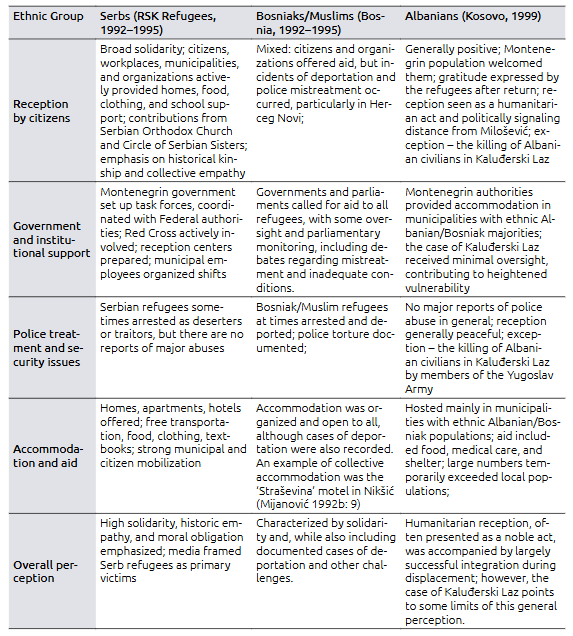
The Montenegrin case further illustrates that refugee treatment cannot be reduced to the binary of humanitarianism or hostility; rather, it is shaped by continuous negotiation mediated by national-ethnic relations and shifting political alignments (see Table 1). Serb refugees from Krajina, Croatia, and Bosnia received the most extensive support—public solidarity, institutional assistance, and government-organized care. Their plight was framed as a continuation of historical Serbian suffering, and their integration was facilitated by both state and civil society actors. By contrast, while there was solidarity with Bosniak refugees, they were sometimes subject to police intervention and detention, reflecting security and political concerns alongside ongoing support efforts. Albanian refugees from Kosovo in 1999 occupied yet another position: they were welcomed in Albanian- and Bosniak-majority municipalities, where humanitarian aid was extended through local solidarity, but their stay was seen as temporary and politically sensitive, linked to Montenegro’s cautious distancing from Belgrade. Reports also indicate that some Albanian refugees were exposed to violence, including killings, highlighting that humanitarian assistance coexisted with lethal threats for certain groups.
| Ethnic Group | Serbs (RSK Refugees, 1992–1995) | Bosniaks/Muslims (Bosnia, 1992–1995) | Albanians (Kosovo, 1999) |
|---|---|---|---|
| Reception by citizens | Broad solidarity; citizens, workplaces, municipalities, and organizations actively provided homes, food, clothing, and school support; contributions from Serbian Orthodox Church and Circle of Serbian Sisters; emphasis on historical kinship and collective empathy | Mixed: citizens and organizations offered aid, but incidents of deportation and police mistreatment occurred, particularly in Herceg Novi; | Generally positive; Montenegrin population welcomed them; gratitude expressed by the refugees after return; reception seen as a humanitarian act and politically signaling distance from Milošević; exception – the killing of Albanian civilians in Kaluđerski Laz |
| Government and institutional support | Montenegrin government set up task forces, coordinated with Federal authorities; Red Cross actively involved; reception centers prepared; municipal employees organized shifts | Governments and parliaments called for aid to all refugees, with some oversight and parliamentary monitoring, including debates regarding mistreatment and inadequate conditions. | Montenegrin authorities provided accommodation in municipalities with ethnic Albanian/Bosniak majorities; the case of Kaluđerski Laz received minimal oversight, contributing to heightened vulnerability |
| Police treatment and security issues | Serbian refugees sometimes arrested as deserters or traitors, but there are no reports of major abuses | Bosniak/Muslim refugees at times arrested and deported; police torture documented; | No major reports of police abuse in general; reception generally peaceful; exception – the killing of Albanian civilians in Kaluđerski Laz by members of the Yugoslav Army |
| Accommodation and aid | Homes, apartments, hotels offered; free transportation, food, clothing, textbooks; strong municipal and citizen mobilization | Accommodation was organized and open to all, although cases of deportation were also recorded. An example of collective accommodation was the ‘Straševina’ motel in Nikšić (Mijanović 1992b: 9) | Hosted mainly in municipalities with ethnic Albanian/Bosniak populations; aid included food, medical care, and shelter; large numbers temporarily exceeded local populations; |
| Overall perception | High solidarity, historic empathy, and moral obligation emphasized; media framed Serb refugees as primary victims | Characterized by solidarity and, while also including documented cases of deportation and other challenges. | Humanitarian reception, often presented as a noble act, was accompanied by largely successful integration during displacement; however, the case of Kaluđerski Laz points to some limits of this general perception. |
This intersection of humanitarian practice, political strategy, and ethicized identity highlights the multidimensional character of forced migration. Humanitarian aid functioned simultaneously as a moral imperative and as a mechanism of political legitimacy; ethnic identity mediated access to protection and social recognition; and media discourse oscillated between empathy and exclusion. The contrast between the extensive solidarity with Serb refugees, the selective and repressive measures toward Bosniak refugees, and the geographically circumscribed, politically sensitive, and sometimes life-threatening conditions for Albanian refugees reveals the stratified nature of Montenegro’s refugee policy. Collectively, these dynamics demonstrate that displacement is simultaneously a humanitarian, structural, and strategic process, producing spaces of vulnerability, agency, and contested visibility (Augé 2005;Duhaček 2010;Freeman 1995).
In sum, Montenegro’s handling of forced migration in the 1990s exemplifies the interplay of sudden displacement, political instrumentalization, humanitarian engagement, ethicized social boundaries, media framing, and refugee agency.
6 CONCLUSION: IMPORTANCE AND IMPLICATIONS
The Montenegrin experience of refugee reception during the 1990s demonstrates that protection in the small, economically fragile republic was profoundly conditioned by the intersection of humanitarian imperatives, national-ethnic tensions, and political transformations. Refugees from Bosnia and Herzegovina (1992–1995) and Kosovo (1999) encountered both solidarity and hostility, revealing the contradictory dynamics of a society negotiating its identity amid the disintegration of Yugoslavia.
Positive manifestations—such as widespread citizen hospitality, state resource allocation, and public appeals for solidarity—coexisted with episodes of discrimination, deportations, and violence, particularly targeting Muslim/Bosniak and Albanian populations. Notably, these patterns persisted across both refugee waves: humanitarian impulses were consistently counterbalanced with structural and socially embedded exclusions. This duality underscores how refugee treatment was deeply mediated by ethnic, religious, and political fault lines, highlighting the conditionality of protection in contexts of social and political fragility.
From a scholarly perspective, this study addresses a critical gap in the literature. While extensive research has examined the reception of refugees in Western host states, the experiences of refugees within the former Yugoslav republics have remained comparatively underexplored. In Montenegro, empirical evidence has been limited and fragmented, derived primarily from government records, Red Cross reports, and a small corpus of academic studies. By situating refugee experiences within the broader theoretical frameworks of forced migration, this study contributes to a more nuanced understanding of how a small republic navigated one of post-war Europe’s largest forced migrations.
The Montenegrin case also carries broader societal and practical significance. It illustrates the ambivalent nature of refugee protection in conflict settings: acts of solidarity and civic engagement coexisted with grave violations whose legacies remain embedded in collective memory. These findings underscore the importance of fostering multi-ethnic and multi-religious coexistence as foundational elements of peace, stability, and regional cooperation. They also reinforce the imperative for continued scholarly engagement with forced migration in post-Yugoslav societies, not only as a humanitarian concern, but as a politically and ethically charged phenomenon with enduring consequences for policy, civil society, and regional governance.
Data availability statement
All sources used in this study (newspapers, parliamentary stenographic records, legal acts, and published literature) are publicly available and fully cited in the manuscript.
References
- Augé, M. (2005). Non-lieux : introduction à une anthropologie de la surmodernité (Nemesta: Uvod u antropologiju nadmodernosti). Beograd: Biblioteka XX veka. https://www.scribd.com/document/48285323/nemesta-mark-oze
- Black, R. (2001). Fifty years of refugee studies: From theory to policy. International Migration Review, 35(1), 57–78. https://doi.org/10.1111/j.1747-7379.2001.tb00004.x
- Bojović, J. R. (1992). Izbjeglice iz Albanije u Crnu Goru 1991. godine – prikaz knjige Drašković, Aleksandar, Istorijski zapisi, 65 (1–4 ), 287–289. https://istorijskizapisi.me/wp-content/uploads/2021/05/DRASKOVIC-Jovan-R.-Bojovic-Izbjeglice-iz-Albanije.pdf
- Borba. (1991, October 17). Sve veći problem izbjeglica u Jugoslaviji. Borba, Beograd. https://pretraziva.rs/prikaz/%D0%B1%D0%BE%D1%80%D0%B1%D0%B0/1991-10-17/4
- Borović, G. (1999, April 16). Kosovske izbjeglice u Crnoj Gori – žrtve ’najskuplje riječi’. Monitor.
- Chimni, B. S. (2009). The birth of a ‘discipline’: From refugee to forced migration studies. Journal of Refugee Studies, 22(1), 11–29. https://doi.org/10.1093/jrs/fen051
- Čikić, I. (2009). Gdje sunce ne grije. Podgorica: Inicijativa mladih za ljudska prava (Kragujevac: Zlatna knjiga). https://archive.org/details/cikic-ibrahim-gdje-sunce-ne-grije-2012
- COBISS+ (2025). https://plus.cobiss.net/cobiss/cg/cnr_latn/bib/search (accessed August 16 2025)
- Coughlan, R., & Owens-Manley, J. (2006). Bosnian Refugees in America, New York, NY: Springer. https://doi.org/10.1007/b106744
- Crisp, J. (2018). Mobilizing political will for refugee protection and solutions: A framework for analysis and action. World Refugee Council Research Paper No. 1. The Centre for International Governance Innovation. https://www.cigionline.org/static/documents/documents/WRC%20Research%20Paper%20no.1web.pdf
- Dimitrijević, V. (2001). Ljudska prava u Jugoslaviji 2000. Pravo i praksa u Saveznoj Republici Jugoslaviji i međunarodni standardi ljudskih prava, Beograd: Beogradski centar za ljudska prava. https://kucaljudskihprava.rs/wp-content/uploads/2020/03/ljudska-prava-u-jugoslaviji-2001.pdf
- Duhaček, D. (2010). Breme našeg doba: odgovornost i rasuđivanje u delu Hane Arent. Beogradski krug.
- Durgut, J. (2003). Bukovica 1992–1995 – etničko čišćenje, zločini, nasilje. Podgorica: Almanah.
- Federal Statistical Office. (1993). Popis ‘91: Stanovništvo, SRJ. Beograd: Savezni zavod za statistiku.
- Freeman, G. P. (1995). Modes of immigration politics in liberal democratic states. International Migration Review, 29(4), 881–902. https://doi.org/10.1177/019791839502900401
- Government of Montenegro. (2025, June 4). Exhumation of three individuals carried out in Nikšić. https://www.gov.me/clanak/ekshumacija-tri-lica-izvrsena-u-niksicu (accessed August 16 2025)
- Halilovich, H., Hasić, J., Karabegović, D., Karamehić-Muratović, A. & Oruc, N. (2018 ). Mapping the Bosnian-Herzegovinian diaspora (BiH migrants in Australia, Austria, Denmark, Germany, Italy, Netherlands, Slovenia, Sweden, Switzerland, and the United States of America): utilizing the socio-economic potential of the diaspora for development of BiH. Sarajevo, BiH: International Organization for Migration. https://www.mhrr.gov.ba/PDF/MAPPING%20BIH%20DIASPORA%20REPORT.pdf
- Hamović, M. (1995). Izbjeglištvo u Bosni i Hercegovini u Drugom svjetskom ratu i u ratu 1991–1995. In Drugi svjetski rat – 50 godina kasnije: radovi sa naučnog skupa (pp. 695–702). Podgorica: CANU. https://canupub.me/Docs/1997/170-2-sv-rat-50-I/Drugi%20sv.%20rat%20-%2050%20-%20I%20-%2054.%20Milos%CC%8C%20Hamovic%CC%81.pdf (accessed August 20 2025)
- Hathaway, J. C. (2007). Forced migration studies: Could we agree just to ‘date’? Journal of Refugee Studies, 20(3), 349–369. https://doi.org/10.1093/jrs/fem019
- Journal of Refugee Studies. (1988). Vol. 1, No. 1. Oxford: Oxford University Press. https://academic.oup.com/jrs/issue/1/1
- Karabegović, D. (2024). Diaspora and development: The IOM’s role in diaspora mapping in Bosnia and Herzegovina. International Migration, 62 : 146–158. https://doi.org/10.1111/imig.13293
- Karamehic-Oates, A., Karamehic-Muratovic, A. (2020). Borders and integration: Becoming a Bosnian-American. Washington University Global Studies Law Review, 19(3), 327–351. https://journals.library.wustl.edu/globalstudies/article/id/572/
- Kopinak, J. K. (1999). The Health of Bosnian Refugees in Canada. Ethnicity & Health 4(1–2), 65–82. https://doi.org/10.1080/13557859998209
- Koser, K. (1996). Changing agendas in forced migration: A report on the 5th International Research and Advisory Panel. Journal of Refugee Studies, 9(4), 353–366. https://doi.org/10.1093/jrs/9.4.353
- Le Bras, H. (1996). La planète au village: Migrations et peuplement en France (The planet in the village: Migration and population in France). Paris: Éditions de l’Aube.
- Leković, Ž. (2025). Antisrpstvo u Crnoj Gori (1996–2020) [Anti-Serbian sentiment in Montenegro (1996–2020)]. In Radovi iz istorije Crne Gore. Institut za srpsku kulturu.
- Lukic V. & Nikitovic, V. (2004). Refugees from Bosnia and Herzegovina in Serbia: A Study of Refugee Selectivity. International Migration. 42(4): 85–110. https://doi.org/10.1111/j.0020-7985.2004.00296.x
- Mesić, M. (1992). Prisilne migracije kao sredstvo nacionalnog inženjeringa [Forced migration as a tool of national engineering]. Zagreb: Hrvatski sociološki društvo.
- Mesić, M. (1994). Tipologija prognanika i izbjeglica [Typology of expellees and refugees]. Zagreb: Institut za migracije i narodnosti.
- Mežnarić, S. (2003). Migracijske aktualnosti: stanje, problemi, perspektive paradigmi istraživanja. Migracijske i etničke teme, 19(4), 323–341. https://hrcak.srce.hr/7846
- Mijanović, Đ. (1992a, January 23). Sve više izbjeglica. Nikšićke novine, No. 1115.
- Mijanović, Đ. (1992b, April 16). Mržnja je došla sa strane. Nikšićke novine, No. 1120.
- Mijanović, Đ. (1992c, April 30). Preko 2000 izbjeglica. Nikšićke novine, No. 1121.
- Mojsi, D. (2016). Geopolitika televizijskih serija. Geopoetika. https://clio.rs/proizvodi/opstanak/geopolitika-televizijskih-serija_40186
- Mrnjačević, E., Vujović, M., Rakočević, D., Obradović, A., & Ostojić, S. (2022). Deportacija Muslimana Bošnjaka iz Herceg Novog 1992. godine. Građanska alijansa. https://gamn.org/wp-content/uploads/2022/12/Istrazivacki-rad-na-temu-Deportacija-Muslimana-Bosnjaka-iz-Herceg-Novog-1992.-godine.pdf
- MUP (2003) Izvještaj o registraciji raseljenih lica sa Kosova u Crnoj Gori. Podgorica: Komesarijat za raseljena lica Republike Crne Gore.
- MUP (2004) Izvještaj o registraciji raseljenih lica iz republika bivše Jugoslavije u Crnoj Gori. Podgorica: Komesarijat za raseljena lica Republike Crne Gore.
- Nenadić, M., Džepar-Ganibegović, N., Lipjankić, M., Borovčanin, D., Spasojević, N., Pobrić, A., & Kovač, D. (2005, December). Uporedna analiza pristupa pravima izbjeglica i raseljenih osoba [Comparative analysis of approaches to the rights of refugees and displaced persons]. Sarajevo: Ministarstvo za ljudska prava i izbjeglice Bosne i Hercegovine. https://vladars.rs/sr-SP-Cyrl/Vlada/Ministarstva/mirl/Documents/uporedna+analiza+o+pravima+pristupa+izbjeglica+i+raseljenih+osoba.pdf
- Official Gazette of the Republic of Montenegro 037/92, 045/06, 072/06. (1992a). Decree on the Care of Displaced Persons. (Službeni list Crne Gore 037/92, 045/06, 072/06, Uredba o zbrinjavanju raseljenih lica), Articles 1–4.
- Official Gazette of the Republic of Montenegro 041/92. (1992b). Rulebook on the Form of the Displaced Person’s Card. (Službeni list Crne Gore 041/92, Pravilnik o obrascu kartona raseljenog lica).
- Official Gazette of the Republic of Montenegro 041/92, 076/04. (1992c). Rulebook on the Identification of Displaced Persons. (Službeni list Crne Gore 041/92, 076/04, Pravilnik o legitimaciji raseljenih lica).
- Opačić, G., Vidaković, I., & Vujadinović, B. (2005). Život u posleratnim zajednicama. Međunarodna mreža pomoći. https://www.ian.org.rs/arhiva/publikacije/posleratnezajednice/knjiga/cela.pdf
- OSCE. (1999). Kosovo, kako viđeno tako rečeno – analiza OEBS-a, Verifikacione komisije Kosovo, stanje ljudskih prava oktobar 1998 – jun 1999. (report) Fond za humanitarno pravo. https://www.osce.org/sr/odihr/17773
- Oxford’s Refugee Studies Programme (1982). Refugee Studies Centre, University of Oxford. About us. Available at: https://www.rsc.ox.ac.uk/about (accessed 12 September 2025)
- Palmer, J. R. B. (2018). Patterns of settlement following forced migration: The case of Bosnians in the United States (Working Paper Series No. 35). Harvard Center for Population and Development Studies. http://hdl.handle.net/10230/34262
- Parliament of Montenegro. (1992a). Verbatim Records of the proceedings of the Parliament of Montenegro (Stenografske bilješke sa petnaeste sjednice Skupštine Republike Crne Gore) 2 December 1992.
- Parliament of Montenegro. (1992b). Conclusion of the Parliament of Montenegro regarding the report of the Red Cross of Montenegro on the situation and problems of refugee assistance in the territory of the Republic of Montenegro (No. 02-3625).
- Parliament of Montenegro. (1992c). Verbatim Records of the proceedings of the Parliament of Montenegro (Stenografske bilješke sa petnaeste sjednice Skupštine Republike Crne Gore) 2 and 5 June 1992.
- Petersen, W. (1958). A general typology of migration. American Sociological Review, 23(3), 256–266. https://doi.org/10.2307/2089239
- Pobjeda. (1995, August 8). Besplatni udžbenici. Pobjeda. Podgorica.
- Pobjeda. (1995, August 10). Osnovan informacioni centar u Beogradu. Pobjeda. Podgorica.
- Pobjeda. (1995, August 11). Besplatan prevoz. Pobjeda. Podgorica.
- Pobjeda. (1995, August 15). Svaki treći raseljenik. Pobjeda. Podgorica.
- Pobjeda. (1995, August 17). Hiljadu flaša meda. Pobjeda. Podgorica.
- Pobjeda. (1995, August 22). Saosjećanje uz uslov. Pobjeda. Podgorica.
- Pobjeda. (1995, August 29). Nevoljnici i međunarodna briga. Pobjeda. – agencijska vijest. Podgorica.
- Radević, D. (2005). Izbjeglice i interno raseljene osobe u Crnoj Gori – trajna rješenja. Migracijske i etničke teme 21 (4), 379–391. https://hrcak.srce.hr/2587
- Radončić, Š. (1996). Crna kutija: policijska tortura u Crnoj Gori 1992–1996. Podgorica: Monitor (Popdgorica: Slog)
- Raduški, N. (2011). Prisilne migracije u Srbiji – izbeglice iz Bosne i Hercegovine. Sociološki pregled, 45(3), 373–92. https://doi.org/10.5937/socpreg1103373R
- Rastoder, R. (2003). Usud imena, Štrpci. Podgorica: Almanah.
- Rastoder, Š. (2011). Državna uprava u Crnoj Gori. Cetinje-Podgorica: Matica.
- Rastoder, Š., & Adžić, N. (2020). Moderna istorija Crne Gore 1988–2017: od prevrata do Nato pakta, tom III. Podgorica: Daily Press – Vijesti,
- Šćekić, R., & Ćuković, A. (2025). Political transition in Montenegro 1989–2010. Zgodovinski časopis, 79, 184–203. https://doi.org/10.56420/Zgodovinskicasopis.2025.1-2.07
- Šiber, I. (1998). Osnove političke psihologije. Politička kultura.
- Stamatović, J. (1995a, August 9). Akcije solidarnosti. Pobjeda. Podgorica.
- Stamatović, J. (1995b, August 12). Ruke pune solidarnosti. Pobjeda. Podgorica.
- Stamatović, J. (1995c, August 15). Organizovane akcije solidarnosti. Pobjeda. Podgorica.
- Stojović, M. (1995, August 31). Sjeme bez zemlje. Nikšićke novine, No. 1170. Nikšić.
- Tadić, M. (1999). Zločin etničkog inžinjeringa. Monitor, Podgorica, 9.4.1999, str. 7
- UN General Assembly. (1951). 1951 Convention Relating to the Status of Refugees, United Nations, Treaty Series, vol. 189, p. 137, 28 July 1951, https://www.refworld.org/legal/agreements/unga/1951/en/39821 (accessed 10 September 2025)
- UN General Assembly. (1967) 1967 Protocol Relating to the Status of Refugees, United Nations, Treaty Series, vol. 606, p. 267, 31 January 1967, https://www.refworld.org/legal/agreements/unga/1967/en/41400 (accessed 10 September 2025)
- Universal Declaration of Human Rights (1948). United Nations General Assembly, Resolution 217 A (III), Paris, 10 December 1948. https://www.un.org/en/about-us/universal-declaration-of-human-rights
- Uskoković, R. (1995, August 16). Svi smješteni. Pobjeda. Podgorica.
- Valenta M. & Strabac, Z. (2013). The Dynamics of Bosnian Refugee Migrations in the 1990s, Current Migration Trends and Future Prospects. Refugee Survey Quarterly, 32 (3), 1–22. http://www.jstor.org/stable/45054962
- Vujisić, R. (1995, August 17). I penzioneri treba da pomognu. Pobjeda. Podgorica.
- Vujović, G. (1995, August 9). Spremna prva pomoć. Pobjeda. Podgorica.
- Zetter, R. (2007). More labels, fewer refugees: Remaking the refugee label in an era of globalization. Journal of Refugee Studies, 20(2), 172–192. https://doi.org/10.1093/jrs/fem011
- Zolberg, A. R., Suhrke, A., & Aguayo, S. (1989). Escape from Violence: Conflict and the Refugee Crisis in the Developing World. Oxford: Oxford University Press.
- Zračak nade. (1995). Newspaper. Danish Refugee Council in Montenegro, No. 1, April 1995. Podgorica.
Footnotes
- The Republic of Serbian Krajina (RSK) was established on the territory of the Republic of Croatia within the framework of the SFRY and existed from 1991 to 1995.
- The newspaper was published every other Thursday.
Article Details
Published by the Institute of Social Sciences - Center for Demographic Research




References
Augé, M. (2005). Non-lieux : introduction à une anthropologie de la surmodernité (Nemesta: Uvod u antropologiju nadmodernosti). Beograd: Biblioteka XX veka. https://www.scribd.com/document/48285323/nemesta-mark-oze
Black, R. (2001). Fifty years of refugee studies: From theory to policy. International Migration Review, 35(1), 57–78. https://doi.org/10.1111/j.1747-7379.2001.tb00004.x DOI: https://doi.org/10.1111/j.1747-7379.2001.tb00004.x
Bojović, J. R. (1992). Izbjeglice iz Albanije u Crnu Goru 1991. godine - prikaz knjige Drašković, Aleksandar, Istorijski zapisi, 65 (1 - 4 ), 287-289. https://istorijskizapisi.me/wp-content/uploads/2021/05/DRASKOVIC-Jovan-R.-Bojovic-Izbjeglice-iz-Albanije.pdf
Borba. (1991, October 17). Sve veći problem izbjeglica u Jugoslaviji. Borba, Beograd. https://pretraziva.rs/prikaz/%D0%B1%D0%BE%D1%80%D0%B1%D0%B0/1991-10-17/4
Borović, G. (1999, April 16). Kosovske izbjeglice u Crnoj Gori – žrtve 'najskuplje riječi'. Monitor.
Chimni, B. S. (2009). The birth of a ‘discipline’: From refugee to forced migration studies. Journal of Refugee Studies, 22(1), 11–29. https://doi.org/10.1093/jrs/fen051 DOI: https://doi.org/10.1093/jrs/fen051
Čikić, I. (2009). Gdje sunce ne grije. Podgorica: Inicijativa mladih za ljudska prava (Kragujevac: Zlatna knjiga). https://archive.org/details/cikic-ibrahim-gdje-sunce-ne-grije-2012
COBISS+ (2025). https://plus.cobiss.net/cobiss/cg/cnr_latn/bib/search (accessed August 16, 2025)
Coughlan, R., & Owens-Manley, J. (2006). Bosnian Refugees in America, New York, NY: Springer. https://doi.org/10.1007/b106744 DOI: https://doi.org/10.1007/b106744
Crisp, J. (2018). Mobilizing political will for refugee protection and solutions: A framework for analysis and action. World Refugee Council Research Paper No. 1. The Centre for International Governance Innovation. https://www.cigionline.org/static/documents/documents/WRC%20Research%20Paper%20no.1web.pdf
Dimitrijević, V. (2001). Ljudska prava u Jugoslaviji 2000. Pravo i praksa u Saveznoj Republici Jugoslaviji i međunarodni standardi ljudskih prava, Beograd: Beogradski centar za ljudska prava. https://kucaljudskihprava.rs/wp-content/uploads/2020/03/ljudska-prava-u-jugoslaviji-2001.pdf
Duhaček, D. (2010). Breme našeg doba: odgovornost i rasuđivanje u delu Hane Arent. Beogradski krug.
Durgut, J. (2003). Bukovica 1992–1995 - etničko čišćenje, zločini, nasilje. Podgorica: Almanah.
Federal Statistical Office. (1993). Popis ‘91: Stanovništvo, SRJ. Beograd: Savezni zavod za statistiku.
Freeman, G. P. (1995). Modes of immigration politics in liberal democratic states. International Migration Review, 29(4), 881–902. https://doi.org/10.1177/019791839502900401 DOI: https://doi.org/10.1177/019791839502900401
Government of Montenegro. (2025, June 4). Exhumation of three individuals carried out in Nikšić. https://www.gov.me/clanak/ekshumacija-tri-lica-izvrsena-u-niksicu (accessed August 16, 2025)
Halilovich, H ., Hasić, J ., Karabegović, D ., Karamehić-Muratović, A . & Oruc, N . (2018 ). Mapping the Bosnian-Herzegovinian diaspora (BiH migrants in Australia, Austria, Denmark, Germany, Italy, Netherlands, Slovenia, Sweden, Switzerland, and the United States of America): utilizing the socio-economic potential of the diaspora for development of BiH . Sarajevo, BiH: International Organization for Migration. https://www.mhrr.gov.ba/PDF/MAPPING%20BIH%20DIASPORA%20REPORT.pdf
Hamović, M. (1995). Izbjeglištvo u Bosni i Hercegovini u Drugom svjetskom ratu i u ratu 1991–1995. In Drugi svjetski rat – 50 godina kasnije: radovi sa naučnog skupa (pp. 695–702). Podgorica: CANU. https://canupub.me/Docs/1997/170-2-sv-rat-50-I/Drugi%20sv.%20rat%20-%2050%20-%20I%20-%2054.%20Milos%CC%8C%20Hamovic%CC%81.pdf (accessed August 20, 2025)
Hathaway, J. C. (2007). Forced migration studies: Could we agree just to ‘date’? Journal of Refugee Studies, 20(3), 349–369. https://doi.org/10.1093/jrs/fem019 DOI: https://doi.org/10.1093/jrs/fem019
Journal of Refugee Studies. (1988). Vol. 1, No. 1. Oxford: Oxford University Press. https://academic.oup.com/jrs/issue/1/1
Karabegović, D. (2024). Diaspora and development: The IOM's role in diaspora mapping in Bosnia and Herzegovina. International Migration , 62 : 146–158. https://doi.org/10.1111/imig.13293 DOI: https://doi.org/10.1111/imig.13293
Karamehic-Oates, A ., Karamehic-Muratovic , A. (2020). Borders and integration: Becoming a Bosnian-American. Washington University Global Studies Law Review, 19(3), 327-351. https://journals.library.wustl.edu/globalstudies/article/id/572/
Kopinak, J. K. (1999). The Health of Bosnian Refugees in Canada. Ethnicity & Health 4(1–2), 65–82. https://doi.org/10.1080/13557859998209 DOI: https://doi.org/10.1080/13557859998209
Koser, K. (1996). Changing agendas in forced migration: A report on the 5th International Research and Advisory Panel. Journal of Refugee Studies, 9(4), 353–366. https://doi.org/10.1093/jrs/9.4.353 DOI: https://doi.org/10.1093/jrs/9.4.353
Le Bras, H. (1996). La planète au village: Migrations et peuplement en France (The planet in the village: Migration and population in France). Paris: Éditions de l’Aube.
Leković, Ž. (2025). Antisrpstvo u Crnoj Gori (1996–2020) [Anti-Serbian sentiment in Montenegro (1996–2020)]. In Radovi iz istorije Crne Gore . Institut za srpsku kulturu.
Lukic V. & Nikitovic, V. (2004). Refugees from Bosnia and Herzegovina in Serbia: A Study of Refugee Selectivity. International Migration. 42(4): 85-110. https://doi.org/10.1111/j.0020-7985.2004.00296.x DOI: https://doi.org/10.1111/j.0020-7985.2004.00296.x
Mesić, M. (1992). Prisilne migracije kao sredstvo nacionalnog inženjeringa [Forced migration as a tool of national engineering]. Zagreb: Hrvatski sociološki društvo.
Mesić, M. (1994). Tipologija prognanika i izbjeglica [Typology of expellees and refugees]. Zagreb: Institut za migracije i narodnosti.
Mežnarić, S. (2003). Migracijske aktualnosti: stanje, problemi, perspektive paradigmi istraživanja. Migracijske i etničke teme, 19(4), 323–341. https://hrcak.srce.hr/7846
Mijanović, Đ. (1992a, January 23). Sve više izbjeglica. Nikšićke novine, No. 1115.
Mijanović, Đ. (1992b, April 16). Mržnja je došla sa strane. Nikšićke novine, No. 1120.
Mijanović, Đ. (1992c, April 30). Preko 2000 izbjeglica. Nikšićke novine, No. 1121.
Mojsi, D. (2016). Geopolitika televizijskih serija. Geopoetika. https://clio.rs/proizvodi/opstanak/geopolitika-televizijskih-serija_40186
Mrnjačević, E., Vujović, M., Rakočević, D., Obradović, A., & Ostojić, S. (2022). Deportacija Muslimana Bošnjaka iz Herceg Novog 1992. godine. Građanska alijansa. https://gamn.org/wp-content/uploads/2022/12/Istrazivacki-rad-na-temu-Deportacija-Muslimana-Bosnjaka-iz-Herceg-Novog-1992.-godine.pdf
MUP (2003) Izvještaj o registraciji raseljenih lica sa Kosova u Crnoj Gori. Podgorica: Komesarijat za raseljena lica Republike Crne Gore.
MUP (2004) Izvještaj o registraciji raseljenih lica iz republika bivše Jugoslavije u Crnoj Gori. Podgorica: Komesarijat za raseljena lica Republike Crne Gore.
Nenadić, M., Džepar-Ganibegović, N., Lipjankić, M., Borovčanin, D., Spasojević, N., Pobrić, A., & Kovač, D. (2005, December). Uporedna analiza pristupa pravima izbjeglica i raseljenih osoba [Comparative analysis of approaches to the rights of refugees and displaced persons]. Sarajevo: Ministarstvo za ljudska prava i izbjeglice Bosne i Hercegovine. https://vladars.rs/sr-SP-Cyrl/Vlada/Ministarstva/mirl/Documents/uporedna+analiza+o+pravima+pristupa+izbjeglica+i+raseljenih+osoba.pdf
Official Gazette of the Republic of Montenegro 037/92, 045/06, 072/06. (1992a). Decree on the Care of Displaced Persons. (Službeni list Crne Gore 037/92, 045/06, 072/06, Uredba o zbrinjavanju raseljenih lica), Articles 1–4.
Official Gazette of the Republic of Montenegro 041/92, 076/04. (1992c). Rulebook on the Identification of Displaced Persons. (Službeni list Crne Gore 041/92, 076/04, Pravilnik o legitimaciji raseljenih lica)..
Official Gazette of the Republic of Montenegro 041/92. (1992b). Rulebook on the Form of the Displaced Person’’s Card. (Službeni list Crne Gore 041/92, Pravilnik o obrascu kartona raseljenog lica).
Opačić, G., Vidaković, I., & Vujadinović, B. (2005). Život u posleratnim zajednicama. Međunarodna mreža pomoći. https://www.ian.org.rs/arhiva/publikacije/posleratnezajednice/knjiga/cela.pdf
OSCE. (1999). Kosovo, kako viđeno tako rečeno – analiza OEBS-a, Verifikacione komisije Kosovo, stanje ljudskih prava oktobar 1998 – jun 1999. (report) Fond za humanitarno pravo. https://www.osce.org/sr/odihr/17773
Oxford’s Refugee Studies Programme (1982). Refugee Studies Centre, University of Oxford. About us. Available at: https://www.rsc.ox.ac.uk/about (Accessed: 12 September 2025)
Palmer, J. R. B. (2018). Patterns of settlement following forced migration: The case of Bosnians in the United States (Working Paper Series No. 35). Harvard Center for Population and Development Studies. http://hdl.handle.net/10230/34262
Parliament of Montenegro. (1992a). Verbatim Records of the proceedings of the Parliament of Montenegro (Stenografske bilješke sa petnaeste sjednice Skupštine Republike Crne Gore) 2 December 1992.
Parliament of Montenegro. (1992b). Conclusion of the Parliament of Montenegro regarding the report of the Red Cross of Montenegro on the situation and problems of refugee assistance in the territory of the Republic of Montenegro (No. 02-3625).
Parliament of Montenegro. (1992c). Verbatim Records of the proceedings of the Parliament of Montenegro (Stenografske bilješke sa petnaeste sjednice Skupštine Republike Crne Gore) 2 and 5 June 1992.
Petersen, W. (1958). A general typology of migration. American Sociological Review, 23(3), 256–266. https://doi.org/10.2307/2089239 DOI: https://doi.org/10.2307/2089239
Pobjeda. (1995, August 8). Besplatni udžbenici. Pobjeda. Podgorica.
Pobjeda. (1995, August 10). Osnovan informacioni centar u Beogradu. Pobjeda. Podgorica.
Pobjeda. (1995, August 11). Besplatan prevoz. Pobjeda. Podgorica.
Pobjeda. (1995, August 15). Svaki treći raseljenik. Pobjeda. Podgorica.
Pobjeda. (1995, August 17). Hiljadu flaša meda. Pobjeda. Podgorica.
Pobjeda. (1995, August 22). Saosjećanje uz uslov. Pobjeda. Podgorica.
Pobjeda. (1995, August 29). Nevoljnici i međunarodna briga. Pobjeda. – agencijska vijest. Podgorica.
Radević, D. (2005). Izbjeglice i interno raseljene osobe u Crnoj Gori – trajna rješenja. Migracijske i etničke teme 21 (4), 379–391. https://hrcak.srce.hr/2587
Radončić, Š. (1996). Crna kutija: policijska tortura u Crnoj Gori 1992-1996. Podgorica: Monitor (Popdgorica: Slog)
Raduški, N. (2011). Prisilne migracije u Srbiji - izbeglice iz Bosne i Hercegovine. Sociološki pregled, 45(3), 373-92. https://doi.org/10.5937/socpreg1103373R. DOI: https://doi.org/10.5937/socpreg1103373R
Rastoder, R. (2003). Usud imena, Štrpci. Podgorica: Almanah.
Rastoder, Š. (2011). Državna uprava u Crnoj Gori. Cetinje-Podgorica: Matica.
Rastoder, Š., & Adžić, N. (2020). Moderna istorija Crne Gore 1988-2017: od prevrata do Nato pakta, tom III. Podgorica: Daily Press - Vijesti,
Šćekić, R., & Ćuković, A. (2025). Political transition in Montenegro 1989–2010. Zgodovinski časopis, 79, 184–203. https://doi.org/10.56420/Zgodovinskicasopis.2025.1-2.07 DOI: https://doi.org/10.56420/Zgodovinskicasopis.2025.1-2.07
Šiber, I. (1998). Osnove političke psihologije. Politička kultura.
Stamatović, J. (1995a, August 9). Akcije solidarnosti. Pobjeda. Podgorica.
Stamatović, J. (1995b, August 12). Ruke pune solidarnosti. Pobjeda. Podgorica.
Stamatović, J. (1995c, August 15). Organizovane akcije solidarnosti. Pobjeda. Podgorica.
Stojović, M. (1995, August 31). Sjeme bez zemlje. Nikšićke novine, No. 1170. Nikšić.
Tadić, M. (1999). Zločin etničkog inžinjeringa. Monitor, Podgorica, 9.4.1999, str. 7
UN General Assembly. (1951). 1951 Convention Relating to the Status of Refugees, United Nations, Treaty Series, vol. 189, p. 137, 28 July 1951, https://www.refworld.org/legal/agreements/unga/1951/en/39821 [accessed 10 September 2025]
UN General Assembly. (1967) 1967 Protocol Relating to the Status of Refugees, United Nations, Treaty Series, vol. 606, p. 267, 31 January 1967, https://www.refworld.org/legal/agreements/unga/1967/en/41400 [accessed 10 September 2025]
Universal Declaration of Human Rights (1948). United Nations General Assembly, Resolution 217 A (III), Paris, 10 December 1948. https://www.un.org/en/about-us/universal-declaration-of-human-rights
Uskoković, R. (1995, August 16). Svi smješteni. Pobjeda. Podgorica.
Valenta M. & Strabac, Z. (2013). The Dynamics of Bosnian Refugee Migrations in the 1990s, Current Migration Trends and Future Prospects. Refugee Survey Quarterly, 32 (3), 1-22. http://www.jstor.org/stable/45054962 DOI: https://doi.org/10.1093/rsq/hdt013
Vujisić, R. (1995, August 17). I penzioneri treba da pomognu. Pobjeda. Podgorica.
Vujović, G. (1995, August 9). Spremna prva pomoć. Pobjeda. Podgorica.
Zetter, R. (2007). More labels, fewer refugees: Remaking the refugee label in an era of globalization. Journal of Refugee Studies, 20(2), 172–192. https://doi.org/10.1093/jrs/fem011 DOI: https://doi.org/10.1093/jrs/fem011
Zolberg, A. R., Suhrke, A., & Aguayo, S. (1989). Escape from Violence: Conflict and the Refugee Crisis in the Developing World. Oxford: Oxford University Press.
Zračak nade. (1995). Newspaper. Danish Refugee Council in Montenegro, No. 1, April 1995. Podgorica.