
Assessing Natural Hazard Exposure and Demographic Vulnerability in Serbian LSGUs Using FAHP and FMULTIMOORA
Bočna strana članka
Glavni sadržaj članka
Apstrakt
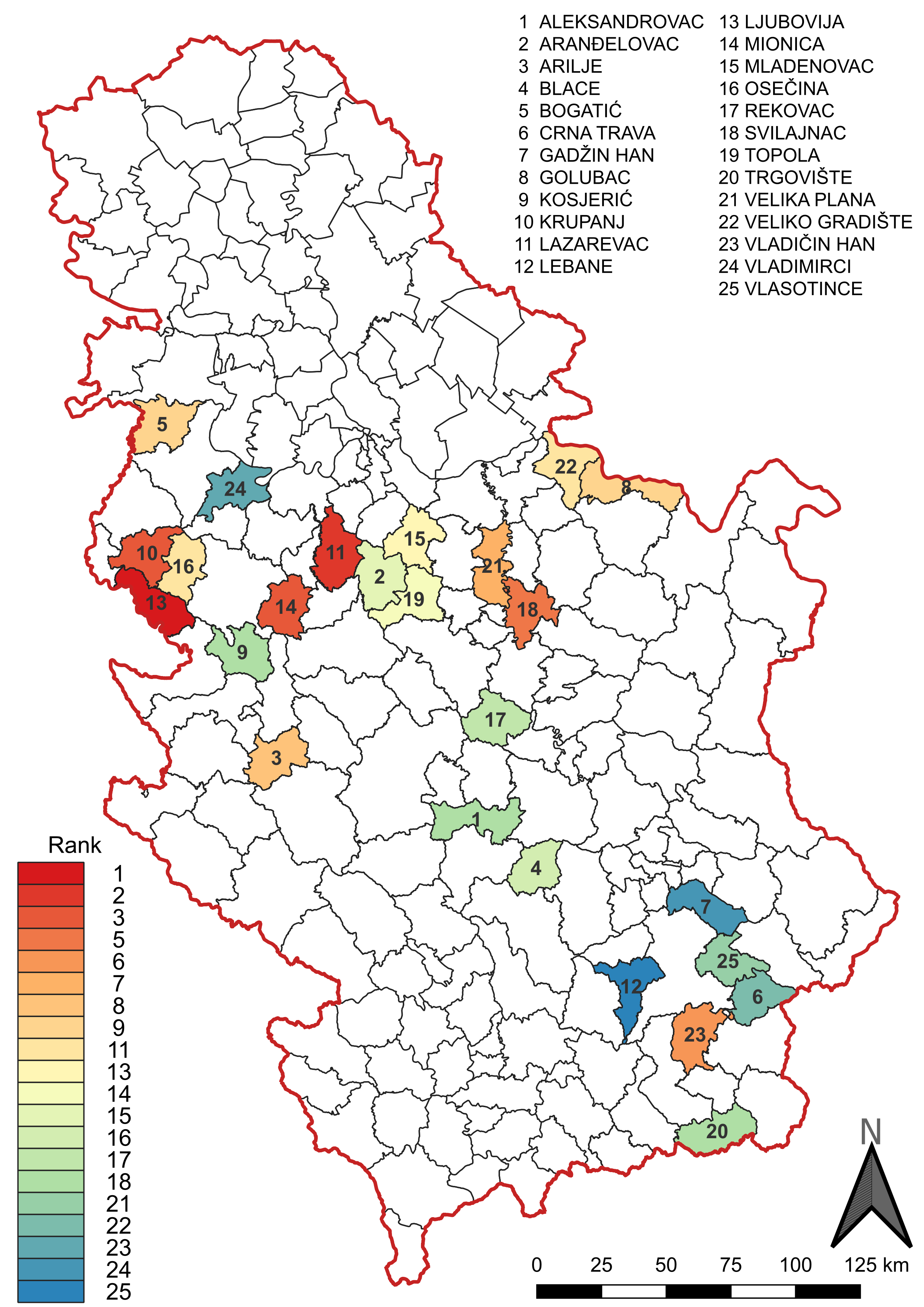
Natural hazards increasingly represent a significant challenge to sustainable development, disaster risk reduction, and population wellbeing, particularly in regions affected by adverse demographic trends. This study examines the interaction between natural hazard exposure and demographic vulnerability across 25 Serbian local self-government units (LSGUs) through the integration of Geographic Information Systems (GIS), the Triangular Fuzzy Analytic Hierarchy Process (FAHP), and the Fuzzy MULTIMOORA method. Fifteen indicators were organized into three groups representing natural hazard exposure, hazard exposure within built-up areas, and demographic vulnerability. The hazard-related indicators included flood-prone areas, landslide and rockfall susceptibility, seismic hazard, hail-prone areas, and areas exposed to erosion and torrential floods. The demographic indicators included the shares of people with disabilities, population aged 65 years and over, population without educational attainment, economically inactive population, and elderly single-person households. Criterion weights were determined using Triangular FAHP, while Fuzzy MULTIMOORA was applied to rank LSGUs according to their integrated vulnerability. Additional group-specific Fuzzy MULTIMOORA analyses were conducted separately for each indicator group to identify the principal drivers of vulnerability. The integrated assessment identified Ljubovija, Vladičin Han, and Krupanj as the most vulnerable LSGUs, whereas Lebane, Gadžin Han, and Vladimirci occupied the lowest positions. The group-specific analyses further revealed that municipalities characterized by the highest demographic vulnerability were not necessarily those with the highest integrated vulnerability, emphasizing the importance of interactions among environmental and demographic dimensions of vulnerability. The study contributes to the understanding of local vulnerability patterns by integrating demographic and environmental perspectives within a unified decision-making framework. The proposed approach may support evidence-based disaster risk reduction policies, population protection measures, spatial planning, and local resilience-building initiatives in Serbia and other regions facing similar demographic and environmental challenges.
Puni tekst članka je dostupan za ovaj lokalitet: English.
Detalji članka
Centar za demografska istraživanja Instituta društvenih nauka




Reference
Adger, W. N. (2006). Vulnerability. Global Environmental Change, 16(3), 268-281. https://doi.org/10.1016/j.gloenvcha.2006.02.006 DOI: https://doi.org/10.1016/j.gloenvcha.2006.02.006
Altuntas, S., Dereli, T., & Yılmaz, M. K. (2015). Evaluation of excavator technologies: application of data fusion based MULTIMOORA methods. Journal of Civil Engineering and Management, 21(8), 977-997. https://doi.org/10.3846/13923730.2015.1064468 DOI: https://doi.org/10.3846/13923730.2015.1064468
Birkmann, J. (Ed.). (2006). Measuring Vulnerability to Natural Hazards: Towards Disaster Resilient Societies. United Nations University Press. https://archive.unu.edu/unupress/2006/measuringVulnerability.html
Brauers, W. K. M., & Zavadskas, E. K. (2006). The MOORA method and its application to privatization in a transition economy. Control and Cybernetics, 35(2), 445-469. https://eudml.org/doc/209425
Brauers, W. K. M., & Zavadskas, E. K. (2010). Project management by MULTIMOORA as an instrument for transition economies. Technological and Economic Development of Economy, 16(1), 5-24. https://doi.org/10.3846/tede.2010.01 DOI: https://doi.org/10.3846/tede.2010.01
Buckley, J. J. (1985). Fuzzy hierarchical analysis. Fuzzy Sets and Systems, 17(3), 233-247. https://doi.org/10.1016/0165-0114(85)90090-9 DOI: https://doi.org/10.1016/0165-0114(85)90090-9
Chang, D.-Y. (1996). Applications of the extent analysis method on fuzzy AHP. European Journal of Operational Research, 95(3), 649-655. https://doi.org/10.1016/0377-2217(95)00300-2 DOI: https://doi.org/10.1016/0377-2217(95)00300-2
Clar, C. (2019). How demographic developments determine the management of hydrometeorological hazard risks in rural communities: The linkages between demographic and natural hazards research. WIREs Water, 6, e1378. https://doi.org/10.1002/wat2.1378 DOI: https://doi.org/10.1002/wat2.1378
Clar, C., Löschner, L., Nordbeck, R., Fischer, T., & Thaler, T. (2020). Population dynamics and natural hazard risk management: conceptual and practical linkages for the case of Austrian policy making. Natural Hazards, 105(2), 1765-1796. https://doi.org/10.1007/s11069-020-04376-z DOI: https://doi.org/10.1007/s11069-020-04376-z
Cutter, S. L., & Finch, C. (2008). Temporal and spatial changes in social vulnerability to natural hazards. Proceedings of the National Academy of Sciences, 105(7), 2301-2306. https://doi.org/10.1073/pnas.0710375105 DOI: https://doi.org/10.1073/pnas.0710375105
Cutter, S. L., Boruff, B. J., & Shirley, W. L. (2003). Social vulnerability to environmental hazards. Social Science Quarterly, 84(2), 242-261. https://doi.org/10.1111/1540-6237.8402002 DOI: https://doi.org/10.1111/1540-6237.8402002
Cvetković, V. M., Milenković, D., & Lukić, T. (2026). Measuring Community Disaster Resilience in Serbia Using an Adapted BRIC Framework Grounded in DROP: Index Construction and Regional Disparities. Geosciences, 16(4). https://doi.org/10.3390/geosciences16040135 DOI: https://doi.org/10.3390/geosciences16040135
Dragicevic, S., Filipovic, D., Kostadinov, S., Ristic, R., Novkovic, I., Zivkovic, N., Andjelkovic, G., Abolmasov, B., Secerov, V., & Djurdjic, S. (2011). Natural hazard assessment for land-use planning in Serbia. International Journal of Environmental Research, 5(2), 371-380. https://doi.org/10.22059/ijer.2011.322
Esendemir, Ş., Çatıkkaş, N. M., & Karan, M. A. (2025). “Get Ready!” The vulnerability and resilience of older adults in disasters. European Journal of Geriatrics and Gerontology, 7(1), 29-36. https://doi.org/10.4274/ejgg.galenos.2025.2024-8-3 DOI: https://doi.org/10.4274/ejgg.galenos.2025.2024-8-3
Fekete, A. (2009). Validation of a social vulnerability index in context to river floods in Germany. Natural Hazards and Earth System Sciences, 9(2), 393-403. https://doi.org/10.5194/nhess-9-393-2009 DOI: https://doi.org/10.5194/nhess-9-393-2009
Intergovernmental Panel on Climate Change (IPCC). (2022). Climate Change 2022 – Impacts, Adaptation and Vulnerability. Cambridge University Press. https://doi.org/10.1017/9781009325844 DOI: https://doi.org/10.1017/9781009325844
Malczewski, J. (1999). GIS and Multicriteria Decision Analysis. John Wiley & Sons. https://www.wiley-vch.de/en/areas-interest/natural-sciences/gis-and-multicriteria-decision-analysis-978-0-471-32944-2
Malczewski, J. (2006). GIS‐based multicriteria decision analysis: a survey of the literature. International Journal of Geographical Information Science, 20(7), 703-726. https://doi.org/10.1080/13658810600661508 DOI: https://doi.org/10.1080/13658810600661508
Malinić, V., Durlević, U., Brašanac-Bosanac, L., Novković, I., Joksimović, M., Golić, R., & Krstić, F. (2025). A Hybrid Fuzzy AHP-MULTIMOORA Approach for Solar Energy Development on Rural Brownfield Sites in Serbia. Sustainability, 17(17). https://doi.org/10.3390/su17177988 DOI: https://doi.org/10.3390/su17177988
Ministry of Construction, Transport and Infrastructure of the Republic of Serbia. (2021). Spatial Plan of the Republic of Serbia 2021-2035: Draft. https://www.mgsi.gov.rs/sites/default/files/PPRS%20Nacrt.pdf
Newsham, N., & Rowe, F. (2022). Understanding trajectories of population decline across rural and urban Europe: A sequence analysis. Population, Space and Place, 29(3), e2630. https://doi.org/10.1002/psp.2630 DOI: https://doi.org/10.1002/psp.2630
Novkovic, I., Markovic, G. B., Lukic, D., Dragicevic, S., Milosevic, M., Djurdjic, S., Samardzic, I., Lezaic, T., & Tadic, M. (2021). GIS-Based Forest Fire Susceptibility Zonation with IoT Sensor Network Support, Case Study—Nature Park Golija, Serbia. Sensors, 21(19). https://doi.org/10.3390/s21196520 DOI: https://doi.org/10.3390/s21196520
Novković, I., Šećerov, V., & Filipović, D. (2024). Application of Fuzzy Logic in the Analysis of Sustainable Development Indicators. In B. Stojkov & M. Pantić (Eds.), Sustainable development : the vector of Serbia to the future (pp. 231-246). Institute of Architecture and Urban & Spatial Planning of Serbia. https://doi.org/10.46793/82154-04-4.231n DOI: https://doi.org/10.46793/82154-04-4.231N
Rashed, T., & Weeks, J. (2003). Assessing vulnerability to earthquake hazards through spatial multicriteria analysis of urban areas. International Journal of Geographical Information Science, 17(6), 547-576. https://doi.org/10.1080/1365881031000114071 DOI: https://doi.org/10.1080/1365881031000114071
Runkler, T. A. (1997). Selection of appropriate defuzzification methods using application specific properties. IEEE Transactions on Fuzzy Systems, 5(1), 72-79. https://doi.org/10.1109/91.554449 DOI: https://doi.org/10.1109/91.554449
Saaty, T. L. (1980). The Analytic Hierarchy Process: Planning, Priority Setting, Resource Allocation. McGraw-Hill. https://openlibrary.org/books/OL4425444M/The_analytic_hierarchy_process
Statistical Office of the Republic of Serbia. (2023). 2022 Census of Population, Households and Dwellings in the Republic of Serbia. https://www.stat.gov.rs/en-us/vesti/20230428-konacnirezpopisa/?a=0&s=130002
Tipaldo, J. F., Balk, D., & Hunter, L. M. (2024). A framework for ageing and health vulnerabilities in a changing climate. Nature Climate Change, 14(11), 1125-1135. https://doi.org/10.1038/s41558-024-02156-2 DOI: https://doi.org/10.1038/s41558-024-02156-2
United Nations. (2024). World Population Ageing 2023. United Nations Department of Economic and Social Affairs. https://www.un.org/development/desa/pd/content/world-population-ageing-2023
United Nations Office for Disaster Risk Reduction (UNDRR). (2015). Sendai Framework for Disaster Risk Reduction 2015-2030. https://www.undrr.org/publication/sendai-framework-disaster-risk-reduction-2015-2030
Vadrevu, K. P., Eaturu, A., & Badarinath, K. V. S. (2009). Fire risk evaluation using multicriteria analysis—a case study. Environmental Monitoring and Assessment, 166(1-4), 223-239. https://doi.org/10.1007/s10661-009-0997-3 DOI: https://doi.org/10.1007/s10661-009-0997-3
Wang, Y.-M., Luo, Y., & Hua, Z. (2008). On the extent analysis method for fuzzy AHP and its applications. European Journal of Operational Research, 186(2), 735-747. https://doi.org/10.1016/j.ejor.2007.01.050 DOI: https://doi.org/10.1016/j.ejor.2007.01.050
Wisner, B., Gaillard, J. C., … Kelman, I. (Eds.). (2014). Handbook of Hazards and Disaster Risk Reduction. Routledge. https://doi.org/10.4324/9780203844236 DOI: https://doi.org/10.4324/9780203844236
Zadeh, L. A. (1965). Fuzzy sets. Information and Control, 8(3), 338-353. https://doi.org/10.1016/S0019-9958(65)90241-X DOI: https://doi.org/10.1016/S0019-9958(65)90241-X