
Modelling Union Dissolution: A Global Comparative Review of Quantitative Approaches (2001–2025)
Bočna strana članka
Glavni sadržaj članka
Apstrakt
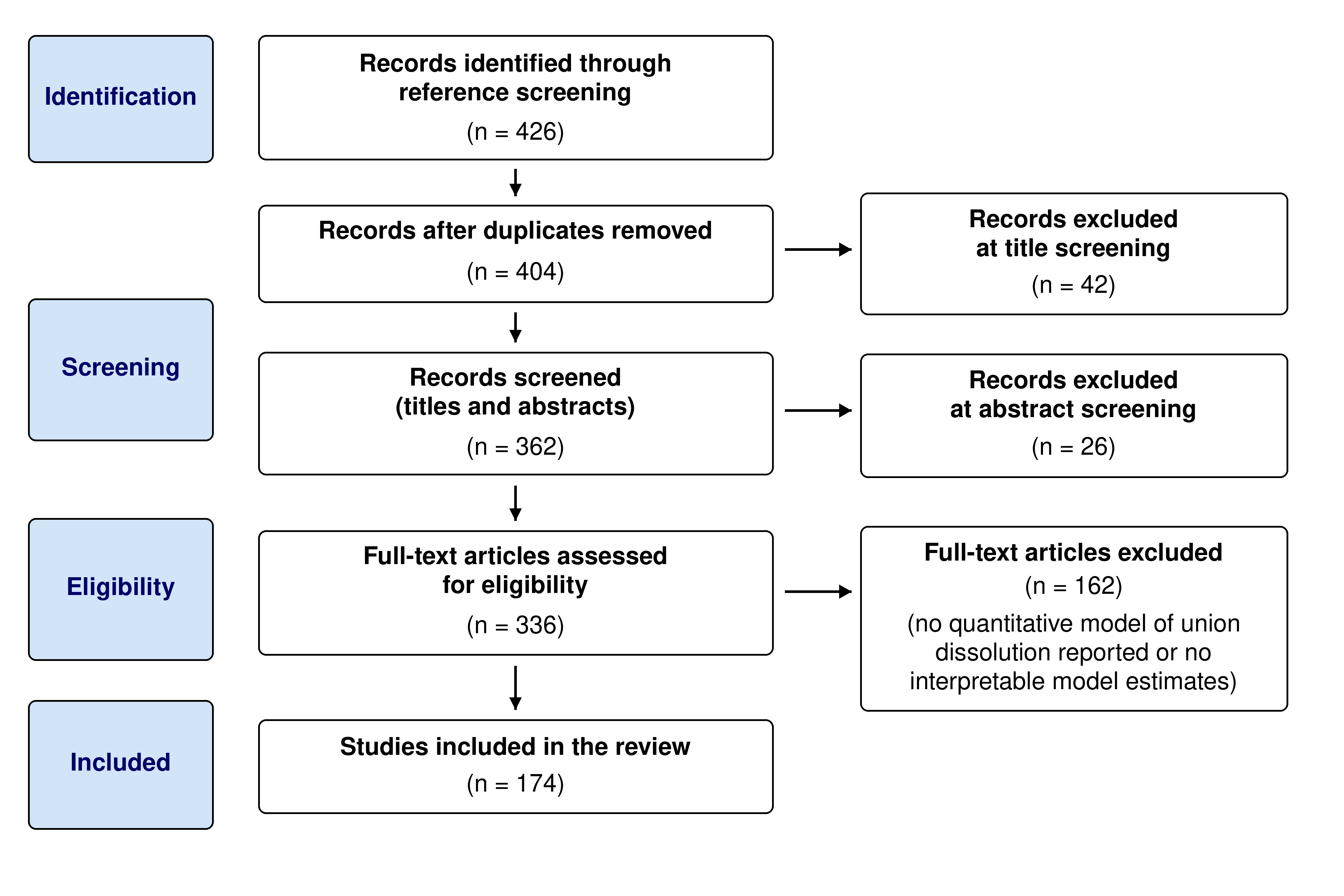
Research on union dissolution has expanded considerably over the past two decades, yet evidence remains fragmented across regions, methodological traditions, data systems and union types, particularly outside North America and Western Europe. This study provides a global comparative synthesis of quantitative research on union dissolution, by identifying the dominant statistical approaches, examining their distribution across world regions, and determining which predictors are most frequently analysed in relation to union dissolution. It also highlights methodological and geographical imbalances that limit cross-national comparability and the cumulative development of demographic knowledge. The review covers 174 peer-reviewed articles published between 2001 and 2025, comprising 312 statistical models from 45 countries and four African regions. Models were classified according to methodological approach, union type and categories of explanatory variables. The findings show that discrete-time event history models and Cox regression dominate empirical research in the field. Despite the growing demographic relevance of non-marital partnerships, cohabiting couples remain substantially underrepresented in empirical analyses. Across regions, the most frequently examined predictors include demographic, socioeconomic, child-related, family-background and socio-psychological factors, reflecting both common patterns and region-specific determinants of union dissolution. The study concludes that, despite its increasing scope, the literature on union dissolution remains methodologically and geographically uneven. Limited access to timely longitudinal data continues to hinder the development of comparable evidence and the broader application of advanced statistical methods in many regions. By synthesising more than two decades of quantitative research, this paper provides a methodological synthesis of quantitative approaches to union dissolution across diverse demographic and institutional contexts, while identifying prevailing modelling practices, regional research gaps and key predictor domains.
Puni tekst članka je dostupan za ovaj lokalitet: English.
Detalji članka
Centar za demografska istraživanja Instituta društvenih nauka




Reference
Amato, P. R. (2010). Research on divorce: Continuing trends and new developments. Journal of Marriage and Family, 72(3), 650-666. https://doi.org/10.1111/j.1741-3737.2010.00723.x
Becker, G. S., Landes, E. M., & Michael, R. T. (1977). An economic analysis of marital instability. Journal of Political Economy, 85(6), 1141-1187. https://doi.org/10.1086/260631
Burstein, N. R. (2007). Economic influences on marriage and divorce. Journal of Policy Analysis and Management, 26(2), 387-429. https://doi.org/10.1002/pam.20257
Carlson, M. J. (2018). Families Unequal: Socioeconomic Gradients in Family Patterns across the United States and Europe. In N. Cahn, J. Carbone, L. F. DeRose, & W. B. Wilcox (Eds.), Unequal family lives: Causes and consequences in Europe and the Americas (pp. 21-39). Cambridge University Press. https://doi.org/10.1017/9781108235525.002
Cherlin, A. (2017). Introduction to the Special Collection on Separation, Divorce, Repartnering, and Remarriage around the World. Demographic Research, 37, 1275-1296. https://doi.org/10.4054/demres.2017.37.38
Cherlin, A. J. (2018). How Inequality Drives Family Formation: The Prima Facie Case. In N. Cahn, J. Carbone, L. F. DeRose, & W. B. Wilcox (Eds.), Unequal family lives: Causes and consequences in Europe and the Americas (pp. 69-82). Cambridge University Press. https://doi.org/10.1017/9781108235525.004
Cherlin, A. J. (2020). Degrees of change: An assessment of the deinstitutionalization of marriage thesis. Journal of Marriage and Family, 82(1), 62-80. https://doi.org/10.1111/jomf.12605
Elder, G. H., Johnson, M. K., & Crosnoe, R. (2003). The Emergence and Development of Life Course Theory. In J. T. Mortimer & M. J. Shanahan (Eds.), Handbook of the Life Course (pp. 3-19). Springer US. https://doi.org/10.1007/978-0-306-48247-2_1
Esteve, A., & Florez-Paredes, E. (2018). Families in Latin America: Dimensions, Diverging Trends, and Paradoxes. In N. Cahn, J. Carbone, L. F. DeRose, & W. B. Wilcox (Eds.), Unequal family lives: Causes and consequences in Europe and the Americas (pp. 40-65). Cambridge University Press. https://doi.org/10.1017/9781108235525.003
Kalmijn, M. (2007). Explaining cross-national differences in marriage, cohabitation, and divorce in Europe, 1990-2000. Population Studies, 61(3), 243-263. https://doi.org/10.1080/00324720701571806
Kiernan, K. (2002). The state of European unions: An analysis of FFS data on partnership formation and dissolution. In M. Macura & G. C. N. Beets (Eds.), Dynamics of fertility and partnership in Europe: Insights and lessons from comparative research (pp. 57-76). United Nations.
Kleinbaum, D. G., & Klein, M. (2012). Survival Analysis: A Self-Learning Text. Springer New York. https://doi.org/10.1007/978-1-4419-6646-9
Lesthaeghe, R. (2010). The Unfolding Story of the Second Demographic Transition. Population and Development Review, 36(2), 211-251. https://doi.org/10.1111/j.1728-4457.2010.00328.x
Lesthaeghe, R. J. (2020). The second demographic transition: Cohabitation. In R. Schoen (Ed.), Cross-Cultural Family Research and Practice (pp. 103-141). Academic Press. https://doi.org/10.1016/b978-0-12-815493-9.00004-1
Liefbroer, A. C., & Dourleijn, E. (2006). Unmarried cohabitation and union stability: Testing the role of diffusion using data from 16 European countries. Demography, 43(2), 203-221. https://doi.org/10.1353/dem.2006.0018
Lyngstad, T., & Jalovaara, M. (2010). A review of the antecedents of union dissolution. Demographic Research, 23, 257-292. https://doi.org/10.4054/demres.2010.23.10
Matysiak, A., Styrc, M., & Vignoli, D. (2014). The educational gradient in marital disruption: A meta-analysis of European research findings. Population Studies, 68(2), 197-215. https://doi.org/10.1080/00324728.2013.856459
Milne, B. J., D’Souza, S., Andersen, S. H., & Richmond-Rakerd, L. S. (2022). Use of Population-Level Administrative Data in Developmental Science. Annual Review of Developmental Psychology, 4(1), 447-468. https://doi.org/10.1146/annurev-devpsych-120920-023709
Mortelmans, D. (Ed.). (2020). Divorce in Europe: New Insights in Trends, Causes and Consequences of Relation Break-ups. Springer International Publishing. https://doi.org/10.1007/978-3-030-25838-2
National Research Council. (2002). Leveraging Longitudinal Data in Developing Countries: Report of a Workshop. National Academies Press. https://doi.org/10.17226/10405
Oláh, L. S. (2001). Gender and family stability: Dissolution of the first union in Sweden and Hungary. Demographic Research, 4(2), 29-96. https://doi.org/10.4054/demres.2001.4.2
Perelli-Harris, B. (2018). Universal or unique? Understanding diversity in partnership experiences across Europe. In N. Cahn, J. Carbone, L. F. DeRose, & W. B. Wilcox (Eds.), Unequal family lives: Causes and consequences in Europe and the Americas (pp. 83-104). Cambridge University Press. https://doi.org/10.1017/9781108235525.005
Perelli-Harris, B., & Gassen, N. S. (2012). How similar are cohabitation and marriage? Legal approaches to cohabitation across Western Europe. Population and Development Review, 38(3), 435-467. https://doi.org/10.1111/j.1728-4457.2012.00511.x
Rodrigues, A. E., Hall, J. H., & Fincham, F. D. (2006). What predicts divorce and relationship dissolution?. In M. A. Fine & J. H. Harvey (Eds.), Handbook of divorce and relationship dissolution (pp. 85-112). Lawrence Erlbaum Associates. https://psycnet.apa.org/record/2006-08138-005
Singer, J. D., & Willett, J. B. (2003). Applied longitudinal data analysis: Modeling change and event occurrence. Oxford University Press. https://doi.org/10.1093/acprof:oso/9780195152968.001.0001
Wagner, M. (2020). On Increasing Divorce Risks. In D. Mortelmans (Ed.), Divorce in Europe: New insights in trends, causes and consequences of relation break-ups (pp. 37-61). Springer International Publishing. https://doi.org/10.1007/978-3-030-25838-2_3
Wagner, M., & Weiß, B. (2006). On the variation of divorce risks in Europe: Findings from a meta-analysis of European longitudinal studies. European Sociological Review, 22(5), 483-500. https://doi.org/10.1093/esr/jcl014
White, L. K. (1990). Determinants of Divorce: A Review of Research in the Eighties. Journal of Marriage and the Family, 52(4), 904-912. https://doi.org/10.2307/353309