
The Integration Challenges in the Educational Context – A Comparative Perspective of the Refugees in Poland and in the Netherlands
Article Sidebar
Main Article Content
Abstract
This text examines the specificities of migrants’ integration by analysing the attitudes and expectations of the Ukrainian war refugees in Poland and their integration into the public education system, with a comparative perspective on the experience of the Moroccan refugees in the Netherlands. In both situations, the everyday challenges of growing multiculturalism in school environments are approached. The analysis presents challenges in integrating foreign-born students and their families into the public education system and mainstream societies in both selected countries. In this research, the authors used standardised questionnaires with both closed- and open-ended questions, distributed to a group of teachers (N=101) working in a multicultural environment in Poland. The results are presented in the text, with an emphasis on the challenges of teaching and general work with foreign-born pupils both in the Netherlands and Poland. In the discussion, the authors propose a list of challenges for integration and coexistence, as well as the potential for future return migration. Finally, an overview of dos and don’ts regarding national policies for settling and integrating refugees is provided. Both examples are treated according to their potential to be generalised in the integrational context of public education policies, the school environment, and the challenges that arise when the multicultural environment of pupils, teachers, and parents becomes a new reality.
1 Introduction
Integration as a process can be analysed from many angles, dimensions, communities, and spaces (Gatrell, 2013). The authors selected two cases: the Dutch and the Polish, to show the general context of migratory strategies introduced in the specific cases, the educational system in both countries, and its integrational potential. Even if the two cases are based on different contexts, they both demonstrate similar challenges and the ways these challenges were responded to. In both cases, a massive influx of newcomers necessitated the adaptation of various institutions of mainstream society. Among specific cases, the educational system in both countries, Poland and the Netherlands, were analysed. The research question we want to pose is: how these two examples, the Dutch and the Polish, can be compared to identify best practices for integrating refugees amid mass inflows and states’ responses to the challenges ahead. Educational context is particularly relevant here as it shows the scale of challenges and the undertaken actions, as school, apart from its educational function, is perceived as the main integration institution incorporating new generations into the society, while transmitting social norms and values (Centre for Civic Education, 2023a, 2023b; Chrostowska, 2024).
After the Russian invasion of Ukraine on 24 February 2022, millions of people fled the country. Just three months after the invasion, approximately 2.9 million Ukrainians had fled to Poland (mainly women aged 18-65 - 40%, and children - 26%, as well as 2% elderly; source: Necel, 2024). This is the sum of two types of Ukrainian refugees: those who had been in Poland before the war (1.35 million) and those who arrived after the war started (1.55 million) (all data after National Bank of Poland [NBP], 2022). Though Ukrainian migration waves were present in Poland before 2022, the immigrants usually continued to take a circular approach to their move to Poland, migrating to and from, so technically, they can be classified as labour migrants even though many of them fled due to the conflict and Russian attacks in the eastern areas of Ukraine, including Crimea Peninsula. This pattern of working migrants has completely changed in 2022. According to the data the Polish Border Guard collected, the Polish Ukrainian border noticed a high increase in two-way border crossings - in 2022 alone, there were 9,677,000 entries and 7,611,000 departures. In the meantime, over 1 million Ukrainians in Poland were granted a PESEL (Polish ID) number, the registration procedure that gave them access to free healthcare, education, and various state-financed services in Poland. During the first month of their stay, they could travel across the country using public transportation free of charge and the estimated 25% of the refugees were hosted by Polish citizens. The quantitative change was caused by the invasion of Russia in February 2022, resulting in a more significant number of Ukrainian refugees who are still living with the desire to move back to their homeland, but could not be due to a variety of reasons connected with war and military actions, demolition of infrastructure, perception of threat, or military mobilization. However, the main issue is not in numbers, but in the modes of integration following the drawn context. The pre-2022 migration wave consisted mostly of working-age people, with limited interest in permanent settlement. What happened after February 2022 was the feminisation of the Ukrainian refugee community (Andrews et al., 2023), which led to the need for inclusion not only in social and labour market segments, but also in educational services for children. This context was relatively new to Poland, which had, for years, faced high out-migration and negative net migration rates. Duszczyk and Kaczmarczyk (2022) stated that “immigration to Poland also had several important qualitative features, starting with a minimal number of source countries (with a clear majority of post-Soviet countries and Ukraine as the most important country of origin)” (p. 165). The main reasons of in-migration were: the weak (although developing) Polish economy, relatively high unemployment rates (above 10%), and low labour demand since the early 1990s. What played a role here, initially, was the fact that Polish society was not too enthusiastic about refugees’ arrivals in general. Before February 2022, less than 45% of Poles declared their approval towards refugees from conflict regions, and 33% professed their support for granting refugees any temporary protection status (Lazarenko & Rabinovych, 2024), while a slightly higher rate - about 50% of the public opinion – declared interest in helping Ukrainian refugees. However, just after the Russian aggression, this rate changed and skyrocketed to 97% of Poles expressing positive attitudes towards Ukrainian refugees, and over 60% declaring their direct involvement in one of many forms of help and support to the refugees in their private households (including providing shelter and temporary housing free of charge, accessible transportation services with private cars, and many other forms of volunteering support, see Andrews et al., 2023). Similar high rates of perception of international Polish-Ukrainian relations were expected - over 90% of the poll respondents declared their positive attitude.
The integration challenges exceed social needs (Gońda, 2025; Grabowska et al., 2025; Polska pomoc Ukrainie, 2025) and can be analysed across various contexts. The authors chose to focus on educational practices (Tędziagolska et al., 2022; Directorate-General for Education, Youth, Sport and Culture, 2024) to determine which integration challenges occurred, according to teachers of both Polish and foreign origin.
This study analyses how such (un)conscious desire and external circumstances may affect the integration process of Ukrainian students and their families in Poland. By exploring public statistics in Poland and the empirical data collected from teachers in Polish schools (computer-assisted web interviewing [CAWI], N=101), this study presents the challenges Polish professionals face in integrating Ukrainian pupils and their families into the public education system and the mainstream society. By comparing these challenges with the existing theory concerning similar challenges in the Dutch education system, this study aims to provide an overview of the challenges faced by policy actors and active members of educational initiatives dealing with refugees. The selection of these two groups is based on the authors’ research and, to some extent, the comparability of the newcomers’ experiences and their adaptation in their new settings, as well as on their (Ukrainian) perspectives on integration challenges (Mieroszewski Centre, 2024).
2 Literature review: refugees and integration - terminologies and phenomena
When studying the flow of migrants who are also viewed as refugees in any national context, we realised that it is essential to make a difference between ‘non-forced migration’ and ‘forced migration’ due to, for example, war. The first transforms those who move elsewhere into ‘migrants’, often described in the existing literature as ‘labour migrants’ (Skeldon, 2008), while the latter transforms those affected into ‘refugees’ (Loescher, 2021). What both these groups have in common is that they leave their homeland to seek a better future for themselves and their relatives elsewhere. And yet, they are often treated differently upon arrival. “Most non-forced migration is demand driven. People, once they know about opportunities elsewhere, and that itself is a function of education, will tend to move towards them” (Skeldon, 2008, p. 4). People settle in the country where they seek these opportunities and often differ in long-term plans or goals. Some plan to stay and return only occasionally to their homeland. Others plan to leave after a specific time (de Haas, 2003). Such differences may depend on both the individual and the conditions in the homeland.
“The term ‘refugee’ first entered English to describe the Huguenots expelled from France in the seventeenth century” (FitzGerald & Arar, 2018, p. 389). At the beginning of the twentieth century, many groups, such as White Russians, Armenians, and German Jews, were labelled as refugees by European government administrations (Gatrell, 2013). During that same period, Europe had an emerging sense that refugees deserved protections that other mobile persons did not (Gatrell, 2013). However, there is still debate in both the academic and public spheres over whether certain groups and individuals are refugees or “merely” migrants (FitzGerald & Arar, 2018). The open deterrence of refugees became less politically legitimate, even as the criteria for selecting these social groups in settler states continued to be deeply embedded in Western economics (Kofman et al., 2017; Blankvoort et al., 2024). After World War II, the Allied nations drafted the 1951 Convention Relating to the Status of Refugees. In Article 1 A.2, the Convention describes a refugee as someone who, because of a well-founded fear of persecution based on their race, religion, nationality, membership in a particular social group, or political beliefs, is outside their home country and cannot—or, due to that fear, does not wish to—seek that country’s protection. It also includes individuals without a nationality who, for the same reasons, are outside the place where they previously lived and cannot or do not want to return (FitzGerald & Arar, 2018). The existing literature shows that the unwillingness to return to the homeland often coexists with the desire for such a situation to change. Automatically, the way refugees and displaced people integrate into the host country is deeply affected by the understandable desire to return home. As Tabor and Milfont (2011) stated, when examining any migration process, it is essential to consider why people leave their countries (along with their jobs, friends, and familiar surroundings) and how they experience their migration. It is necessary to consider the experiences of those who move between countries and their descendants (Ouacha, 2024). The refugee and forced-migration context of Ukrainian migrants might be compared with the former experience of adaptation in the Netherlands, when the country had faced a comparable wave of newcomers decades earlier, and adapted its educational system and the country as a whole to the situation. Similar challenges in long-distance caring relations have been discussed in the literature on children in Polish migratory families (Kloc-Nowak & Ryan, 2023), in Ukrainian families, and among younger children attending schools in their new settings who needed to adapt to the situation.
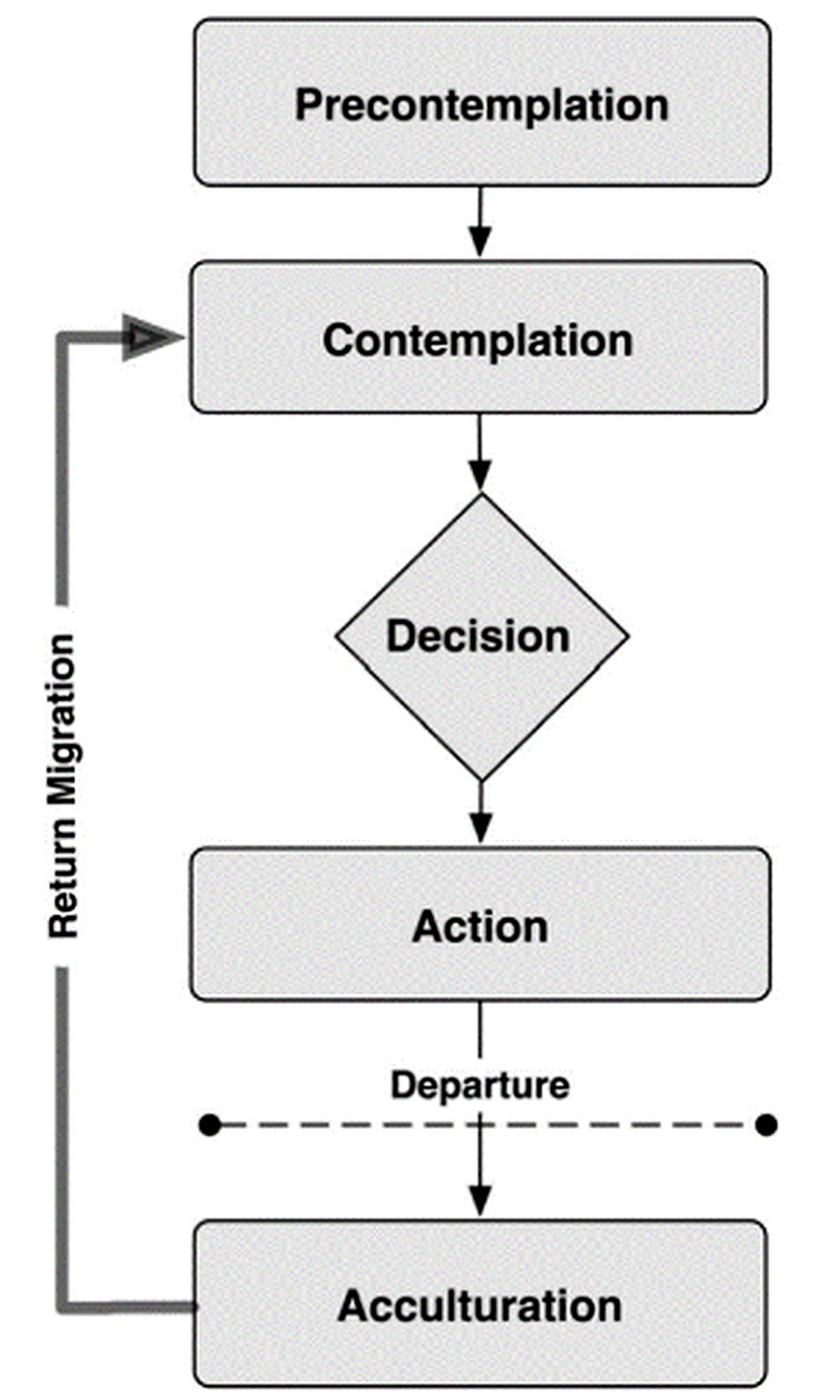
The Stages of Change model (Tabor and Milfont, 2011, p. 825; see model in Figure 1 below) can, therefore, be used to develop a deep understanding of the effects of migrations and migrants’ or refugees’ integration, including children and youth, such as posttraumatic stress disorder (PTSD) or, at least, problems with self-regulation and self-expression (Suarez-Orozco et al., 2018), or language proficiency challenges (Seredyńska-Abou Eid, 2017).
Figure 1. Stages of Change model.
Source: Authors; see Ouacha (2024) for further details.
Tabor and Milfont’s model consists of five stages forming the migration process. The actual departure separates this model’s first two and the last two parts from the homeland location. The first stage is pre-contemplation, i.e. the period in which the individual has not seriously considered moving abroad. The second stage, contemplation, examines the possibilities of moving out of the country of origin (Ouacha, 2024). This period may begin before any opportunity arises to make this possible, or immediately after an unexpected opportunity (e.g., job offers). When potential migrants decide to move abroad, they proceed to the third stage, i.e. action. Although decision is a step in itself, the actual psychological ramifications are not felt until acting on that decision has begun (e.g., applying for residence, purchasing an airplane ticket, or informing extended family members). These challenges may lead to higher stress levels, thus demanding a coping response. The stress and coping framework are often used to examine the acculturation experiences of migrants and refugees upon arrival in their new country (Ward et al., 2001).
Further down in the model, migrants move on from the action stage, as they depart from the country of origin, and enter the final stage, that of acculturation, i.e. the process resulting from intercultural contact. Psychologists have researched this topic more thoroughly than the other stages in the model (Ouacha, 2024). The two most essential aspects that migrants and refugees face at this stage are psychological adjustment and sociocultural adaptation (Ward & Kennedy, 2001). Within the new cultural context, migrants and refugees decide how they would cope in a society that is different from their own. The choices involve a relative preference for maintaining one’s culture and cultural identity (cultural maintenance) and for having contact with and participating in the host culture (cultural reference) (Berry, 1980, 2005). Berry’s model of acculturation identifies four distinct acculturation strategies: integration, segregation, assimilation, and marginalisation. These strategies depend on how migrants and refugees relate to the culture of origin relative to the settlement culture (Berry, 1980, 2005). This is both on an individual and a collective level.
The experience of marginalisation can present migrants and refugees with an ongoing choice of whether to stay in the new country or return to their country of origin (Ley and Kobayashi, 2005). Ouacha (2024) adds that historical colonial relationships could shorten the cultural distance, but this is not always true. For example, Algerians also experienced marginalisation in France, even after their country had been a French colony for 130 years. This also happened with the Indonesians migrating to the Netherlands after Indonesia’s independence in 1945 (Zara, 2022). What is particularly interesting about this case concerns the way that the complex Polish-Ukrainian relations would influence present-day concerns. Poland and Ukraine are neighbouring countries with an intense migratory interconnection and a shared multicultural history of conflict and cooperation, to some extent comparable to the postcolonial perspective due to Polish domination over Ukraine in the XVI - XVIII centuries and, partly, in 1918-1939. Last year, unexpectedly, opened a new chapter in the acculturation processes, the one whose ending is still unknown, where Ukrainian refugees in Poland are increasingly analysed as merely migrants, or just members of the Polish society. As this process is, in fact, ongoing, it draws public attention, and so researchers interested in its uniqueness search for other good practices. In this text, we try to analyse and compare Polish and Dutch cases in their integrative contexts.
3 Regional Contexts of Poland and the Netherlands
Based on the existing literature, this study aims to compare the selected cases—those of Poland and the Netherlands—to assess how, and to what extent, it is possible to identify or update a model of education-based integration for newcomers in their new environments. Both countries have experienced significant inflows of migrants and refugees and have been attempting to adapt state institutions to better manage and support these populations. In Poland, the 2014 Russian annexation of Crimea triggered the arrival of an estimated one million Ukrainian forced migrants, whose integration was primarily linked to the labour market. The mass arrival of war refugees after February 2022—predominantly mothers with children—created an urgent need to adjust the education system to accommodate many new pupils and students (see Eurostat, 2026).
In the Netherlands, 113,000 migrants arrived during the 1990s (De Valk et al., 2004). Migration increased further after the country joined the EU, although this study focuses on non-EU contexts. Migration has long shaped Dutch society, and the diverse influences of migrant communities continue to fuel political, academic, media, and public debates. These debates often revolve around the expected level of integration of migrant and refugee groups in Western European countries (e.g., Vermeulen & Penninx, 2000). Large-scale research among the four main migrant groups in the Netherlands—Turkish, Moroccan, Antillean, and Surinamese—found that “perceived discrimination was the strongest negative predictor of host national identification” (Verkuyten, 2016, p. 585; de Vroome et al., 2014; see also Tolsma et al., 2012). The presence of criminal networks within Surinamese and Moroccan diaspora groups has been used by extreme-right politicians to justify polarizing political agendas (Cankaya, 2017). Yet empirical evidence shows that navigating a new society can be profoundly challenging for migrants, refugees, and their descendants.
Focusing on one of these groups, research on Moroccan migrants in the Netherlands shows that education for children was not an immediate priority after migration (De Haas, 2003). Only when local authorities had noticed that immigrant children were not attending school—and that parents were unaware of the necessity of them doing so—did social workers and community organizers begin advocating for their participation in education. As the literature indicates, many Moroccan migrants initially intended to return to their homeland (Ouacha, 2024). Consequently, schooling in Dutch institutions was not considered essential. It was only after a substantial number of families had collectively decided to settle permanently in the Netherlands that Moroccan children began entering classrooms across the country.
A quantitative analysis by Bevelander and Veenman (2006) comparing Moroccan and Turkish migrants in the Netherlands shows that age of migration, and education strongly influence the likelihood of naturalisation. When including indicators of cultural integration, gender differences become particularly significant (Kee, 1994). Turkish women scored high on modernization measures, giving them a higher probability of naturalising. According to Bevelander and Veenman (2006), naturalised Turkish women also have better employment prospects, which is linked to language acquisition, familiarity with Dutch society, and alignment with the norms and values of the host country (Verkuyten, 2016). Their findings support the argument that “employment integration analysis speaks in favour of the idea that modern Turkish women from traditional areas in Turkey (…) seem to have a higher naturalization rate and once naturalized have better employment opportunities” (Bevelander & Veenman, 2006, p. 343).
The Surinamese and Antillean communities in the Netherlands present another compelling case. Due to the colonial relationship between the Netherlands and Suriname—which was a Dutch colony for nearly 300 years—and the continued constitutional ties with the Antilles, these groups can be considered (former) Dutch citizens. After Suriname gained independence in 1975, many Surinamese migrated to the Netherlands while maintaining strong connections to their homeland, which was developing its own national identity (Tolsma et al., 2012). Fearing the political and economic consequences of independence, thousands moved to the Netherlands under visa-free travel arrangements. In total, around 100,000 Surinamese migrated, representing a population that mirrored Suriname’s ethnic and class diversity (Ogle, 2011). Today, approximately 350,000 Surinamese live in the Netherlands—almost equal to Suriname’s current population of 400,000 (Hoefte, 1996).
All the cases described above demonstrate that limited commitment to the host country does not necessarily indicate disengagement or rejection of the host society. Low identification with the country of residence also does not imply weak personal or group identity (Verkuyten, 2016; Kreiner & Ashforth, 2004). Nonetheless, fostering a meaningful sense of belonging—both to the host society and to one’s own identity—remains an important and attainable goal for migrants and refugees, as well as for the institutions that support them. Taken together, the Polish and Dutch cases illustrate how different historical trajectories, migration patterns, and institutional responses shape the integration experiences of refugees and migrants. While Poland is currently navigating a rapid and large‑scale educational adjustment due to recent refugee and migrant inflows, the Netherlands offers decades of accumulated experience with diverse migrant and refugee communities and long‑term integration debates. Comparing these contexts provides valuable insights into how education systems can be adapted to support migrants and refugees more effectively, and how integration models must remain flexible to respond to shifting demographic and political realities.
The influx of refugees from Ukraine was positively received in neighbouring countries and contributed to an increase in favourable attitudes towards migrants and their presence in these countries. Public opinion, as well as public space, was full of pro-Ukrainian initiatives and corresponding forms of support. Research carried out by various organisations show very high support for accepting refugees in Poland - at 80% in spring 2022, according to the Pew Research Center study (2024), and up to 94% in March 2022 in a survey conducted by the Polish Public Opinion Research Center (Centrum Badania Opinii Społecznej [CBOS], 2023a, 2023b). As mentioned, before February 2022, the percentage of Poles supporting the admission of Ukrainian refugees did not exceed 50%, while the percentage of people who supported accepting refugees from outside Europe and enabling them to apply for asylum was 33%. There may be many reasons for the change - the most obvious being the tendency to help people in need or the attack on the neighbouring country of Ukraine by Russia, the country which attacked and occupied Poland many times throughout history.
Of the already mentioned number of the Ukrainian refugees who crossed the border with Poland in February 2022, over 675,000 were children under 18 years of age, and they received official temporary status protection in Poland in November 2023. To determine the exact number of these children that participate in the Polish education system is not easy, because a significant share (approx. 1/3) continue distance learning in schools operating in Ukraine, and many register in the Polish education system, but do not continue their education there. Additionally, approximately 1.5 million Ukrainians have been issued a PESEL (Polish ID) number, enabling them to use free health care and other state-financed services just like Polish citizens (children and adolescents constitute 43% of this group). According to other data, the number of Ukrainians residing in Poland in mid-2023 exceeded 3 million. Due to the distribution of Ukrainian refugees mainly in cities, their estimated number in the largest Polish cities amounts to 20% of the current total number of the inhabitants, e.g. in Poznań, the empirical study was carried out with about 100,000 Ukrainians living there, compared to less than 600,000 of the city’s regular inhabitants.
Regardless of the threats related to military operations in Crimea and the eastern areas of Ukraine, as well as the danger of shelling and air raids throughout the country’s territory, the declared tendency to emigrate has decreased in Ukraine since 2021, while the percentage of people planning to stay and work in their place of residence has increased. The course of hostilities has affected the spatial distribution of those who declare their willingness to migrate. Still, the principle of willingness to stay in the country is visible in extensive census surveys and in the statements by the people with whom we conducted in-depth interviews in Poland. The decision to return is influenced not only by arguments related to the challenges of life in emigration (these challenges are visible despite the relatively straightforward, positive assessment of the attitude of the inhabitants of the host country towards refugees; see Isański et al., 2022) - that is, the rising costs of living in the new place, the adaptation difficulties for children in new environments, or challenges in accessing specialist healthcare. The decision to return is also influenced by homesickness, the desire to reunite with one’s family, or to raise children in their homeland. It is also important to note that Polish, Ukrainian, and Russian are all Slavic languages and involve certain similarities, making mutual understanding and cross-cultural learning relatively easy. It is particularly relevant for children who, even with the limited language proficiency, have been able to learn Polish language quite easily at school.
Positive attitudes and openness correspond, only partially, with school achievements: the exam results depict the achievement gaps in the standardised test scores of Polish and foreign-born (Ukrainian) elementary school pupils (see Figure 2). The elementary school final tests were completed in May 2023 by c. 510 thousand pupils, including 13,800 Ukrainian pupils attending the Polish school system. In 2024, the test was completed by 220,900 Polish and 11,300 Ukrainian students, while in 2025 the number of Polish and Ukrainian students was 363,200 and 13,070 respectively. Ukrainians’ results have been significantly lower in all the major subjects, which shows challenges for the education system in teaching Polish as a foreign language and other issues. Importantly, Ukrainian students achieved lower results in the Polish language exam and subjects such as mathematics and English in all the three analysed years. This prompted us to look at this phenomenon and try to find possible answers to questions about its causes. Apart from the obvious ones resulting from the shorter stay in Poland, one should also examine the reasons related to the Polish education system, the teachers working there, and the students themselves.
Figure 2. Elementary school final test in the school year 2023-2025, average results, data in %.
Source: Authors’ elaboration based on Central Examination Board data (2023, 2024, 2025).
4 Data and Results
The research within the Polish part of the study was conducted as fieldwork between 2023 and 2025. It was two years after the outbreak of the full-scale Russian invasion in Ukraine, which resulted in the mass inflow of refugees and forced migrants to Poland. Children were incorporated into the educational system, and our data have shown particular challenges and obstacles that arose at both the systemic and micro levels. To make our analyses more accurate, we have also drawn on other research conducted across various areas of the Polish education system. Considering our own part of the research, it is also worth noting that we managed to reach a diverse sample of teachers, including those of Polish and Ukrainian origin. In our study, we aimed at examining the environments in which migrants functioned daily, particularly schools where children of Ukrainian refugees and migrants fulfilled their statutory schooling requirements. For this purpose, three schools were selected, supported by the Education Board in Poznań, in which a significant percentage of international students, mostly newly arrived pupils from Ukraine, were enrolled. All the study participants were informed about the anonymity and the right to withdraw from the study. The questionnaires were completed during an on-site study during regular school meetings.
As a part of the ongoing empirical research project, a CAWI study was conducted on a purposefully selected sample (N=101) of teachers working in three schools: two primary schools and one secondary school in Poznań, Poland, in environments with a substantial share of foreign-born pupils. Below (see Table 1), the data from our study are presented for a sample of 101 teachers working in an ethnically mixed environment with Polish and international students (among them, foreign-born Ukrainian students having clear predominance; over 95% arrived in Poland recently). Metric data (see Appendix Table A2) show that 3/4 of the sample were women. The majority of teachers declared higher education level, mainly with the substantial amount of additional professional courses, including education for children with special needs (various areas of physical and mental challenges, speech therapy, spectrum of autism), foreign language proficiency (i.e., Polish as a foreign language, Belarusian, Bulgarian, German, Russian, or Ukrainian), crisis interventions, informatics, or physical activities and fitness. Teachers see underachievement of foreign-born pupils (see Table 2), however their perception of the overall school environment is rather positive (see Table 3). In the following open-ended questions, they provided a variety of possible solutions to problems included in three main areas of interest. The first was the institutional one, linked with the upper limit of pupils in one class or group and additional teacher assistants with foreign origin themselves. The second area of suggestions was linked to language issues (see Appendix Table A1), and teachers suggested various actions, including “Polish language courses for foreigners” and “additional freshman year with extra Polish classes”. The third group of frequently suggested ideas were connected with the need to treat pupils individually, not only in terms of their ethnic origin, but also personal biographies connected with migratory trauma.
| Responses | General satisfaction with working conditions at school (data in %) | Satisfaction with respondents’ work with foreign pupils (data in %) |
|---|---|---|
| Definitely yes | 11 | 15 |
| Moderately yes | 36 | 46 |
| Hard to say | 23 | 24 |
| Moderately no | 16 | 8 |
| Definitely no | 14 | 7 |
| Total | 100 | 100 |
| Responses | % of responses |
|---|---|
| Much better | 4 |
| Better | 8 |
| Hard to say | 29 |
| Worse | 46 |
| Much worse | 13 |
| Total | 100 |
| Responses | Perception of attitudes towards migrants in respondents’ place of residence | Perception of Polish pupils’ attitudes towards foreign-born pupils | Perception of other migrants’ attitudes towards Ukrainian refugees |
|---|---|---|---|
| Very positively | 14.9 | 8.5 | 8.5 |
| Moderately positively | 46.9 | 62.6 | 23.4 |
| Hard to say | 24.4 | 17.2 | 59.7 |
| Moderately negatively | 11.7 | 11.7 | 7.4 |
| Very negatively | 2.1 | 0 | 1 |
| Total | 100 | 100 | 100 |
5 Discussion
The results of our research show how challenging it is to adapt the education system to the current requirements posed by the sudden influx of international students. It should be remembered that students from Ukraine are unique, not only because they have to attend school in Poland, but also because their presence in Poland is related to the need to leave their home country and peer environment in stressful circumstances; the limited sample size and purposive selection procedure limit the potential for any generalisations. However, by analysing our data in a wider context based on the desk research, we found some interesting conclusions. The uncertainty about one’s own and one’s family's future is surely not conducive to adapting to a new place or learning at school. An additional difficulty is that the public education system in Poland has been struggling for many years with underinvestment, low teacher salaries, a high employee turnover rate, as well as frequent curriculum changes. All this together creates a very demanding situation for everyone involved - students, teachers, and school management. Again, the limited size of our sample does not allow us to generalise the results to the entire population. Still, the results confirm the crisis-like nature of the challenges emerging over the last two years and the manners to address them. There is a lack of dissemination of best practices. Underinvestment in the system has had a negative impact, especially on international students - numerous working groups and classes, an insufficient number of Polish language hours, as well as teachers’ excessive work burden mean that the crisis, as mentioned earlier, the context of leaving the place of origin of international students is also present as a key to describing their temporariness in functioning in the Polish education system. In this situation, the very positive attitudes of Poles towards Ukrainian refugees may not be enough to provide Ukrainian children with learning conditions outside their places of origin.
It also seems that this involves not only the need to increase expenditure on education, but also the need to rethink the requirements for international students, as well as to involve the children’s teachers and parents in their adaptation to local conditions. This challenge may turn out to be no less problematic, since most Ukrainian children are in Poland without their fathers (usually breadwinners), who remained in Ukraine following the imposition of martial law in response to Russian aggression, while their mothers often possess limited competence in Polish. Employing over 20,000 Ukrainian teachers in the Polish public education system only partially solved this problem. However, it should not be forgotten that a significant part of the problems faced by the Polish education system is related to the generally difficult financial situation and underinvestment in education. Even though the solutions are pretty obvious - reducing the size of classes, increasing the number of hours of teaching Polish, or employing additional supporting teachers - this requires increased spending on education. Given the ongoing war in Ukraine and the inflow of a large number of refugees to Poland, this is not an easy task.
Based on the results, the refugee integration experience in Poland provides a bridge to the existing effects in the Dutch contexts, as briefly addressed in the literature review. Furthermore, there are dos and don’ts in the management of refugee issues for Polish audiences and other societies hosting Ukrainian refugees. However, the durability of the change in the mutual perception of Poles and Ukrainians remains to be questioned. Regardless of a range of positive gestures, these relationships are full of obstacles.
Two dominant proposals were to introduce additional Polish language classes and reduce the number of pupils per class. The less frequently mentioned ones also include additional psychological support for students, co-financing for teachers working with international students, and the introduction of a cultural assistant role. A separate group of suggestions included those in which teachers indicated a need to change students' and their parents' approaches to school. These arguments point to systemic problems regarding the organisation of the teaching process and its adaptability to the sudden influx of students from another country (and, consequently, from a different teaching system with limited language competencies and a cultural barrier). However, it may be considered optimistic that the number of teachers reporting no significant peer conflicts was twice the number of those who wrote about any problems in this field (no=40; yes=20). If the problems did occur, they were due to language misunderstandings or Ukrainian-Russian personal conflicts stemming from their ethnic origin. It is complicated, and in most cases impossible, as the participating teachers wrote, to obtain information about these students’ current educational path in Ukraine, which is essential for students with diagnosed special educational needs. The incompatibility of the legal provisions in both countries in this respect and the difficulties in validating relevant documents make it necessary, in many cases, to conduct long-term diagnostics of the needs of these children. The implementation on site, in Poland, is additionally hampered by the limited number of working specialists with appropriate qualifications and knowledge of Russian or Ukrainian.
A separate problem is the animosity between ethnic groups of international students, in this specific case, children from Ukraine, Belarus, and Russia. The current political situation and the ongoing war create conflicts between students from these countries. Solving them is an additional challenge for teachers. The teachers’ suggestions in our study can be treated as bottom-up recommendations. Their implementation is in our collective interest.
6 Conclusions, Recommendations and Remarks for Further Research
The unexpected inflow of a large number of war refugees from Ukraine to Poland, and the visible change in the attitude of Polish public opinion towards their arrival and residence allow us to observe in vivo the processes of social dynamics. Compared with examples from the Netherlands, the results of both these pieces of research may serve as both a test of existing theoretical approaches and grounds for updating them. The process of influx and social integration is happening before our eyes, and it seems that so far, we have managed to avoid many dead ends, such as housing ghettoisation or social stigmatisation of refugees, particularly of the second generation. Our study will hopefully provide information about the mentioned dynamics of the social change process and its possible future course. The school environment seems to be a good laboratory for social changes and allows for assessing the depth of the changes in mutual relations between Poles and Ukrainians, similarly to the cases of Moroccans in the Netherlands. In the Polish case, this was demonstrated by the successful integration of Ukrainian students who arrived in Poland with their families before the outbreak of the refugee crisis in February 2022. The relatively low saturation of international students and the friendly atmosphere around Ukrainian migrants favoured this integration. As of 2022, the number of international students has increased dramatically. Although there was an amicable social atmosphere, questions arose concerning the system’s capacity. Daily functioning in the same environment is an opportunity to verify the declaration of willingness to help, as well as to show the complexity of everyday life's challenges. These challenges are exceptionally difficult for refugee children and youth with possible post-traumatic stress disorder and accompanied by one or both of their parents. Comparing the Polish case to the Dutch one, we noticed similarities in the educational environment challenges and sought to discuss particular experiences from the Netherlands, including the educational system responses at the micro level and schools’ responses in classroom environments. The data we have collected allow us to conclude that these challenges concern the organisational level of the researched schools rather than interpersonal relations or ethnic-based prejudices. This conclusion may be considered optimistic, but a system reform should follow bottom-up signals to respond to the challenges approaching. Such signals might also be analysed in the international context, as we have attempted to do in our research. Otherwise, the openness evident in public opinion polls and our respondents' statements may face increasingly severe challenges in the coming years, as recognised in the literature (Ivert & Magnusson, 2020). This might also be a critical issue in the acculturation stage of the presented model (see Figure 1), as well as when it comes to the possible return, or deeper integration incentives that may occur soon. The results do not lead to a simple conclusion about the outcomes in the educational system as predictors of successful acculturation; however, the stated expectation regarding its content may inform the priorities to be implemented in the critical areas linked to communication needs.
Many countries apply several requirements during the naturalisation procedure for migrants, concerning their age, education, condition and health, as well as the knowledge of the language, culture, and history of the receiving country. Fulfilling them usually requires many years of preparation, living, and learning, and this normally ends with an exam with various possible results. The exceptional and urgent situation of refugees eliminated the possibility of preparation, and this role had to be fulfilled through years of contact between neighbours and the flexibility of both parties. To summarise the results of the statements we collected from teachers of various nationalities working in Poland, when it comes to dos, we can mention openness, avoiding stigmatisation, ghettoisation, and isolation on the part of the receiving community, and similar transparency on the side of the receiving society. However, among the don’ts, stereotyping, homogenisation of the arriving group, and demandingness are worth mentioning. In addition to the above, our data demonstrate the importance of racial familiarity, intersectional approaches, and discussions in specific research projects, such as this study.
It is fair to assume that the researcher’s positionality becomes relevant as we progress. As Holmes and Gary (2020) argue, having the same personal background as one’s participants can be highly beneficial for gathering data and translating it to co-authors. This was the case with the first and the second author in this study. Therefore, this study pleads for a more in-depth approach by researchers when approaching a vulnerable research group, as done in this study. The insider position of a researcher could lead to a deeper understanding of a research population, more in-depth data, and, therefore, a more intersectional approach when reflecting on the practical adjustments of theory.
As stated, our research is based on a limited sample and cannot be generalised to the general population in any country; however, we see the potential of the two analysed cases in the dynamics of their social status, from refugees to members of integrated societies. Remembering that integration is a process, as presented in the text, we see the educational system as a useful platform for implementing integration policies. Both authors continue their research based on such cases, to describe and understand the phenomenon, as well as its limitations. Anyway, even if authors would wish to refer to the field study results within a wider research project or in public statistics, the results should be treated with this caveat.
Data availability statement
Empirical database available upon reasonable request.
Coauthor contributions
Jakub Isański: main text writing, empirical data, analyses
Malika Ouacha: main text writing, analyses
References
- Andrews, J., Isański, J., Nowak, M., Sereda, V., Vacroux, A., & Vakhitova, H. (2023). Feminized forced migration: Ukrainian war refugees. Women’s Studies International Forum, 99, 102756. https://doi.org/10.1016/j.wsif.2023.102756
- Berry, J. W. (1980). Acculturation as varieties of adaptation. In A. M. Padilla (Ed.), Acculturation: Theory, models, and some new findings (pp. 9-25). Westview Press.
- Berry, J. W. (2005). Acculturation: Living successfully in two cultures. International Journal of Intercultural Relations, 29(6), 697-712. https://doi.org/10.1016/j.ijintrel.2005.07.013
- Bevelander, P., & Veenman, J. (2006). Naturalization and employment integration of Turkish and Moroccan immigrants in the Netherlands. Journal of International Migration and Integration, 7, 327-349. https://doi.org/10.1007/s12134-006-1016-y
- Blankvoort, N., Laliberte Rudman, D., van Hartingsveldt, M., & Krumeich, A. (2024). ‘New’ Dutch civic integration: Learning ‘spontaneous compliance’ to address inherent difference. Critical Discourse Studies, 21(4), 463-481. https://doi.org/10.1080/17405904.2023.2179648
- Cankaya, S. (2017). The racialization of ethnic minority police officers and researchers: On positionality and (auto)ethnographic fieldwork. European Journal of Policing Studies, 5(Special Issue 1), 119-132. https://www.maklu-online.eu/en/tijdschrift/ejps/volume-5/special-issue-observing-the-observers-ethnographie/racialization-ethnic-minority-police-officers-and-/
- Centralna Komisja Egzaminacyjna [Central Examination Board]. (2023). Informacja o wynikach egzaminu ósmoklasisty 2023. Centralna Komisja Egzaminacyjna [Central Examination Board]. https://www.gov.pl/web/edukacja/informacje-o-wynikach-egzaminu-osmoklasisty-2023
- Centralna Komisja Egzaminacyjna [Central Examination Board]. (2024). Informacja o wynikach egzaminu ósmoklasisty 2024. Centralna Komisja Egzaminacyjna [Central Examination Board]. https://www.gov.pl/web/edukacja/informacja-o-wynikach-egzaminu-osmoklasisty-2024
- Centralna Komisja Egzaminacyjna [Central Examination Board]. (2025). Wstępne wyniki egzaminu ósmoklasisty 2025. Centralna Komisja Egzaminacyjna [Central Examination Board]. https://www.gov.pl/web/edukacja/wstepne-wyniki-egzaminu-osmoklasisty-2025
- Centre for Civic Education. (2023a). Polska–Ukraina razem w szkole 2023. Centre for Civic Education. https://globalna.ceo.org.pl/programy-edukacyjne/polska-ukraina-razem-w-szkole-2023/
- Centre for Civic Education. (2023b). Uczniowie uchodźczy z Ukrainy w polskim systemie edukacji: Opracowanie: Paulina Chrostowska, stan na październik 2023 r. [Refugee students from Ukraine in the Polish education system: Prepared by Paulina Chrostowska, as of October 2023]. Centre for Civic Education. https://ceo.org.pl/wp-content/uploads/2024/01/Uczniowie-uchodzczy-w-polskim-systemie-edukacji-CEO-01_2024.pdf
- Centrum Badania Opinii Społecznej. (2023b). O wojnie na Ukrainie i Ukraińcach w Polsce [On war in Ukraine and Ukrainians in Poland] (J. Scovil, Ed.). Research Report No. 120/2023. https://cbos.pl/SPISKOM.POL/2023/K_120_23.PDF
- Centrum Badania Opinii Społecznej. (2023a). Wojna na Ukrainie i dystans społeczny wobec Ukraińców [War in Ukraine and social distance towards Ukrainians] (J. Scovil, Ed.). Research Report No. 84/2023. https://cbos.pl/SPISKOM.POL/2023/K_084_23.PDF
- Chrostowska, P. (2024). Uczniowie z Ukrainy z doświadczeniem uchodźstwa w polskim systemie edukacji [Students from Ukraine with refugee experience in the Polish education system]. Centrum Edukacji Obywatelskiej. https://ceo.org.pl/wp-content/uploads/2024/07/CEO-Uczniowie-z-Ukrainy-z-doswiadczeniem-uchodzstwa-w-polskim-systemie-edukacji.-Kwiecien-2024.pdf
- De Haas, H. (2003). Migration and development in southern Morocco: The disparate socioeconomic impacts of out-migration on the Todgha Oasis Valley. De Haas. https://heindehaas.org/wp-content/uploads/2016/02/de-haas-2003-phd-thesis-migration-and-development-in-southern-morocco-the-disparate-socio-economic-impacts-of-out-migration-on-the-todgha-oasis-valley.pdf
- De Valk, H., Liefbroer, H., Esveldt, I., & Henkens, K. (2004). Family formation and cultural integration among migrants in the Netherlands. Genus, 60(3/4), 9-35. http://www.jstor.org/stable/29788822
- de Vroome, T., Martinovic, B., & Verkuyten, M. (2014). The integration paradox: Level of education and immigrants’ attitudes towards natives and the host society. Cultural Diversity & Ethnic Minority Psychology, 20(2), 166-175. https://doi.org/10.1037/a0034946
- Directorate-General for Education, Youth, Sport and Culture. (2024). The inclusion of displaced children from Ukraine in the EU education systems 2023–2024. Publications Office of the European Union. https://www.newcommunities.ie/assets/files/pdf/the_inclusion_of_displaced_children_from_ukraine_in-nc0524470enn.pdf
- Duszczyk, M., & Kaczmarczyk, P. (2022). The war in Ukraine and migration to Poland: Outlook and challenges. Intereconomics, 57(3), 164-170. https://doi.org/10.1007/s10272-022-1053-6
- Eurostat. (2026). Temporary protection for persons fleeing Ukraine: Monthly statistics. Eurostat. https://ec.europa.eu/eurostat/statistics-explained/index.php?title=Temporary_protection_for_persons_fleeing_Ukraine_-_monthly_statistics
- FitzGerald, D., & Arar, R. (2018). The sociology of refugee migration. Annual Review of Sociology, 44, 387-406. https://doi.org/10.1146/annurev-soc-073117041204
- Gatrell, P. (2013). The making of the modern refugee. Oxford University Press.
- Gońda, M. (2025). Settlement intentions of Ukrainian pre-war and forced migrants in Poland: Challenges for migrant integration policy at the local level. Journal of International Migration and Integration, 26(2), 1007-1035. https://doi.org/10.1007/s12134-024-01211-3
- Grabowska, I., Kyliushyk, I., & Chról, E. (2025). Ukrainian female war migrants: Mobilising resources for prospective social remittances. Routledge. https://doi.org/10.4324/9781003480754
- Hoefte, R. (1996). Thrust together: The Netherlands relationship with its Caribbean partners. Journal of Interamerican Studies and World Affairs, 38(4), 35-54. https://doi.org/10.1111/j.1548-2456.1996.tb00002.x
- Holmes, A., & Gary, D. (2020). Researcher positionality: A consideration of its influence and place in qualitative research: A new researcher guide. Shanlax International Journal of Education, 8(4), 1-10. https://doi.org/10.34293/education.v8i4.3232
- Isański, J., Nowak, M., Michalski, M., Sereda, V., & Vakhitova, G. (2022). Social reception and inclusion of refugees from Ukraine. UKREF Research Report 1/2022. https://doi.org/10.21203/rs.3.rs-1694920/v1
- Ivert, A.-K., & Magnusson, M.-M. (2020). Drug use and criminality among unaccompanied refugee minors: A review of the literature. International Journal of Migration, Health and Social Care, 16(1), 93-107. https://doi.org/10.1108/IJMHSC-05-2019-0050
- Kee, P. (1994). Native-immigrant employment differentials in the Netherlands: The role of assimilation and discrimination. International Review of Applied Economics, 8(2), 297-302. https://doi.org/10.1080/758539745
- Kloc-Nowak, W., & Ryan, L. (2023). Negotiating long-distance caring relations: Migrants in the UK and their families in Poland. In J. Waters & B. Yeoh (Eds.), Handbook on migration and the family (pp. 154-169). Edward Elgar Publishing. https://doi.org/10.4337/9781789908732.00016
- Kofman, E., Lukes, S., D’Angelo, A., Montagna, N., & Di Florido, E. (2017). New immigrants in England and their needs. Research and Consultancy Unit, Refugee Support. https://www.migrationyorkshire.org.uk/research-entry/new-migrants-england-and-their-needs
- Kreiner, G. E., & Ashforth, B. E. (2004). Evidence toward an expanded model of organizational identification. Journal of Organizational Behavior, 25(1), 1-27. https://doi.org/10.1002/job.234
- Lazarenko, V., & Rabinovych, M. (2024). Collective protection for Ukrainians in the EU: Laws, practices, and implications for EU and Ukrainian policies. In M. Rabinovych & A. Pintsch (Eds.), Ukraine’s thorny path to the EU: From “integration without membership” to “integration through war” (pp. 93-122). Palgrave Macmillan. https://doi.org/10.1007/978-3-031-69154-6_5
- Ley, D., & Kobayashi, A. (2005). Back to Hong Kong: Return migration or transnational sojourn?. Global Networks, 5(2). https://doi.org/10.1111/j.1471-0374.2005.00110.x
- Loescher, G. (2021). Refugees: A very short introduction. Oxford University Press.
- Mieroszewski Centre. (2024). Polska i Polacy oczami Ukraińców 2024 [Poland and Poles through Ukrainians’ eyes 2024]. Mieroszewski Centre. https://mieroszewski.pl/upload/2024/12/polska-i-polacy-oczami-ukraincow-2024-pl-www.pdf
- National Bank of Poland. (2022). Sytuacja życiowa i ekonomiczna uchodźców z Ukrainy w Polsce [The life and economic situation of refugees from Ukraine in Poland]. National Bank of Poland. https://nbp.pl/wp-content/uploads/2022/11/sytuacja-uchodzcow-z-Ukrainy-w-Polsce.pdf
- Necel, R. (2024). The welfare system in the face of war refugees from Ukraine: The experience of social workers in Poland. Global Networks, e12517. https://doi.org/10.1111/glob.12517
- Ogle, J. (2011). The continuously changing self: The story of Surinamese Creole migration to the Netherlands. Independent Study Project (ISP) Collection. https://digitalcollections.sit.edu/isp_collection/1152
- Ouacha, M. (2024). Receiving by Giving: The Examining of Cross-Border Diasporic and Bi-Cultural Philanthropy.
- Pew Research Center. (2024). Views of Ukraine and U.S. involvement with the Russia-Ukraine war. Pew Research Center. https://www.pewresearch.org/global/2024/05/08/views-of-ukraine-and-u-s-involvement-with-the-russia-ukraine-war/
- Polska pomoc Ukrainie 2022–2023 Rada do Spraw Współpracy z Ukrainą. (2025). Polska pomoc Ukrainie 2022–2023 Rada do Spraw Współpracy z Ukrainą. Kancelaria Prezesa Rady Ministrów. https://instytutpolski.pl/kyiv/wp-content/uploads/sites/19/2026/02/Polska_Pomoc_Ukrainie_2022-2023.pdf
- Seredyńska-Abou Eid, R. (2017). Does acculturation mean progress?. Progress(es), Theories and Practices: Proceedings of the 3rd International Multidisciplinary Congress on Proportion Harmonies Identities (PHI 2017), October 4–7, 2017, Bari, Italy.
- Skeldon, R. (2008). Migration and development. United Nations Expert Group Meeting on International Migration and Development in Asia and the Pacific. https://www.un.org/development/desa/pd/sites/www.un.org.development.desa.pd/files/unpd_egm_200809_paper_skeldon_mig_and_dev.pdf
- Suarez-Orozco, C., Motti-Stefanidi, F., Marks, A., & Katsiaficas, D. (2018). An integrative risk and resilience model for understanding the adaptation of immigrant-origin children and youth. American Psychologist, 73(6), 781-796. https://doi.org/10.1037/amp0000265
- Tabor, A. S., & Milfont, T. L. (2011). Migration change model: Exploring the process of migration on a psychological level. International Journal of Intercultural Relations, 35(6), 818-832. https://doi.org/10.1016/j.ijintrel.2010.11.013
- Tolsma, J., Lubbers, M., & Gijsberts, M. (2012). Education and cultural integration among ethnic minorities and natives in the Netherlands: A test of the integration paradox. Journal of Ethnic and Migration Studies, 38(5), 793-813. https://doi.org/10.1080/1369183X.2012.667994
- Tędziagolska, M., Walczak, B., & Żelazowska-Kosiorek, A. (2022). Szkoła zróżnicowana kulturowo: Wyzwania i potrzeby związane z napływem uczniów z Ukrainy [Culturally diverse school: Challenges and needs related to the influx of students from Ukraine]. Centrum Edukacji Obywatelskiej. https://ceo.org.pl/wp-content/uploads/2022/09/CEO_Szkola-zroznicowana-kulturowo_raport_sierpien22.pdf
- Verkuyten, M. (2016). The integration paradox: Empiric evidence from the Netherlands. American Behavioral Scientist, 60(5–6). https://doi.org/10.1177/0002764216632838
- Vermeulen, H., & Penninx, R. (2000). Immigrant integration: The Dutch case. Spinhuis.
- Ward, C., & Kennedy, A. (2001). Coping with cross-cultural transition. Journal of Cross-Cultural Psychology, 32(5), 636-642. https://doi.org/10.1177/0022022101032005007
- Ward, C., Bochner, S., & Furnham, A. (2001). The psychology of culture shock. Routledge. https://doi.org/10.4324/9780203992258
- Zara, M. Y. (2022). Attracting and educating ‘new citizens’: Indonesian public discourse on the integration of Indo-Europeans into Indonesian society during the Dutch-Indonesian War (1945–1947). Advances in Southeast Asian Studies, 15(1), 61-85. https://doi.org/10.14764/10.ASEAS-0063
APPENDIX
| No. | Question |
|---|---|
| 1 | Are you generally satisfied with the conditions of your work in school? (scale 1-5) |
| 2 | Are you generally satisfied with your level of contact with pupils? (scale 1-5) OR: can you see any pupils’ linguistic/competence/knowledge progress? |
| 3 | Do you have any suggestions on how to improve the conditions of work in school? Please provide any details: … |
| 4 | Are you generally satisfied with your conditions of life as a teacher in Poland? (scale 1-5) Please provide any details: … |
| 5 | How would you rate locals’/Poles’ attitudes toward migrants? (scale 1-5) |
| 6 | Did you notice any ethnic/national/... conflicts between pupils? (open-ended) … |
| 7 | What is, as you see it, the biggest challenge for foreign pupils? … |
| 8 | Do you have any friendly relations at work? If so, how many: … (in your ethnic group/in other ethnic groups) |
| 9 | Do you plan to stay in Poland? If so, please explain why: … |
| 10 | Do you have any family left in Ukraine? If so, please provide any details: … |
| 11 | Have you visited Ukraine since Feb 2022? If so, how many times? … |
| 12 | Do you have any friends at work? If so, how many: … (in your ethnic group/in other ethnic groups) |
| Metric data: | |
| 1 | Place of origin in Ukraine: … |
| 2 | Length of stay in Poland: … |
| 3 | Type of settlement (housing): [I own a flat; I rent a flat on my own; I rent a flat with other migrants; I live with locals; other] |
| 4 | How many adult residents live with you in Poland: … |
| 5 | How many children live with you in Poland: … |
| 6 | Level of education completed: … |
| 7 | Additional courses completed: ... |
| 8 | Professional experience as a teacher (in years): [0-1; 2-5; 6-10; 10+] |
| 9 | Professional experience in working with foreigners (in years): [0-1; 2-5; 6-10; 10+] |
| 10 | School subject(s) taught: … |
| 11 | Language(s) used at work: ... |
| 12 | Age: … |
| 13 | Sex/gender: … |
| Item | N=101 |
|---|---|
| sex/gender | |
| man | 20 |
| woman | 66 |
| No responses | 15 |
| age | |
| Below 25 | 1 |
| 25-29 | 2 |
| 30-40 | 23 |
| Above 40 | 55 |
| No responses | 20 |
| Professional experience as a teacher (in years) | |
| Less than 1 year | 6 |
| 1-2 | 6 |
| 3-5 | 15 |
| 6-10 years | 10 |
| More than 10 years | 51 |
| No responses | 13 |
| Professional experience as a teacher working with foreign pupils (in years) | |
| Less than 1 year | 7 |
| 1-2 | 19 |
| 3-5 | 42 |
| 6-10 | 16 |
| More than 10 years | 4 |
| No responses | 13 |
| Level of education | |
| BA | 3 |
| MA | 85 |
| Ph.D. | 1 |
| No responses | 12 |
Article Details
Published by the Institute of Social Sciences - Center for Demographic Research




References
Andrews, J., Isański, J., Nowak, M., Sereda, V., Vacroux, A., & Vakhitova, H. (2023). Feminized forced migration: Ukrainian war refugees. Women’s Studies International Forum, 99, 102756. https://doi.org/10.1016/j.wsif.2023.102756 DOI: https://doi.org/10.1016/j.wsif.2023.102756
Berry, J. W. (1980). Acculturation as varieties of adaptation. In A. M. Padilla (Ed.), Acculturation: Theory, models, and some new findings (pp. 9-25). Westview Press.
Berry, J. W. (2005). Acculturation: Living successfully in two cultures. International Journal of Intercultural Relations, 29(6), 697-712. https://doi.org/10.1016/j.ijintrel.2005.07.013 DOI: https://doi.org/10.1016/j.ijintrel.2005.07.013
Bevelander, P., & Veenman, J. (2006). Naturalization and employment integration of Turkish and Moroccan immigrants in the Netherlands. Journal of International Migration and Integration, 7, 327-349. https://doi.org/10.1007/s12134-006-1016-y DOI: https://doi.org/10.1007/s12134-006-1016-y
Blankvoort, N., Laliberte Rudman, D., van Hartingsveldt, M., & Krumeich, A. (2024). ‘New’ Dutch civic integration: Learning ‘spontaneous compliance’ to address inherent difference. Critical Discourse Studies, 21(4), 463-481. https://doi.org/10.1080/17405904.2023.2179648 DOI: https://doi.org/10.1080/17405904.2023.2179648
Cankaya, S. (2017). The racialization of ethnic minority police officers and researchers: On positionality and (auto)ethnographic fieldwork. European Journal of Policing Studies, 5(Special Issue 1), 119-132. https://www.maklu-online.eu/en/tijdschrift/ejps/volume-5/special-issue-observing-the-observers-ethnographie/racialization-ethnic-minority-police-officers-and-/ DOI: https://doi.org/10.5553/EJPS/2034760X2017005001008
Centralna Komisja Egzaminacyjna [Central Examination Board]. (2023). Informacja o wynikach egzaminu ósmoklasisty 2023. Centralna Komisja Egzaminacyjna [Central Examination Board]. https://www.gov.pl/web/edukacja/informacje-o-wynikach-egzaminu-osmoklasisty-2023
Centralna Komisja Egzaminacyjna [Central Examination Board]. (2024). Informacja o wynikach egzaminu ósmoklasisty 2024. Centralna Komisja Egzaminacyjna [Central Examination Board]. https://www.gov.pl/web/edukacja/informacja-o-wynikach-egzaminu-osmoklasisty-2024
Centralna Komisja Egzaminacyjna [Central Examination Board]. (2025). Wstępne wyniki egzaminu ósmoklasisty 2025. Centralna Komisja Egzaminacyjna [Central Examination Board]. https://www.gov.pl/web/edukacja/wstepne-wyniki-egzaminu-osmoklasisty-2025
Centre for Civic Education. (2023a). Polska–Ukraina razem w szkole 2023. Centre for Civic Education. https://globalna.ceo.org.pl/programy-edukacyjne/polska-ukraina-razem-w-szkole-2023/
Centre for Civic Education. (2023b). Uczniowie uchodźczy z Ukrainy w polskim systemie edukacji: Opracowanie: Paulina Chrostowska, stan na październik 2023 r. [Refugee students from Ukraine in the Polish education system: Prepared by Paulina Chrostowska, as of October 2023]. Centre for Civic Education. https://ceo.org.pl/wp-content/uploads/2024/01/Uczniowie-uchodzczy-w-polskim-systemie-edukacji-CEO-01_2024.pdf
Centrum Badania Opinii Społecznej. (2023b). O wojnie na Ukrainie i Ukraińcach w Polsce [On war in Ukraine and Ukrainians in Poland] (J. Scovil, Ed.). Research Report No. 120/2023. https://cbos.pl/SPISKOM.POL/2023/K_120_23.PDF
Centrum Badania Opinii Społecznej. (2023a). Wojna na Ukrainie i dystans społeczny wobec Ukraińców [War in Ukraine and social distance towards Ukrainians] (J. Scovil, Ed.). Research Report No. 84/2023. https://cbos.pl/SPISKOM.POL/2023/K_084_23.PDF
Chrostowska, P. (2024). Uczniowie z Ukrainy z doświadczeniem uchodźstwa w polskim systemie edukacji [Students from Ukraine with refugee experience in the Polish education system]. Centrum Edukacji Obywatelskiej. https://ceo.org.pl/wp-content/uploads/2024/07/CEO-Uczniowie-z-Ukrainy-z-doswiadczeniem-uchodzstwa-w-polskim-systemie-edukacji.-Kwiecien-2024.pdf
De Haas, H. (2003). Migration and development in southern Morocco: The disparate socioeconomic impacts of out-migration on the Todgha Oasis Valley. De Haas. https://heindehaas.org/wp-content/uploads/2016/02/de-haas-2003-phd-thesis-migration-and-development-in-southern-morocco-the-disparate-socio-economic-impacts-of-out-migration-on-the-todgha-oasis-valley.pdf
De Valk, H., Liefbroer, H., Esveldt, I., & Henkens, K. (2004). Family formation and cultural integration among migrants in the Netherlands. Genus, 60(3/4), 9-35. http://www.jstor.org/stable/29788822
de Vroome, T., Martinovic, B., & Verkuyten, M. (2014). The integration paradox: Level of education and immigrants’ attitudes towards natives and the host society. Cultural Diversity & Ethnic Minority Psychology, 20(2), 166-175. https://doi.org/10.1037/a0034946 DOI: https://doi.org/10.1037/a0034946
Directorate-General for Education, Youth, Sport and Culture. (2024). The inclusion of displaced children from Ukraine in the EU education systems 2023–2024. Publications Office of the European Union. https://www.newcommunities.ie/assets/files/pdf/the_inclusion_of_displaced_children_from_ukraine_in-nc0524470enn.pdf
Duszczyk, M., & Kaczmarczyk, P. (2022). The war in Ukraine and migration to Poland: Outlook and challenges. Intereconomics, 57(3), 164-170. https://doi.org/10.1007/s10272-022-1053-6 DOI: https://doi.org/10.1007/s10272-022-1053-6
Eurostat. (2026). Temporary protection for persons fleeing Ukraine: Monthly statistics. Eurostat. https://ec.europa.eu/eurostat/statistics-explained/index.php?title=Temporary_protection_for_persons_fleeing_Ukraine_-_monthly_statistics
FitzGerald, D., & Arar, R. (2018). The sociology of refugee migration. Annual Review of Sociology, 44, 387-406. https://doi.org/10.1146/annurev-soc-073117041204 DOI: https://doi.org/10.1146/annurev-soc-073117-041204
Gatrell, P. (2013). The making of the modern refugee. Oxford University Press. DOI: https://doi.org/10.1093/acprof:oso/9780199674169.001.0001
Gońda, M. (2025). Settlement intentions of Ukrainian pre-war and forced migrants in Poland: Challenges for migrant integration policy at the local level. Journal of International Migration and Integration, 26(2), 1007-1035. https://doi.org/10.1007/s12134-024-01211-3 DOI: https://doi.org/10.1007/s12134-024-01211-3
Grabowska, I., Kyliushyk, I., & Chról, E. (2025). Ukrainian female war migrants: Mobilising resources for prospective social remittances. Routledge. https://doi.org/10.4324/9781003480754 DOI: https://doi.org/10.4324/9781003480754
Hoefte, R. (1996). Thrust together: The Netherlands relationship with its Caribbean partners. Journal of Interamerican Studies and World Affairs, 38(4), 35-54. https://doi.org/10.1111/j.1548-2456.1996.tb00002.x DOI: https://doi.org/10.2307/166258
Holmes, A., & Gary, D. (2020). Researcher positionality: A consideration of its influence and place in qualitative research: A new researcher guide. Shanlax International Journal of Education, 8(4), 1-10. https://doi.org/10.34293/education.v8i4.3232 DOI: https://doi.org/10.34293/education.v8i4.3232
Isański, J., Nowak, M., Michalski, M., Sereda, V., & Vakhitova, G. (2022). Social reception and inclusion of refugees from Ukraine. UKREF Research Report 1/2022. https://doi.org/10.21203/rs.3.rs-1694920/v1 DOI: https://doi.org/10.21203/rs.3.rs-1694920/v1
Ivert, A.-K., & Magnusson, M.-M. (2020). Drug use and criminality among unaccompanied refugee minors: A review of the literature. International Journal of Migration, Health and Social Care, 16(1), 93-107. https://doi.org/10.1108/IJMHSC-05-2019-0050 DOI: https://doi.org/10.1108/IJMHSC-05-2019-0050
Kee, P. (1994). Native-immigrant employment differentials in the Netherlands: The role of assimilation and discrimination. International Review of Applied Economics, 8(2), 297-302. https://doi.org/10.1080/758539745 DOI: https://doi.org/10.1080/758539745
Kloc-Nowak, W., & Ryan, L. (2023). Negotiating long-distance caring relations: Migrants in the UK and their families in Poland. In J. Waters & B. Yeoh (Eds.), Handbook on migration and the family (pp. 154-169). Edward Elgar Publishing. https://doi.org/10.4337/9781789908732.00016 DOI: https://doi.org/10.4337/9781789908732.00016
Kofman, E., Lukes, S., D’Angelo, A., Montagna, N., & Di Florido, E. (2017). New immigrants in England and their needs. Research and Consultancy Unit, Refugee Support. https://www.migrationyorkshire.org.uk/research-entry/new-migrants-england-and-their-needs
Kreiner, G. E., & Ashforth, B. E. (2004). Evidence toward an expanded model of organizational identification. Journal of Organizational Behavior, 25(1), 1-27. https://doi.org/10.1002/job.234 DOI: https://doi.org/10.1002/job.234
Lazarenko, V., & Rabinovych, M. (2024). Collective protection for Ukrainians in the EU: Laws, practices, and implications for EU and Ukrainian policies. In M. Rabinovych & A. Pintsch (Eds.), Ukraine’s thorny path to the EU: From “integration without membership” to “integration through war” (pp. 93-122). Palgrave Macmillan. https://doi.org/10.1007/978-3-031-69154-6_5 DOI: https://doi.org/10.1007/978-3-031-69154-6_5
Ley, D., & Kobayashi, A. (2005). Back to Hong Kong: Return migration or transnational sojourn?. Global Networks, 5(2). https://doi.org/10.1111/j.1471-0374.2005.00110.x DOI: https://doi.org/10.1111/j.1471-0374.2005.00110.x
Loescher, G. (2021). Refugees: A very short introduction. Oxford University Press. DOI: https://doi.org/10.1093/actrade/9780198811787.001.0001
Mieroszewski Centre. (2024). Polska i Polacy oczami Ukraińców 2024 [Poland and Poles through Ukrainians’ eyes 2024]. Mieroszewski Centre. https://mieroszewski.pl/upload/2024/12/polska-i-polacy-oczami-ukraincow-2024-pl-www.pdf
National Bank of Poland. (2022). Sytuacja życiowa i ekonomiczna uchodźców z Ukrainy w Polsce [The life and economic situation of refugees from Ukraine in Poland]. National Bank of Poland. https://nbp.pl/wp-content/uploads/2022/11/sytuacja-uchodzcow-z-Ukrainy-w-Polsce.pdf
Necel, R. (2024). The welfare system in the face of war refugees from Ukraine: The experience of social workers in Poland. Global Networks, e12517. https://doi.org/10.1111/glob.12517 DOI: https://doi.org/10.1111/glob.12517
Ogle, J. (2011). The continuously changing self: The story of Surinamese Creole migration to the Netherlands. Independent Study Project (ISP) Collection. https://digitalcollections.sit.edu/isp_collection/1152
Ouacha, M. (2024). Receiving by Giving: The Examining of Cross-Border Diasporic and Bi-Cultural Philanthropy.
Pew Research Center. (2024). Views of Ukraine and U.S. involvement with the Russia-Ukraine war. Pew Research Center. https://www.pewresearch.org/global/2024/05/08/views-of-ukraine-and-u-s-involvement-with-the-russia-ukraine-war/
Polska pomoc Ukrainie 2022–2023 Rada do Spraw Współpracy z Ukrainą. (2025). Polska pomoc Ukrainie 2022–2023 Rada do Spraw Współpracy z Ukrainą. Kancelaria Prezesa Rady Ministrów. https://instytutpolski.pl/kyiv/wp-content/uploads/sites/19/2026/02/Polska_Pomoc_Ukrainie_2022-2023.pdf
Seredyńska-Abou Eid, R. (2017). Does acculturation mean progress?. Progress(es), Theories and Practices: Proceedings of the 3rd International Multidisciplinary Congress on Proportion Harmonies Identities (PHI 2017), October 4–7, 2017, Bari, Italy.
Skeldon, R. (2008). Migration and development. United Nations Expert Group Meeting on International Migration and Development in Asia and the Pacific. https://www.un.org/development/desa/pd/sites/www.un.org.development.desa.pd/files/unpd_egm_200809_paper_skeldon_mig_and_dev.pdf
Suarez-Orozco, C., Motti-Stefanidi, F., Marks, A., & Katsiaficas, D. (2018). An integrative risk and resilience model for understanding the adaptation of immigrant-origin children and youth. American Psychologist, 73(6), 781-796. https://doi.org/10.1037/amp0000265 DOI: https://doi.org/10.1037/amp0000265
Tabor, A. S., & Milfont, T. L. (2011). Migration change model: Exploring the process of migration on a psychological level. International Journal of Intercultural Relations, 35(6), 818-832. https://doi.org/10.1016/j.ijintrel.2010.11.013 DOI: https://doi.org/10.1016/j.ijintrel.2010.11.013
Tolsma, J., Lubbers, M., & Gijsberts, M. (2012). Education and cultural integration among ethnic minorities and natives in the Netherlands: A test of the integration paradox. Journal of Ethnic and Migration Studies, 38(5), 793-813. https://doi.org/10.1080/1369183X.2012.667994 DOI: https://doi.org/10.1080/1369183X.2012.667994
Tędziagolska, M., Walczak, B., & Żelazowska-Kosiorek, A. (2022). Szkoła zróżnicowana kulturowo: Wyzwania i potrzeby związane z napływem uczniów z Ukrainy [Culturally diverse school: Challenges and needs related to the influx of students from Ukraine]. Centrum Edukacji Obywatelskiej. https://ceo.org.pl/wp-content/uploads/2022/09/CEO_Szkola-zroznicowana-kulturowo_raport_sierpien22.pdf
Verkuyten, M. (2016). The integration paradox: Empiric evidence from the Netherlands. American Behavioral Scientist, 60(5–6). https://doi.org/10.1177/0002764216632838 DOI: https://doi.org/10.1177/0002764216632838
Vermeulen, H., & Penninx, R. (2000). Immigrant integration: The Dutch case. Spinhuis.
Ward, C., & Kennedy, A. (2001). Coping with cross-cultural transition. Journal of Cross-Cultural Psychology, 32(5), 636-642. https://doi.org/10.1177/0022022101032005007 DOI: https://doi.org/10.1177/0022022101032005007
Ward, C., Bochner, S., & Furnham, A. (2001). The psychology of culture shock. Routledge. https://doi.org/10.4324/9780203992258 DOI: https://doi.org/10.4324/9780203992258
Zara, M. Y. (2022). Attracting and educating ‘new citizens’: Indonesian public discourse on the integration of Indo-Europeans into Indonesian society during the Dutch-Indonesian War (1945–1947). Advances in Southeast Asian Studies, 15(1), 61-85. https://doi.org/10.14764/10.ASEAS-0063