
Premature Mortality as a Neglected Demographic Challenge of Serbia: Population Policy beyond Subsidizing Births
Article Sidebar
Main Article Content
Serbia faces three major demographic problems: low fertility, net emigration and premature mortality. Public discussion and population policy focus mainly on births, while premature mortality is insufficiently recognized as a demographic problem in its own right (Rašević & Galjak, 2022, 2024). I argue that investment in health is also population policy. Reducing deaths that can be avoided would reduce population loss, preserve years of productive life and improve its quality. If a state allocates substantial resources to demographic objectives, the effectiveness and opportunity costs of that allocation must be examined.
1 The Premature Mortality Problem
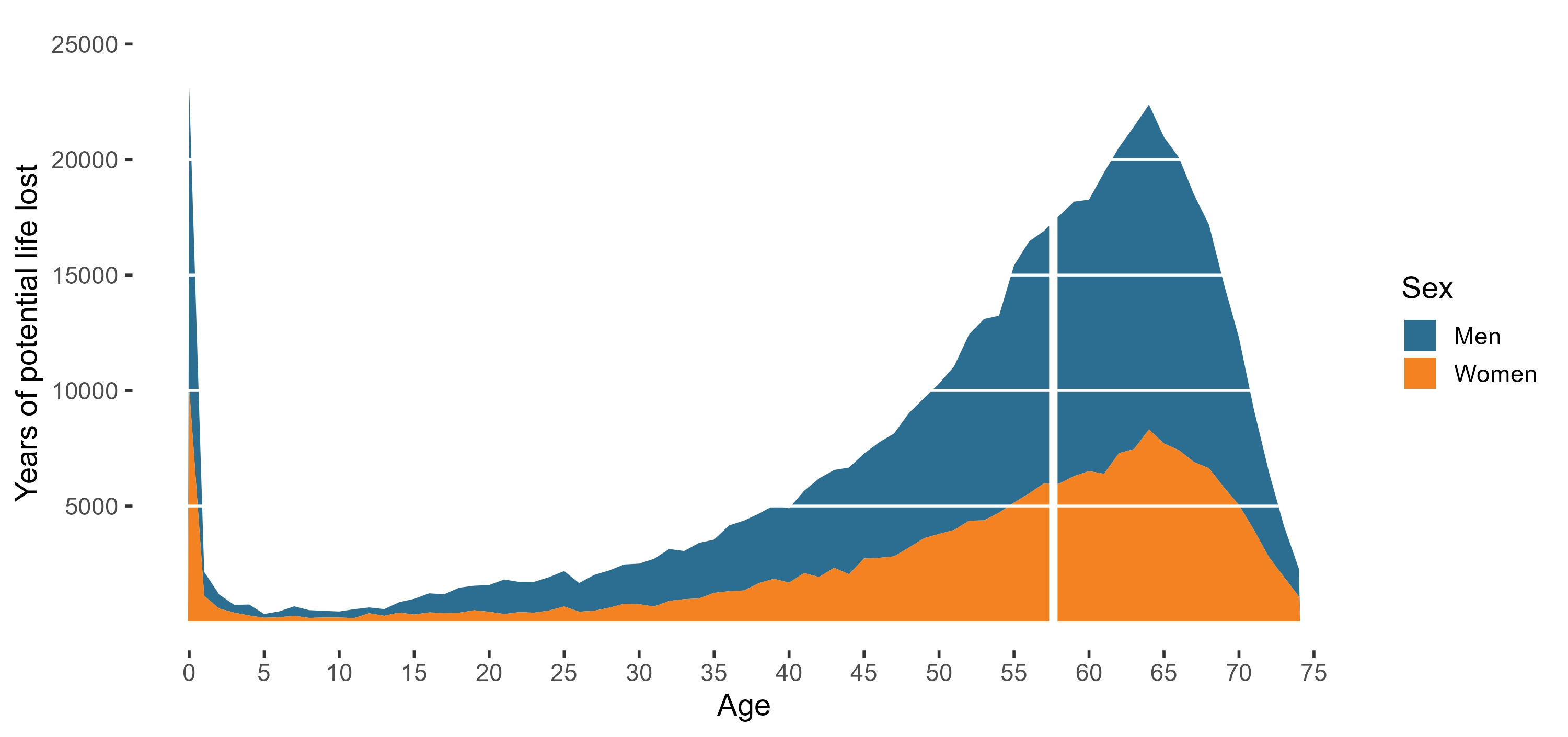
In Serbia in the pre-pandemic three-year period (2017-2019) there were approximately 102,000 deaths annually, including about 42,000 deaths before the age of 75. Almost 27,000 deaths annually fell within the avoidable category: roughly one quarter of all deaths and nearly two thirds of premature deaths. During 2017–2019, Serbia lost more than 330,000 years of potential life (YPLL) annually due to avoidable causes of death. Considering all causes of death before the age of 75, annual YPLL totaled approximately at 540,000, with more than half occurring below the age of 58 (Figure 1). These are substantial losses among people of working age, including people with considerable experience.
Figure 1. Distribution of lost years of potential life by sex and age (2017-2019 three-year average)
Source: (Galjak, 2023)
2 Resources Going into Birth Subsidies
Based on 2024 vital statistics, the parental allowance is estimated to be almost 0.5 billion EUR (Table 1). For reference, entire Serbian government expenditure for 2024 was around 20 billion EUR, meaning that the cost of this population policy per one cohort represents 2.5%1 of the annual Republic of Serbia budget expenditures (Ministry of Finance of the Republic of Serbia, 2025) which shows a real commitment. The question, however, is whether these resources are well spent and what the opportunity costs involved are.
| Birth order | Live births | Total per child (RSD) | Total per child (EUR) | Cohort total (RSD) | Cohort total (EUR) | Share (%) |
|---|---|---|---|---|---|---|
| First | 27,459 | 507,500 | 4333.9 | 13,935,442,500 | € 119,004,633 | 24.0 |
| Second | 21,116 | 742,500 | 6340.7 | 15,678,630,000 | € 133,890,948 | 27.0 |
| Third | 8,578 | 2,422,500 | 20687.4 | 20,780,205,000 | € 177,456,917 | 35.8 |
| Fourth | 2,399 | 3,187,500 | 27220.3 | 7,646,812,500 | € 65,301,559 | 13.2 |
| Total | 59,552 | 58,041,090,000 | € 495,654,057 | 100.0 | ||
| Note. Author’s calculations from the Statistical Office of the Republic of Serbia (2025) and Law on Financial Support to Families with Children (Zakon o finansijskoj podršci porodici sa decom, 2017). Base allowances for the first to fourth child are RSD 500,000; 600,000; 2,280,000; and 3,180,000. RSD 135,000 is added for the second and third child and RSD 7,500 for equipment at each order. The 1,290 fifth and subsequent births and three births of unknown order are excluded. For RSD to EUR conversion, mean exchange rate for 2024 of 117.1 was used. | ||||||
3 Effectiveness of Subsidizing Births
The 2022 census showed that completed cohort fertility keeps steadily declining, largely due to rising childlessness and declining progression to second birth, with increases in higher-order births being insufficient to offset the decline (Nikitović & Magdalenić, 2024). As the third- and fourth-order births account for 49% of the estimated entitlements (Table 1), the question is whether the distribution of expenditure corresponds to the demographic processes the policy seeks to influence.
While there is an uptick in tempo-adjusted total fertility rate (Figure 2) after the expansion of the abovementioned policy (2018), the gains are meager and in line with fluctuations in the previous period which oscillated between 1.61 and 1.77 children per woman in the previous two decades when looking at a five-year average. While this is not definitive evidence that the policy failed (we do not know the counterfactual), it represents some evidence that fits with what has already been established: cash payments for births have limited effectiveness in raising fertility sustainably, with the observed increases often reflecting changes in birth timing (Bergsvik et al., 2021; Sobotka et al., 2019).
Figure 2. Total fertility rates in Serbia, 2002–2024: annual values, centered five-year averages.
Note. Points show annual values; solid grey and dashed black lines show centered five-year averages for TFR and tempo-adjusted TFR, respectively. Tempo-adjusted TFR was calculated from the SORS data using a grouped-age implementation of the Bongaarts & Feeney (1998) adjustment. Each average uses five complete years (t−2 to t+2), covering 2004–2022 for both series. Means and ranges summarize these plotted averages; subscript years identify the center year of each minimum or maximum. The 2002 and 2024 tempo-adjusted estimates use one-sided changes in mean maternal age. Annual values are given in Table A1 in the appendix. Sources: Statistical Office of the Republic of Serbia (2011, 2026), and author’s calculations in R. Full source references, table and page details, data, and R code are provided in the repository identified in the Data Availability Statement.
An argument can be made that this policy serves a social purpose, with significant cash transfer that can help those in greatest need. With the minimum wage in Serbia being at around 400 EUR in 2024 (Odluka o visini minimalne cene rada za period januar-decembar 2024. godine, 2023), there was a need for such support. But if this were the purpose, its universal nature means the same amount goes to everyone, those struggling to put food on the table and those earning many multiples of minimum wage.
4 What Could Be Done Instead?
Serbia continues to have one of the highest levels of treatable mortality in Europe (Eurostat, 2026). As opposed to pronatalist measures that are relying on costly cash transfers of uncertain effectiveness, when it comes to fighting premature mortality there are proven policy interventions that lower the levels of premature mortality (World Health Organization, 2024), which are comparatively inexpensive (Table 2). Estimating the costs and effects of each intervention in Serbia would require a separate study.
| Cause | Specific interventions | Rationale |
|---|---|---|
| Neoplasms |
Increase tobacco excise taxes and prices (<I$100). Implement large graphic health warnings on all tobacco packages, accompanied by plain or standardized packaging (<I$100). Enact and enforce comprehensive bans on tobacco advertising, promotion and sponsorship (<I$100). Eliminate exposure to second-hand tobacco smoke in all indoor workplaces, public places and public transport (<I$100). Implement effective mass-media campaigns explaining the harms of tobacco use and second-hand smoke and encouraging behavior change (<I$100). Provide cost-covered, population-wide tobacco cessation support, including brief advice, toll-free quitlines and mobile cessation services (<I$100). |
Lung cancer and COPD accounted for 48,518 and 10,216 YPLL annually, respectively, in Serbia during 2017–2019. Tobacco control also addresses ischemic heart disease and stroke, extending its relevance across several major causes of premature mortality. |
|
Expand HPV vaccination among girls aged 9–14 years (<I$100). Expand HPV-DNA cervical screening linked to treatment (<I$100). |
Cervical cancer accounted for 6,289 YPLL and 368 deaths before age 75 annually. | |
| Link early breast and colorectal cancer diagnosis to timely treatment (I$100–500 for each). | Breast and colorectal cancer accounted for 15,197 and 16,983 YPLL annually, respectively and 32,180 combined. | |
| Circulatory diseases | Treat hypertension and provide risk-based antihypertensive/statin therapy (I$500–1,000 for each). | Avoidable deaths from circulatory diseases accounted for 96,292 YPLL annually, the second-largest cause group. Acute myocardial infarction, acute stroke, and hypertensive diseases accounted for 27,878, 26,743, and 17,881 YPLL, respectively. |
| External causes |
Increase excise taxes on alcoholic beverages (<I$100). Ban or comprehensively restrict alcohol advertising across media (I$100–500). Restrict retail alcohol sales hours (I$100–500). |
Avoidable external causes of death accounted for 47,654 YPLL annually, the third-largest cause group, including 13,455 YPLL from transport accidents. The alcohol-attributable share was not estimated. |
|
Note. Parentheses report WHO’s modelled cost per healthy life-year gained (a higher bar than YPLL) in international dollars (I$) for upper-middle-income countries and do not represent Serbia-specific estimates.
Sources: (Galjak, 2022, pp. 37–48; World Health Organization, 2024). |
||
Reducing premature mortality should be an explicit population-policy objective, with measurable targets and regular reporting. Investment in health can mean both fewer premature deaths and a better quality of life which has intrinsic value beyond premature mortality quantification. Nevertheless, there is a political reality in play, as subsidizing births is popular with voters. Politicians have little incentive to tackle smoking, as more than 40% (World Health Organization, 2023) of voters are themselves smokers (who would presumably react badly to anti-smoking policies) and the tobacco excise tax alone brings 1.33 billion EUR in revenue in 2025 (Državna revizorska institucija, 2026), a number not including VAT, and other revenue coming from the industry. A more realistic path forward could be a compromise solution, with gradual but firm and enforced antismoking measures and an updated parental allowance with different amounts and a revised structure, targeted at those who really need it. This could be politically framed as a refocus rather than giving up on addressing insufficient births.
A leaky bucket analogy comes to mind when thinking about Serbia’s population. The existing policy directs resources into birth subsidies, while at the same time ignoring the holes through which people are lost to avoidable mortality and emigration. It makes little sense to spend 0.5 billion EUR for each cohort to affect inflow without fixing the outflows. Even if there were evidence of the existing subsidies working (which so far there is little), the gains would be reduced by every death of a working-age person that could have been avoided and by every departure that could have been discouraged by better living conditions. A better approach to population policy would include keeping the people already here alive and giving them reasons to stay.
Data availability statement
All the data and code necessary for the analysis and visualizations are available in an open repository located at https://doi.org/10.6084/m9.figshare.33801157
Generative AI declaration
I used large language models during the preparation of this work for: literature and data search, text editing and organizing original code from my dissertation and coding new analysis and visualization. For all these purposes I used Codex and Claude Code with following models: GPT-5.6 Sol, GPT-6 Astra, Claude Opus 4.6 and Claude Opus 5.
References
- Bergsvik, J., Fauske, A., & Hart, R. K. (2021). Can Policies Stall the Fertility Fall? A Systematic Review of the (Quasi‐) Experimental Literature. Population and Development Review, 47(4), 913-964. https://doi.org/10.1111/padr.12431
- Bongaarts, J., & Feeney, G. (1998). On the Quantum and Tempo of Fertility. Population and Development Review, 24(2), 271-291. https://doi.org/10.2307/2807974
- Državna revizorska institucija. (2026). Završni račun budžeta Republike Srbije za 2025. godinu. https://dri.rs/izvestaj/15923
- Eurostat. (2026). Preventable and treatable mortality statistics. https://web.archive.org/web/20260910064911/https://ec.europa.eu/eurostat/statistics-explained/index.php?title=Preventable_and_treatable_mortality_statistics
- Galjak, M. (2022). Prevremeni Mortalitet U Srbiji [Doktorska Disertacija]. https://bgteze.phaidrabg.rs/application/showtheses?thesesId=8954
- Galjak, M. (2023). Assessing premature mortality in Serbia: Insights from the Median Age of Years of Life Lost. Demografija, 20, 69-84. https://doi.org/10.5937/demografija2320069g
- Ministry of Finance of the Republic of Serbia. (2025). Public Finance Bulletin: July 2025 (Nos. 1452-0028). https://www.mfin.gov.rs/en/activities/bulletin-public-finances-july-2025-2
- Nikitović, V., & Magdalenić, I. (2024). Rodne razlike u obrascima kohortnog fertiliteta u Srbiji: uloga obrazovnog gradijenta. Stanovnistvo, 62(S1), S5-S35. https://doi.org/10.59954/stnv.627
- Odluka o visini minimalne cene rada za period januar-decembar 2024. godine (2023). Službeni glasnik Republike Srbije, br. 79/2023. https://pravno-informacioni-sistem.rs/eli/rep/sgrs/vlada/odluka/2023/79/1/reg
- Rašević, M., & Galjak, M. (2022). Demographic Challenges in Serbia. In E. Manić, V. Nikitović, & P. Djurović (Eds.), The Geography of Serbia: Nature, People, Economy (pp. 143-155). Springer International Publishing. https://doi.org/10.1007/978-3-030-74701-5_11
- Rašević, M., & Galjak, M. (2024). Serbia: Policy Response to Demographic Challenges. In K. N. Zafeiris, B. Kotzamanis, & C. Skiadas (Eds.), Population Studies in the Western Balkans (pp. 153-178). Springer International Publishing. https://doi.org/10.1007/978-3-031-53088-3_7
- Sobotka, T., Matysiak, A., & Brzozowska, Z. (2019). Policy responses to low fertility: How effective are they?. United Nations Population Fund. https://www.unfpa.org/publications/policy-responses-low-fertility-how-effective-are-they
- Statistical Office of the Republic of Serbia. (2011). Demographic yearbook in the Republic of Serbia, 2010 (Table 2-11). https://publikacije.stat.gov.rs/G2011/Pdf/G20114003.pdf
- Statistical Office of the Republic of Serbia. (2025). Vitalni događaji, 2024. [Vital events, 2024]. https://publikacije.stat.gov.rs/G2025/HtmlL/G20251174.html
- Statistical Office of the Republic of Serbia. (2026). Vital statistics, 2025. https://publikacije.stat.gov.rs/G2026/HtmlE/G20261177.html
- Stjepanović, J. (2026). Roditeljski dodatak rekordan, ali povećanja nataliteta zasad nema. Biznis.Rs. https://biznis.rs/vesti/srbija/roditeljski-dodatak-rekordan-ali-povecanja-nataliteta-zasad-nema/
- World Health Organization. (2023). WHO report on the global tobacco epidemic, 2023: Country profile: Serbia. https://cdn.who.int/media/docs/default-source/country-profiles/tobacco/gtcr-2023/tobacco-2023-srb.pdf?download=true&sfvrsn=e361aebd_3
- World Health Organization. (2024). Tackling NCDs: best buys and other recommended interventions for the prevention and control of noncommunicable diseases. https://www.who.int/publications/i/item/9789240091078
- Zakon o finansijskoj podršci porodici sa decom (2017). Službeni glasnik Republike Srbije, br. 113/2017, 50/2018, 46/2021 – odluka US, 51/2021 – odluka US, 53/2021 – odluka US, 66/2021, 130/2021, 43/2023 – odluka US, 62/2023, 11/2024 – odluka US i 79/2024. https://www.paragraf.rs/propisi/zakon-o-finansijskoj-podrsci-porodici-sa-decom.html
Footnotes
- Second-child allowances are paid over 24 months; third- and fourth-child allowances over 120 months. The actual expenditure for 2024 was 0.33 billion EUR (Stjepanović, 2026), and it will keep rising toward the cohort figure as older entitlements are replaced by ones set at current levels.
APPENDIX
| Year | TFR | Tempo-adjusted TFR |
|---|---|---|
| 2002 | 1.57 | 1.67 |
| 2003 | 1.59 | 1.79 |
| 2004 | 1.57 | 1.69 |
| 2005 | 1.45 | 1.55 |
| 2006 | 1.43 | 1.70 |
| 2007 | 1.38 | 1.67 |
| 2008 | 1.41 | 1.83 |
| 2009 | 1.44 | 1.90 |
| 2010 | 1.41 | 1.75 |
| 2011 | 1.40 | 1.67 |
| 2012 | 1.45 | 1.65 |
| 2013 | 1.43 | 1.64 |
| 2014 | 1.47 | 1.76 |
| 2015 | 1.46 | 1.69 |
| 2016 | 1.46 | 1.59 |
| 2017 | 1.49 | 1.71 |
| 2018 | 1.48 | 1.68 |
| 2019 | 1.52 | 1.57 |
| 2020 | 1.48 | 1.48 |
| 2021 | 1.52 | 1.66 |
| 2022 | 1.63 | 1.87 |
| 2023 | 1.61 | 1.76 |
| 2024 | 1.63 | 1.81 |
| 2025 | 1.62 | NA |
|
Note. Rates are children per woman, rounded to two decimal places. TFR is the published total fertility rate. Tempo-adjusted TFR is the author’s grouped-age Bongaarts–Feeney estimate, calculated in R from SORS yearbook data. The 2002 and 2024 adjustments use one-sided changes in mean maternal age; 2003–2023 use centered changes. NA = not available. All years exclude Kosovo and Metohija. The census-related changes in population estimates in 2011 and 2022 may affect comparability.
Sources: Statistical Office of the Republic of Serbia (2011, 2026) and other volumes of Demografska statistika; author’s calculations. Data, R code, and individual yearbook references: https://doi.org/10.6084/m9.figshare.33801157 Method: Bongaarts & Feeney (1998) |
||
Article Details
Published by the Institute of Social Sciences - Center for Demographic Research




References
Bergsvik, J., Fauske, A., & Hart, R. K. (2021). Can Policies Stall the Fertility Fall? A Systematic Review of the (Quasi‐) Experimental Literature. Population and Development Review, 47(4), 913-964. https://doi.org/10.1111/padr.12431 DOI: https://doi.org/10.1111/padr.12431
Bongaarts, J., & Feeney, G. (1998). On the Quantum and Tempo of Fertility. Population and Development Review, 24(2), 271-291. https://doi.org/10.2307/2807974 DOI: https://doi.org/10.2307/2807974
Državna revizorska institucija. (2026). Završni račun budžeta Republike Srbije za 2025. godinu. https://dri.rs/izvestaj/15923
Eurostat. (2026). Preventable and treatable mortality statistics. https://web.archive.org/web/20260910064911/https://ec.europa.eu/eurostat/statistics-explained/index.php?title=Preventable_and_treatable_mortality_statistics
Galjak, M. (2022). Prevremeni Mortalitet U Srbiji [Doktorska Disertacija]. https://bgteze.phaidrabg.rs/application/showtheses?thesesId=8954
Galjak, M. (2023). Assessing premature mortality in Serbia: Insights from the Median Age of Years of Life Lost. Demografija, 20, 69-84. https://doi.org/10.5937/demografija2320069g DOI: https://doi.org/10.5937/demografija2320069G
Ministry of Finance of the Republic of Serbia. (2025). Public Finance Bulletin: July 2025 (Nos. 1452-0028). https://www.mfin.gov.rs/en/activities/bulletin-public-finances-july-2025-2
Nikitović, V., & Magdalenić, I. (2024). Rodne razlike u obrascima kohortnog fertiliteta u Srbiji: uloga obrazovnog gradijenta. Stanovnistvo, 62(S1), S5-S35. https://doi.org/10.59954/stnv.627 DOI: https://doi.org/10.59954/stnv.627
Odluka o visini minimalne cene rada za period januar-decembar 2024. godine (2023). Službeni glasnik Republike Srbije, br. 79/2023. https://pravno-informacioni-sistem.rs/eli/rep/sgrs/vlada/odluka/2023/79/1/reg
Rašević, M., & Galjak, M. (2022). Demographic Challenges in Serbia. In E. Manić, V. Nikitović, & P. Djurović (Eds.), The Geography of Serbia: Nature, People, Economy (pp. 143-155). Springer International Publishing. https://doi.org/10.1007/978-3-030-74701-5_11 DOI: https://doi.org/10.1007/978-3-030-74701-5_11
Rašević, M., & Galjak, M. (2024). Serbia: Policy Response to Demographic Challenges. In K. N. Zafeiris, B. Kotzamanis, & C. Skiadas (Eds.), Population Studies in the Western Balkans (pp. 153-178). Springer International Publishing. https://doi.org/10.1007/978-3-031-53088-3_7 DOI: https://doi.org/10.1007/978-3-031-53088-3_7
Sobotka, T., Matysiak, A., & Brzozowska, Z. (2019). Policy responses to low fertility: How effective are they?. United Nations Population Fund. https://www.unfpa.org/publications/policy-responses-low-fertility-how-effective-are-they
Statistical Office of the Republic of Serbia. (2011). Demographic yearbook in the Republic of Serbia, 2010 (Table 2-11). https://publikacije.stat.gov.rs/G2011/Pdf/G20114003.pdf
Statistical Office of the Republic of Serbia. (2025). Vitalni događaji, 2024. [Vital events, 2024]. https://publikacije.stat.gov.rs/G2025/HtmlL/G20251174.html
Statistical Office of the Republic of Serbia. (2026). Vital statistics, 2025. https://publikacije.stat.gov.rs/G2026/HtmlE/G20261177.html
Stjepanović, J. (2026). Roditeljski dodatak rekordan, ali povećanja nataliteta zasad nema. Biznis.Rs. https://biznis.rs/vesti/srbija/roditeljski-dodatak-rekordan-ali-povecanja-nataliteta-zasad-nema/
World Health Organization. (2023). WHO report on the global tobacco epidemic, 2023: Country profile: Serbia. https://cdn.who.int/media/docs/default-source/country-profiles/tobacco/gtcr-2023/tobacco-2023-srb.pdf?download=true&sfvrsn=e361aebd_3
World Health Organization. (2024). Tackling NCDs: best buys and other recommended interventions for the prevention and control of noncommunicable diseases. https://www.who.int/publications/i/item/9789240091078
Zakon o finansijskoj podršci porodici sa decom (2017). Službeni glasnik Republike Srbije, br. 113/2017, 50/2018, 46/2021 – odluka US, 51/2021 – odluka US, 53/2021 – odluka US, 66/2021, 130/2021, 43/2023 – odluka US, 62/2023, 11/2024 – odluka US i 79/2024. https://www.paragraf.rs/propisi/zakon-o-finansijskoj-podrsci-porodici-sa-decom.html