
Perspectives of AI in empowering persons with disabilities in Serbia
Article Sidebar
Main Article Content
Abstract
The integration of artificial intelligence (AI) into assistive technologies represents a transformative advancement in enhancing the quality of life for persons with disabilities. This paper explores the multifaceted applications of AI, from aiding daily activities and providing personalized medical care, to improving social and emotional well-being. By examining AI-powered tools such as text readers, robotic assistants, and communication aids, the study highlights how these technologies facilitate independence and better healthcare outcomes. A survey from 2022 focusing on Serbia explores how many basic digital literate persons with disabilities use AI-based communication aids, and how many are aware that AI is following their everyday activities. The study reveals a possibility of future high usage rates and positive impacts on persons with disabilities in Serbia. About 24.32% of them already utilize AI-based communication tools, mostly audio and text processing tools. In this paper we underscore AI’s potential to foster inclusivity and independence, which is an important topic that should be emphasized in the society today.
1 INTRODUCTION
The use of devices and machines with embedded artificial intelligence (AI) for the purpose of improving the quality of life for persons with disabilities and elderly individuals is an exemplary instance of the humane, ethical, and socially acceptable use of innovative technologies. Developed assistive technologies based on artificial intelligence aim to ensure independent living for individuals with disabilities. Utilizing AI-based assistive technologies for the needs of persons with disabilities represents a synergy between human and artificial intelligence, rather than a substitution of human intelligence with artificial one. Implants, aids, text readers, eye movement detectors, electromyography muscle movement detectors, robot assistants, and similar tools are utilized for this purpose.
According to the World Health Organization, about 1.3 billion people worldwide are living with disabilities, which accounts for approximately 16% of the global population (World Health Organization 2022). The fact that populations are aging in developed countries further emphasizes the need for a thorough examination of the opportunities, as well as risks associated with integrating AI into the care and provision of medical services for such a significant portion of the population. Google, Microsoft, Apple, Amazon and other corporate conglomerates, as well as a great number of startup companies are working separately on developing new solutions for acquiring new abilities, which could be of significant help for persons with disabilities (Kumar et al. 2024;Chakraborty et al. 2023). Those increasingly sophisticated approaches could tackle multifaceted obstacles experienced by persons with disabilities in a new way (Kumar et al. 2024). The development of AI-based technologies like voice assistants, with Siri and Alexa being the most popular ones, and the advancement of speech recognition applications and text readers, facilitates communication for individuals with speech or mobility impairments, as well as for those who are blind or visually impaired (Pekar 2010;Delić et al. 2014). Beyond verbal and textual interaction, AI enables control of household devices through voice commands and gestures, making daily activities easier for persons with disabilities, thus enhancing their independence.
There is a high frequency of using the Internet among basic digital literate persons with disabilities in Serbia, and a large number consider Internet content to be well-adapted, and use phones for communication (Masliković and Tomić 2024). All of this indicates that those persons have high access to communication content on the Internet that incorporates AI. AI applications are now incorporated into numerous online digital services. These individuals may be using such applications without being aware of it, as not all applications notify users of their AI integration. Even if a person doesn`t use AI applications, using the Internet at least provides an opportunity to utilize AI applications, which may prove significant in overcoming a person`s impairments in the future. In this paper, the potential of AI applications and robots in improving the quality of life for persons with disabilities is being explored, supplemented with data on the usage of AI-based communication aids by persons with disabilities in Serbia, and on familiarity with AI as a background for these persons’ Internet activities. Data was collected in the second half of 2022 using an online questionnaire. The tendency was to answer the following research questions, keeping in mind that AI applications are in the background of the Internet content analyzing and ranking.
RQ1: Do basically digitally literate (BDL) persons with disabilities in Serbia use AI-based communication aids?
RQ2: What is the perspective of the AI-based communication aids usage by persons with disabilities?
RQ3: How familiar are BDL persons with disabilities with the background of their Internet content analyzing and ranking?
2 NEW ABILITIES FOR PERSONS WITH DISABILITIES
The numerous aspects in which AI-powered applications and robots are beneficial to the elderly and persons with disabilities can be classified into two categories. The first category of assistance includes patient care and medical services for those in need. The second category encompasses tools aimed to compensate for the lack of ability caused by illnesses or disability that prevent individuals from professional achievement, engaging in culture in their free time, having social life and achieving emotional relationships.
2.1 MEDICAL CARE AND TREATMENT
Robots with implemented artificial intelligence are being used in medicine and care as therapists or patient assistants (Borovac et al. 2022). Their presence is particularly beneficial for individuals with various types of disabilities, with the most significant application seen in patients with neurodegenerative pathologies such as Parkinson’s disease, Alzheimer’s disease, multiple sclerosis, etc. (Devillers 2021). The need for an intelligent assistant is also evident when it comes to blind or visually impaired individuals, as well as those with physical (motor) or cognitive disabilities. AI can take care of patients by analyzing their health data, monitoring their health status, and identifying potential issues. It can recognize individual needs in terms of treatment and prescription of therapy, providing personalized care and recommendations (Padhan et al. 2023). In addition to saving time and resources, such parameter monitoring influences timely response and efficient control of the therapy’s effects (Padhan et al. 2023). Based on the analysis of individual characteristics, AI can recommend personalized therapies and treatments, using an algorithm to identify the optimal medication dosage based on specific patient’s needs. For individuals with disabilities who often have multiple associated conditions, personalized monitoring can facilitate treatment and improve the quality of life.
AI has the ability to analyze vast amounts of health-related data, including the data on vital functions, as well as the data on habits, namely movement and sleep patterns. Continuous monitoring of data sets can lead to revealing potential problems in early stages. Identifying risk factors and providing recommendations for disease prevention or complications, speak of the significant role of AI in disease prevention and early symptom detection. Its analysis can identify potential development of certain diseases, as well as worsening of the conditions, thus enabling timely intervention and risk reduction.
Devices with embedded AI software are widely used to collect and process heart function parameters in particular pulse and blood pressure, automatically analyze the data, and generate reports. Their use leads to therapy individualization and treatment optimization (Padhan et al. 2023). AI can automatically detect symptoms or changes in acute conditions and injuries, such as falls in heart pace or changes in rhythm, and then automatically notify responsible individuals or services. For elderly individuals living alone and people with disabilities lacking regular access to healthcare professionals, this function provides security (Abedi et al. 2024).
In the case of elderly individuals who depend on the care and assistance of others, artificial intelligence can be implemented not only as a technological aid in delivering therapy, which reminds them of their daily tasks, while measuring, analyzing, and evaluating daily, monthly, and yearly health parameters, but also as an assistant that can influence the improvement of the psychological state of a person. Participating in conversations, answering questions, evoking memories as a mechanism for memory refreshment, contacting family and friends, providing companionship during leisure time, and other similar functions are valuable tools that can compensate for the lack of social component presence. New robots have the abilities to do these things. The second category of AI benefits for persons with disabilities could be implemented in several aspects of everyday life and basic needs.
2.1.1 Education and culture
AI simplifies the customizing of education and personalization of learning, as well as adaptation of cultural content. It can adjust educational resources and enable learning accessibility for individuals with various disabilities. Used for analyzing individual needs and preferences, it provides personalized educational resources (Kulikov and Shirokova 2021;Tomić and Radovanović 2024). The level of tasks and learning pace can be customized to match the specific abilities of individuals with disabilities. Inclusive educational tools and assistive AI technologies, such as speech recognition or text-to-speech communication technologies, facilitate access to educational resources and learning for individuals with disabilities.
Artificial intelligence also plays a significant role in adapting and selecting cultural content for individuals with disabilities and the elderly. The use of AI in libraries enables staff and policy makers to identify topics, articles and literature that are suitable and accessible for persons with disabilities (Vasishta et al. 2024). Persons with disabilities have benefits of advanced technologies in daily life for various tasks, including education, culture and leisure (Kadijevich et al. 2016;Kadijevich et al. 2020;Kadijevich et al. 2022). AI can recommend personalized cultural content, such as books, movies, based on individuals’ interests, catering to the elderly population, and utilize digital resources to create virtual tours through museums or cultural monuments, providing access to these sites for individuals with limited mobility (Masliković 2023; Masliković et al. 2023). AI is used to automatically generate subtitles, transcripts, or audio descriptions for movies, theater performances, museum exhibitions, and other cultural content, making them accessible to individuals with impaired hearing and vision.
The goal of using AI in culture and education is to provide specialized services and optimization of the use of limited resources. This implies that library services should include technical and public services that use intelligent systems in order to provide acceptable and accessible services to everyone (Asemi et al. 2021).
2.1.2 Social and Emotional Aspect
Beyond the capability to execute specific tasks on behalf of humans, an AI robot designed for such purposes must possess developed sophisticated social skills, as well as the capacity for emotional engagement. Therefore, the development of AI therapeutic assistants and patient monitoring assistants belongs to social and emotional robotics, where emotional AI represents systems capable of accessing and processing emotional data (Gremsl and Hödl 2022). The application of emotional AI is extensive, with examples including the recognition of drivers’ emotions in autonomous vehicles, voice analytics in call centers, market analysis, applications for wellness, dating, security, and beyond (Gremsl and Hödl 2022;McStay 2018). With the aim of enabling robots to comprehend emotions and interpret human behavior, mechanisms have been researched in laboratories to allow AI to recognize emotions, facial expressions, gestures, and overall patient mood. The research has identified three primary areas that require focused development: emotion detection and interpretation, emotion generation and synthesis, and understanding emotional information in dialogue (McStay 2018).
The socio-emotional aspect of utilizing robots for care and medical services also speaks to the need for robots to acquire a human-like form, encompassing human movements, facial expressions, appearance, and motor functions (Milosavljević et al. 2022). The development of AI is progressing towards creating sophisticated autonomous machines that would speak and recognize emotions, although lacking instincts or intentions to initiate decision-making. Cognitive neuroscience serves as a foundation for research in machine learning, and advancements in computer science. The interaction between patients and robots is of immense significance for the progress of artificial intelligence and machine learning. For example, difficulties in recognizing emotions that are present in autism have been useful while building a role model for recognizing emotions by machine (Nagy 2024). Employing robots in the care for vulnerable groups, as well as in assisting the elderly and persons with disabilities, significantly impacts the progress of robotics, opening new perspectives in AI development and adding a dimension to the role of robots which is learning to live within a community.
3 PERSONS WITH DISABILITIES AND AI IN SERBIA
The prerequisite for having AI benefits in the categories and aspects of life needs mentioned in the paper is that it is available and used. In order to determine the degree of use among the skilled, data have been collected from BDL persons with disabilities in Serbia, and subsequently analyzed.
In the 2022 population census conducted in Serbia, it was found that 5.46% of the population, totaling 356,404 individuals, are persons with disabilities (Statistical Office of the Republic of Serbia 2023), which included only persons with motor and sensory impairments. The largest number of them have difficulties with walking and climbing stairs, followed by those with vision impairments, hearing impairments, challenges with daily tasks such as clothing, taking food or personal hygiene, then with memory/concentration issues, while the lowest number of individuals face communication difficulties (Statistical Office of the Republic of Serbia 2023). In 2020, the Government of the Republic of Serbia adopted the Ethical Guidelines for the Development, Implementation, and Use of Reliable and Responsible Artificial Intelligence, in which, under paragraph The principles of non-harm and justice it is explicitly stated that special attention should be paid to protecting vulnerable categories, including elderly persons and persons with disabilities (Vlada Republike Srbije 2023). Our study focuses on the perspectives for everyday use of AI-based algorithms and technological aids by persons with disabilities in Serbia. We also investigate familiarity of persons with disabilities with the AI-based technologies for communication.
3.1 METHOD
We have used the study data from a survey held in 2022 across the Republic of Serbia, which included a convenient sample of 111 BDL respondents with physical and/or sensory disabilities aged 18 to 59. The data were collected through associations of people with disabilities, using the online questionnaire that had been sent to the respondents by the e-mail. We took a look at the collected data, bearing in mind the defined research questions RQ1, RQ2 and RQ3 concerning the usage of AI-based communication aids, its perspective, and familiarity with AI as a background for Internet activities.
3.2 RESULTS
3.2.1 Communication Aids
Of the 41 respondents that use communication aids, which represents about one third of all the respondents from the study, there are those that utilize speech-to-text and text-to-speech, as well as Tobii Communicator. Speech-to-text and text-to-speech are AI-based applications, while Tobii is an AI-based assistive communication aid. Additionally, they also stated to be using other forms of communication aids that we consider AI-based, as well as tablets, and applications on their mobile phones.
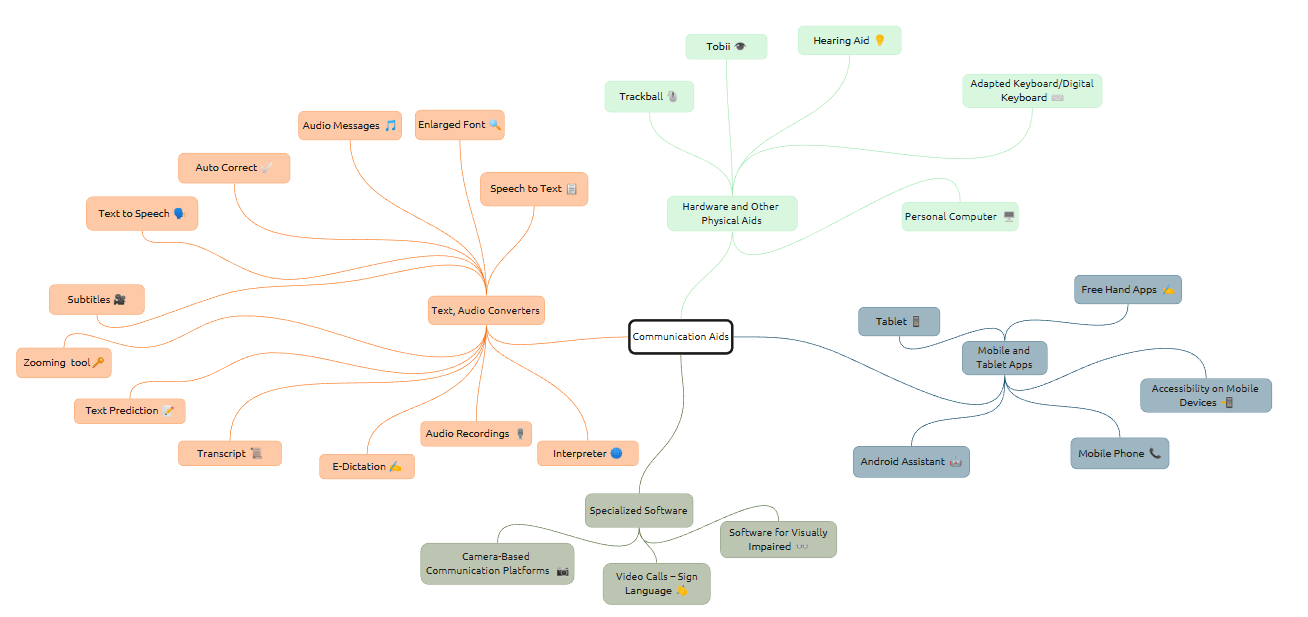
Knowing that the answers that were given concerning communication aids were diverse, and that there were 25 different answers, we have grouped them in order to reveal what kind of services and devices the respondents used. The groups have also been useful in finding out the ratio of AI involvement in each. We have grouped respondents’ answers concerning the service support and aids they used for communication into four groups according to the type of support – whether they were being used through touchscreen devices like tablet and mobile, or some other physically present device or aid, or they belonged to text and audio converters category, or a software specially developed for persons with disabilities. The groups include Text and audio converters, Mobile and tablet apps, Specialized software, and Hardware and other physical aids. Most of the answers could be classified into more than one group, of which we had to choose the most representative. The classification is shown in Figure 1.
Figure 1. Communication support and aids grouped into four categories.
The distribution of responses concerning the use of communication support and aids in each of these groups is presented in percentages, relative to the total number of respondents, in Figure 2 the text and audio converters prevail.
Figure 2. Percentage of persons that use support and aids in each group.
We determined the number of responses from each group representing AI-based support and aids. Considering that a large number of applications for tablets and mobile phones used in everyday life incorporate AI, we have observed the Mobile and Tablet Apps group as completely AI-based. In the Text and Audio Converters group, we have considered applications such as speech to text, text prediction, autocorrect, text to speech and subtitles to be AI-based, and font-enlarging applications not AI-based. When it comes to the Specialized Software group, the computer and Tobii are taken to be AI-based, while hearing aid, digital keyboard and trackball are not AI-based. In the Hardware and Other Physical Aids group, we have considered video call – sign language, software for the visually impaired, and application for high diopter to be AI-related, while Zoom and camera-based communication platforms have not been considered as such. Overall, of our four groups, one is marked as AI-based, and the other three as partially, with the perspective of becoming predominantly AI-based. Finding out the percentages for each group, provided in Table 1, we conclude that 65.85% out of all the positive answers for using communication aids have been AI-based. Concerning all the participants in the study, 24.32% of the respondents possess basic digital literacy in Serbia and use AI to compensate for their communication limitations.
| Group | Percentage of answers | Percentage of AI in group |
|---|---|---|
| Text and audio converters | 31.70% | 84.62% |
| Mobile and tablet apps | 26.83% | 100% |
| Specialized software | 12.20% | 60% |
| Hardware and other physical aids | 29.27% | 16.67% |
| Overall | 100% | 65.85% |
Since we have found that 65.85% of the participants that use services and aids utilize AI-based ones, it can be concluded that the majority of respondents who use services and aids utilize those that are AI-based.
Further on, we would like to assume the percentage of the answers that concern communication aids which have the perspective of becoming AI-based in the future. Knowing that there is a wide tendency of integrating AI software and robots in technological devices, it is easy to conclude that all of the considered services and aids will have integrated AI applications.
3.2.2 Familiarity with Personalization and Data Protection
An important aspect of machine learning and creating algorithms for the development of AI modules is data collection. For this purpose, respondents answered questions related to allowing the personalization of their future contents according to their data. In fact, the goal was to examine how satisfied they were with the data protection from misuse for marketing purposes and other actions that would threaten their identity and privacy.
Participants in the study rated the veracity of statements regarding data protection and personalization of social networks’ and media platforms’ contents. The statements were the following:
Statement I: I understand how social networks and media platforms rank my content.
Statement II: I understand the purpose of the “cookie policy”.
Statement III: I read the “cookie policy”.
Statement IV: I am familiar with the general provisions on data protection (GDPR) and the new provisions of the Law on the Protection of Personal Data.
We have made descriptive and inferential statistics for the answers, provided in Table 2, and presented the answers graphically in Figure 3.
| Statement | Descriptive statistics | Inferential statistics |
|---|---|---|
|
I understand how social networks and media platforms rank my content. |
completely disagree – 2.70% mostly disagree – 7.21% partially agree – 45.05% mostly agree – 36.04% completely agree – 9.01% Mean = 3.41 Variance = 0.74 Standard Deviation = 0.86 |
Chi-Square = 81.48 Critical Value = 9.488 Confidence Interval = [3.25, 3.58] p < 0.0001 |
|
I understand the purpose of the “cookie policy”. |
completely disagree – 0.90% mostly disagree – 19.82% partially agree – 45.05% mostly agree – 27.93% completely agree – 6.31% Mean = 3.19 Variance = 0.74 Standard Deviation = 0.86 |
Chi-Square = 68.95 Critical Value = 9.488 Confidence Interval = [3.03, 3.35] p < 0.0001 |
|
I read the “cookie policy”. |
completely disagree – 22.52% mostly disagree – 42.34% partially agree – 27.93% mostly agree – 4.50% completely agree – 2.70% Mean = 2.23 Variance = 0.89 Standard Deviation = 0.94 |
Chi-Square = 61.48 Critical Value = 9.488 Confidence Interval = [2.05, 2.40] p < 0.0001 |
|
I am familiar with the general provisions on data protection and the new provisions of the Law on Protection of Personal Data. |
completely disagree – 3.60% mostly disagree – 26.13% partially agree – 44.14% mostly agree – 19.82% completely agree – 6.31% Mean = 2.99 Variance = 0.86 Standard Deviation = 0.93 |
Chi-Square = 59.77 Critical Value = 9.488 Confidence Interval = [2.82, 3.17] p < 0.0001 |
Figure 3. Distribution of responses to statements I-IV.
Distribution of the responses concerning Statement I indicates a moderate level of awareness of how social networks and media platforms rank the participants’ content. The mean value of 3.41 suggests that most users have some level of understanding, but are not fully confident. The standard deviation (0.86) indicates a small dispersion. There is a 95% confidence that the true mean understanding level lies between 3.25 and 3.58, suggesting that the average response is between “partially agree” and “mostly agree.”
For Statement II, there is a moderate level of understanding what the cookie policy is used for, suggested by the mean value of 3.19, standard deviation of 0.86, and the confidence interval between 3.03 and 3.35.
Results for Statement III indicate that majority of the participants mostly do not read the cookie policy, with the mean value of 2.23, standard deviation of 0.94, and the confidence interval between 2.05 and 2.40.
When it comes to Statement IV, the responses imply a moderate level of familiarity with the general provisions on data protection and the new provisions of the Law on Protection of Personal Data, with the mean value of 2.99, standard deviation of 0.93, and the confidence interval between 2.82 and 3.17.
4 DISCUSSION
According to the data from our research, most persons with disabilities use exactly those communication aids that are linked to AI. The future of service support is even brighter, since we consider communication aids from all of the given answers as future AI integrated. Actually, the stated devices and products already have AI-integrated modalities, but these are not yet widely in use, or not used in Serbia which is under consideration here. Moreover, it is known that in the Western Balkans region, the AlfaNum text reader is widely used by blind and visually impaired individuals (Pekar 2010). Earlier studies also show that persons with disabilities recognize and quickly accept the possibilities of new technologies (Bigham & Carrington 2018). What’s more, compensating for the disadvantages faced by persons with disabilities is a challenge in technological development, and even its driver. The second part of the study refers to the person’s awareness of his or her exposure to the influence of AI-based algorithms that personalize content on the Internet based on an individual’s interests, needs, affinities and requests. For guiding user`s online experience, social media empower AI in different forms like machine learning, natural language processing, and deep learning, with incorporating various ranking signals that personalize and prioritize the content. The moderate level of awareness of how social networks and media platforms rank the participants’ content, and also of the purpose of the cookie policy, along with the finding that the cookie policy is not read much, while the respondents are moderately familiar with data protection provisions, suggests that the participants in the study are moderately familiar with the background of following and ranking their content. This result indicates that persons with disabilities are not sufficiently aware that they encounter AI, as well as that on the basis of their needs, requests, and affinities, AI personalizes content which has many potential applications, but also some far-reaching implications (Saheb et al. 2024).
Overcoming physical and sensory disabilities enables persons with disabilities to gain access to education, employment, inclusion, empowerment, social interaction and connection, to obtain information, participate in social life, and have the stigmatization and social prejudice reduced. It provides opportunities for formal and informal education and professional development for individuals with disabilities, which is a key factor in employment and professional advancement. Accessibility of education and informational content enhances these persons’ social integration, empowering them and giving them a sense of visibility in the society. The ability to communicate freely increases the interaction abilities, contributing to better connections with one’s family, friends, and society. Being well-informed facilitates participation in social life. All of this contributes to ultimately shaping a new image of persons with disabilities as active and competent members of the society, thereby reducing prejudices and social stigma. The progress in this field is transdisciplinary and requires collaboration between technological innovators, healthcare professionals, and user communities to ensure that AI serves everyone to the best of its ability. To utilize AI most effectively, it is essential to adhere to ethical principles in the development and integration of these technologies, and ensure access to all members of the society, including marginalized social groups.
5 CONCLUSION
Considering the possibilities provided by AI to the population of people with disabilities, it can be noted that its application represents a milestone in realizing the fundamental rights of persons with disabilities and building an inclusive society. Artificial intelligence presents a powerful tool for transforming the lives of persons with disabilities and the elderly, providing innovative solutions that enhance their independence, communication, quality of life, and healthcare outcomes. Its application in healthcare and social protection is characterized as advanced and personalized.
We concentrated on persons with disabilities in Serbia, and their familiarity with AI technologies. We showed the extent to which persons with disabilities were using AI-based technologies, either intentionally or not, what was the perspective of their use in terms of the needs of persons with disabilities in Serbia, and to what extent these persons were familiar with the involvement of AI algorithms in their daily use of the Internet. It has been found that more than one-third utilizes communication tools, with about one-fourth (24.32%) employing AI-based tools. Although this is a small number, the high Internet usage suggests them having the opportunity to utilize AI applications, which in future may prove significant for overcoming their impairments. By classifying the answers into four groups according to the type of aids they used, it was determined that the surveyed persons with disabilities used AI-based aids the most. This optimistic result indicates that persons with disabilities have recognized the possibilities of AI software, regardless of being really familiar with its underlying foundations.
In order to determine the extent to which persons with disabilities are aware of the involvement of AI algorithms in their daily use of the Internet, we have considered the respondents’ familiarity with the way content is ranked on social networks and media platforms and their interest in the cookie policy. It was taken into account that AI was involved in both processes, as well as that persons with disabilities declared that they most often used the Internet, social networks, and specialized platforms as sources of information. We found that most respondents were moderately familiar with the involvement of AI algorithms and data protection provisions, which indicates that BDL persons with disabilities are partially aware that AI lies in the background of their Internet content analyzing and ranking. In terms of the desire to engage with AI, this segment of the population’s extent of interest in this topic has been indicative.
Based on our results, it can be concluded that the use of AI by persons with disabilities in Serbia has a perspective, and that the predictions made in developed countries, that the use of AI by persons with disabilities would have a great impact, will also affect Serbia. The range of services that AI machines can provide to persons with disabilities indicates that meeting the needs of this population could be a driving force in the development of intelligent robots and applications.
The paper is supported by the Ministry of Science, Technological Development and Innovations of the Republic of Serbia within the research program of the University of Belgrade – Institute for Multidisciplinary Research (Contract No. 451-03-136/2025-03/200053) and of the Institute of Social Science. The authors would like to thank Aleksandar Bogdanović, Executive Director of The Inclusive Society Development Center.
Data availability statement
Data are available from the authors upon request.
References
- Abedi, A., Colella, T. J. F., Pakosh, M., & Khan S. S. (2024). Artificial intelligence-driven virtual rehabilitation for people living in the community: A scoping review. npj Digital Medicine, 7(25). https://doi.org/10.1038/s41746-024-00998-w
- Asemi, A., Ko, A., & Nowkarizi, M. (2021). Intelligent libraries: a review on expert systems, artificial intelligence, and robot. Library Hi Tech, 39 (2), 412–434. https://doi.org/10.1108/LHT-02-2020-0038
- Bigham, J. P., & Carrington, P. (2018). Learning from the Front: People with Disabilities as Early Adopters of AI. In Proceedings of the 2018 HCIC Human-Computer Interaction Consortium. https://www.cs.cmu.edu/~jbigham/pubs/pdfs/2018/ai-and-hci-people-with-disabilities-as-early-adopters.pdf (accessed 13. 9. 2024)
- Borovac, B., Raković, M., Nikolić, M., Delić, V., Savić, S., Penčić, M., & Mišković, D. (2022). Robotics as Assistive Technology for Treatment of Children with Developmental Disorders—Example of Robot MARKO. In M. Rackov, R. Mitrović, M. Čavić (Eds.), Machine and Industrial Design in Mechanical Engineering. KOD 2021 (pp. 69–76). Mechanisms and Machine Science, 109. Springer, Cham. https://doi.org/10.1007/978-3-030-88465-9_4
- Chakraborty, N., Mishra, Y., Bhattacharya, R., & Bhattacharya, B. (2023). Artificial Intelligence: The road ahead for the accessibility of persons with Disability. Materials Today: Proceedings, 80(3), 3757–3761. https://doi.org/10.1016/j.matpr.2021.07.374
- Delić, V., Sečujski, M., Vujnović Sedlar, N., Mišković, D., Mak, R., & Bojanić, M. (2014). How Speech Technologies Can Help People with Disabilities. In A. Ronzhin, R. Potapova, V. Delic (Eds.), Speech and Computer. SPECOM 2014 (pp. 243–250). Lecture Notes in Computer Science, 8773. Springer, Cham. https://doi.org/10.1007/978-3-319-11581-8_30
- Devillers, L. (2021). Human–Robot Interactions and Affective Computing: The Ethical Implications. In J. von Braun, M. S. Archer, G. M. Reichberg, M. Sánchez Sorondo, (Eds.), Robotics, AI, and Humanity (pp. 205–211). Springer, Cham. https://doi.org/10.1007/978-3-030-54173-6_17
- Gremsl, T., & Hödl, E. (2022). Emotional AI: Legal and ethical challenges. Information Polity, 27(2), 163–174. http://doi.org/10.3233/IP-211529
- Kadijevich, D. M., Masliković, D., & Tomić, B. M. (2020). Dataset regarding access to information for persons with disabilities in Serbia. Data in Brief, 32, 106309. https://doi.org/10.1016/j.dib.2020.106309
- Kadijevich, Dj. M., Masliković, D., & Tomić, B. M. (2022). Familiarity with state regulations regarding access to information for persons with disabilities in Serbia. International Journal of Disability, Development and Education, 69(5), 1715–1725. https://doi.org/10.1080/1034912X.2020.1802646
- Kadijevich, D., Odovic, G., & Maslikovic, D. (2016). Using ICT and Quality of Life: Comparing Persons with and Without Disabilities. In K. Miesenberger, C. Bühler, P. Penaz (Eds.), Computers Helping People with Special Needs. ICCHP 2016 (pp. 129–133). Lecture Notes in Computer Science, 9758. Springer, Cham. https://doi.org/10.1007/978-3-319-41264-1_18
- Kulikov, S. B., & Shirokova, A. V. (2021). Artificial intelligence, culture and education. AI & Society, 36, 305–318. https://doi.org/10.1007/s00146-020-01026-7
- Kumar, V., Barik, S., Aggarwal, S., Kumar, D., & Raj, V. (2024). The use of artificial intelligence for persons with disability: a bright and promising future ahead. Disability and Rehabilitation: Assistive Technology, 19(6), 2415–2417. https://doi.org/10.1080/17483107.2023.2288241
- Masliković, D. (2023). Culture of equality – Integration of persons with disabilities into the work of cultural institutions. Rad Muzeja Vojvodine, 65, 172–180. http://iriss.idn.org.rs/1822/1/M52%20D.%20Maslikovi%C4%87.%20%282023%29.pdf (accessed 30. 4. 2025)
- Masliković, D., & Tomić, B. (2024). Is there communication? Access to information by persons with disabilities in Serbia. Stanovništvo, 62(1), 153–166. https://doi.org/10.59954/stnv.563
- Masliković, D., Tomić, B. M., & Tomić, M. (2023). Inovativni alati za očuvanje i prezentaciju kulturnog nasleđa. In D. Bojović, K. Mitić (Eds.), Vizantijsko-slovenska čtenija VI (pp. 525–532). Niš: Međunarodni centar za pravoslavne studije, Centar za vizantijsko-slovenske studije Univerziteta u Nišu, Centar za crkvene studije. https://rimsi.imsi.bg.ac.rs/bitstream/handle/123456789/2189/525-532.pdf?sequence=1&isAllowed=y (accessed 30. 4. 2025)
- McStay, A. (2018). The Right to Privacy in the Age of Emotional AI. OHCHR. https://www.ohchr. org/sites/default/files/Documents/Issues/DigitalAge/ReportPrivacyinDigitalAge/Andrew McStayProfessor_of_Digital_Life,_BangorUniversityWalesUK.pdf (accessed 13. 9. 2024)
- Milosavljević, P., Masliković, D., & Grubišić Đ. (2022). Aspekti društvene implementacije veštačke inteligencije: stavovi i iskustva. In Tehnologija, kultura, razvoj: tematski zbornik radova XXIX naučnog skupa međunarodnog značaja "Tehnologija, kultura i razvoj", održan u Tivtu, Crna Gora, 29–31.8. 2022. godine (pp. 153–167). Beograd: Institut „Mihajlo Pupin“, Udruženje „Tehnologija i društvo“. http://iriss.idn.org.rs/1825/ (accessed 30. 4. 2025)
- Nagy, J. (2024). Autism and the making of emotion AI: Disability as resource for surveillance capitalism. New Media & Society, 26(7), 3989–4007. https://doi.org/10.1177/1461444822 1109550
- Padhan, S., Mohapatra, A., Ramasamy, S. K., & Agrawal, S. (2023), Artificial Intelligence (AI) and Robotics in Elderly Healthcare: Enabling Independence and Quality of Life. Cureus, 15(8), e42905. https://doi.org/10.7759/cureus.42905
- Pekar, D., Mišković, D., Knežević, D., Vujnović Sedlar, N., Sečujski, M., & Delić, V. (2010). Applications of Speech Technologies in Western Balkan Countries. In N. Shabtai (Ed.), Advances in Speech Recognition (pp. 105–122). SCIYO. http://dx.doi.org/10.5772/10113
- Saheb, T., Sidaoui, M., & Schmarzo, B. (2024). Convergence of artificial intelligence with social media: A bibliometric & qualitative analysis. Telematics and Informatics Reports, 14, 100146. https://doi.org/10.1016/j.teler.2024.100146
- Statistical Office of the Republic of Serbia (2023). Population according to disability status and type of problem of persons with disabilities. https://www.stat.gov.rs/en-US/vesti/20231201-invaliditet/?a=0&s=0102 (accessed 13. 9. 2024)
- Tomić, B. M., & Radovanović, N. D. (2024). Primena veštačke inteligencije u kontekstu obrazovnog sistema u Srbiji, s posebnim fokusom na religijsko obrazovanje. Sociološki pregled, 58(2), 435–459. https://doi.org/10.5937/socpreg58-48911
- Vasishta, P., Dhingra, N., & Vasishta, S. (2024). Application of artificial intelligence in libraries: a bibliometric analysis and visualisation of research activities. Library Hi Tech, ahead-of-print No. ahead-of-print. https://doi.org/10.1108/LHT-12-2023-0589
- Vlada Republike Srbije (2023). Etičke smernice za razvoj, primenu i upotrebu pouzdane i odgovorne veštačke inteligencije. Službeni glasnik Republike Srbije, 23/2023. http://demo.paragraf.rs/demo/combined/Old/t/t2023_03/SG_023_2023_007.htm (accessed 30. 4. 2025)
- World Health Organization (2022). Global Report on Health Equity for Persons With Disabilities. Geneva: World Health Organization. https://www.who.int/publications/i/item/9789240063600 (accessed 30. 4. 2025)
Article Details
Published by the Institute of Social Sciences - Center for Demographic Research




References
Abedi, A., Colella, T. J. F., Pakosh, M., & Khan S. S. (2024). Artificial intelligence-driven virtual rehabilitation for people living in the community: A scoping review. npj Digital Medicine, 7(25). https://doi.org/10.1038/s41746-024-00998-w DOI: https://doi.org/10.1038/s41746-024-00998-w
Asemi, A., Ko, A., & Nowkarizi, M. (2021). Intelligent libraries: a review on expert systems, artificial intelligence, and robot. Library Hi Tech, 39 (2), 412–434. https://doi.org/10.1108/LHT-02-2020-0038 DOI: https://doi.org/10.1108/LHT-02-2020-0038
Bigham, J. P., & Carrington, P. (2018). Learning from the Front: People with Disabilities as Early Adopters of AI. In Proceedings of the 2018 HCIC Human-Computer Interaction Consortium. https://www.cs.cmu.edu/~jbigham/pubs/pdfs/2018/ai-and-hci-people-with-disabilities-as-early-adopters.pdf (accessed 13. 9. 2024)
Borovac, B., Raković, M., Nikolić, M., Delić, V., Savić, S., Penčić, M., & Mišković, D. (2022). Robotics as Assistive Technology for Treatment of Children with Developmental Disorders—Example of Robot MARKO. In M. Rackov, R. Mitrović, M. Čavić (Eds.), Machine and Industrial Design in Mechanical Engineering. KOD 2021 (pp. 69–76). Mechanisms and Machine Science, 109. Springer, Cham. https://doi.org/10.1007/978-3-030-88465-9_4 DOI: https://doi.org/10.1007/978-3-030-88465-9_4
Chakraborty, N., Mishra, Y., Bhattacharya, R., & Bhattacharya, B. (2023). Artificial Intelligence: The road ahead for the accessibility of persons with Disability. Materials Today: Proceedings, 80(3), 3757–3761. https://doi.org/10.1016/j.matpr.2021.07.374 DOI: https://doi.org/10.1016/j.matpr.2021.07.374
Delić, V., Sečujski, M., Vujnović Sedlar, N., Mišković, D., Mak, R., & Bojanić, M. (2014). How Speech Technologies Can Help People with Disabilities. In A. Ronzhin, R. Potapova, V. Delic (Eds.), Speech and Computer. SPECOM 2014 (pp. 243–250). Lecture Notes in Computer Science, 8773. Springer, Cham. https://doi.org/10.1007/978-3-319-11581-8_30 DOI: https://doi.org/10.1007/978-3-319-11581-8_30
Devillers, L. (2021). Human–Robot Interactions and Affective Computing: The Ethical Implications. In J. von Braun, M. S. Archer, G. M. Reichberg, M. Sánchez Sorondo, (Eds.), Robotics, AI, and Humanity (pp. 205–211). Springer, Cham. https://doi.org/10.1007/978-3-030-54173-6_17 DOI: https://doi.org/10.1007/978-3-030-54173-6_17
Gremsl, T., & Hödl, E. (2022). Emotional AI: Legal and ethical challenges. Information Polity, 27(2), 163–174. http://doi.org/10.3233/IP-211529 DOI: https://doi.org/10.3233/IP-211529
Kadijevich, D. M., Masliković, D., & Tomić, B. M. (2020). Dataset regarding access to information for persons with disabilities in Serbia. Data in Brief, 32, 106309. https://doi.org/10.1016/j.dib.2020.106309 DOI: https://doi.org/10.1016/j.dib.2020.106309
Kadijevich, Dj. M., Masliković, D., & Tomić, B. M. (2022). Familiarity with state regulations regarding access to information for persons with disabilities in Serbia. International Journal of Disability, Development and Education, 69(5), 1715–1725. https://doi.org/10.1080/1034912X.2020.1802646 DOI: https://doi.org/10.1080/1034912X.2020.1802646
Kadijevich, D., Odovic, G., & Maslikovic, D. (2016). Using ICT and Quality of Life: Comparing Persons with and Without Disabilities. In K. Miesenberger, C. Bühler, P. Penaz (Eds.), Computers Helping People with Special Needs. ICCHP 2016 (pp. 129–133). Lecture Notes in Computer Science, 9758. Springer, Cham. https://doi.org/10.1007/978-3-319-41264-1_18 DOI: https://doi.org/10.1007/978-3-319-41264-1_18
Kulikov, S. B., & Shirokova, A. V. (2021). Artificial intelligence, culture and education. AI & Society, 36, 305–318. https://doi.org/10.1007/s00146-020-01026-7 DOI: https://doi.org/10.1007/s00146-020-01026-7
Kumar, V., Barik, S., Aggarwal, S., Kumar, D., & Raj, V. (2024). The use of artificial intelligence for persons with disability: a bright and promising future ahead. Disability and Rehabilitation: Assistive Technology, 19(6), 2415–2417. https://doi.org/10.1080/17483107.2023.2288241 DOI: https://doi.org/10.1080/17483107.2023.2288241
Masliković, D. (2023). Culture of equality – Integration of persons with disabilities into the work of cultural institutions. Rad Muzeja Vojvodine, 65, 172–180. http://iriss.idn.org.rs/1822/1/M52%20D.%20Maslikovi%C4%87.%20%282023%29.pdf (accessed 30. 4. 2025)
Masliković, D., & Tomić, B. (2024). Is there communication? Access to information by persons with disabilities in Serbia. Stanovništvo, 62(1), 153–166. https://doi.org/10.59954/stnv.563 DOI: https://doi.org/10.59954/stnv.563
Masliković, D., Tomić, B. M., & Tomić, M. (2023). Inovativni alati za očuvanje i prezentaciju kulturnog nasleđa. In D. Bojović, K. Mitić (Eds.), Vizantijsko-slovenska čtenija VI (pp. 525–532). Niš: Međunarodni centar za pravoslavne studije, Centar za vizantijsko-slovenske studije Univerziteta u Nišu, Centar za crkvene studije. https://rimsi.imsi.bg.ac.rs/bitstream/handle/123456789/2189/525-532.pdf?sequence=1&isAllowed=y (accessed 30. 4. 2025)
McStay, A. (2018). The Right to Privacy in the Age of Emotional AI. OHCHR. https://www.ohchr.
org/sites/default/files/Documents/Issues/DigitalAge/ReportPrivacyinDigitalAge/Andrew
McStayProfessor_of_Digital_Life,_BangorUniversityWalesUK.pdf (accessed 13. 9. 2024)
Milosavljević, P., Masliković, D., & Grubišić Đ. (2022). Aspekti društvene implementacije veštačke inteligencije: stavovi i iskustva. In Tehnologija, kultura, razvoj : tematski zbornik radova XXIX naučnog skupa međunarodnog značaja "Tehnologija, kultura i razvoj", održan u Tivtu, Crna Gora, 29–31.8. 2022. godine (pp. 153–167). Beograd: Institut „Mihajlo Pupin“, Udruženje „Tehnologija i društvo“. http://iriss.idn.org.rs/1825/ (accessed 30. 4. 2025)
Nagy, J. (2024). Autism and the making of emotion AI: Disability as resource for surveillance
capitalism. New Media & Society, 26(7), 3989–4007. https://doi.org/10.1177/1461444822
Padhan, S., Mohapatra, A., Ramasamy, S. K., & Agrawal, S. (2023), Artificial Intelligence (AI) and Robotics in Elderly Healthcare: Enabling Independence and Quality of Life. Cureus, 15(8), e42905. https://doi.org/10.7759/cureus.42905 DOI: https://doi.org/10.7759/cureus.42905
Pekar, D., Mišković, D., Knežević, D., Vujnović Sedlar, N., Sečujski, M., & Delić, V. (2010). Applications of Speech Technologies in Western Balkan Countries. In N. Shabtai (Ed.), Advances in Speech Recognition (pp. 105–122). SCIYO. http://dx.doi.org/10.5772/10113 DOI: https://doi.org/10.5772/10113
Saheb, T., Sidaoui, M., & Schmarzo, B. (2024). Convergence of artificial intelligence with social media: A bibliometric & qualitative analysis. Telematics and Informatics Reports, 14, 100146. https://doi.org/10.1016/j.teler.2024.100146 DOI: https://doi.org/10.1016/j.teler.2024.100146
Statistical Office of the Republic of Serbia (2023). Population according to disability status and type of problem of persons with disabilities. https://www.stat.gov.rs/en-US/vesti/20231201-invaliditet/?a=0&s=0102 (accessed 13. 9. 2024)
Tomić, B. M., & Radovanović, N. D. (2024). Primena veštačke inteligencije u kontekstu obrazovnog sistema u Srbiji, s posebnim fokusom na religijsko obrazovanje. Sociološki pregled, 58(2), 435–459. https://doi.org/10.5937/socpreg58-48911 DOI: https://doi.org/10.5937/socpreg58-48911
Vasishta, P., Dhingra, N., & Vasishta, S. (2024). Application of artificial intelligence in libraries: a bibliometric analysis and visualisation of research activities. Library Hi Tech, ahead-of-print No. ahead-of-print. https://doi.org/10.1108/LHT-12-2023-0589 DOI: https://doi.org/10.1108/LHT-12-2023-0589
Vlada Republike Srbije (2023). Etičke smernice za razvoj, primenu i upotrebu pouzdane i odgovorne veštačke inteligencije. Službeni glasnik Republike Srbije, 23/2023. http://demo.paragraf.rs/demo/combined/Old/t/t2023_03/SG_023_2023_007.htm (accessed 30. 4. 2025)
World Health Organization (2022). Global Report on Health Equity for Persons With Disabilities. Geneva: World Health Organization. https://www.who.int/publications/i/item/9789240063600 (accessed 30. 4. 2025)