
Modelling Union Dissolution: A Global Comparative Review of Quantitative Approaches (2001–2025)
Article Sidebar
Main Article Content
Abstract
Research on union dissolution has expanded considerably over the past two decades, yet evidence remains fragmented across regions, methodological traditions, data systems and union types, particularly outside North America and Western Europe. This study provides a global comparative synthesis of quantitative research on union dissolution, by identifying the dominant statistical approaches, examining their distribution across world regions, and determining which predictors are most frequently analysed in relation to union dissolution. It also highlights methodological and geographical imbalances that limit cross-national comparability and the cumulative development of demographic knowledge. The review covers 174 peer-reviewed articles published between 2001 and 2025, comprising 312 statistical models from 45 countries and four African regions. Models were classified according to methodological approach, union type and categories of explanatory variables. The findings show that discrete-time event history models and Cox regression dominate empirical research in the field. Despite the growing demographic relevance of non-marital partnerships, cohabiting couples remain substantially underrepresented in empirical analyses. Across regions, the most frequently examined predictors include demographic, socioeconomic, child-related, family-background and socio-psychological factors, reflecting both common patterns and region-specific determinants of union dissolution. The study concludes that, despite its increasing scope, the literature on union dissolution remains methodologically and geographically uneven. Limited access to timely longitudinal data continues to hinder the development of comparable evidence and the broader application of advanced statistical methods in many regions. By synthesising more than two decades of quantitative research, this paper provides a methodological synthesis of quantitative approaches to union dissolution across diverse demographic and institutional contexts, while identifying prevailing modelling practices, regional research gaps and key predictor domains.
1 Introduction
Over the past several decades, marriage, cohabitation and union dissolution have undergone substantial transformations across many world regions. Declining marriage rates, increasing diversity in partnership forms, and changes in the prevalence and meaning of divorce have made union dissolution a central topic in contemporary demographic research. These developments are closely connected to broader shifts in family formation, gender relations, economic insecurity and the institutional contexts in which partnerships are formed and dissolved.
Union dissolution remains important, not only as a demographic event, but also because of its links with economic insecurity, child well-being, intergenerational inequality and social policy. Economic research has also shown that marriage and divorce are closely linked to poverty, family well-being and broader social outcomes, which explains the continued policy relevance of this topic (Burstein, 2007). Its consequences have therefore attracted sustained attention across demography, sociology, economics, psychology and family studies. At the same time, research on union dissolution has become increasingly methodologically diverse. As Amato (2010) noted, the field has incorporated a wide range of approaches, including structural equation models, growth curve analysis, propensity score methods, pooled time-series designs, genetically informed designs and fixed-effects models.
Within this broad body of literature, quantitative approaches have played a particularly important role in estimating the timing, probability and predictors of union dissolution. Event history models, Cox regression, logistic models, fixed-effects designs and other statistical approaches have been used to examine how demographic, socioeconomic, cultural and psychological factors relate to marital and partnership instability. Mortelmans (2020) emphasises that quantitative modelling has strongly shaped knowledge about the causes and consequences of divorce, while Wagner (2020) underlines the importance of decision models of marital instability for explaining long-term divorce trends.
Despite this methodological development, the existing knowledge remains fragmented. Earlier reviews have noted that the literature on predictors of divorce and relationship dissolution is extensive, heterogeneous and difficult to systematise (Rodrigues et al., 2006). Moreover, the availability of longitudinal, register-based and cross-nationally comparable data differs greatly across regions, which affects both the types of models that can be applied and the comparability of findings. A further source of fragmentation concerns the treatment of different union types, since many studies still focus on formal marriage and divorce, while the dissolution of cohabiting unions is less consistently incorporated. Consequently, much of the existing evidence continues to be concentrated in North America and Western Europe, while studies from Asia, Africa and Latin America are less systematically represented in methodological overviews.
This article aims to provide a structured global synthesis of quantitative models of union dissolution published between 2001 and 2025. Specifically, it identifies the dominant statistical approaches used in this field, compares their application across world regions, and examines the predictor domains most frequently analysed in relation to union dissolution. The review covers 174 peer-reviewed articles, comprising 312 statistical models from 45 countries and four African regions. By mapping modelling practices and regional gaps, the article provides a basis for more globally comparable evidence on union dissolution.
The main contribution of the article is to provide a structured global overview of modelling practices, regional coverage and predictor domains in quantitative research on union dissolution, while making visible the methodological and geographical imbalances that shape the current evidence base.
The review is guided by three research questions:
RQ1: Which quantitative models have been most frequently used to analyse union dissolution between 2001 and 2025?
RQ2: How are quantitative studies and models of union dissolution distributed across world regions, countries and union types?
RQ3: Which predictor domains are most frequently examined in quantitative studies of union dissolution?
The aim of this review is not to compare divorce determinants across countries as if they operated within a common social context. Rather, the review compares the quantitative modelling approaches that have been used in different settings. Differences in institutional, cultural and demographic contexts are therefore interpreted as an important source of methodological heterogeneity rather than as a limitation of the review itself. Accordingly, the review does not assume that predictors of union dissolution have identical meanings or effects across countries. Instead, it focuses on identifying common methodological patterns while acknowledging differences in demographic, cultural and institutional contexts.
2 Background
2.1 Theoretical perspectives on union dissolution
Research on union dissolution has been informed by several complementary theoretical perspectives that explain why unions differ in their stability, and why the determinants of dissolution vary across individuals, cohorts, and societies. Rather than offering competing explanations, these perspectives emphasize different levels of analysis, ranging from individual decision-making and life-course trajectories to broader cultural and institutional transformations.
According to the economic theory of marriage, individuals enter marriage when the expected utility from marriage exceeds the expected utility of remaining single, whereas marital dissolution occurs when the expected utility of remaining married falls below the expected utility associated with divorce and possible remarriage (Becker et al., 1977). Differences in education, earnings, employment and household specialization influence these expected gains from marriage and, consequently, the likelihood of union dissolution.
A complementary perspective is offered by the life-course approach, which emphasizes that partnership trajectories are embedded in the timing and sequencing of life events. Characteristics such as age at union formation, educational attainment, childbearing, previous partnerships, and employment histories are viewed as interconnected experiences that shape subsequent relationship outcomes. The life-course perspective also stresses that individual behaviour is influenced by historical context and changing social conditions, implying that the determinants of union dissolution may differ across cohorts and societies (Elder et al., 2003).
At the macro level, the Second Demographic Transition (SDT) provides an important framework for understanding long-term changes in family formation and partnership behaviour. According to this perspective, increasing individual autonomy, secularization, gender equality, and the growing emphasis on self-realization have contributed to the postponement of marriage, the expansion of cohabitation, declining fertility, and greater instability of intimate unions, particularly in Western Europe and other highly developed societies (Lesthaeghe, 2010). However, the pace and extent of these demographic changes have differed substantially across regions, reflecting variations in cultural norms, institutional arrangements, and socioeconomic development.
Related to these broader demographic transformations, the deinstitutionalization of marriage perspective argues that marriage has gradually lost its exclusive role as the socially prescribed setting for intimate relationships and family formation. As cohabitation and other forms of partnership have become increasingly accepted in many societies, the normative boundaries surrounding marriage have weakened, although this process has not occurred uniformly across countries or social groups (Cherlin, 2020). Consequently, the diversity of institutional and cultural contexts suggests that predictors of union dissolution identified in one setting may not necessarily operate in the same way across other societies.
These theoretical perspectives provide the conceptual background for interpreting the findings of the present review. However, the primary objective of this study is not to evaluate competing theories of union dissolution, but rather to examine how different theoretical traditions have been operationalized through quantitative statistical models across diverse demographic, cultural, and institutional settings. Recognizing this diversity is essential for interpreting similarities and differences in the predictors and methodological approaches identified in the reviewed literature.
2.2 Previous research on union dissolution
Building on these theoretical perspectives, previous empirical research has shown that union dissolution is shaped by demographic, socioeconomic, cultural and institutional contexts, making cross-national and cross-regional comparison particularly important. Earlier studies have emphasised that predictors of union dissolution may vary across social contexts and that marriage and divorce patterns differ considerably between countries (Wagner & Weiß, 2006; Kalmijn, 2007). Lyngstad and Jalovaara (2010) also note that much of what is known about the antecedents of union dissolution originates from the United States, although European research has expanded substantially in recent decades. This concentration of evidence highlights the need for broader comparative reviews that consider not only North America and Western Europe, but also less frequently examined regions.
The importance of cross-national research is further underlined by the diversity of union dissolution and repartnering processes across and within world regions. Cherlin (2017), referring to the International Seminar on Union Breakdown and Repartnering around the World, stresses that no single demographic regime can be assumed to characterise an entire continent, let alone the world. Similarly, Kalmijn (2007) points out that cross-national research on marriage and divorce has remained relatively scarce and that several earlier comparative studies are now dated. These observations are particularly relevant for research on union dissolution, where differences in data availability, legal frameworks, family norms and partnership patterns affect both the questions asked and the quantitative methods that can be applied.
Partnership behaviour differs substantially across regions due to variations in cultural norms, institutional arrangements, and socioeconomic development. While the SDT has been associated with the diffusion of cohabitation, delayed marriage, and increasing diversity of family forms in Western Europe, these developments have followed different trajectories across other world regions (Lesthaeghe, 2020). Moreover, even within Western Europe, the legal recognition and social meaning of cohabitation vary considerably, reflecting differences in national institutional frameworks (Perelli-Harris & Gassen, 2012). Accordingly, this review does not assume that determinants of union dissolution are directly comparable across countries but instead compares quantitative methodological approaches while recognising the demographic, cultural, and institutional contexts in which they were applied.
The unequal geographical distribution of the reviewed studies also reflects differences in the availability of demographic data. Studies from Western countries are generally based on richer longitudinal and register-based data, whereas studies from Asia, Africa and Latin America often face more limited access to longitudinal or harmonised demographic data. This pattern is consistent with documented international differences in the development of comprehensive civil registration systems and linked administrative data resources, which remain substantially more advanced in many Western countries than in much of the developing world (National Research Council, 2002; Milne et al., 2022). These differences influence not only the volume of published research, but also the methodological approaches that can be applied to the analysis of union dissolution.
Important differences can also be observed between the research traditions in Western contexts and those in Asia, Africa and other under-researched regions. The studies conducted in Western countries, especially in the United States, Australia and Europe, often rely on rational choice theory, life course theory and economic theories of the family. Their analytical focus is commonly placed on individual and structural factors that can be measured quantitatively. These contexts also tend to have stronger longitudinal data infrastructures, register-based datasets and longer traditions of sample-based data collection, which facilitate the use of statistical models such as Cox proportional hazards models, discrete-time event history models and other approaches to modelling union dissolution.
In contrast, the research in many Asian and African contexts more often adopts sociocultural and normative perspectives, interpreting divorce through family traditions, religious norms, collective structures and culturally specific factors. Reported explanations may include lack of communication, sexual incompatibility, mistrust, interference by extended family members, female illiteracy and related issues. In such contexts, the legal process of divorce may be complex, some divorces may remain formally unregistered, and the stigma surrounding divorced women may be pronounced. As a result, research may rely more frequently on qualitative approaches, interviews, court records, or localised case studies, than on nationally representative longitudinal data. Similar methodological constraints help explain the limited visibility of quantitative models of union dissolution in Latin American countries, where cohabitation is also highly prevalent and may complicate the statistical distinction between formal and non-formal unions.
A further conceptual issue concerns the changing meaning of union dissolution itself. Cohabitation has increasingly become an important subject in the analysis of partnership dynamics (Kiernan, 2002; Cherlin, 2017, 2018; Carlson, 2018; Esteve & Florez-Paredes, 2018; Perelli-Harris, 2018). Mortelmans (2020) argues that marriage has lost its exclusive centrality in divorce research, as the dissolution of cohabiting unions has also entered the scope of analysis. Similarly, Lyngstad and Jalovaara (2010) define union dissolution more broadly, by focusing on the stability of coresidential partnerships rather than only on formal divorce. This shift is crucial because a narrow focus on formal divorce would overlook many dissolutions of intimate unions that were never registered as marriages, and therefore do not appear as divorces in official statistics (Cherlin, 2017; Kiernan, 2002).
Nevertheless, cohabitation remains unevenly integrated into quantitative studies of union dissolution. In many empirical models, cohabitation appears as an explanatory variable affecting the likelihood of divorce, while fewer studies specifically examine the dissolution of cohabiting unions as an outcome. This distinction is important because contemporary partnership dynamics increasingly involve both marital and non-marital unions. A comprehensive review of quantitative approaches to union dissolution must therefore consider whether models focus only on formal marriages, or they also include cohabiting couples as observational units.
The methodological literature on union dissolution is closely linked to event history analysis. Models such as Kaplan–Meier estimates, Cox proportional hazards models, Weibull models, piecewise constant exponential models and discrete-time event history models are commonly used to examine the timing and probability of union dissolution. These approaches are particularly suitable since they allow researchers to analyse whether and when a union ends, while accounting for the duration, censoring and time-varying characteristics. Alongside these models, other quantitative methods have also been used, including decomposition techniques, structural equation modelling, multivariate approaches and, more recently, machine learning. The diversity of these methods reflects the increasing methodological sophistication of union dissolution research, but also raises questions about how these approaches are distributed across countries and regions.
The literature has also attempted to classify the factors associated with union dissolution. Several authors have grouped predictors into broad categories such as demographic factors, socioeconomic factors, marital characteristics, psychological and individual factors, contextual and cultural factors, and interactional factors (White, 1990; Rodrigues et al., 2006; Amato, 2010; Lyngstad & Jalovaara, 2010). Demographic factors typically include age at marriage, duration of union, number and age of children, and parental divorce. Socioeconomic factors include education, employment and income, while marital characteristics include premarital cohabitation, previous marriages and differences between partners in age, education or religion. Education has also received particular attention in comparative European research, especially in relation to the educational gradient in marital disruption (Matysiak et al., 2014). Psychological and individual factors include attitudes towards marriage and divorce, marital satisfaction, personality traits and mental health. Contextual, cultural and interactional factors refer to broader norms, institutional settings, communication, conflict, division of household roles and social support.
However, these categories often overlap, and no universal classification can fully capture the complexity of union dissolution predictors. Moreover, quantitative models most frequently focus on demographic, socioeconomic and marital characteristics, while psychological, contextual, cultural and interactional factors are more often examined in qualitative research, or smaller-scale studies. This imbalance is partly related to data availability, since standard surveys, registers and censuses more readily provide information on education, employment, income, age at marriage, children and marital history than on attitudes, emotions, communication patterns or cultural norms.
Against this background, the present review examines how quantitative research on union dissolution has developed across world regions between 2001 and 2025. It focuses on the statistical models used, the geographical distribution of studies, the inclusion of cohabiting unions and the predictor domains most frequently analysed. In doing so, it provides a structured basis for assessing both the achievements and the remaining gaps in comparative demographic research on union dissolution.
3 Data and Method
3.1 Article selection and inclusion criteria
The review covers peer-reviewed studies published between 2001 and 2025 that examine factors associated with the risk of union dissolution. The selection of the studies was guided by methodological, rather than theoretical criteria. Accordingly, the review included quantitative studies estimating statistical models of union dissolution regardless of the theoretical perspective adopted by the original authors. Studies were included if they presented one or more clearly specified quantitative models in which union dissolution, divorce, marital dissolution, or partnership dissolution was treated as the outcome of interest. To be eligible for inclusion, studies also had to report the statistical significance and direction of association of explanatory variables with the probability or hazard of union dissolution. This criterion was used to ensure that each included model provided interpretable evidence on the association between explanatory variables and union dissolution.
The final sample comprises 174 peer-reviewed articles, from which 312 statistical models were extracted. In general, each included model referred to the population of a specific country. An exception was made for studies on Africa, where the number of country-specific studies remains extremely limited. In these cases, models referring to groups of countries or sub-regions, such as Western, Southern, Eastern and Central Africa, were retained when they explicitly analysed union dissolution using quantitative models.
The review relied on a structured snowball search strategy, like the backward reference-searching approach described by Wagner and Weiß (2006). For each study on union dissolution published after 2000, the reference list was examined to identify additional relevant studies published between 2001 and 2025. This initial pool was then screened to retain only the studies that used quantitative models to estimate union dissolution and reported model results in sufficient detail. The sample was further supplemented by searches in Google Scholar using combinations of terms including union dissolution, divorce risk, marital dissolution, partnership dissolution and quantitative modelling approaches.
Studies were excluded if they did not include a quantitative model of union dissolution, if the outcome variable did not refer to dissolution, separation or divorce, if the statistical direction and significance of explanatory variables were not reported, or if the paper was purely theoretical, qualitative or descriptive without model-based estimates.
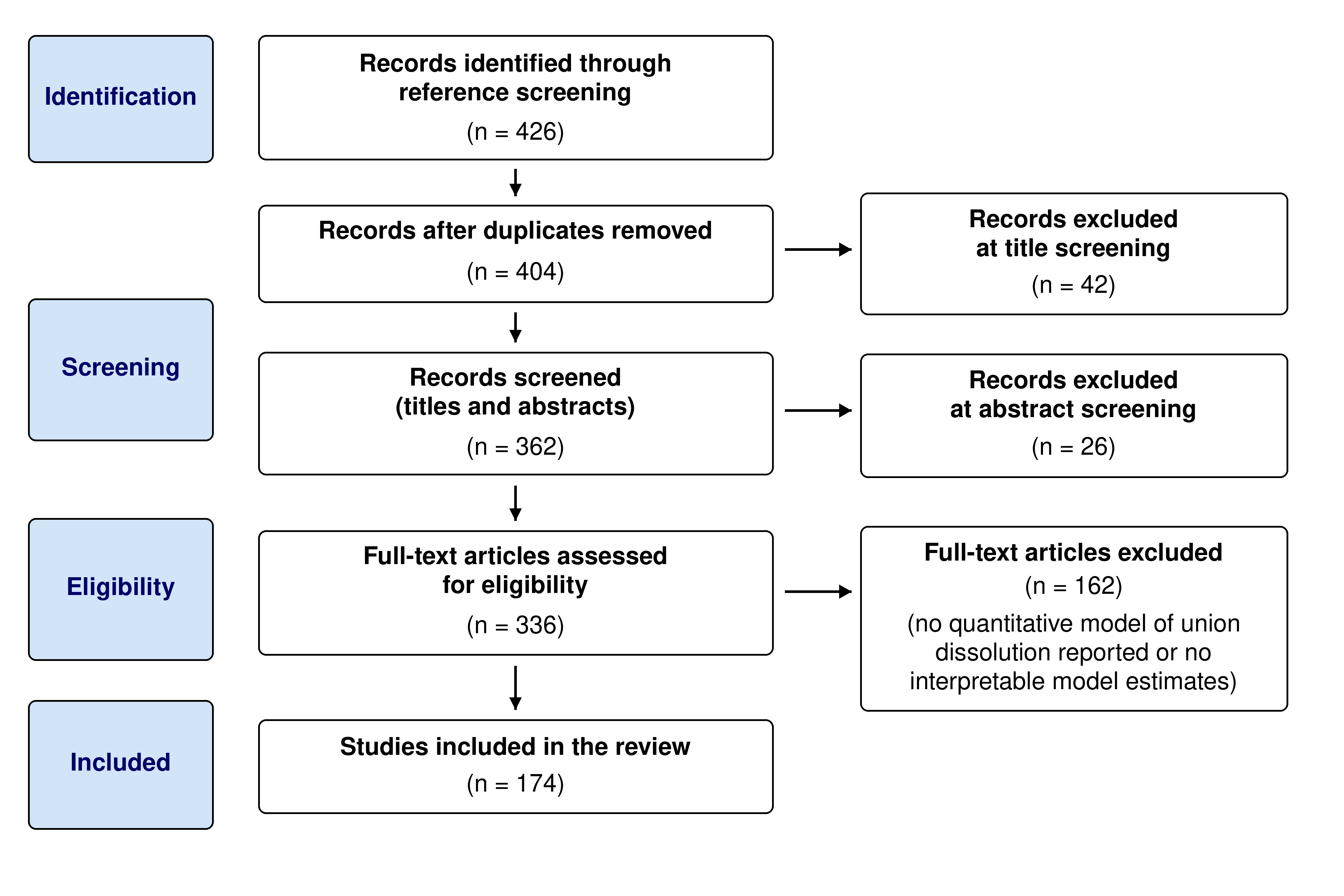
Although this review was not conducted according to a formal PRISMA protocol, the identification and selection of studies followed a structured multistage process (Figure 1). After identifying potentially relevant studies through backward reference searching and Google Scholar, duplicate records were removed. Titles, abstracts and full texts were screened according to predefined inclusion criteria. Only the studies reporting at least one quantitative model of union dissolution with interpretable model estimates were retained.
Figure 1. Flow diagram of the study selection process.
3.2 Data extraction and coding
For each article and model, information was extracted at two levels. At the article level, the database included bibliographic information, year of publication, country or region analysed, continent, data source, sample size, type of data used, and the most recent year from which the data were drawn. At the model level, the database recorded the unit of observation, union type, model type, list of independent variables, statistical significance of each variable, and the reported direction of association with union dissolution.
The unit of observation was coded according to whether the model referred to marriages, couples, households, individuals or women. Union type was coded by distinguishing the models focused only on formal unions from those that also included cohabiting couples or broader partnership forms. Quantitative methods were classified according to the type of model applied, including Kaplan–Meier estimates, Cox regression, Weibull models, discrete-time event history models, piecewise constant exponential models, Karlson–Holm–Breen (KHB) decomposition, other hazard models and other quantitative methods. When a study referred only generally to “event-history regression”, “hazard regression” or “proportional hazards models” without specifying the exact model type, it was coded under the broader category of other hazard models.
Explanatory variables were grouped into the following predictor domains: education, economic activity, finances, demography, child-related variables, religion, race and ethnicity, urbanisation, family ties, socio-psychological variables and other variables. For each predictor, the number of articles and models in which it appeared was recorded, as well as the number of models in which the predictor was reported as statistically significant. The direction of association was not summarised at the aggregate level, because the interpretation of positive and negative effects depended on model specification, country context, measurement and the reference category used in each study.
3.3 Counting of models
The unit of analysis in this review is statistical model. When a single study presented several specifications of the same model type for the same country or region, differing only in the inclusion of additional control variables, these specifications were counted as one model. In such cases, the significance and direction of all variables across specifications were recorded. When a study applied two distinct model types to the same country or region, such as Cox and Weibull models, these were counted as two separate models. When the same model type was applied separately to multiple countries, each country-specific model was counted separately. For example, if Cox regression was applied to 13 countries, this was coded as 13 models. This approach was adopted to preserve country-level and regional comparability, and to maximise the amount of comparable information available for each country and region.
3.4 Scope and limitations of the review design
This review should be understood as a structured global review, rather than a fully protocol-based systematic review. The search strategy combined reference-list screening with supplementary Google Scholar searches, which enabled the identification of a broad body of literature across regions and methodological traditions. However, because the search was not based on a pre-registered protocol, a single database query, or a formal PRISMA procedure, some relevant studies may not have been captured.
Another limitation is that the review was restricted to peer-reviewed quantitative studies published in scientific journals. As a result, relevant evidence contained in grey literature, including methodological reports, governmental publications, statistical office reports and documents produced by international organizations, was not considered. This may be particularly relevant for underrepresented regions, where quantitative demographic research is not always disseminated through peer-reviewed journals.
This limitation is partly mitigated by the inclusion of many peer-reviewed articles, the explicit focus on clearly specified quantitative models, and the systematic coding of model characteristics, predictor domains and regional coverage. The resulting dataset therefore provides a broad comparative overview of how union dissolution has been modelled quantitatively across countries and world regions between 2001 and 2025. Although the review does not claim to exhaust all the published studies on union dissolution, it offers a structured basis for identifying dominant modelling practices, regional imbalances and recurring predictor domains in quantitative research.
4 Results
4.1 Distribution across countries and continents
The first set of results refers to the distribution of articles and models according to the countries and continents. The sample provides a basis for cross-continental and cross-country comparison. Europe was divided into Eastern and Western Europe because of the large number of studies and the observed differences between these two parts of the continent (Table 1).
| Continent | Number of articles | Number of models | Share of models (%) |
|---|---|---|---|
| Western Europe | 81 | 146 | 46.79 |
| North America | 54 | 66 | 21.15 |
| Asia | 16 | 18 | 5.77 |
| Africa | 10 | 13 | 4.17 |
| Eastern Europe | 7 | 63 | 20.19 |
| Australia | 6 | 6 | 1.92 |
| South America | 0 | 0 | 0.00 |
| Total | 174 | 312 | 100.00 |
| Source: own design. | |||
The geographical distribution of studies reveals a pronounced concentration of quantitative research on union dissolution in Western Europe and North America, indicating that current knowledge in the field is largely shaped by evidence generated in a limited number of regions. This imbalance suggests that the dominant theories, methodological approaches and empirical findings may primarily reflect the social, institutional and demographic realities of developed Western societies, rather than global patterns of partnership instability.
The comparatively limited representation of Asia and Africa, together with the complete absence of identified studies from South America, point to significant gaps in the international evidence base. As a result, important regional variations in the determinants and dynamics of union dissolution may remain insufficiently understood. The findings also highlight inequalities in access to longitudinal and high-quality demographic data, which appear to be a key prerequisite for conducting sophisticated quantitative analyses. Consequently, future progress in comparative research will depend not only on methodological advances, but also on strengthening data infrastructures and research capacity in underrepresented regions.
Another important implication is that cross-national comparisons may currently be constrained by the uneven geographical coverage of the literature. Regions that experience distinct family patterns, cultural norms and institutional arrangements remain underrepresented, limiting the generalisability of the existing conclusions. This imbalance may also contribute to the persistence of region-specific blind spots in the theories of union dissolution. Expanding quantitative research beyond the traditional centres of demographic research would therefore not only improve geographical representation, but also enrich theoretical understanding by incorporating a broader range of social and cultural contexts.
The following Table 2 shows the number of articles and models for the countries that have most frequently been the subject of union dissolution probability modelling.
| Country | Number of articles | Number of models |
|---|---|---|
| USA | 53 | 62 |
| Germany | 13 | 13 |
| UK | 11 | 12 |
| Sweden | 9 | 17 |
| Netherlands | 9 | 10 |
| Italy | 8 | 17 |
| Source: own design. | ||
Models were identified for the total of 45 countries, as well as four African regions: Eastern, Western, Southern and Central Africa. In the case of Germany, in addition to the 13 models referring to Germany as a whole, the sample includes nine models referring specifically to West Germany and six models referring to East Germany. Among Eastern European countries, the largest number of models refers to Hungary (11 models in 2 articles), followed by Lithuania, Estonia and Poland. No models were identified in most of the Eastern European countries.
The country-level distribution of studies demonstrates that quantitative research on union dissolution is heavily concentrated in a small number of countries, with the United States occupying a particularly dominant position. This suggests that a substantial share of current empirical knowledge and theoretical development in the field is derived from a limited set of national contexts, potentially influencing the questions researchers ask and the conclusions they draw about partnership instability. The strong presence of several Western European countries further reinforces the central role of developed societies in shaping the international research agenda.
At the same time, the findings indicate that research capacity and data availability vary considerably across countries. The prominence of countries such as Sweden, Germany, the United Kingdom, Italy and the Nordic states reflect not only academic interest, but also the existence of high-quality longitudinal surveys and administrative data systems. Consequently, countries with more advanced demographic data infrastructures can contribute disproportionately to the cumulative evidence base. This creates a situation in which some societies are studied repeatedly and in considerable depth, while many others remain largely absent from comparative analyses.
An additional implication is that the current literature may not fully capture the diversity of union dissolution processes across different institutional and cultural settings. The absence or limited representation of many countries, particularly in Eastern Europe and other under-researched regions, restricts opportunities to assess whether established findings hold under different social and economic conditions.
4.2 Cohabitation in focus
Although most models in the sample focus on divorce or marital dissolution, a smaller number also include cohabiting couples as observational units. In many empirical models, cohabitation appears as an explanatory variable associated with the likelihood of divorce, whereas fewer models specifically examine separation among cohabiting couples (Table 3).
| Continent | Number of models including cohabiting and married couples as observational units | Number of models including married couples only as observational units |
|---|---|---|
| Western Europe | 42 | 104 |
| Eastern Europe | 10 | 53 |
| North America | 6 | 60 |
| Australia | 2 | 4 |
| Asia | 1 | 17 |
| Africa | 0 | 13 |
| South America | 0 | 0 |
| Total | 61 | 251 |
| Source: own design. | ||
The country-level distribution indicates a concentration of research on cohabiting couples in Northern and Western Europe. Sweden records the largest number of articles including cohabiting and married couples as observational units (7), followed by the United States (6), Germany (5), Italy (5) and Norway (5). In Eastern Europe, separation among cohabiting couples has rarely been incorporated into quantitative research. Only two studies addressing this issue were identified for the period 2001–2025: Oláh (2001), who analysed separation in Hungary using data available up to 1993, and Liefbroer and Dourleijn (2006), who developed models for 16 European countries, including seven Eastern European contexts, using the data available up to 1998.
The distribution of models by union type shows that quantitative research on union dissolution remains predominantly focused on formal marriage, despite the increasing demographic significance of cohabitation in many societies. Consequently, existing evidence offers a more comprehensive understanding of divorce than of partnership instability in its broader form, which includes the dissolution of non-marital unions.
The results also reveal substantial regional differences in the treatment of cohabitation. Western European studies are considerably more likely to include cohabiting couples, reflecting both changing family patterns and the availability of more suitable data sources. In contrast, cohabitation remains largely overlooked in many other regions, limiting the ability of researchers to capture the full diversity of contemporary partnership trajectories.
These findings suggest that future research should broaden its focus beyond formal marriage and incorporate cohabiting unions more systematically. Such an approach would improve the relevance of empirical evidence, strengthen cross-national comparisons and provide a more complete understanding of family change and union instability in contemporary societies.
4.3 Time lag between data collection and publication
For all the articles in the sample, the year of publication and the most recent year of data used for modelling were recorded. If a study was based on longitudinal data collected over several years, the final year of data collection was recorded as the most recent year available for modelling. This indicator was used to assess the temporal proximity of the data (Table 4) to the publication of the results.
| Time lag between data collection and publication | Number of articles |
|---|---|
| 1 to 5 years | 66 |
| 6 to 10 years | 78 |
| 11 to 20 years | 28 |
| Over 20 years | 2 |
| Total | 174 |
| Source: own design. | |
Most of the articles used data that were between one and ten years old at the time of publication. However, 30 articles (17%) relied on data older than ten years, indicating that time lag remains an important feature of the reviewed literature.
The analysis of publication lags indicates that quantitative research on union dissolution is often based on data that do not fully reflect contemporary partnership behaviours and family dynamics. Although most studies rely on relatively recent information, a substantial proportion are based on datasets collected many years before the publication, suggesting that empirical evidence may not always keep pace with ongoing demographic change. This is particularly relevant in a field characterised by rapid transformations in marriage patterns, cohabitation, fertility behaviour and gender relations.
The findings therefore raise important questions about the temporal relevance of the existing evidence. Long delays between data collection and publication may reduce the ability of researchers to capture emerging trends and new forms of partnership instability, especially in the societies undergoing rapid social and economic change. As a result, some conclusions reported in the literature may reflect historical rather than current relationship dynamics. This challenge is especially pronounced when studies rely on data collected before major demographic, institutional or cultural shifts occurred.
More broadly, the results highlight the importance of timely and continuously updated longitudinal data for advancing research on union dissolution. Improving the speed with which new data become available and are incorporated into quantitative analyses would enhance the policy relevance and explanatory power of future studies. Greater investment in longitudinal data infrastructures could therefore play a crucial role in ensuring that empirical research remains aligned with contemporary family realities and changing partnership trajectories.
4.4 Reporting units and type of data
A further characteristic of the reviewed literature concerns the reporting units used in the surveys. In 117 articles, information was provided by individuals (67.2% of the total number of surveyed articles), whereas 57 articles relied exclusively on female respondents (32.8%). Only one study collected data separately from male and female participants and developed models distinct by gender.
The results show that most articles rely on individual-level reporting units, while almost one-third of the reviewed articles are based exclusively on female respondents. This is relevant for interpreting the literature, since models based only on women may capture union dissolution from a more restricted reporting perspective.
Regarding the type of data used, 20 of the 174 articles relied on national censuses or population registers, producing 20 quantitative models based on population-level data. This approach was most common in Western Europe, where it appeared in 15 cases, compared with one case in Eastern Europe, three in Asia and one in the United States.
The remaining 154 articles, comprising 292 models, were based on sample surveys. Sample sizes varied considerably, ranging from 111 cases in Nigeria to 511,604 ever-married women in India.
4.5 Distribution of quantitative methods
The reviewed studies were classified according to the quantitative methods used to model union dissolution. Since several studies applied more than one method, the total number of method applications exceeds the number of reviewed articles (Table 5). For example, although the piecewise constant exponential model appears in only 13 articles, it was used in 71 models, as several authors applied it across multiple countries in the same paper. By contrast, methods such as machine learning remain rare in the reviewed literature, with only one identified application.
| Type of method | Number of articles with method application | Share of articles (%) |
|---|---|---|
| Discrete-time event history model (logit/probit) | 104 | 47.49 |
| Cox regression | 49 | 22.37 |
| Kaplan-Meier | 22 | 10.05 |
| Piecewise constant exponential model | 13 | 5.94 |
| Other hazard models | 12 | 5.48 |
| Weibull model | 5 | 2.28 |
| KHB decomposition method | 3 | 1.37 |
| Other methods | 11 | 5.02 |
| Total | 219 | 100.00 |
| Source: own design. | ||
The methodological landscape of union dissolution research is characterised by a strong reliance on event history approaches, indicating a broad consensus that partnership instability is best understood as a dynamic process unfolding over time. The dominance of discrete-time event history models and Cox regression suggests that researchers prioritise the analysis of the timing and risk of union dissolution rather than merely its occurrence. At the same time, the limited use of alternative and more innovative methods indicates that the field remains methodologically concentrated around a relatively narrow set of established techniques, highlighting opportunities for greater methodological diversification in future research.
The predominance of discrete-time event history models and Cox proportional hazards models reflects their complementary methodological strengths. Cox regression provides a flexible semi-parametric framework that does not require specification of the baseline hazard function, making it one of the most widely used approaches for analysing time-to-event data (Kleinbaum & Klein, 2012). Discrete-time event history models are particularly advantageous when events are observed in discrete time intervals, as they can be estimated using generalized linear models while accommodating time-varying covariates (Singer & Willett, 2003). At the same time, both approaches have limitations. Cox regression relies on the proportional hazards assumption, whereas discrete-time models may be less efficient when exact event timing is available on a continuous scale. The widespread use of these methods in union dissolution research reflects both their methodological robustness, and their suitability for analysing longitudinal event history data.
This concentration around a small number of modelling strategies is likely linked to the widespread availability of longitudinal and retrospective life-course data, for which these methods are particularly well suited. However, it may also limit the ability of researchers to capture complex, non-linear and context-dependent processes underlying partnership instability. The relatively modest presence of decomposition techniques, advanced parametric models and machine learning approaches suggests that the field has not yet fully exploited recent methodological developments available in social sciences. Expanding the use of such methods could provide new insights into heterogeneous pathways of union dissolution and improve the predictive capacity of quantitative models.
4.6 Predictor domains in quantitative models
The reviewed models included a wide range of explanatory variables. For analytical purposes, variables were grouped into several domains, including education, economic activity, finances, demography, child-related variables, religion, race and ethnicity, urbanisation, family ties, socio-psychological variables and other variables.
Education-related variables (Table 6) emerge as one of the central predictor domains in quantitative research on union dissolution. The findings indicate that researchers consistently consider educational attainment, particularly that of wives, as a key factor in explaining partnership instability. Moreover, the high frequency of statistically significant effects suggests that education is not merely a standard control variable, but represents a substantive determinant of union dissolution across different countries and research settings. In contrast, educational differences between partners receive considerably less attention, indicating that future research could benefit from a stronger focus on educational homogamy and heterogamy as potential mechanisms influencing union stability.
| Variable name | Number of articles | Number of models | Number of models in which the variable was significant |
|---|---|---|---|
| Wife’s education | 126 | 262 | 117 |
| Husband’s education | 87 | 118 | 65 |
| Husband more educated than wife | 13 | 13 | 6 |
| Wife more educated than husband | 12 | 12 | 7 |
| Other variables related to education | 11 | 11 | 6 |
| Source: own design. | |||
Economic activity (Table 7) is a frequently examined dimension of union dissolution, reflecting the long-standing interest of researchers in the relationship between economic roles within the household and partnership stability. The results suggest that employment-related characteristics, particularly those of wives, are considered more relevant than those of husbands in explaining union outcomes, indicating a strong focus on changing gender roles and economic independence within contemporary unions. At the same time, the substantial proportion of statistically significant effects across employment variables highlights that labor market position remains an important component of the socioeconomic mechanisms associated with union dissolution.
| Variable name | Number of articles | Number of models | Number of models in which the variable was significant |
|---|---|---|---|
| Wife’s employment | 56 | 79 | 38 |
| Husband’s employment | 38 | 41 | 24 |
| Wife’s working hours | 7 | 10 | 5 |
| Wife works part-time | 6 | 8 | 3 |
| Other economic activity variables | 28 | 32 | 18 |
| Source: own design. | |||
Financial resources represent a distinct but highly influential dimension of union stability. Although financial variables (Table 8) are included less frequently than demographic or educational characteristics, the results indicate that they often have substantial explanatory power when incorporated into quantitative models. The relatively high proportion of significant findings suggests that economic conditions within the household, including income distribution and financial hardship, are closely linked to the risk of union dissolution. These findings support the view that financial security and economic balance between partners remain important factors shaping the stability of intimate relationships across diverse social contexts.
| Variable name | Number of articles | Number of models | Number of models in which the variable was significant |
|---|---|---|---|
| Household income | 36 | 43 | 20 |
| Wife’s income | 17 | 21 | 13 |
| Husband’s income | 15 | 16 | 9 |
| Economic hardship | 9 | 13 | 8 |
| Wife earns more than husband | 7 | 12 | 8 |
| Other financial variables | 9 | 15 | 5 |
| Source: own design. | |||
Demographic variables (Table 9) are highly prevalent in the models of union dissolution. Demographic characteristics constitute the core explanatory framework of quantitative research on union dissolution. The findings indicate that variables related to the timing and life-course trajectory of partnerships, such as age at marriage, union duration, premarital cohabitation and marriage history, are among the most consistently examined and statistically influential predictors of union stability. Their widespread use and frequent significance suggest that the risk of union dissolution is strongly embedded in the demographic circumstances under which partnerships are formed and evolve, making demographic factors the most robust and universally applicable predictor domain across different countries and research traditions.
| Variable name | Number of articles | Number of models | Number of models in which the variable was significant |
|---|---|---|---|
| Wife’s age at marriage | 95 | 227 | 197 |
| Duration of the union | 79 | 122 | 95 |
| Cohabitation before marriage | 70 | 154 | 125 |
| Marriage cohort | 47 | 104 | 80 |
| Higher-order marriage | 44 | 49 | 35 |
| Husband’s age at marriage | 41 | 66 | 55 |
| Wife older than husband | 31 | 35 | 25 |
| Husband older than wife | 23 | 27 | 14 |
| Other demographic variables | 28 | 41 | 39 |
| Source: own design. | |||
Child-related factors (Table 10) represent one of the most consistently important domains in explaining union dissolution. The findings suggest that the presence and characteristics of children are not merely background family attributes, but central elements shaping partnership stability across a wide range of social contexts. Their frequent inclusion and high rate of statistical significance indicate that the decisions surrounding childbearing, family formation and parenting are closely intertwined with the processes that either strengthen or weaken long-term unions. More broadly, the results confirm that family structure and reproductive history remain fundamental components of contemporary models of union dissolution.
| Variable name | Number of articles | Number of models | Number of models in which the variable was significant |
|---|---|---|---|
| Children within marriage | 108 | 205 | 173 |
| Premarital fertility | 30 | 82 | 66 |
| Age of the youngest child | 21 | 29 | 21 |
| Children outside marriage | 15 | 15 | 9 |
| Other child-related variables | 36 | 58 | 27 |
| Source: own design. | |||
Variables related to religion, race and ethnicity (Table 11) were grouped together. Religion is the most frequently used variable in this category, while studies referring to the United States frequently include race-related variables.
| Variable name | Number of articles | Number of models | Number of models in which the variable was significant |
|---|---|---|---|
| Religion | 48 | 49 | 31 |
| Wife’s race | 23 | 24 | 21 |
| Ethnicity | 14 | 14 | 10 |
| Couple’s race | 13 | 14 | 7 |
| Husband’s race | 9 | 10 | 7 |
| Interracial marriage | 8 | 8 | 6 |
| Other religion-, race- and ethnicity-related variables | 17 | 17 | 13 |
| Source: own design. | |||
Religious, racial and ethnic characteristics constitute an important contextual dimension of union dissolution, reflecting the influence of social identity, cultural norms and group membership on partnership stability. The results indicate that these factors are frequently associated with union outcomes across diverse settings, suggesting that union dissolution cannot be fully understood through demographic and socioeconomic characteristics alone. Their relatively high rate of statistical significance highlights the enduring role of cultural and social boundaries in shaping relationship dynamics, while also pointing to substantial cross-national variation in the mechanisms linking identity-related factors to union stability.
Variables grouped under urbanisation include urban–rural differences, region, home ownership, housing density and migration-related indicators (Table 12).
| Variable name | Number of articles | Number of models | Number of models in which the variable was significant |
|---|---|---|---|
| Community size / urban-rural residence | 26 | 45 | 39 |
| Region | 26 | 26 | 22 |
| Home tenure / home ownership | 19 | 20 | 18 |
| Housing density / urbanisation | 6 | 6 | 5 |
| Other variables related to urbanisation | 7 | 7 | 6 |
| Source: own design. | |||
Spatial and residential context appears to be an important component of union dissolution research, indicating that partnership stability is influenced not only by individual and family characteristics, but also by the environments in which the couples live. The consistently high proportion of significant effects suggests that geographical location, housing conditions and community characteristics are closely associated with the likelihood of union dissolution. These findings support the view that union stability is shaped by broader structural and contextual factors, highlighting the importance of incorporating residential and regional dimensions into quantitative analyses of family behaviour.
Family background emerges as one of the most influential and consistently supported domains in the literature on union dissolution. The findings suggest that experiences and characteristics inherited from the family of origin, particularly parental relationship histories, play a substantial role in shaping the stability of adult partnerships. The strong and recurring significance of these variables (Table 13) provides evidence for the intergenerational transmission of union instability, indicating that family behaviors and relationship patterns may persist across generations. More broadly, the results highlight that union dissolution is not only a consequence of current individual and couple characteristics, but is also deeply rooted in earlier family experiences and socialization processes.
| Variable name | Number of articles | Number of models | Number of models in which the variable was significant |
|---|---|---|---|
| Parental separation | 51 | 133 | 119 |
| Mother’s education | 13 | 21 | 10 |
| Father’s education | 11 | 19 | 10 |
| Parental education | 8 | 8 | 4 |
| Other family-tie variables | 28 | 43 | 22 |
| Source: own design. | |||
Socio-psychological variables appear in a smaller number of models. The most frequent indicators include the husband’s contribution to housework (12 models), emancipatory values (9) and the wife’s weekly hours of housework (8). Socio-psychological factors remain relatively underrepresented in quantitative research on union dissolution, despite their recognized importance for understanding relationship dynamics. The findings suggest that variables capturing values, attitudes and the division of responsibilities within the household are incorporated far less frequently than demographic or socioeconomic characteristics, largely reflecting limitations in data availability. Nevertheless, the substantial share of significant effects among the models that include such variables indicates that socio-psychological processes play a meaningful role in partnership stability and may represent an important avenue for future research.
The remaining variables appear only in a small number of cases and were grouped under “other variables”. This residual group includes health-related and psychosocial variables, such as a spouse’s illness (9 models in 9 articles), depression, social isolation and alcohol-related problems, as well as macro-level indicators such as female labour force participation, male unemployment, residential mobility and the share of the educated population.
5 Discussion
The findings of this review reveal several important patterns in the quantitative literature on union dissolution. Although research has expanded considerably during the past two decades, the available evidence remains unevenly distributed across regions, methodological traditions and partnership forms. Accordingly, the findings should not be interpreted as evidence that determinants of union dissolution are universally comparable across countries. Rather, they highlight common methodological patterns observed under diverse demographic, cultural and institutional conditions.
A major finding concerns the pronounced geographical imbalance of the literature. Western Europe and North America account for most published quantitative studies, whereas Asia, Africa, Latin America and much of Eastern Europe remain substantially underrepresented. This pattern appears to reflect differences in the availability of longitudinal and register-based data, institutional capacity and research traditions, rather than differences in the demographic relevance of union dissolution.
These regional differences also provide an important context for interpreting the observed variation in predictors of union dissolution. The theoretical perspectives discussed earlier suggest that partnership behaviour is influenced not only by individual socioeconomic characteristics and life-course trajectories, but also by broader demographic change, institutional arrangements and family norms. Consequently, differences in estimated effects across studies are likely to reflect contextual variation, rather than inconsistencies in the empirical evidence. The principal contribution of this review therefore lies in identifying methodological regularities while recognising contextual heterogeneity.
The review also demonstrates that event-history approaches, particularly discrete-time event history models and Cox proportional hazards models, remain the dominant analytical strategies. More advanced approaches, including Bayesian methods and machine-learning techniques, are still rarely used despite their potential to address increasingly complex longitudinal data.
Another important observation is that demographic and socioeconomic variables dominate the literature, whereas contextual, psychological and relationship-quality indicators are examined much less frequently. This imbalance largely reflects data limitations and suggests promising directions for future research.
Overall, the review indicates that quantitative research on union dissolution has reached a high level of methodological maturity, but would benefit from broader geographical coverage, richer longitudinal datasets, greater attention to cohabiting unions and wider methodological diversification.
6 Conclusion
This review synthesised the quantitative studies on union dissolution published between 2001 and 2025 and identified the principal methodological approaches used to analyse partnership instability.
The evidence shows that quantitative research is concentrated in a relatively small number of countries with well-developed demographic data infrastructures. Event-history models dominate the literature, while cohabiting unions and many regions of the world remain insufficiently represented.
The main contribution of this review is methodological rather than substantive. Instead of proposing universally valid determinants of union dissolution, it provides a structured overview of how quantitative models have been applied across different demographic, cultural and institutional contexts.
Future research should expand evidence from underrepresented regions, improve access to longitudinal and administrative data, incorporate cohabiting unions more systematically and continue developing innovative statistical approaches. These developments would strengthen both the comparability and the global relevance of research on union dissolution.
Data availability statement
Data are available from the authors upon request.
Generative AI declaration
Generative AI tools (ChatGPT, OpenAI) were used exclusively for language editing and improving the clarity of the manuscript. The authors were fully responsible for all aspects of the study, including literature review, data collection, coding, analysis, interpretation of findings, and preparation of the final manuscript. No AI tools were used to generate, analyse, or interpret research data.
Coauthor contributions
Mirko Savić: Data curation, Investigation, Writing - Original Draft, Methodology, Conceptualization
Stojanka Dakić: Writing - Review & Editing, Visualization, Validation
References
- Amato, P. R. (2010). Research on divorce: Continuing trends and new developments. Journal of Marriage and Family, 72(3), 650-666. https://doi.org/10.1111/j.1741-3737.2010.00723.x
- Becker, G. S., Landes, E. M., & Michael, R. T. (1977). An economic analysis of marital instability. Journal of Political Economy, 85(6), 1141-1187. https://doi.org/10.1086/260631
- Burstein, N. R. (2007). Economic influences on marriage and divorce. Journal of Policy Analysis and Management, 26(2), 387-429. https://doi.org/10.1002/pam.20257
- Carlson, M. J. (2018). Families Unequal: Socioeconomic Gradients in Family Patterns across the United States and Europe. In N. Cahn, J. Carbone, L. F. DeRose, & W. B. Wilcox (Eds.), Unequal family lives: Causes and consequences in Europe and the Americas (pp. 21-39). Cambridge University Press. https://doi.org/10.1017/9781108235525.002
- Cherlin, A. (2017). Introduction to the Special Collection on Separation, Divorce, Repartnering, and Remarriage around the World. Demographic Research, 37, 1275-1296. https://doi.org/10.4054/demres.2017.37.38
- Cherlin, A. J. (2018). How Inequality Drives Family Formation: The Prima Facie Case. In N. Cahn, J. Carbone, L. F. DeRose, & W. B. Wilcox (Eds.), Unequal family lives: Causes and consequences in Europe and the Americas (pp. 69-82). Cambridge University Press. https://doi.org/10.1017/9781108235525.004
- Cherlin, A. J. (2020). Degrees of change: An assessment of the deinstitutionalization of marriage thesis. Journal of Marriage and Family, 82(1), 62-80. https://doi.org/10.1111/jomf.12605
- Elder, G. H., Johnson, M. K., & Crosnoe, R. (2003). The Emergence and Development of Life Course Theory. In J. T. Mortimer & M. J. Shanahan (Eds.), Handbook of the Life Course (pp. 3-19). Springer US. https://doi.org/10.1007/978-0-306-48247-2_1
- Esteve, A., & Florez-Paredes, E. (2018). Families in Latin America: Dimensions, Diverging Trends, and Paradoxes. In N. Cahn, J. Carbone, L. F. DeRose, & W. B. Wilcox (Eds.), Unequal family lives: Causes and consequences in Europe and the Americas (pp. 40-65). Cambridge University Press. https://doi.org/10.1017/9781108235525.003
- Kalmijn, M. (2007). Explaining cross-national differences in marriage, cohabitation, and divorce in Europe, 1990-2000. Population Studies, 61(3), 243-263. https://doi.org/10.1080/00324720701571806
- Kiernan, K. (2002). The state of European unions: An analysis of FFS data on partnership formation and dissolution. In M. Macura & G. C. N. Beets (Eds.), Dynamics of fertility and partnership in Europe: Insights and lessons from comparative research (pp. 57-76). United Nations.
- Kleinbaum, D. G., & Klein, M. (2012). Survival Analysis: A Self-Learning Text. Springer New York. https://doi.org/10.1007/978-1-4419-6646-9
- Lesthaeghe, R. (2010). The Unfolding Story of the Second Demographic Transition. Population and Development Review, 36(2), 211-251. https://doi.org/10.1111/j.1728-4457.2010.00328.x
- Lesthaeghe, R. J. (2020). The second demographic transition: Cohabitation. In R. Schoen (Ed.), Cross-Cultural Family Research and Practice (pp. 103-141). Academic Press. https://doi.org/10.1016/b978-0-12-815493-9.00004-1
- Liefbroer, A. C., & Dourleijn, E. (2006). Unmarried cohabitation and union stability: Testing the role of diffusion using data from 16 European countries. Demography, 43(2), 203-221. https://doi.org/10.1353/dem.2006.0018
- Lyngstad, T., & Jalovaara, M. (2010). A review of the antecedents of union dissolution. Demographic Research, 23, 257-292. https://doi.org/10.4054/demres.2010.23.10
- Matysiak, A., Styrc, M., & Vignoli, D. (2014). The educational gradient in marital disruption: A meta-analysis of European research findings. Population Studies, 68(2), 197-215. https://doi.org/10.1080/00324728.2013.856459
- Milne, B. J., D’Souza, S., Andersen, S. H., & Richmond-Rakerd, L. S. (2022). Use of Population-Level Administrative Data in Developmental Science. Annual Review of Developmental Psychology, 4(1), 447-468. https://doi.org/10.1146/annurev-devpsych-120920-023709
- Mortelmans, D. (Ed.). (2020). Divorce in Europe: New Insights in Trends, Causes and Consequences of Relation Break-ups. Springer International Publishing. https://doi.org/10.1007/978-3-030-25838-2
- National Research Council. (2002). Leveraging Longitudinal Data in Developing Countries: Report of a Workshop. National Academies Press. https://doi.org/10.17226/10405
- Oláh, L. S. (2001). Gender and family stability: Dissolution of the first union in Sweden and Hungary. Demographic Research, 4(2), 29-96. https://doi.org/10.4054/demres.2001.4.2
- Perelli-Harris, B. (2018). Universal or unique? Understanding diversity in partnership experiences across Europe. In N. Cahn, J. Carbone, L. F. DeRose, & W. B. Wilcox (Eds.), Unequal family lives: Causes and consequences in Europe and the Americas (pp. 83-104). Cambridge University Press. https://doi.org/10.1017/9781108235525.005
- Perelli-Harris, B., & Gassen, N. S. (2012). How similar are cohabitation and marriage? Legal approaches to cohabitation across Western Europe. Population and Development Review, 38(3), 435-467. https://doi.org/10.1111/j.1728-4457.2012.00511.x
- Rodrigues, A. E., Hall, J. H., & Fincham, F. D. (2006). What predicts divorce and relationship dissolution?. In M. A. Fine & J. H. Harvey (Eds.), Handbook of divorce and relationship dissolution (pp. 85-112). Lawrence Erlbaum Associates. https://psycnet.apa.org/record/2006-08138-005
- Singer, J. D., & Willett, J. B. (2003). Applied longitudinal data analysis: Modeling change and event occurrence. Oxford University Press. https://doi.org/10.1093/acprof:oso/9780195152968.001.0001
- Wagner, M. (2020). On Increasing Divorce Risks. In D. Mortelmans (Ed.), Divorce in Europe: New insights in trends, causes and consequences of relation break-ups (pp. 37-61). Springer International Publishing. https://doi.org/10.1007/978-3-030-25838-2_3
- Wagner, M., & Weiß, B. (2006). On the variation of divorce risks in Europe: Findings from a meta-analysis of European longitudinal studies. European Sociological Review, 22(5), 483-500. https://doi.org/10.1093/esr/jcl014
- White, L. K. (1990). Determinants of Divorce: A Review of Research in the Eighties. Journal of Marriage and the Family, 52(4), 904-912. https://doi.org/10.2307/353309
Article Details
Published by the Institute of Social Sciences - Center for Demographic Research




References
Amato, P. R. (2010). Research on divorce: Continuing trends and new developments. Journal of Marriage and Family, 72(3), 650-666. https://doi.org/10.1111/j.1741-3737.2010.00723.x
Becker, G. S., Landes, E. M., & Michael, R. T. (1977). An economic analysis of marital instability. Journal of Political Economy, 85(6), 1141-1187. https://doi.org/10.1086/260631
Burstein, N. R. (2007). Economic influences on marriage and divorce. Journal of Policy Analysis and Management, 26(2), 387-429. https://doi.org/10.1002/pam.20257
Carlson, M. J. (2018). Families Unequal: Socioeconomic Gradients in Family Patterns across the United States and Europe. In N. Cahn, J. Carbone, L. F. DeRose, & W. B. Wilcox (Eds.), Unequal family lives: Causes and consequences in Europe and the Americas (pp. 21-39). Cambridge University Press. https://doi.org/10.1017/9781108235525.002
Cherlin, A. (2017). Introduction to the Special Collection on Separation, Divorce, Repartnering, and Remarriage around the World. Demographic Research, 37, 1275-1296. https://doi.org/10.4054/demres.2017.37.38
Cherlin, A. J. (2018). How Inequality Drives Family Formation: The Prima Facie Case. In N. Cahn, J. Carbone, L. F. DeRose, & W. B. Wilcox (Eds.), Unequal family lives: Causes and consequences in Europe and the Americas (pp. 69-82). Cambridge University Press. https://doi.org/10.1017/9781108235525.004
Cherlin, A. J. (2020). Degrees of change: An assessment of the deinstitutionalization of marriage thesis. Journal of Marriage and Family, 82(1), 62-80. https://doi.org/10.1111/jomf.12605
Elder, G. H., Johnson, M. K., & Crosnoe, R. (2003). The Emergence and Development of Life Course Theory. In J. T. Mortimer & M. J. Shanahan (Eds.), Handbook of the Life Course (pp. 3-19). Springer US. https://doi.org/10.1007/978-0-306-48247-2_1
Esteve, A., & Florez-Paredes, E. (2018). Families in Latin America: Dimensions, Diverging Trends, and Paradoxes. In N. Cahn, J. Carbone, L. F. DeRose, & W. B. Wilcox (Eds.), Unequal family lives: Causes and consequences in Europe and the Americas (pp. 40-65). Cambridge University Press. https://doi.org/10.1017/9781108235525.003
Kalmijn, M. (2007). Explaining cross-national differences in marriage, cohabitation, and divorce in Europe, 1990-2000. Population Studies, 61(3), 243-263. https://doi.org/10.1080/00324720701571806
Kiernan, K. (2002). The state of European unions: An analysis of FFS data on partnership formation and dissolution. In M. Macura & G. C. N. Beets (Eds.), Dynamics of fertility and partnership in Europe: Insights and lessons from comparative research (pp. 57-76). United Nations.
Kleinbaum, D. G., & Klein, M. (2012). Survival Analysis: A Self-Learning Text. Springer New York. https://doi.org/10.1007/978-1-4419-6646-9
Lesthaeghe, R. (2010). The Unfolding Story of the Second Demographic Transition. Population and Development Review, 36(2), 211-251. https://doi.org/10.1111/j.1728-4457.2010.00328.x
Lesthaeghe, R. J. (2020). The second demographic transition: Cohabitation. In R. Schoen (Ed.), Cross-Cultural Family Research and Practice (pp. 103-141). Academic Press. https://doi.org/10.1016/b978-0-12-815493-9.00004-1
Liefbroer, A. C., & Dourleijn, E. (2006). Unmarried cohabitation and union stability: Testing the role of diffusion using data from 16 European countries. Demography, 43(2), 203-221. https://doi.org/10.1353/dem.2006.0018
Lyngstad, T., & Jalovaara, M. (2010). A review of the antecedents of union dissolution. Demographic Research, 23, 257-292. https://doi.org/10.4054/demres.2010.23.10
Matysiak, A., Styrc, M., & Vignoli, D. (2014). The educational gradient in marital disruption: A meta-analysis of European research findings. Population Studies, 68(2), 197-215. https://doi.org/10.1080/00324728.2013.856459
Milne, B. J., D’Souza, S., Andersen, S. H., & Richmond-Rakerd, L. S. (2022). Use of Population-Level Administrative Data in Developmental Science. Annual Review of Developmental Psychology, 4(1), 447-468. https://doi.org/10.1146/annurev-devpsych-120920-023709
Mortelmans, D. (Ed.). (2020). Divorce in Europe: New Insights in Trends, Causes and Consequences of Relation Break-ups. Springer International Publishing. https://doi.org/10.1007/978-3-030-25838-2
National Research Council. (2002). Leveraging Longitudinal Data in Developing Countries: Report of a Workshop. National Academies Press. https://doi.org/10.17226/10405
Oláh, L. S. (2001). Gender and family stability: Dissolution of the first union in Sweden and Hungary. Demographic Research, 4(2), 29-96. https://doi.org/10.4054/demres.2001.4.2
Perelli-Harris, B. (2018). Universal or unique? Understanding diversity in partnership experiences across Europe. In N. Cahn, J. Carbone, L. F. DeRose, & W. B. Wilcox (Eds.), Unequal family lives: Causes and consequences in Europe and the Americas (pp. 83-104). Cambridge University Press. https://doi.org/10.1017/9781108235525.005
Perelli-Harris, B., & Gassen, N. S. (2012). How similar are cohabitation and marriage? Legal approaches to cohabitation across Western Europe. Population and Development Review, 38(3), 435-467. https://doi.org/10.1111/j.1728-4457.2012.00511.x
Rodrigues, A. E., Hall, J. H., & Fincham, F. D. (2006). What predicts divorce and relationship dissolution?. In M. A. Fine & J. H. Harvey (Eds.), Handbook of divorce and relationship dissolution (pp. 85-112). Lawrence Erlbaum Associates. https://psycnet.apa.org/record/2006-08138-005
Singer, J. D., & Willett, J. B. (2003). Applied longitudinal data analysis: Modeling change and event occurrence. Oxford University Press. https://doi.org/10.1093/acprof:oso/9780195152968.001.0001
Wagner, M. (2020). On Increasing Divorce Risks. In D. Mortelmans (Ed.), Divorce in Europe: New insights in trends, causes and consequences of relation break-ups (pp. 37-61). Springer International Publishing. https://doi.org/10.1007/978-3-030-25838-2_3
Wagner, M., & Weiß, B. (2006). On the variation of divorce risks in Europe: Findings from a meta-analysis of European longitudinal studies. European Sociological Review, 22(5), 483-500. https://doi.org/10.1093/esr/jcl014
White, L. K. (1990). Determinants of Divorce: A Review of Research in the Eighties. Journal of Marriage and the Family, 52(4), 904-912. https://doi.org/10.2307/353309