
A Longitudinal Analysis of Functional Transformation and Demographic Change in Small Towns in Serbia
Article Sidebar
Main Article Content
Abstract
This paper examines the interrelation between functional transformation and demographic change in small towns in Serbia, focusing on temporal and spatial disparities and uneven development trajectories. Small towns are identified according to Eurostat methodology and its adaptation for Serbia (Degree of urbanisation (DEGURBA) level 2). The analysis adopts a longitudinal perspective spanning four decades, based on the Census data for three selected years: 1981, the peak of industrial development; 2002, marking industrial collapse and transition; and 2022, which illustrates the current state. Functional transformation is explored through thenar diagrams, which capture employment shifts across the main economy’s sectors, harmonized and categorized in line with the official Classification of Activities. Results revealed a significant correlation between functional shifts and demographic trends, as well as the fact that functional transformation does not lead to uniform demographic outcomes across the small towns, but rather produces divergent development trajectories. Negative functional shifts associated with severe demographic decline are common for the small towns with a strong orientation toward the industry sector. Also, some of the small towns that faced a significant shift to the service economy experienced a pronounced demographic decline. Conversely, some towns demonstrate positive adjustment by restructuring their economies towards specific service activities and redefining their roles in the local development and settlements network. The findings challenge the assumption that tertiarization represents a sustainable development path for small towns. By linking long-term demographic change with functional restructuring, the paper contributes to a deeper understanding of small-town development in post-socialist contexts.
1 INTRODUCTION
Small towns have undergone significant changes since the time of industrialization and the early phases of urbanization, inducing diversity in life quality and causing various challenges. They are placed between villages and large cities on the urbanization trajectory (Spasić, 1984; Spasić et al., 2005; Academy for Spatial Research and Planning [ARL], 2019; Steinführer, 2021; Bański & Mazurek, 2025), with a tendency to move into the category of medium-sized towns offering the high “quality” of living, or drop to the rural category due to incapability to overcome structural problems. Smaller urban centres are losing their functions, being incorporated into rural areas, and evolving into geospatial complexes with multifunctional characteristics and mosaic landscapes (Drobnjaković, 2019). On the other hand, certain small towns grow and develop into medium-sized towns, offering a certain quality of living conditions. Small towns are often presented as the counterpart to large cities, benefiting and losing from this association (ARL, 2019), which depends on the broader context and a range of complex factors. The development trajectory of small towns is preconditioned by various factors, determined by the historical and social context and globalization, and expressing different patterns of spatial, functional, and demographical transformation or even stigmatisation (Steinführer et al., 2016).
The issue of small towns defining and determining their role in the settlements network is an under-researched topic with little systematic research focusing on a “small urbanity” (Steinführer et al., 2016; Bell & Jayne, 2009). The determination and differentiation of urban settlement based on population size was one of the earliest attempts to deal with this issue in the world, until the first population census and the development of modern statistical services (Vresk, 1979; Drobnjaković, 2019). Due to the increasing attention that large cities attract, medium-sized cities and small towns are neglected in international and national contexts, professional or academic circles, and often viewed through the lens of urban research (Steinführer, 2021; Kokotović Kanazir, 2016). Therefore, it is not surprising that the criteria and thresholds for defining small towns vary between countries (Ljubenović et al., 2025). Small towns’ differentiation could be based on various approaches and factors, mostly of population size, historical town privileges, urban fabric, centrality functions, and economic or social structures (ARL, 2019). Recent attempts, however, require more detailed, in-depth and complex approaches and analyses.
Some experiences among European countries indicate the variety of definitions of small towns. Today, there is not one generally accepted definition of “small town”, and their determination is based on demographic, administrative, functional, or complex indicator sets. The population size of small towns varies. Recently, European Observation Network for Territorial Development and Cohesion [ESPON] (2024) established a small-town definition that considers small cities as settlements with the population exceeding 50,000 inhabitants and exposed to similar socioeconomic challenges. In Germany, the threshold for small towns is 5,000 inhabitants (Steinführer et al., 2016; ARL, 2019), just like in Russia, where the threshold for the small town category is up to 5,000 inhabitants (Spasić et al., 2007). In Central Europe, the definition of small towns relies on a comprehensive understanding, involving the micro-regional centres in rural areas that attracts the surrounding villages (Jousseaume & Talandier, 2016; Malý, 2016; Kokotović Kanazir, 2016). Small towns are usually associated with stereotypical representations as compact, comfortable, or cramped settlements or environments (ARL, 2019; Bański & Mazurek, 2025). They often represent symbolic centres in regional contexts, and structural nodes in the settlement network due to the capacity to provide basic services, economic, social, cultural, etc., and to link rural with highly urbanized areas (Pirisi & Trócsányi, 2014; Steinführer et al., 2016; Bański, 2021). This ‘bridging’ role was depicted dually by Malý (2016), using the concept of “borrowed size” and the “agglomeration shadow” effect. According to Marinović-Uzelac (1999), “a small town is an urban agglomeration that meets the minimum population requirements, in which the representation of the primary sector of activity within the urban corpus is reduced, and which has a minimal gravitational impact on its environment.”
Despite limited studies on social life and the economy of small towns, their economic diversity and characteristic social structures have been confirmed (ARL, 2019). Diversity and heterogeneity are common for small towns in European countries, determined by the level of functional diversification of their surroundings and their proximity to metropolitan areas (Bański, 2021). The specific functions in small towns have usually been reinforced in order to achieve independence and determine a role in regional development. They could be recognized as mining towns, spa or residential towns of rural-to-urban commuters, nodes of transmission or small administrative and cultural centres (Steinführer et al., 2016; Stoica et al., 2020).
The functional development of small towns has been examined insufficiently and attracts little attention among geographers, spatial planners, economists, and sociologists (Stafford, 1963; Rondinelli, 1983; Tacoli, 2017; ARL, 2019; Bański, 2021). The focus has shifted from agriculture toward service activities, supported by the metropolization processes that affect their transformation and induce different development trajectories (ESPON, 2024). The functional development trajectories of small towns can be interpreted within the broader theoretical framework of sectoral transformation, grounded in Clark-Fisher’s three-sector model (Fisher, 1939; Clark, 1940), which focuses on the need for economic sectoral transformation. The three-sector model proposed a way of understanding a rapidly modernizing and globalizing economic activity beyond agriculture, mining, and manufacturing, and conceptualizes economic development as a structural shift from the primary sector, with low productivity of labour, to the secondary and subsequently tertiary sector, with high labour productivity. The classical theory established the basic, remarkable, resilient division by which economic structure is still understood (Schafran et al., 2018). This framework is widely used for examining structural transformation of national economies, illustrating changes in the sectoral composition of employment that reflect deeper socio-economic restructuring processes. It highlights the influence of the services sector beyond industrial or sectoral economics elaborated in studies of urban and regional development, and spatial inequalities (Hamnett, 1994; Taylor & Walker, 2001). The three-sectoral model provides an analytical basis for understanding the functional transformation of small towns, particularly in the post-socialist contexts marked by deindustrialization and the expansion of service activities.
There is no consensus on this issue in Serbia either (Kokotović Kanazir, 2016; Ljubenović et al., 2025). To this day, small towns in Serbia have most often been defined as small urban settlements with up to 20,000 inhabitants (Spasić, 1984). Small towns are represented by a highly heterogeneous group of settlements in functional and morphological terms, and by the urbanization degree (Spasić & Petrić, 2006; Filipović et al., 2016; Kokotović Kanazir, 2016). In Serbia, small towns could be understood as an important bond between large cities and rural areas, and often represent administrative, economic, and cultural centres of municipalities (Spasić, 1984; Spasić, 1995), potential sub-regional centres, and individual mono-functional developed settlements like spas, industrial, and mining settlements (Kokotović Kanazir, 2016). The role of small towns in achieving balanced development is highly significant, as well. Although small towns have not been in the spotlight of scientific research in Serbia in previous decades, certain studies have been done, which shed light on the demographic potential of small towns (Kokotović Kanazir, 2016), their development potential (Spasić & Petrić, 2006; Filipović et al., 2016), or their shrinkage and identification of the driving factors and impacts that affected their transformation (Ljubenović et al., 2022; Ljubenović et al., 2025).
The most recent definition of small towns underpins this research. It is based on a novel understanding of small towns that emerged from the recently established differentiation of settlements conducted by the Statistical Office of the Republic of Serbia (SORS) (Drobnjaković & Kokotović Kanazir, 2025). Small towns are recognized as settlements within the urban type of area and represented by a category of towns and suburbs. The second level of classification involves the typology of small spatial units according to the population participation of more than 50% in the corresponding cluster (Eurostat, 2021), which gradually distinguishes urban settlements within this type of area. This classification involves adjustments of the Eurostat methodology to the specificities of the settlements’ system in Serbia by creating a set of indicators that imply the degree of socio-economic transformation and current demographic trends, reflecting the relationships in the settlements network (Drobnjaković & Kokotović Kanazir, 2025).
Based on the assumption that there is a general lack of knowledge about this type of towns (ARL, 2019) and their role in the settlement system in Serbia, this research aims to highlight the necessity of evidence-based research on small towns. It hypothesizes that the direction and intensity of demographic change in small towns in Serbia during the period 1981–2022 were significantly associated with the type and degree of their functional transformation, resulting in differentiated development patterns. The authors wanted to examine the interconnection between functional restructuring and demographic change, in order to identify development trajectories of small towns and their spatial and temporal dimensions. In line with that, the research encompasses an analysis of the shifts in the sectoral employment structure across the selected Census years; examination of demographic dynamics through population change indices, age structure, and economic activity indicators; assessment of functional and demographic changes through the intersection of the tertiarization index and population change index; and recognition and interpretation of the development trajectories typical for the small towns in Serbia.
2 METHODOLOGY AND DATA
The research focuses on small towns in Serbia identified based on the second level of the Degree of urbanisation (DEGURBA) methodology (Eurostat, 2021) and adapted to the Serbian perspective and settlements’ network in order to capture the urban-rural continuum (Drobnjaković & Kokotović Kanazir, 2025). According to this typology, small towns are recognized within an urban cluster, in a type of town and semi-dense areas, which embed a series of transitional forms of settlements. This settlement type is characterized by moderate population density of at least 300 inhabitants per km2 and population size of at least 5,000, with a distance of more than 2 km from a dense urban cluster or an urban centre (Eurostat, 2021). There are 78 small towns in Serbia identified, represented by a group of settlements heterogeneous in population size, functional orientation, and role in the local and regional settlement network.
The differentiation of small towns was made according to the economic composition of the active population by activity sector, which was used for determining the directions of their socio-economic transformation (Miletić & Drobnjaković, 2015). Following a pioneering research project on functional typology of cities (Nelson, 1955), this research identifies dominant economic functions in small towns based on the population’s employment and activity structure. Functional transformation of the small towns has been assessed using Fehre’s model of thenar diagram, which has found wide application in spatial planning and geography of settlements (Grčić, 1999; Tošić, 1999; Veljković et al., 1995). The model is presented by an equilateral triangle as one of the graphical methods of the functional types’ and their subtypes’ allocation, interpreted through variations in the share of employed persons across primary, secondary and tertiary-quaternary sectors. Three relevant years have been chosen for the research time section: 1) 1981, when the most favourable parameters of the functional capacities of small towns were recorded and when they acquired the functional role that marked their development; 2) 2002, which was marked by a critical development phase caused by decline in industrial production and preparation for the transition phase; and 3) 2022, which represents the current functional role of small towns and the end point on the functional transformation trajectory. The research is limited in terms of non-comparability through time, due to definitional or statistical modifications and changing methodologies for data collection. In order to accurately group activities into sectors, the current Decree on the Classification of Activities (Uredba o klasifikaciji delatnosti, 2010) and its harmonization with the previous ones were used. The data from the Census of Population, Households and Apartments in 1981, 2002, and 2022 were used pertaining to the economic activity of the population by activity sector. Methodological adjustments between the Census years address the classification of economic activity in agriculture, which induces variation in the primary-sector employment. The individuals engaged in subsistence farming are considered economically inactive (Statistical Office of the Republic of Serbia [SORS], 2022). On the other hand, the Agriculture census under labour force in agriculture considers only the persons who performed farming and are over 15 years of age (SORS, 2023b). Different data sources affect employment in this sector. In this study, the authors capture the changes in functional development following the census data on population per activity sectors, avoiding different types of data to provide the comparability of the sectoral data across the Census years.
The shifts in the demographic basis of small towns in the 1981-2022 period were analysed using the population change index. A comparative analysis of the demographic and functional characteristics of small towns was performed through their distribution in the quadrants representing the category and level of small towns’ transformation. The quadrants were determined by the intersection of the population change index and the tertiarization index, calculated based on changes in the active population engaged in tertiary and quaternary activities for a selected year.
One of the model’s limitations is related to the aggregate observation of the tertiary and quaternary activities. The ‘three-sector’ model remains as the dominant paradigm despite the attempts of economists and geographers to introduce the quaternary sector in order to crystallise the Clark’s messy tertiary category (Foote & Hatt, 1953). In this regard, the study relies on the analytical approach that aggregates tertiary and quaternary sectors of activities and allows data comparability and consistent longitudinal monitoring of functional transformation. The qualitative differences within the service sector of the settlements examined may exist; however, further sectoral disaggregation may reduce statistical reliability due to the absence of a commonly adopted conceptualization of a model based on the four-sector division (Schafran et al., 2018).
While this approach allows a consistent longitudinal perspective based on relevant Census years, it captures structural change exclusively through a relative redistribution of the active population. Applied methodological framework does not account for qualitative dimensions of economic restructuring or the effects of tertiarization. The structural changes do not necessarily imply economic strengthening or decline. These limitations were taken into consideration during the interpretation of the results.
3 RESULTS
3.1 The Role of Small Towns in the Urban-Rural Divide in Serbia
The largest number of small towns is located in the Vojvodina Region (30). Although the Region of Šumadija and Western Serbia and the Region of Southern and Eastern Serbia are characterized by a significant number of small towns (23 and 20, respectively), their share is negligible considering the large number of settlements identified in these regions. On the other hand, only five small towns were identified in the Belgrade Region, which is determined by the strong influence and dominance of the capital city.
The average population size of the small towns is 10,623, which is significantly lower than the average size of cities and medium-sized towns; however, these are still more populated than suburbs and rural settlements (Drobnjaković & Kokotović Kanazir, 2025). Observing the population density, it is evident that small towns are lagging behind all urban types of settlements (Figure 1a). The recorded population density is 236.8 inhabitants per km2 on average, which is approximately 100 inhabitants/km2 less than in the suburbs and medium-sized towns, as well as several times lower than in cities. Small towns are more populated than rural areas and above the republic’s average, indicating a certain demographic potential of these settlements. A similar pattern could be observed in the population change for the 1981-2022 period. Small towns experienced a slight population decline, similar to medium-sized towns; however, with favourable dynamics compared to rural areas and the republic’s average (Figure 1b). In this regard, the demographic profile of small towns falls between the densely populated towns and suburbs marked by expansive development on one hand, and rural areas facing continuous shrinkage, on the other.
Figure 1. Positioning small towns in the settlements’ network according to the selected demographic indicators: a) Average population size; b) Population density.
The economic indicators clearly pointed out to a gradual decline of small towns in economic terms, making them less attractive places for living, which affects the demographic trends. The employment rate in small towns drops below the republic’s average and approaches the values for rural areas, which indicates deteriorating economic conditions and employment opportunities (Figure 2a). Lagging behind the cities and medium-sized towns triggers population outflows and induces a negative demographic dynamic. The economic dependency ratio expresses a favourable relation between the dependent and active population (Figure 2b). With a value of 134, small towns are close to the republic’s average. However, the economic dependency ratio indicates a high dependency of the local population since almost a third of the population is dependent. Since an active person has to “support” him/herself and the average of 1.34 other dependents, the quality of life is not satisfactory. This imbalance mirrors the deteriorated population structure and scarce labour force in small towns.
Figure 2. Positioning small towns in the settlements’ network according to selected economic indicators: a) Employment rate; b) Economic dependency ratio.
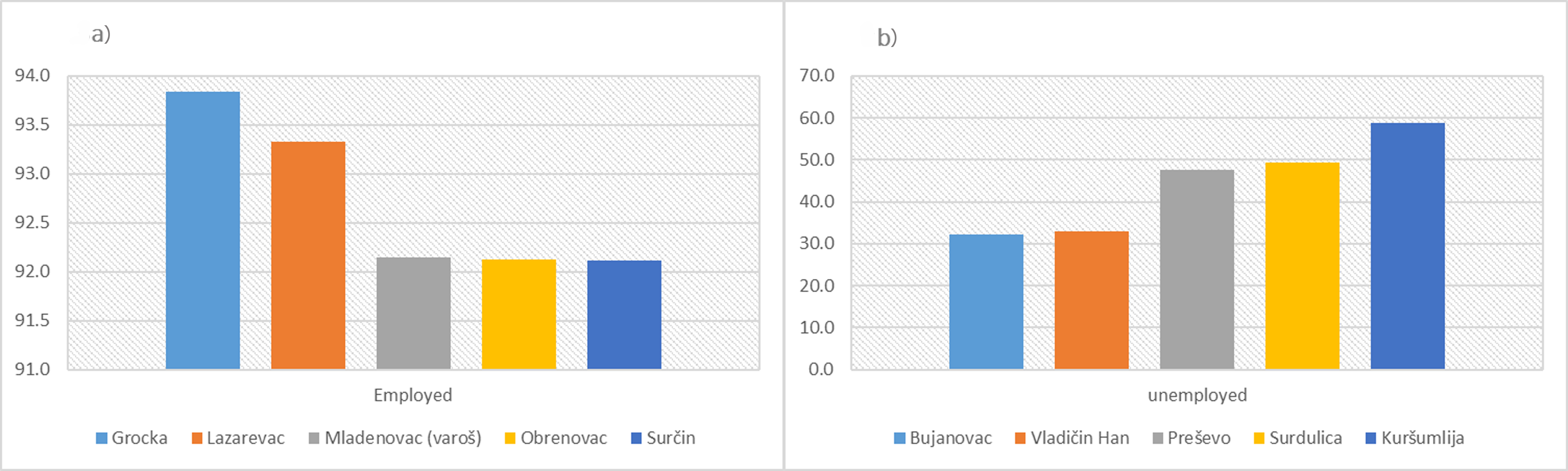
Small towns recording the highest shares of the employed population are predominantly located in the Belgrade Region. In 16 small towns, the employment rate exceeds 90% (Figure 3a). The average share of employed persons across all small towns amounts to 83.2%. In contrast, the lowest employment levels are observed mainly in small towns situated in the Southern and Eastern Serbia Region, such as Bujanovac (67.8%), Vladičin Han (67.1%), Preševo (56.5%), Surdulica (50.7%) and Kuršumlija (41.3%). These findings indicate that certain small towns can be characterised as demographically vital (Bujanovac and Preševo), where a substantial underutilisation of the working-age population could be observed. Despite their relatively young age structure and favourable demographic potential, these municipalities exhibit low employment rates, pointing to structural weaknesses in the local labour market. Furthermore, Figure 3b shows this relationship, indicating that small towns with lower shares of employed population simultaneously record the highest proportions of unemployed residents.
Figure 3. Top five small towns with the biggest employed (a) and unemployed (b) share, 2022.
3.2 Demographic development of small towns
Demographic changes in small towns reflect long-term structural processes shaped by socio-economic dynamics such as industrialization, migration flows, and subsequent functional transformation (Atkinson, 2019; Kokotović Kanazir, 2016). Analysing demographic trends in small towns over an extended period provides insight into the transformation of development phases, as well as into the key moments at which significant changes have occurred. In demographic terms, this refers to the transition from population growth to the phase of depopulation. In this paper, demographic indicators, including total population size, age structure, and measures of economic activity, are examined simultaneously as both outcomes and signals of broader social and economic restructuring. This approach provides a basis for understanding divergent development trajectories among small towns in Serbia.
The period from the 1960s to the 1980s is considered the most favourable in terms of demographic indicators in small towns. The average value of the population change index (Table 1) amounted to 126 in the period 1961–1971 and 121 in the period 1971–1981. Population growth was recorded in as many as 72 settlements, while in 13 small towns the population size doubled (e.g., Bajina Bašta, Ivanjica, Kladovo). Population decline was observed in only five settlements, predominantly in small towns located in the Vojvodina Region (Novi Kneževac, Senta, Srbobran).
| 1948/ 1953 | 1953/ 1961 | 1961/ 1971 | 1971/ 1981 | 1981/ 1991 | 1991/ 2002 | 2002/ 2011 | 2011/ 2022 | |
|---|---|---|---|---|---|---|---|---|
| Small towns | 109.7 | 119.2 | 126 | 121.5 | 110.7 | 100.3 | 94.1 | 93.4 |
| Source: Comparative overview of the number of population in 1948, 1953, 1961, 1971, 1981, 1991, 2002, 2011 and 2022, database, SORS, 2023a. | ||||||||
The 1980s marked a slowdown in demographic growth and, in certain small towns, predominantly in the Vojvodina Region, an actual decline in population size. In the intercensus period 1981–1991 (Table 1), the average population change index amounted to 110.7, while population decrease was recorded in 15 small towns (e.g., Bačka Topola, Kovin, Kanjiža). During this period, the most intensive population growth was observed in towns with predominantly Muslim and Albanian populations (such as Tutin and Bujanovac), in small towns located in the vicinity of Belgrade (Lazarevac), and small towns with merging tourism development potential (Zlatibor).
By the late 1990s and the early 2000s, small towns in Serbia experienced a more pronounced decline in population. According to the 2002 census, the average population change index amounted to 100.3 (Table 1), while the number of towns recording population decrease almost doubled compared to the 1981 census, reaching 34 settlements (Figure 4). In this period, several small towns lost 10% or more of their population, e.g., Majdanpek (85), Lapovo (85), Ada (88), etc. On the contrary, more significant population growth was recorded in Zlatibor (139), Čajetina (122), Sremski Karlovci (117), and Surčin (115.8).
Figure 4. Number of small towns with population decline 1981-2022.
The latest 2022 Census indicates unfavourable demographic trends in small towns in Serbia. The average population change index is 93.4, while population decline is recorded in 70 small towns. This represents almost 90% of the total number of small towns in Serbia. In 15 settlements, the population decreased by more than 15%. The lowest population change index was recorded in Palić (70%), Senta (77.3%), Ada (77.6%), and Mol (80%). On the other hand, the highest population change index is recorded in a couple of small towns in Serbia, such as Zlatibor (131), Surčin (113), Tutin (110), and Ub (108).
The analysis of the average share of age groups according to the size categories of small towns (Table 2) reveals pronounced differences in their demographic profiles and reflects their current demographic condition, indicating future demographic prospects. In the smallest population category (up to 2,000 inhabitants), a relatively high share of children aged 0–14 is observed compared to other categories, alongside a notable proportion of the population aged 65 and over (16.3%). In the size categories ranging from 2,001 to 5,000 and from 5,001 to 10,000 inhabitants, the process of population ageing is evident, with the share of the elderly reaching 29.8% and 28.5%, respectively. At the same time, the proportion of children and younger working-age population remains low, indicating a long-term unfavourable trend in natural population change. These categories also record slightly higher dependency ratio values, consistent with the observed age structure.
| Population size | 0-14 | 25-34 | 15-64 | 65 | Total dependency ratio |
|---|---|---|---|---|---|
| < 2.000 | 21.7 | 15.7 | 61.9 | 16.3 | 0.6 |
| 2001-5.000 | 9.9 | 10.5 | 61.1 | 29.8 | 0.8 |
| 5.001-10.000 | 11.7 | 9.5 | 60.4 | 28.5 | 0.7 |
| 10.0001-15.000 | 10.5 | 10.7 | 60.3 | 29 | 0.7 |
| 15.001-20.000 | 11.7 | 9.8 | 57.2 | 31 | 0.8 |
| >20.001 | 12.4 | 11.5 | 62.9 | 24.6 | 0.6 |
| Source: SORS, 2023b. | |||||
The category of small towns with up to 20,000 inhabitants is characterized by pronounced unfavourable age-structure conditions, with the share of elderly of up to 31%. The dependency ratio of 0.8 indicates an exceptionally high burden on the working-age population, rendering this group of small towns particularly demographically vulnerable, especially in the context of future demographic development. By contrast, a small number of towns with more than 20,000 inhabitants stand out with a relatively more favourable age structure. In this group, the share of the working-age population is the highest (62.9%), while the proportion of the elderly is lower (24.6%). The higher share of the younger working-age population (11.5%) indicates greater economic development and a stronger position within the labour market.
3.3 Functional Transformation of the Small Towns
The functional features of the small towns are very heterogeneous, and their development is marked by different dynamics and patterns. Certain settlements in Serbia acquired the small town status based on the specific functions developed in the settlement. However, the development trajectories of the small towns indicate that this status was not supported continuously by financial and institutional capacities, and most of the small towns experienced demographic shrinkage and economic decline.
In order to determine the development trajectories of small towns, their functional orientation has been observed in the period 1981-2022. It has been noted that their development is shifting towards specialization, pronounced in the service sector, while production and industry, including agriculture, are gradually declining.
The functional orientation of small towns in Serbia was diverse during the 1980s (Figure 5a). The agriculture and primary sector play a marginal role in shaping their development. There was no small town with the dominant agrarian function, and several settlements express some of the functional variety with the presence of the primary sector. Agriculture, as a primary activity, has been identified mostly in small towns located in the Vojvodina Region, associated with the industry sector (Mol) or service activities (Srbobran, Rumenka, Kać). Secondary role supported by industry was recorded in a number of Vojvodina’s small towns (Crvenka, Titel, Palić, Novi Bečej), while in Preševo and Tutin it represents a complementary activity to the service sector. In the 1980s, the dominant activity in small towns was industry, since the majority of these settlement types have been grouped in the industry section or variety (Figure 5a). Some of the small towns represent strong industrial centres (e.g., Sevojno, Trstenik, Kostolac, Priboj, Majdanpek, Aleksandrovac, etc.). Industry as a dominant activity complemented by services is represented in 24 small towns with dispersive spatial distribution (Temerin, Vrbas, Bačka Topola, Vladičin Han, Sjenica, Raška, Požega, Smederevska Palanka, Čajetina, etc.), while the secondary role in the corpus of service-industrial activities is evident in 17 small towns (Grocka, Kovin, Velika Plana, Svilajnac, Bujanovac, Stara Pazova, Sremski Karlovci, Lazarevac, Ćuprija, Ivanjica, etc.). Orientation toward service has been recorded in small towns with specific functions, e.g., Zlatibor, Vrnjačka Banja, Sokobanja, Banja Koviljača, Surčin, etc.
Figure 5. Functional orientation of the small towns, 1981 (a), 2002 (b), and 2022 (c).
Note: 1 - agrarian; 2 – agr.-industrial; 3 – agr.-service; 4 – industrial; 5 – ind.-agrarian; 6 – ind.-service; 7 – service; 8 – service-agrarian; 9 – service-industrial type
A subsequent functional shift has been observed in the 2000s, commonly a transfer from the agrarian and industrial sectors toward services and mixed functional types (Figure 5b). Agriculture and industry faced decline, reflected in the decreased number of small towns with functional orientation in this activity sector. Agriculture dominantly shaped the economy only in Srbobran, while in Mol, its influence is associated with industry. The economy of small towns was marked by the process of deindustrialization. The industry has remained the most important activity in Lazarevac, Majdanpek, and Kostolac, while other small towns faced a serious decline at the beginning of the 2000s, with the prevailing service sector. Industry associated with services kept the important role in the small towns’ economy for 23 settlements (Sevojno, Ivanjica, Svrljig, Crvenka, Vladičin Han, Knjaževac, Nova Varoš, Trstenik, Kuršumlija, Aleksandrovac, Apatin, Vrbas, etc.), and in 30 small towns it has been replaced by services and quaternary activities due to intensive decline and economy transformation (Priboj, Lapovo, Velika Plana, Grocka, Bačka Topola, Titel, Smederevska Palanka, Obrenovac, Mladenovac, Surdulica, Požega, Stara Pazova, Dimitrovgrad, etc.). A significant number of small towns have economies that rely dominantly on services and other non-productive activities. This group of small towns encompasses not strictly mentioned touristic settlements but also underdeveloped small towns (Bela Crkva, Petrovac, Tutin, Negotin, Šid, Preševo, Svilajnac, Raška, Ćuprija, Bujanovac, Ub, Aleksinac).
The recent period shows that the economy of small towns has shifted toward a specialization in the service sector and pronounced quarterly activities in underdeveloped municipalities. The functional orientation of small towns has been marked by three types, where services participated dominantly or complementarily (Figure 5c). Agriculture, as an activity that shapes the functional profile of small towns, has been absent, and the industry minimized. Deindustrialization is a continuing process which has resulted in a drop in industry production and its significance. Industry has persisted as a primary activity, associated with services and quarterly activities, in eight small towns (Kostolac, Majdanpek, Arilje, Lazarevac, etc.) and marginally supports the economy of 28 small towns next to the service sector (Srbobran, Bačka Topola, Vladičin Han, Svrljig, Sevojno, Aleksinac, Trstenik, etc.). The remaining 42 small towns rely on services and dominantly quarterly activities due to shrinkage and a continuous negative economic trend.
4 DEVELOPMENT TRAJECTORIES OF THE SMALL TOWNS IN SERBIA
Small towns in Serbia have undergone a serious transformation and faced demographic shrinkage; however, they still have favourable living conditions (Zavodnik et al., 2008; Ljubenović et al., 2022). Their capacity represents a certain reservoir of demographic and developmental potential, facilitating better territorial cohesion, which could reduce negative demographic and migration flows in their surroundings (Pirisi & Trócsányi, 2014). These potentials offer a favorable living “quality” despite the restructuring of small towns’ economy and mostly negative demographic trends (Bański & Mazurek, 2025).
The demographic development of small towns in Serbia during the second half of the 20th century, did not follow a linear trajectory but was significantly shaped by political, socio-economic, and functional changes. In the post-war period, small towns in Serbia experienced intensive demographic growth, largely driven by industrialisation and rural–urban migration (Kokotović Kanazir, 2016). Their average population size had an increasing trend, positioning them as local employment centres. The most pronounced population growth was recorded in towns with highly developed industrial or administrative functions, while slower demographic dynamics were present in more isolated, or functionally less developed towns (Miletić, 2008). Demographic growth combined with a favourable age structure further strengthened the role of small towns within the settlements network, making them key drivers of local development in this period.
Between 1981 and 2022, the majority of small towns experienced a decline in processing activity sectors and population shrinkage. From the late 1980s onwards, small towns faced an intensive population decline, due to out-migration towards larger urban centres (Lutz et al., 2001; Pirisi & Trócsányi, 2014). Previous studies indicate a direct relation between the mentioned demographic trends and changes in the functional structure of small towns, which were reflected through labour market contraction and reduced migration activity (Spasić, 1984; Filipović et al., 2016). Industrialization, development of services, and metropolization ensured that many of the functions typical of small towns were being taken on by large centres (Bański, 2021), which caused their gradual shrinkage. Deagrarization and deindustrialization marked the economy of these settlements. Agriculture was marginalized in the development of small towns, while industry remained important only for a few small towns in the industrial regions that successfully underwent the transition period. A continuous decline was pronounced in agriculture. This activity maintained employment levels at approximately the same level in 1981 and in 2002 for small towns in the Vojvodina Region, reflecting the advantage of the processing sector over the services. However, agriculture in these towns faced a rapid decline in the engaged active population, which reflects the prevailing services sector. On the other hand, the industry underwent a serious transformation. This activity faced a significant drop, expressed through a rapid decline in the share of the active population in this activity sector, where the number of active people in the majority of small towns has been halved. The most intensive decline has been recorded in mono-industrial small towns (e.g., Trstenik, Priboj, Prijepolje, Sevojno, Smederevska Palanka, Aleksandrovac, etc.) and small economies (Raška, Aleksinac, Futog, Mladenovac, Bela Crkva, Nova Varoš, Čajetina, etc.).
The turnover was identified during the transition period, when these small towns failed to reorganize and restructure their economy, which is typical for “loser” regions and declining economies (Gorzelak, 1998). By the late 1990s and the early 2000s, the majority of small towns entered the phase of depopulation, while they were simultaneously under the severe influence of deindustrialization, economic crisis, loss of former development functions, and subsequent privatisation processes. During this period, they were strongly affected by the collapse of industry, leading to a sharp reduction in employment opportunities. Only 17 small towns did not face shrinkage of the industrial sector in the observed period (Obrenovac, Grocka, Ivanjica, Beočin, Lazarevac, Lapovo, Rumenka, etc.). The serious drop in the agrarian sector and decline or stagnation in the secondary sector caused economy’s restructuring and pronounced tertiarization, illustrated by the “transformation of the economic system, transition from industrial production to development and diversification of tertiary activities” (Miletić, 2008, p. 55). Consequently, migration flows were redirected towards larger urban centres (medium-sized and large cities), while small towns gradually lost their role as key drivers of local development.
The development trajectory of small towns in Serbia was dominantly determined by the increasing service sector. The tertiarization of small towns’ economy associated with population change has been expressed dually. Four types of small towns have been identified based on the intersection of the population change index and the tertiarization index (Figures 6 and 7).
Figure 6. Development trajectory of the small towns based on population change index and tertiarization index, 2002/1981.
Figure 7. Development trajectory of the small towns based on population change index and services change index, 2022/2002.
The growth of services between 1981 and 2002 has been identified in 69 small towns (Figure 6). In 1981, only 15 small towns recorded dominance of the processing sectors, while in 2002, 40 small towns’ development relied on services. Small towns have largely been characterised by an ageing population and a reduction of the working-age contingent, particularly among younger age groups that represent a crucial development potential (Drobnjaković et al., 2022; Marinković & Galjak, 2025). Introducing a demographic trend, a differentiation of this group of settlements could be observed. It has been confirmed that small towns can have various demographic structures, patterns, and trends (ARL, 2019), which induce differentiation in this settlement type. The negative population and service trend is identified only in Ada, whose economy has been shaped by the secondary sector, which recorded a slight growth, and the relative relation has affected service decline. Demographic shrinkage dominantly marked small towns in the Vojvodina Region, and Ada is one of those that have faced the most intensive decline. Negative population change associated with the increased service sector marked 14 small towns. Bela Crkva is one of the small towns that have experienced the expansion of the service sector, since its functional orientation has been determined by tourism and complementary activities. On the other hand, the majority of small towns in the Vojvodina Region have faced the depopulation process, which shaped their development trajectory.
Eight small towns recorded a population increase accompanied by a decrease in service participation in their economy. Most of these small towns are located in the Belgrade Region, and have thus become absorbers of the population flows and growing industry concentrated in the capital city (Nova Pazova, Surčin) or with a strong orientation toward the secondary sector (Lazerevac, Obrenovac, Majdanpek). It underpins the similar development pattern which is recognized within the successful small cities in the vicinity of the regional centres in Poland (Bański & Mazurek, 2025). The fourth group of small towns has been experiencing population growth as a result of internal migration and population redistribution, with a simultaneous growth in the service sector (Figure 6). This group involves various settlements, from small towns oriented toward tourism (Zlatibor, Čajetina, Banja Koviljača, Sokobanja) to those that replaced processing activities with the quaternary sector, caused by certain underdevelopment and industry decline (Kovin, Surdulica, Vladičin Han, Raška, Aleksandrovac, Tutin, Preševo, etc.).
The period 2002-2022 brought significant changes (Figure 7). Today, the population in small towns in Serbia is in the final phase of demographic transition, characterized by low reproductive rates, i.e., low birth rates and high mortality rates, pronounced population ageing, and increasingly evident spatial disparities (Kokotović Kanazir, 2016). This period represents a turning point in which demographic trends began to follow a downward trajectory, migration inflows weakened, and consequently, the functional structure of small towns started to erode, signalling the onset of adverse trends in the years that followed. On the other hand, the process of tertiarization has been in continuous progress. The growth in the tertiary-quaternary sector has been identified in 71 small towns. The small towns are dominantly classified in the category marked by population decline and rapid tertiarization (62 small towns). This settlement group encompasses various types of small towns. It has included settlements with an economy oriented toward services (Bela Crkva, Palić, Sokobanja, Vrnjačka Banja, Sremski Karlovci), continuously shrinking industrial small towns (Majdanpek, Trstenik, Priboj, Smederevska Palanka, Aleksandrovac, Vladičin Han, Bačka Topola, Sevojno, etc.), and small towns with weak economy that rely on services and quaternary sector (Bečej, Bujanovac, Sjenica, Tutin, Bajina Bašta, Ćuprija, Lebane, Odžaci, etc.). The most intensive population decline and rapid shift from secondary to the services sector has been identified in Majdanpek and Mol (Figure 7).
The Kostolac and Grocka recorded the emphasized service growth associated with a slight population decline. The second settlement group, marked with a negative population change index and service decline, includes six small towns. The extreme represents Vlasotince, a small town with the most intensive decline of the service sector, accompanied by a slight population decline. Functional orientation in this small town is driven by entrepreneurial activities in the secondary sector, which has undergone restructuring. The remaining five small towns have recorded a slight oscillation in the services sector associated with different intensities of demographic decline (Figure 7). Only one small town, that of Zlatibor, is placed in the group marked by population increase and service decline. This small town has recorded continuous population growth, while oscillation occurred in the tertiary-quaternary sector, caused by services stagnation after rapid growth in the previous period and a slight decline in quarterly activities.
Growth in both variables has been recorded in nine small towns (Figure 7). The fourth group functionally encompasses various settlements with different drivers of population increase. Small towns that have managed to redefine their economic structure through specialisation or by orienting towards services, tourism, or other activities have demonstrated greater demographic resilience. On the other hand, in towns that have remained without a clear functional profile, unfavourable demographic trends are expected to continue, manifested through further out-migration, loss of working-age population, and the deepening of population ageing (Drobnjaković et al., 2022; Kokotović Kanazir et al., 2024). Six of them are located in the vicinity of big cities, which attracts population influx. Migration represents one of the key phenomena that has a significant influence on the development and transformation of small towns (Bański & Mazurek, 2025). Traditionally, migration in small towns has followed two patterns: first, movement from the rural surroundings towards small towns, which has been an important channel for modernization and urbanization of the rural population, and second, migration from small towns towards larger urban centres (Trócsányi et al., 2018). These two processes resulted in a positive migration balance and enabled population growth in a considerable number of small towns (Drobnjaković et al., 2023). However, these small towns differ in their functional orientation. Mladenovac and Lazarevac recorded the most pronounced service growth, however, with a different background. The economy of Lazarevac is dominantly shaped by industry. In the 2002-2022 period, the service sector recorded a slight increase, however processing sector was prevalent. On the other hand, Mladenovac underwent a serious transformation of the economy with its industrial activities halved. The activity shift involved increasing services and particularly quaternary activities. Population growth in Preševo and Tutin relies on ethnic composition, while service growth is based on quaternary activities due to the weak economy. Despite mostly unfavourable trajectories and population decline caused by deindustrialization and function losses, small towns in Serbia have remained valid nodes in the settlement network, which could be recognized in other post-socialist countries, as well (Novotný et al., 2016).
In many Serbian small towns, the observed tertiarization trend does not necessarily correspond to enhanced economic capacities in terms of productivity, income generation, or value-added creation. Schafran et al., (2018) raise questions regarding the role of the service sector in shaping urban development and rebuilding of cities, and how helpful this sector is under the current economic conditions. The observed restructuring often does not reflect economic upgrading, but an internal redistribution of employment. Although employment data indicate a growing share of tertiary-quaternary activities, available income statistics at the municipal level (SORS, 2004; referring to 2002 data) suggests that the secondary sector generated substantially higher income compared to the service sector, despite employing fewer people. While these data are not available for later years and therefore cannot be systematically integrated into the longitudinal model, they provide indicative evidence that sectoral expansion does not automatically correspond to increased economic capacity. On the other hand, the growth in the service sector could be dominantly assigned to quaternary activities. It may indicate the strengthening of institutional and public-service capacities in small towns, but it does not necessarily translate into a broader economic expansion or enhance their role within the settlement network. The expansion of quaternary employment reflects the concentration of administrative and social services serving local populations rather than indicating formal tertiarization. That indirectly indicates that the transformation may be interpreted as quasi-tertiarization. This is a process of a quantitative shift in sectoral structure that suggests functional change rather than a qualitative enhancement of economic capacity and developmental resilience of small towns. This divergence between formal tertiarization and limited economic expansion explains why demographic stabilization does not follow the growth of service activities.
5 CONCLUSION
The presented longitudinal analysis suggests a strong structural association between the demographic development of small towns in Serbia and their functional transformation. These processes should not be interpreted as a strictly linear causal sequence. The interaction between economic decline and demographic out-migration operates through cumulative feedback mechanisms, in which functional weakening accelerates population decline, while demographic shrinkage further limits the economic base of small towns. Functional transformation has been the most significant driver of demographic change, providing the basis for the analysis of functional restructuring and development trajectories. Periods of demographic growth coincide with phases of industrial expansion and functional consolidation, while phases of depopulation accompany deindustrialisation, labour market contraction, and the loss of leader roles in local, regional, and consequently national development. These processes should be interpreted as mutually reinforcing and historically conditioned and overlapping rather than as a simple one-directional causal sequence. The results presented in this paper highlight the development trajectories of small towns through the identification, analysis, and explanation of the demographic and functional features, which could be considered as relevant not just in the scope of Serbia, but also in the wider region. Considering all, the current demographic situation in small towns is not exclusively the result of demographic factors such as depopulation, emigration, and population ageing, but also reflects levels of demographic resilience and the capacity to adapt to newly emerging socio-economic changes. Functional diversification has primarily manifested through changes in local labour markets, deepening the differences among small towns.
Between 1981 and 2022, it was observed that the majority of small towns experienced negative shifts in functional transformation. The most intense changes were observed in small towns with dominant industrial orientation (Majdanpek, Priboj, Vladičin Han, Trstenik) and in those that faced extremely negative demographic trends, resulting in a reduction of the labour force and consequently underdevelopment (Knjaževac, Kuršumlija, Dimitrovgrad, Svrljig). Negative development changes can also be seen in small towns with weak economies (Bela Crkva, Ćuprija, Tutin, Bujanovac, Preševo, etc.). In such small towns, a gradual increase and dominance of the quaternary sector can be observed, which, due to the economic decline, assumes a leading role in the employment of the local population. The weakest transformation was recorded in the majority of small towns in Vojvodina and in those that already had a defined economic profile (Zlatibor, Surčin, Vrnjačka Banja, Negotin, Kostolac). Certain positive transformations were recorded in small towns, functionally oriented towards specific activities that redefined their functional role (Palić, Arilje, Čajetina, Lapovo, Futog, Rumenka, Mol, Lazarevac, Srbobran).
Small towns represent a distinct settlement type that requires transdisciplinary research formulated into a comprehensive theory and research approach that integrates spatial, social, cultural, political, and other aspects of their development. In this regard, future research should incorporate the qualitative dimension of functional restructuring to better distinguish between formal sectoral shifts and substantive economic transformation. Such an approach would provide a deeper understanding of the developmental capacity and long-term resilience of small towns in Serbia.
This work was supported by the Ministry of Education, Science and Technological Development of the Republic of Serbia, contract number - 451-03-33/2026-03/ 200172.
Data availability statement
Data are available from the authors upon request.
Coauthor contributions
Vlasta Kokotović Kanazir: Conceptualization (Developing and refining research ideas and plans), Methodology (Managing and organizing research data), Formal Analysis: analyzing data using statistical, mathematical, or other formal techniques, Visualization (Creating visual representations of data and findings), Writing - Original Draft)
Marija Drobnjaković: Conceptualization (Developing and refining research ideas and plans), Methodology (Managing and organizing research data), Formal Analysis: analyzing data using statistical, mathematical, or other formal techniques, Developing or selecting the methodologies used in the research, Creating visual representations of data and findings, Investigation, Writing - Review & Editing, Validation (Verifying the accuracy and validity of findings)
Milena Panić: Conceptualization (Developing and refining research ideas and plans), Developing or selecting the methodologies used in the research, Supervision (Overseeing the research project including mentoring and guiding junior researchers), Writing - review & editing, Verifying the accuracy and validity of findings
References
- Academy for Spatial Research and Planning. (2019). Small town research in Germany – status quo and recommendations. http://nbn-resolving.de/urn:nbn:de:0156-01149
- Atkinson, R. (2019). The Small Towns conundrum: What do we do about them?. Regional Statistics, 9(2), 3-19. https://doi.org/10.15196/RS090201
- Bański, J. (2021). The functions and local linkages of small towns: A review of selected classifications and approaches to research. In J. Bański (Ed.), The Routledge handbook of small towns (pp. 7-19). Routledge. https://doi.org/10.4324/9781003094203-3
- Bański, J., & Mazurek, D. (2025). Successful small towns and development challenges in the perspective of 2040. Journal of Urban and Regional Analysis, 17(2), 5-25. https://doi.org/10.37043/JURA.2025.17.2.1
- Bell, D., & Jayne, M. (2009). Small cities? Towards a research agenda. International Journal of Urban and Regional Research, 33(3), 683-699. https://doi.org/10.1111/j.1468-2427.2009.00886.x
- Clark, C. (1940). The conditions of economic progress. Macmillan and Co. https://archive.org/details/conditionsofecon0000coli
- Drobnjaković, M. (2019). Razvojna uloga ruralnih naselja centralne Srbije / Development role of the rural settlements in central Serbia. Geographical Institute “Jovan Cvijić” SASA. https://hdl.handle.net/21.15107/rcub_dais_13094
- Drobnjaković, M., & Kokotović Kanazir, V. (2025). Srbija između sela i grada – naselja i njihova strukturna obeležja / Serbia between village and city – settlements and their structural features. Statistical Office of the Republic of Serbia. https://publikacije.stat.gov.rs/G2025/Pdf/G20254011.pdf
- Drobnjaković, M., Panić, M., & Kokotović Kanazir, V. (2023). Prostorni i strukturni dispariteti radne snage u Srbiji [Spatial and structural disparities of the labor force in Serbia]. Kritika, 4(1), 167-187. https://zenodo.org/records/7983791
- Drobnjaković, M., Panić, M., Kokotović Kanazir, V., & Javor, V. (2022). Spatial aspects of labor force formation: The interrelation of cohort turnover and net migration in Serbia. Eurasian Geography and Economics, 63(4), 543-559. https://doi.org/10.1080/15387216.2022.2052136
- ESPON. (2024). The role of small and medium-sized towns and cities in territorial development and cohesion. ESPON EGTC. https://www.espon.eu/sites/default/files/publications/files/2024-05/ros1_role-of-small-and-medium-towns_screen.pdf
- Filipović, M., Kanazir, V. K., & Drobnjaković, M. (2016). Small towns in Serbia – the »bridge« between the urban and the rural. European Countryside, 8(4), 462-480. https://doi.org/10.1515/euco-2016-0031
- Fisher, A. G. B. (1939). Production, primary, secondary and tertiary. Economic Record, 15(1), 24-38. https://doi.org/10.1111/j.1475-4932.1939.tb01015.x
- Foote, N. N., & Hatt, P. K. (1953). Social mobility and economic advancement. American Economic Review, 43(2), 364-378. https://tyap.net/mediaf/social_mobility_and_economic_ad.pdf
- Gorzelak, G. (1998). Regional development and planning in East Central Europe. In M. Keune (Ed.), Regional development and employment policy: Lessons from Central and Eastern Europe (pp. 62-76). ILO-CEET.
- Grčić, M. (1999). Funkcionalna klasifikacija naselja Mačve, Šabačke Posavine i Pocerine [Functional classification of settlements in the Mačva, Šabačka Posavina and Pocerina]. Bulletin of the Serbian Geographical Society, 79(1), 5-20. https://digitalna.nb.rs/wb/NBS/casopisi_pretrazivi_po_datumu/glasnik_srpskog_geografskog_drustva/1999/b079#page/0/mode/1up
- Hamnett, C. (1994). Social polarisation in global cities: Theory and evidence. Urban Studies, 31(3), 401-424. https://doi.org/10.1080/00420989420080401
- Jousseaume, V., & Talandier, M. (2016). The dynamics of small towns in France. European Countryside, 8(4), 395-412. https://doi.org/10.1515/euco-2016-0027
- Kokotović Kanazir, V. (2016). Mali gradovi – demografski potencijal Srbije / Small cities – demographic potential of Serbia. Geographical Institute “Jovan Cvijić” SASA. http://www.gi.sanu.ac.rs/media/com_form2content/documents/c23/a423/f466/Mali%20gradovi%20demokgrafski%20potencijal%20Srbije_online.pdf
- Kokotović Kanazir, V., Panić, M., & Drobnjaković, M. (2024). What is our demographic reality? The first results of the 2022 Census in Serbia. Geographical Reviews, 56-57, 65-78. https://doi.org/10.37658/gr2456-57065kk
- Ljubenović, M., Bogdanović Protić, I., Dinić Branković, M., Đekić, J., & Igić, M. (2025). Identifying characteristics and typology of small shrinking towns in Serbia: The case of the Region of Southern and Eastern Serbia. Acta Geographica Slovenica, 65(1), 7-23. https://doi.org/10.3986/ags.13717
- Ljubenović, M., Bogdanović-Protić, I., Vasilevska, L., & Živković, J. (2022). Small shrinking towns in the post socialist context of development. Facta Universitatis: Architecture and Civil Engineering, 20(1), 61-74. https://doi.org/10.2298/FUACE220429008L
- Lutz, W., Sanderson, W., & Scherbov, S. (2001). The end of world population growth. Nature, 412(6846), 543-545. https://doi.org/10.1038/35087589
- Malý, J. (2016). Small towns in the context of “Borrowed Size” and “Agglomeration Shadow” debates: The case of the South Moravian Region (Czech Republic). European Countryside, 8(4), 333-350. https://doi.org/10.1515/euco-2016-0024
- Marinković, I., & Galjak, M. (2025). Starosno-polna struktura stanovništva Republike Srbije [Age-sex structure of the population of the Republic of Serbia]. In V. Nikitović (Ed.), Stanovništvo Srbije – dinamika i strukture [Population of Serbia – dynamics and structures] (pp. 27-46). Statistical Office of the Republic of Serbia. http://iriss.idn.org.rs/2643/1/2025_Marinkovic%26Galjak_StarPol_poglavljeRZSstudija.pdf
- Marinović-Uzelac, A. (1999). Srednji gradovi - Mit ili stvarnost? [Medium towns - Myth or reality?]. Društvena istraživanja, 8(39), 3-20. https://hrcak.srce.hr/file/49916
- Miletić, R. (2008). Globalna međuzavisnost i restrukturiranje industrijske proizvodnje [Global interdependence and restructuring of industrial production]. Bulletin of the Serbian Geographical Society, 88(2), 51-64. https://doi.org/10.2298/GSGD0802051M
- Miletić, R., & Drobnjaković, M. (2015). Changes in the spatial-functional development of the Municipality of Inđija (Serbia). Journal of the Geographical Institute “Jovan Cvijić” SASA, 65(2), 145-161. https://doi.org/10.2298/IJGI1502145M
- Nelson, H. J. (1955). A service classification of American cities. Economic Geography, 31(3), 189-210. https://doi.org/10.2307/142045
- Novotný, L., Csachová, S., Kulla, M., Nestorová-Dická, J., & Pregi, L. (2016). Development trajectories of small towns in East Slovakia. European Countryside, 8(4), 373-394. https://doi.org/10.1515/euco-2016-0026
- Pirisi, G., & Trócsányi, A. (2014). Shrinking small towns in Hungary: The factors behind the urban decline in small scale. Acta Geographica Universitatis Comenianae, 58(2), 131-147. https://dtk.tankonyvtar.hu/bitstream/handle/123456789/7327/08_pirisi.pdf?sequence=1
- Rondinelli, D. A. (1983). Towns and small cities in developing countries. Geographical Review, 73(4), 379-395. https://doi.org/10.2307/214328
- Schafran, A., McDonald, C., López Morales, E., Akyelken, N., & Acuto, M. (2018). Replacing the services sector and three-sector theory: urbanization and control as economic sectors. Regional Studies, 52(12), 1708-1719. https://doi.org/10.1080/00343404.2018.1464136
- Spasić, N. (1984). Mali gradovi Srbije: Karakteristike, perspektive i metodološke osnove urbanističkog planiranja malih gradova SR Srbije van teritorija SAP [Small towns of Serbia: Characteristics, perspectives and methodological bases of urban planning of small towns of the SR of Serbia outside the SAP territory]. Institut za arhitekturu i urbanizam (IAUS).
- Spasić, N. (1995). Mali gradovi: karakteristike i moguća uloga u mreži centara, u: Dugoročni razvoj, organizacija i korišćenje prostora Srbije [Small towns: Characteristics and possible role in the network of centres, in: Long-term development, organisation and use of space in Serbia]. Institut za arhitekturu i urbanizam (IAUS).
- Spasić, N., & Petrić, J. (2006). The role and development perspectives of small towns in central Serbia. Spatium, 13-14, 8-15. https://doi.org/10.2298/SPAT0614008S
- Spasić, N., Petrić, J., & Filipović, M. (2007). Small and medium towns of Central Serbia: Standpoints and assumptions on development perspectives. Institute of Architecture and Urban Planning of Serbia. https://raumplan.iaus.ac.rs/handle/123456789/407?locale-attribute=en
- Spasić, N., Petrić, J., & Krunić, N. (2005). Spatial and functional structure of the city based on the examples of Valjevo, Bor, and Knjaževac. Architecture and Urbanism, 16/17, 40-53. https://raumplan.iaus.ac.rs/handle/123456789/82
- Stafford, H. A. (1963). The functional bases of small towns. Economic Geography, 39(2), 165-175. https://doi.org/10.2307/142509
- Statistical Office of the European Union. (2021). Applying the degree of urbanisation: A methodological manual to define cities, towns and rural areas for international comparisons (2021 edition). European Commission. https://doi.org/10.2785/706535
- Statistical Office of the Republic of Serbia. (2004). Census of population, households and dwellings in 2002: Book 6. Activity and sex of the active population performing occupation: Data by settlements. https://publikacije.stat.gov.rs/G2002/Pdf/G20024006.pdf
- Statistical Office of the Republic of Serbia. (2022). Metadata. Census of Population, Households and Dwellings in 2022. https://data.stat.gov.rs/Home/Result/3104020802?languageCode=en-US
- Statistical Office of the Republic of Serbia. (2023b). Age and sex, 2022 Census of Population, Households and Dwellings. https://publikacije.stat.gov.rs/G2023/pdf/G20234003.pdf
- Statistical Office of the Republic of Serbia. (2023a). Comparative overview of the population in 1948, 1953, 1961, 1971, 1981, 1991, 2002, 2011, and 2022 [Data set]. Comparative overview of the population in 1948, 1953, 1961, 1971, 1981, 1991, 2002, 2011, and 2022. Database. https://popis2022.stat.gov.rs/media/31418/4_uporedni-pregled-broja-stanovnika-1948-2022.xlsx
- Steinführer, A. (2021). Urbanity and rurality: Small towns in the ‘in-between’?. Johann Heinrich von Thünen-Institut. https://coilink.org/20.500.12592/3k6vnm
- Steinführer, A., Vaishar, A., & Zapletalová, J. (2016). The small town in rural areas as an under researched type of settlement: Editors’ introduction to the special issue. European Countryside, 8(4), 322-332. https://doi.org/10.1515/euco-2016-0023
- Stoica, I., Tulla, A. F., Zamfir, D., & Petrișor, A. (2020). Exploring the urban strength of small towns in Romania. Social Indicators Research, 152, 843-875. https://doi.org/10.1007/s11205-020-02465-x
- Tacoli, C. (2017). Why small towns matter: Urbanisation, rural transformations and food security. International Institute for Environment and Development. http://www.jstor.org/stable/resrep02594
- Taylor, P. J., & Walker, D. R. F. (2001). World cities: A first multivariate analysis of their service complexes. Urban Studies, 38(1), 23-47. https://doi.org/10.1080/00420980125400
- Tošić, D. (1999). Prostorno-Funkcionalni Odnosi I Veze U Nodalnoj Regiji Užica [Spatial-Functional Relations and Connections in the Nodal Region of Užice].
- Trócsányi, A., Pirisi, G., & Máté, É. (2018). An interpretation attempt of Hungarian small towns’ shrinking in a post-socialist transformation context. Chasopys Sotsialno-Ekonomichnoi Heohrafii / Journal of Human Geography, 24(1), 5-20. https://doi.org/10.26565/2076-1333-2018-24-01
- Uredba o klasifikaciji delatnosti. (2010). Official Gazette of the Republic of Serbia, 54/2010. https://pravno-informacioni-sistem.rs/SlGlasnikPortal/eli/rep/sgrs/vlada/uredba/2010/54/3
- Veljković, A., Jovanović, R., & Tošić, B. (1995). Gradovi Srbije – razvojni centri u mreži naselja [Towns of Serbia - development centers in the settlements network]. Geographical Institute “Jovan Cvijić” SASA.
- Vresk, M. (1979). Gradovi SR Hrvatske i njihove okolice - Problemi definiranja gradova i gradskih regija [Cities of the Republic of Croatia and their surroundings - Problems of defining cities and city regions]. Hrvatski Geografski Glasnik, 41-42(1), 61-69.
- Zavodnik, L. A., Drobne, S., & Žaucer, T. (2008). Small and medium-sized towns as the basis of polycentric urban development. Geodetski Vestnik, 52(2), 290-312. https://www.geodetski-vestnik.com/arhiv/52/2/gv52-2_290-312.pdf
Article Details
Published by the Institute of Social Sciences - Center for Demographic Research




References
Academy for Spatial Research and Planning. (2019). Small town research in Germany – status quo and recommendations. http://nbn-resolving.de/urn:nbn:de:0156-01149
Atkinson, R. (2019). The Small Towns conundrum: What do we do about them?. Regional Statistics, 9(2), 3-19. https://doi.org/10.15196/RS090201 DOI: https://doi.org/10.15196/RS090201
Bański, J. (2021). The functions and local linkages of small towns: A review of selected classifications and approaches to research. In J. Bański (Ed.), The Routledge handbook of small towns (pp. 7-19). Routledge. https://doi.org/10.4324/9781003094203-3 DOI: https://doi.org/10.4324/9781003094203-3
Bański, J., & Mazurek, D. (2025). Successful small towns and development challenges in the perspective of 2040. Journal of Urban and Regional Analysis, 17(2), 5-25. https://doi.org/10.37043/JURA.2025.17.2.1 DOI: https://doi.org/10.37043/JURA.2025.17.2.1
Bell, D., & Jayne, M. (2009). Small cities? Towards a research agenda. International Journal of Urban and Regional Research, 33(3), 683-699. https://doi.org/10.1111/j.1468-2427.2009.00886.x DOI: https://doi.org/10.1111/j.1468-2427.2009.00886.x
Clark, C. (1940). The conditions of economic progress. Macmillan and Co. https://archive.org/details/conditionsofecon0000coli
Drobnjaković, M. (2019). Razvojna uloga ruralnih naselja centralne Srbije / Development role of the rural settlements in central Serbia. Geographical Institute “Jovan Cvijić” SASA. https://hdl.handle.net/21.15107/rcub_dais_13094
Drobnjaković, M., & Kokotović Kanazir, V. (2025). Srbija između sela i grada – naselja i njihova strukturna obeležja / Serbia between village and city – settlements and their structural features. Statistical Office of the Republic of Serbia. https://publikacije.stat.gov.rs/G2025/Pdf/G20254011.pdf
Drobnjaković, M., Panić, M., & Kokotović Kanazir, V. (2023). Prostorni i strukturni dispariteti radne snage u Srbiji [Spatial and structural disparities of the labor force in Serbia]. Kritika, 4(1), 167-187. https://zenodo.org/records/7983791
Drobnjaković, M., Panić, M., Kokotović Kanazir, V., & Javor, V. (2022). Spatial aspects of labor force formation: The interrelation of cohort turnover and net migration in Serbia. Eurasian Geography and Economics, 63(4), 543-559. https://doi.org/10.1080/15387216.2022.2052136 DOI: https://doi.org/10.1080/15387216.2022.2052136
ESPON. (2024). The role of small and medium-sized towns and cities in territorial development and cohesion. ESPON EGTC. https://www.espon.eu/sites/default/files/publications/files/2024-05/ros1_role-of-small-and-medium-towns_screen.pdf
Filipović, M., Kanazir, V. K., & Drobnjaković, M. (2016). Small towns in Serbia – the »bridge« between the urban and the rural. European Countryside, 8(4), 462-480. https://doi.org/10.1515/euco-2016-0031 DOI: https://doi.org/10.1515/euco-2016-0031
Fisher, A. G. B. (1939). Production, primary, secondary and tertiary. Economic Record, 15(1), 24-38. https://doi.org/10.1111/j.1475-4932.1939.tb01015.x DOI: https://doi.org/10.1111/j.1475-4932.1939.tb01015.x
Foote, N. N., & Hatt, P. K. (1953). Social mobility and economic advancement. American Economic Review, 43(2), 364-378. https://tyap.net/mediaf/social_mobility_and_economic_ad.pdf
Gorzelak, G. (1998). Regional development and planning in East Central Europe. In M. Keune (Ed.), Regional development and employment policy: Lessons from Central and Eastern Europe (pp. 62-76). ILO-CEET.
Grčić, M. (1999). Funkcionalna klasifikacija naselja Mačve, Šabačke Posavine i Pocerine [Functional classification of settlements in the Mačva, Šabačka Posavina and Pocerina]. Bulletin of the Serbian Geographical Society, 79(1), 5-20. https://digitalna.nb.rs/wb/NBS/casopisi_pretrazivi_po_datumu/glasnik_srpskog_geografskog_drustva/1999/b079#page/0/mode/1up
Hamnett, C. (1994). Social polarisation in global cities: Theory and evidence. Urban Studies, 31(3), 401-424. https://doi.org/10.1080/00420989420080401 DOI: https://doi.org/10.1080/00420989420080401
Jousseaume, V., & Talandier, M. (2016). The dynamics of small towns in France. European Countryside, 8(4), 395-412. https://doi.org/10.1515/euco-2016-0027 DOI: https://doi.org/10.1515/euco-2016-0027
Kokotović Kanazir, V. (2016). Mali gradovi – demografski potencijal Srbije / Small cities – demographic potential of Serbia. Geographical Institute “Jovan Cvijić” SASA. http://www.gi.sanu.ac.rs/media/com_form2content/documents/c23/a423/f466/Mali%20gradovi%20demokgrafski%20potencijal%20Srbije_online.pdf
Kokotović Kanazir, V., Panić, M., & Drobnjaković, M. (2024). What is our demographic reality? The first results of the 2022 Census in Serbia. Geographical Reviews, 56-57, 65-78. https://doi.org/10.37658/gr2456-57065kk DOI: https://doi.org/10.37658/GR2456-57065kk
Ljubenović, M., Bogdanović Protić, I., Dinić Branković, M., Đekić, J., & Igić, M. (2025). Identifying characteristics and typology of small shrinking towns in Serbia: The case of the Region of Southern and Eastern Serbia. Acta Geographica Slovenica, 65(1), 7-23. https://doi.org/10.3986/ags.13717 DOI: https://doi.org/10.3986/AGS.13717
Ljubenović, M., Bogdanović-Protić, I., Vasilevska, L., & Živković, J. (2022). Small shrinking towns in the post socialist context of development. Facta Universitatis: Architecture and Civil Engineering, 20(1), 61-74. https://doi.org/10.2298/FUACE220429008L DOI: https://doi.org/10.2298/FUACE220429008L
Lutz, W., Sanderson, W., & Scherbov, S. (2001). The end of world population growth. Nature, 412(6846), 543-545. https://doi.org/10.1038/35087589 DOI: https://doi.org/10.1038/35087589
Malý, J. (2016). Small towns in the context of “Borrowed Size” and “Agglomeration Shadow” debates: The case of the South Moravian Region (Czech Republic). European Countryside, 8(4), 333-350. https://doi.org/10.1515/euco-2016-0024 DOI: https://doi.org/10.1515/euco-2016-0024
Marinković, I., & Galjak, M. (2025). Starosno-polna struktura stanovništva Republike Srbije [Age-sex structure of the population of the Republic of Serbia]. In V. Nikitović (Ed.), Stanovništvo Srbije – dinamika i strukture [Population of Serbia – dynamics and structures] (pp. 27-46). Statistical Office of the Republic of Serbia. http://iriss.idn.org.rs/2643/1/2025_Marinkovic%26Galjak_StarPol_poglavljeRZSstudija.pdf
Marinović-Uzelac, A. (1999). Srednji gradovi - Mit ili stvarnost? [Medium towns - Myth or reality?]. Društvena istraživanja, 8(39), 3-20. https://hrcak.srce.hr/file/49916
Miletić, R. (2008). Globalna međuzavisnost i restrukturiranje industrijske proizvodnje [Global interdependence and restructuring of industrial production]. Bulletin of the Serbian Geographical Society, 88(2), 51-64. https://doi.org/10.2298/GSGD0802051M DOI: https://doi.org/10.2298/GSGD0802051M
Miletić, R., & Drobnjaković, M. (2015). Changes in the spatial-functional development of the Municipality of Inđija (Serbia). Journal of the Geographical Institute “Jovan Cvijić” SASA, 65(2), 145-161. https://doi.org/10.2298/IJGI1502145M DOI: https://doi.org/10.2298/IJGI1502145M
Nelson, H. J. (1955). A service classification of American cities. Economic Geography, 31(3), 189-210. https://doi.org/10.2307/142045 DOI: https://doi.org/10.2307/142045
Novotný, L., Csachová, S., Kulla, M., Nestorová-Dická, J., & Pregi, L. (2016). Development trajectories of small towns in East Slovakia. European Countryside, 8(4), 373-394. https://doi.org/10.1515/euco-2016-0026 DOI: https://doi.org/10.1515/euco-2016-0026
Pirisi, G., & Trócsányi, A. (2014). Shrinking small towns in Hungary: The factors behind the urban decline in small scale. Acta Geographica Universitatis Comenianae, 58(2), 131-147. https://dtk.tankonyvtar.hu/bitstream/handle/123456789/7327/08_pirisi.pdf?sequence=1
Rondinelli, D. A. (1983). Towns and small cities in developing countries. Geographical Review, 73(4), 379-395. https://doi.org/10.2307/214328 DOI: https://doi.org/10.2307/214328
Schafran, A., McDonald, C., López Morales, E., Akyelken, N., & Acuto, M. (2018). Replacing the services sector and three-sector theory: urbanization and control as economic sectors. Regional Studies, 52(12), 1708-1719. https://doi.org/10.1080/00343404.2018.1464136 DOI: https://doi.org/10.1080/00343404.2018.1464136
Spasić, N. (1984). Mali gradovi Srbije: Karakteristike, perspektive i metodološke osnove urbanističkog planiranja malih gradova SR Srbije van teritorija SAP [Small towns of Serbia: Characteristics, perspectives and methodological bases of urban planning of small towns of the SR of Serbia outside the SAP territory]. Institut za arhitekturu i urbanizam (IAUS).
Spasić, N. (1995). Mali gradovi: karakteristike i moguća uloga u mreži centara, u: Dugoročni razvoj, organizacija i korišćenje prostora Srbije [Small towns: Characteristics and possible role in the network of centres, in: Long-term development, organisation and use of space in Serbia]. Institut za arhitekturu i urbanizam (IAUS).
Spasić, N., & Petrić, J. (2006). The role and development perspectives of small towns in central Serbia. Spatium, 13-14, 8-15. https://doi.org/10.2298/SPAT0614008S DOI: https://doi.org/10.2298/SPAT0614008S
Spasić, N., Petrić, J., & Filipović, M. (2007). Small and medium towns of Central Serbia: Standpoints and assumptions on development perspectives. Institute of Architecture and Urban Planning of Serbia. https://raumplan.iaus.ac.rs/handle/123456789/407?locale-attribute=en
Spasić, N., Petrić, J., & Krunić, N. (2005). Spatial and functional structure of the city based on the examples of Valjevo, Bor, and Knjaževac. Architecture and Urbanism, 16/17, 40-53. https://raumplan.iaus.ac.rs/handle/123456789/82
Stafford, H. A. (1963). The functional bases of small towns. Economic Geography, 39(2), 165-175. https://doi.org/10.2307/142509 DOI: https://doi.org/10.2307/142509
Statistical Office of the European Union. (2021). Applying the degree of urbanisation: A methodological manual to define cities, towns and rural areas for international comparisons (2021 edition). European Commission. https://doi.org/10.2785/706535
Statistical Office of the Republic of Serbia. (2004). Census of population, households and dwellings in 2002: Book 6. Activity and sex of the active population performing occupation: Data by settlements. https://publikacije.stat.gov.rs/G2002/Pdf/G20024006.pdf
Statistical Office of the Republic of Serbia. (2022). Metadata. Census of Population, Households and Dwellings in 2022. https://data.stat.gov.rs/Home/Result/3104020802?languageCode=en-US
Statistical Office of the Republic of Serbia. (2023b). Age and sex, 2022 Census of Population, Households and Dwellings. https://publikacije.stat.gov.rs/G2023/pdf/G20234003.pdf
Statistical Office of the Republic of Serbia. (2023a). Comparative overview of the population in 1948, 1953, 1961, 1971, 1981, 1991, 2002, 2011, and 2022 [Data set]. Comparative overview of the population in 1948, 1953, 1961, 1971, 1981, 1991, 2002, 2011, and 2022. Database. https://popis2022.stat.gov.rs/media/31418/4_uporedni-pregled-broja-stanovnika-1948-2022.xlsx
Steinführer, A. (2021). Urbanity and rurality: Small towns in the ‘in-between’?. Johann Heinrich von Thünen-Institut. https://coilink.org/20.500.12592/3k6vnm
Steinführer, A., Vaishar, A., & Zapletalová, J. (2016). The small town in rural areas as an under researched type of settlement: Editors’ introduction to the special issue. European Countryside, 8(4), 322-332. https://doi.org/10.1515/euco-2016-0023 DOI: https://doi.org/10.1515/euco-2016-0023
Stoica, I., Tulla, A. F., Zamfir, D., & Petrișor, A. (2020). Exploring the urban strength of small towns in Romania. Social Indicators Research, 152, 843-875. https://doi.org/10.1007/s11205-020-02465-x DOI: https://doi.org/10.1007/s11205-020-02465-x
Tacoli, C. (2017). Why small towns matter: Urbanisation, rural transformations and food security. International Institute for Environment and Development. http://www.jstor.org/stable/resrep02594
Taylor, P. J., & Walker, D. R. F. (2001). World cities: A first multivariate analysis of their service complexes. Urban Studies, 38(1), 23-47. https://doi.org/10.1080/00420980125400 DOI: https://doi.org/10.1080/00420980125400
Tošić, D. (1999). Prostorno-Funkcionalni Odnosi I Veze U Nodalnoj Regiji Užica [Spatial-Functional Relations and Connections in the Nodal Region of Užice].
Trócsányi, A., Pirisi, G., & Máté, É. (2018). An interpretation attempt of Hungarian small towns’ shrinking in a post-socialist transformation context. Chasopys Sotsialno-Ekonomichnoi Heohrafii / Journal of Human Geography, 24(1), 5-20. https://doi.org/10.26565/2076-1333-2018-24-01 DOI: https://doi.org/10.26565/2076-1333-2018-24-01
Uredba o klasifikaciji delatnosti. (2010). Official Gazette of the Republic of Serbia, 54/2010. https://pravno-informacioni-sistem.rs/SlGlasnikPortal/eli/rep/sgrs/vlada/uredba/2010/54/3
Veljković, A., Jovanović, R., & Tošić, B. (1995). Gradovi Srbije – razvojni centri u mreži naselja [Towns of Serbia - development centers in the settlements network]. Geographical Institute “Jovan Cvijić” SASA.
Vresk, M. (1979). Gradovi SR Hrvatske i njihove okolice - Problemi definiranja gradova i gradskih regija [Cities of the Republic of Croatia and their surroundings - Problems of defining cities and city regions]. Hrvatski Geografski Glasnik, 41-42(1), 61-69.
Zavodnik, L. A., Drobne, S., & Žaucer, T. (2008). Small and medium-sized towns as the basis of polycentric urban development. Geodetski Vestnik, 52(2), 290-312. https://www.geodetski-vestnik.com/arhiv/52/2/gv52-2_290-312.pdf