
Barriers to Work-Family Balance in Bosnia and Herzegovina: Gender Implications
Article Sidebar
Main Article Content
Abstract
Although laws in Bosnia and Herzegovina (B&H) formally guarantee the rights of pregnant women and mothers, their practical implementation is largely absent, preventing women from fully exercising their maternity rights. Women often face dismissals during pregnancy or after childbirth, and labour market discrimination remains unaddressed, particularly in the private sector, where fixed-term contracts hinder maternity leave access. Additionally, unequal wages contribute to disparities in maternity benefits, while paternal leave usage is minimal, reinforcing traditional gender roles in childcare. These structural factors impede the reconciliation of professional and family lives for women, shaping their experiences and perceptions of childbirth and parenting. This paper explores the main challenges women in B&H face in reconciling work and family life, with a focus on systemic, institutional, and cultural barriers. Drawing on a descriptive analysis based on quantitative empirical research conducted with women-working mothers from B&H in 2025, this paper identifies critical limitations on women’s participation in the labour market, without inferring causal relationships. Special attention is given to B&H’s family model, which heavily relies on women for care and unpaid work, making it difficult to achieve a more equitable distribution of responsibilities between partners. The paper explores potential legal and strategic mechanisms to align parental rights, enhance financial support, and encourage greater paternal involvement in childcare, highlighting implications for gender equality and institutional practice.
1 INTRODUCTION
While the reconciliation of family and professional life, commonly framed as “work-life balance“, is often treated as an individual or organizational concern, this concept is fundamentally shaped by structural, cultural, and normative forces that define the distribution of paid and unpaid labour in society. The concept of work-life balance cannot be understood as a neutral or purely technical matter of time management or organizational efficiency. Rather, it is embedded in broader social relations, institutional norms, and gendered power structures that regulate how societies organize production, reproduction, and care (Gornick and Meyers 2003). The regulation of time and labour across all social spheres reflects prevailing ideologies of gender and citizenship, as well as the state’s role in shaping everyday life through policy and law. Work-life balance is situated at the intersection of productive labour (paid work in the formal economy) and reproductive labour (care and domestic work, often unpaid), a distinction that has been foundational in feminist sociology (Fraser 1994). While both forms of labour are essential for social reproduction, only the former is systematically recognized and regulated. This asymmetry underpins structural gender inequalities and informs the social organization of care. Feminist political economy has long emphasized that the invisibility and undervaluation of care work, disproportionately carried out by women, constitute a form of structural inequality (Fraser 1994). As such, policies aimed at improving work-life balance must be evaluated not only for their formal provisions, but also for their capacity to redistribute care responsibilities in a gender-just manner.
The previous research emphasizes that achieving work-life balance is not merely a matter of offering leave or flexibility to individual workers, but must be understood within institutional care regimes (Esping-Andersen 1999;Daly 2011). These regimes reflect normative assumptions about who should provide care, under what conditions, and with what degree of state support. In many post-socialist societies, including B&H, the retreat of the state from direct caregiving roles has led to the re-familiarisation of care, disproportionately burdening women, particularly in the contexts of weak social infrastructure (Saxonberg and Sirovátka 2006).
Key to the critique of existing work-life balance frameworks is the concept of gendered time – the ways in which men’s and women’s time are socially valued, institutionally managed, and culturally constructed (Bryson 2007). Women’s time is more frequently fragmented, interrupted by caregiving demands, and rendered invisible in dominant economic models. Even when legal entitlements such as parental leave exist, cultural expectations and workplace norms often dissuade men from taking them, reinforcing traditional gender roles (Hobson and Fahlén 2009). Recent EU-level developments, such as the Directive (EU) 2019/1158 of the European Parliament and of the Council of 20 June 2019 on work-life balance for parents and carers and repealing Council Directive 2010/18/EU (2019), reflect an attempt to shift this paradigm by promoting non-transferable parental leave and recognizing caregiving as a shared societal responsibility. This directive underscores the importance of non-transferable parental leave for fathers, flexible working arrangements, and caregiver leave, not only as instruments of social protection, but as tools for cultural transformation. By mandating non-transferability, this directive aims to disrupt entrenched gender roles and foster more egalitarian caregiving models. However, various studies have highlighted the risk of policy instrumentalism – whereby work-life balance measures are primarily justified through demographic concerns or labour market productivity, framing such policies in terms of economic efficiency or fertility rates rather than as matters of social justice and wellbeing, that is, as commitments to gender equality and the recognition of care as a public value (Kremer 2007). Without a broader transformation of cultural norms and institutional practices, such measures may remain symbolic rather than substantive. While demographic and productivity concerns often motivate state action in this area, an overemphasis on these goals may obscure persistent gendered inequalities and reinforce the commodification of care.
Moreover, intersectional analysis is critical in understanding how class, ethnicity, disability, and geography mediate access to work-life balance. For example, women with low income and in precarious social position, or women from rural areas and/or members of marginalized ethnic groups often lack access to formal protections or are unable to claim their rights due to administrative barriers or fear of retaliation. In fragmented welfare states such as B&H, decentralized governance further exacerbates these inequalities, resulting in uneven access to leave, childcare, and flexible work arrangements. Formal entitlements may be inaccessible in practice due to rigid eligibility criteria, employer discretion, or institutional fragmentation – a particularly salient issue in decentralized systems such as that of B&H.
In sum, conceptualizing work-life balance requires moving beyond technical policy design to engage with the broader social arrangements that govern time, labour, and care. It demands a multidimensional analytical approach – one that links legal entitlements, institutional capacity, cultural norms, and economic structures in shaping both opportunities and constraints. This framework provides a necessary foundation for evaluating the extent to which current policies in B&H support genuine reconciliation of family and professional life, and indicates the way the analysis will be carried out in this paper. Analytical approach to work-life balance demands relational and structural analysis. It calls for examining not only legal entitlements but also lived experiences of parents. Such a lens allows examination of the transformative potential of work-life balance policies in promoting gender equality and social inclusion.
B&H falls under the so-called Southern European model of familistic solidarity (for an explanation of this model, see Tomanović 2017). According to this model, women’s emancipation was initiated through the ideological promotion of gender equality primarily through a normative framework, and then by supporting women’s transition from the household to the public sphere, the sphere of paid work, to indirectly support changes in the household sphere as well. However, institutional support for parenthood in such a situation in these countries is lacking, so parents often rely on the support of their families of origin (whether in terms of material resources, such as living in an extended family, or in terms of support in caring for children while parents are at work, etc.). However, reliance on the family of origin makes it difficult to move away from the traditional, learned parental models, that is, to take an active stance towards changing inherited parenting models (such as active involvement of fathers in caring for children). Here, barriers arise from the specifics of familism as the context in which parenting practices in B&H are performed. The number of fathers who use the maternity leave is negligible, while all the burden of caring for children during their early years falls on their mothers. Research conducted in B&H in 2020 shows that the father’s role in childcare is supportive compared to the mother’s role, and that mothers carry out the more demanding tasks of childcare, while fathers are more involved in leisure activities with the children (Hasanagić and Papović 2020).
This paper offers a critical analysis of the normative framework for gender equality in B&H, with particular emphasis on legal provisions concerning maternity and parental rights. Drawing on this legislative analysis and an online survey of women’s experiences in the labour market, the study conducted from January to June of 2025 explores the gap between formal guarantees and lived realities. The central research question guiding this study is: What are the causes of the gap between legal provisions and the practical realization of rights for employed mothers in B&H?
By engaging with scholarly debates that conceptualize gender equality beyond formal legal compliance, framing it instead as a matter of substantive social justice and structural transformation, the empirical insights and legal analysis presented herein aim to deepen the academic understanding of the implementation gap in gender equality frameworks. This paper also offers a foundation for critically reflecting on the structural conditions and institutional mechanisms necessary for advancing gender-equitable labour practices and social protections in B&H.
In the first section of the paper, an overview of the normative framework in B&H is provided. This is followed by a presentation of the research methodology and key findings from the survey, accompanied by a discussion of the results. The final section offers concluding reflections on the main empirical insights.
2 BETWEEN LEGAL NORMS AND INSTITUTIONAL REALITIES: GENDERED BARRIERS TO WORK-LIFE BALANCE
B&H has formally committed to international obligations in the field of gender equality through the ratification of core human rights instruments such as the UN Convention on the Elimination of All Forms of Discrimination against Women (CEDAW) (1981), and the Beijing Declaration and Platform for Action (1995). These global commitments were further reinforced by the ratification of the Council of Europe Convention on Preventing and Combating Violence against Women and Domestic Violence (Istanbul Convention) (2014). While these international frameworks provide critical normative guidance for advancing gender equality and the reconciliation of family and professional life, this analysis focuses primarily on the legal standards derived from the European Union acquis, which is particularly relevant in the context of B&H’s EU integration aspirations.
EU legislation provides robust protection for gender equality, with specific emphasis on work-life balance. The Charter of Fundamental Rights of the European Union (2012) guarantees equality between women and men in employment and access to working conditions, including protection against dismissal due to maternity and the right to paid parental leave. The European Pillar of Social Rights (2017) complements this framework by affirming the right of parents and caregivers to access adequate leave, flexible work arrangements, and quality care services. Two key EU directives operationalize these principles: Directive (EU) 2019/1158 of the European Parliament and of the Council of 20 June 2019 on work-life balance for parents and carers and repealing Council Directive 2010/18/EU (2019), and Council Directive 92/85/EEC of 19 October 1992 on the introduction of measures to encourage improvements in the safety and health at work of pregnant workers and workers who have recently given birth or are breastfeeding (tenth individual Directive within the meaning of Article 16 (1) of Directive 89/391/EEC (1992)). Additional relevant instruments include Directive 2006/54/EC of the European Parliament and of Council of 5 July 2006 on the implementation of the principle of equal opportunities and equal treatment of men and women in matters of employment and occupation (recast) (2006), and Council Directive 97/81/EC of 15 December 1997 concerning the Framework Agreement on part-time work concluded by UNICE, CEEP and the ETUC (1997). Directive (EU) of the European Parliament and of the Council of 20 June 2019 on work-life balance for parents and carers and repealing Council Directive 2010/18/EU (2019) introduces a minimum of four months of parental leave per parent, two of which are non-transferable and paid, as well as at least ten days of paid paternity leave. It mandates five days of annual caregiver leave, flexible parental leave arrangements, and access to reduced or flexible working schedules for parents of children under eight. These provisions are intended to foster equal sharing of care responsibilities and enable both parents to participate fully in the labour market. Furthermore, the directive explicitly prohibits dismissal or any unfavourable treatment due to the use of these rights and prescribes effective legal sanctions for non-compliance.
B&H has taken steps to align its national legislation with these standards. The Law on Gender Equality in Bosnia and Herzegovina (2009) and the Law on Prohibition of Discrimination (2016) provide the general legal framework for combating gender-based discrimination. The Law on Equality of Sexes specifically prohibits discrimination in employment and guarantees equal access to parental leave, professional development, and flexible work arrangements. The institutional implementation of these laws is coordinated by the Agency for Gender Equality at the state level, and by the gender centres in the Federation of B&H and Republika Srpska (Law on Gender Equality in Bosnia and Herzegovina 2009: Article 20). By analyzing infomation on the official websites of parliaments in Bosnia and Herzegovina at different levels, we established that the Parliamentary Assembly of B&H, as well as entity- and canton-level parliaments, have established commissions for gender equality. However, reports and expert assessments indicate that the effectiveness of these bodies varies, particularly at the local level, due to insufficient resources and institutional capacities.
The Constitution of Bosnia and Herzegovina (1995), as part of the Dayton Peace Agreement, prioritizes the European Convention on Human Rights, thus providing a formal basis for non-discrimination. Nevertheless, this constitution does not explicitly guarantee parental or maternity rights. Instead, rights relevant to the reconciliation of family and professional life are regulated through a complex set of subnational laws, reflecting the country’s decentralized administrative structure. B&H has no unified law regulating maternity and parental benefits. Rather, these provisions fall under the jurisdiction of the entities and the Brčko District and are further devolved to the cantons within the Federation of B&H. This legal fragmentation has produced twelve distinct regulatory frameworks governing maternity and parental leave across the country. In the Federation of B&H, each of the ten cantons has adopted its own social protection laws, resulting in significant disparities in the level and duration of maternity benefits. Replacement rates range from 40% to 100% of the beneficiary’s previous earnings, subject to varying eligibility conditions and contribution histories. In some cantons, minimum prior insurance periods are required, and compensation ceilings may apply. In Republika Srpska, maternity leave is more uniformly regulated, offering 12 months of leave (or 18 months in specific cases) with 100% salary compensation, financed through the RS Fund for Child Protection. However, while men can access parts of the leave under certain conditions, the law does not recognize parental leave as a shared and non-transferable right. In the Brčko District, maternity leave is similarly defined as a 12-month paid period with no stated compensation ceiling, administered directly by the district government.
In Republika Srpska, the absence of a dedicated gender equality law and the lack of an updated strategic framework have resulted in critical gaps. Although some policy documents, such as Women’s Entrepreneurship Development Strategy in Republika Srpska (Strategija razvoja preduzetništva žena Republike Srpske za period 2019–2023. godine 2019) and Republika Srpska Social Inclusion Strategy for 2021–2027 (2020), acknowledge gender disparities in employment, they do not provide concrete measures to enhance work-life balance. The Employment Strategy of Republika Srpska (2021–2027) (Strategija zapošljavanja Republike Srpske 2021–2027 2021) similarly omits parental leave reforms or the promotion of flexible work arrangements. Empirical data on the implementation of gender-sensitive employment policies is scarce. By analyzing the official website of the Centre for Gender Equality we conclude that reports analysing discrimination in employment or the distribution of care responsibilities between women and men are not publicly available. This may mean either that such reports have not been developed at all, or that they exist but have not been made publicly accessible.
The Brčko District’s strategic documents also lack focus on reconciling family and professional life. Recent work plans and budget proposals do not allocate resources to programs supporting employed mothers or promoting paternal leave. The Brčko District’s laws provide a formal legal framework, but practical measures and institutional strategies to promote gender-sensitive employment remain absent.
Across B&H, persistent structural barriers limit women’s full participation in the labour market. These include occupational segregation, gender pay gaps, and the disproportionate burden of unpaid care work. Legal inconsistencies across administrative units, combined with weak enforcement mechanisms, further undermine the effectiveness of existing protections. Without addressing the structural roots of gender inequality and redistributing care responsibilities more equitably, the normative progress achieved to date risks remaining symbolic rather than transformative. Furthermore, greater paternal engagement not only fosters early childhood development, but also allows women to maintain stronger connections to the labour market. In essence, eroding stereotypes are not solely a matter of social justice but also an instrument for broader economic growth and social prosperity. When women remain in or return to paid employment with fewer interruptions, overall household income can rise, boosting productivity and tax revenues.
The analysis of normative framework pointed to several critical gaps in the existing framework:
• Uneven Standards of Rights Protection: All labour laws in B&H provide for maternity leave of 12 consecutive months, with the possibility of extending it to 18 months in Republika Srpska and Brčko District for twins, third, and subsequent children. However, inconsistencies exist in the periods of leave for multiple births. The uneven and, in some cases, inadequate maternity benefits further exacerbate inequalities, as parents in similar situations face different conditions depending on their place of residence and employment status.
• Shortened Maternity Leave: While all labour laws in B&H allow women to take shorter maternity leave (not less than mandatory 42 days in the Federation of B&H and Brčko District, or 60 days in Republika Srpska, only Republika Srpska explicitly states that this must be based on the woman’s voluntary request, ensuring it is not a result of the employer’s pressure.
• Transferability of Parental Leave: B&H labour laws permit the transfer of maternity leave to fathers after the first 42 or 60 days, depending on the jurisdiction. Fathers can also take leave in cases where the mother is unable to do so. However, B&H legislation does not recognize the concept of a non-transferable portion of parental leave (a minimum of two months), as required by EU standards, which would encourage fathers to actively participate in childcare.
• Terminology and Concept of Maternity Leave: The term “maternity leave” used in B&H laws is not gender-neutral like the term “parental leave” recommended by international standards. Moreover, maternity leave is still primarily framed as a right belonging to mothers, with fathers’ involvement seen as an exception rather than a norm. Although B&H legislation allows fathers to assume leave entitlements after a specified period, this right is framed as a discretionary transfer rather than a non-transferable entitlement for fathers. In Republika Srpska, additional leave provisions exist for mothers of twins or multiple children, extending the duration of the leave to up to 18 months. However, no entity in B&H legally enshrines a father’s independent right to parental leave. In line with the Directive (EU) 2019/1158 of the European Parliament and of the Council of 20 June 2019 on work-life balance for parents and carers and repealing Council Directive 2010/18/EU (2019), B&H labour laws require amendments to establish non-transferable, adequately compensated parental leave for fathers and equivalent caregivers.
• Flexible Leave Arrangements: Current labour laws require that parental leave be taken continuously by one parent. Only the Law on Labour in B&H Institutions allows for partial leave transfer, but flexibility remains limited. International standards encourage allowing employees to take leave in segments or part-time, but B&H legislation does not yet accommodate such arrangements.
• Paternity Leave: Paternity leave in B&H is not recognized as a distinct right but is included in broader provisions covering various family-related situations (such as marriage or the death of a family member). The duration of this leave varies between five and seven days, which does not align with the international standards for paternity leave.
• Leave for Caregivers: B&H labour laws do not provide separate leave entitlement for caregivers of at least five days, as required by EU standards. Since caregiving responsibilities predominantly fall on women, this absence may negatively impact their participation in the labour market.
• Flexible Work Arrangements for Parents of Young Children: Employees in B&H do not have the specific legal right to request flexible working conditions based on family responsibilities. Some laws allow for part-time work, remote work, or adjusted schedules, but these are linked to job demands rather than family needs. Only in FB&H can a parent of a child under one year (or under two years for multiple births or third and subsequent children) work part-time after the maternity leave. Other jurisdictions provide part-time work only for parents of children with developmental disabilities.
• Discrimination and Job Security: Legal protections against discrimination due to pregnancy or parental leave are inconsistent across B&H labour laws. While some laws explicitly prohibit discrimination and dismissal due to pregnancy, parental leave, or flexible work arrangements, not all provide gender-neutral protections covering all employees who are parents. Furthermore, not all laws guarantee the right to return to the same or equivalent position after parental leave.
• Reassignment to Other Positions: Labour laws allow for pregnant women and breastfeeding mothers to be reassigned to other positions with their consent. While intended to protect their health, this provision could be abused by employers to justify less favourable treatment, necessitating additional safeguards.
In conclusion, the existing labour laws in B&H provide a foundational framework for maternity and parental leave, but significant differences remain among them. Unequal standards across different jurisdictions create disparities in the protection of rights, and the lack of gender-responsive measures hinders progress toward true gender equality. The survey presented in the following sections aims to shed light on the discrepancies between legal provisions and their implementation in practice, highlighting the difficulties that employed mothers face in reconciling their professional and family lives.
3 METHODOLOGY
This study builds on the findings of a comprehensive legal analysis by moving into the empirical terrain, seeking to examine how the existing normative frameworks are experienced in the everyday lives of women in B&H. The primary objective of the research is to explore women’s perceptions, experiences, and challenges in relation to parental leave, and exposure to workplace discrimination—key dimensions of work-life balance that are often under-implemented despite legal provisions.
To address these questions, a structured survey was designed and administered among a diverse group of women between the ages of 18 and 45 across B&H. Care was taken to include participants from various regions, including both urban and rural areas of the Federation of B&H, Republika Srpska, and the Brčko District. The research also aimed to include the heterogeneity of the female workforce, such as women employed in the public and private sectors, those who were self-employed, as well as women facing additional structural vulnerabilities, such as disability (their own or that of their children), or social marginalization.
The sampling strategy was guided by the recognition that family status shapes labour market participation. The survey thus engaged women at different stages of motherhood, from those currently pregnant with their second child, to those caring for multiple children, to better understand how care responsibilities intersect with access to employment rights and protections. The data for this study were collected over the course of six months, from January to June 2025.
The data were collected using an online questionnaire designed to probe several interrelated themes. The survey instrument focused on the extent to which women are aware of their legal entitlements and whether they have been able to realize those rights in practice. Respondents were asked to reflect on their experiences with accessing maternity or parental leave, the availability of flexible work arrangements, and institutional support related to childcare. Emphasis was placed on documenting the cases of discrimination linked to pregnancy, motherhood, or care responsibilities, as well as perceptions of whether current policies effectively support equal participation in the labour market. The survey combined quantitative and qualitative elements, using closed-ended questions for consistency and comparability, and open-ended items to capture the nuance and specificity of lived experience.
The analysis of the data collected through the online survey was conducted using descriptive statistical methods. Ethical principles were central to the design and implementation of the study. All participants were informed about the purpose of the research, the voluntary nature of their participation, and the guarantee of anonymity and confidentiality. Given the sensitive nature of the topics addressed, especially in relation to discrimination and labour rights violations, the research was designed to create a space in which participants could safely share their insights without fear of reprisal. The research received approval from the relevant ethics committee.
Regarding the sample itself, 430 employed women with at least one child over one year of age took part in it. However, after closing the field and screening for completeness, 378 questionnaires remained fully valid and were included in our descriptive analysis. Participants were drawn from all three administrative units of B&H—205 from the Federation of B&H, 162 from Republika Srpska, and 11 from the Brčko District—and represented a mix of urban (280), and peri-urban (75), and rural (23) residents. The survey targeted women aged 18–45 to capture experiences at different stages of motherhood and deliberately included those in the public and private sectors, self-employed women, and individuals facing additional vulnerabilities (e.g., disability etc.).
Table 1 Sample Structure presents the structure of the research sample disaggregated by entity affiliation, as well as socio-economic characteristics of the respondents. Due to the sample size, the data given here are presented in absolute numbers.
| Structure | Number of mothers |
|---|---|
| Territorial Distribution | |
| Federation of B&H | 205 |
| Republika Srpska | 162 |
| Brčko District | 11 |
| Residence | |
| Urban | 280 |
| Peri-urban | 75 |
| Rural | 23 |
| Education Level | |
| Primary | 9 |
| Secondary | 66 |
| Bachelor’s degree | 188 |
| Master’s/Doctoral | 115 |
| Household Size | |
| Single-mother’s household | 2 |
| 2–3 members | 142 |
| 4–5 members | 196 |
| 6+ members | 38 |
| Child with developmental disability | 16 |
| Marital Status | |
| Married | 308 |
| Divorced | 41 |
| Cohabiting | 20 |
| Widowed | 7 |
| Single/Never married | 2 |
| Monthly Household Income (in KM) | |
| < 500 | 1 |
| 500–1 000 | 12 |
| 1 000–2 000 | 94 |
| > 2 000 | 217 |
| No response | 54 |
| Age of Mother | |
| 18–25 | 3 |
| 26–35 | 80 |
| 36–45 | 295 |
| Age of Children | |
| 1–6 | 172 |
| 7–14 | 214 |
| 15–19 | 63 |
| 19+ | 48 |
Most of the respondents work full-time in the public sector, with smaller proportions in part-time, private-sector, or self-employment—reflecting the perceived stability and family-friendly policies of public roles. The religious affiliation mirrors regional patterns: 40% identified as Orthodox, 44% as Muslim, 3% as Catholic, 7% as atheist/agnostic, 0.3% as other Christian, and 7% chose not to disclose. This diversity underscores that work–family tensions transcend religious communities.
Highly educated mothers make up roughly 80 percent of our analytical sample, with 188 women holding bachelor’s degrees and 115 holding master’s or doctoral qualifications (303 of 378). This concentration reflects our snowball sampling approach—anchored in the academic networks of the authors—and the greater likelihood that highly educated women engage with scholarly online content and opt into web-based surveys.
Employment patterns in our sample show a majority of mothers working full-time in the public sector, with a smaller number in private-sector roles, self-employment, or part-time positions. This likely speaks to the relative job stability and family-friendly leave arrangements that public employers in B&H tend to offer.
Eighty-two percent of the respondents (308 of 378) reported being married, which underlines the predominance of formal marital unions. Only 18 percent of the participants fall into other categories (divorced, cohabiting, widowed, or single), suggesting both cultural norms around marriage and possible reluctance to disclose non-traditional family forms.
In terms of household income, approximately 25 percent (94 women) live on 1 000–2 000 KM per month, 4 percent (13 women) on under 1 000 KM, and 57 percent (217 women) on over 2 000 KM. The remaining 14 percent did not report income. Given that the national average net wage per individual was about 1 508 KM in February 2025, these figures suggest that a substantial share of participants live in households at or above the national wage level – an important consideration when assessing the affordability of childcare and other work–family supports.
4 ANALYSIS
This section presents an in-depth analysis of the survey on motherhood and work-life balance in B&H, based on a survey conducted with 378 employed women with at least one child over one year of age. The respondents come from the Republika Srpska, the Federation of B&H, and the Brčko District. The analysis captures cross-regional and socio-demographic differences in professional status, family responsibilities, institutional support, and perceived discrimination in the working sphere. We divided the analysis into four analytic dimensions, each capturing a key facet of work–family reconciliation:
1. Leave Utilization
2. Awareness of Fathers’ Entitlements
3. Attitudes toward Shared Caregiving
4. Experience of Discrimination and Benefit Delivery
Below, we present the descriptive statistics and illustrative qualitative excerpts that illuminate the women’s lived realities.
4.1 LEAVE UTILIZATION
Pregnancy sick leave prior to delivery is a vital benefit, giving expectant mothers—particularly those in physically demanding roles—the time to rest and protect their own and their infants’ well-being. In our sample, about half of the respondents (51%) took advantage of this leave, indicating a moderate level of uptake. However, usage rates vary markedly by employment type. The women with permanent, full-time positions—especially in the public sector—were far more likely to access this leave, thanks to well-established procedures and more consistent enforcement of legal rights. In contrast, the freelancers and those on temporary or part-time contracts reported far lower use, likely due to the confusion over eligibility and concerns about lost earnings. Notably, almost none of the self-employed participants made use of pregnancy leave.
In contrast, the majority of women (76% of the respondents) reported utilizing maternity leave, indicating a relatively high level of awareness of and engagement with formal leave entitlements. Among all employment categories, the highest rate of maternity-leave non-use occurs among self-employed women and entrepreneurs, with more than 50% foregoing their leave. In comparison, about 20% of the women in full-time positions, both private and public, also did not take their maternity leave, but no other group comes close to the very high non-uptake seen among the independent workers.
4.2 AWARENESS OF FATHERS’ ENTITLEMENTS
Despite the legal possibility to transfer part or all of mother’s maternity leave to her partner after the mandatory initial postnatal period (42 days in the Federation and Brčko District; 60 days in Republika Srpska), only 16 women (4% of 378) reported that their partner actually took any parental leave. The vast majority, 362 respondents (96%), said their partner did not use the leave. Among the 15 couples who did share leave, most fathers took three months or less, underscoring that even when the transfer occurs, it typically remains brief.
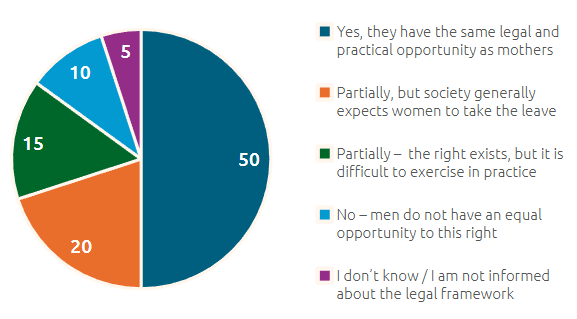
Awareness of fathers’ entitlements is uneven. While 50% of the women recognize that the law formally grants paternal leave, 20% believe societal pressures still force mothers to carry the caregiving burden alone. A further 15% view legal and practical access as genuinely equal for fathers, whereas 10% feel that men have significantly less opportunity, and 5% remain uncertain. These patterns show that—even where legal rights do exist—cultural and informational barriers limit practical uptake by fathers.
Figure 1 provides a detailed overview of these findings presented in percentages.
Figure 1. Women’s Perceptions of Fathers’ Access to and Use of Paternal Leave
When reflecting on fathers’ willingness to take parental leave, 31% believe that most men would decline the opportunity even when legally entitled. Nearly half of the respondents (45%) feel that, while some fathers might take leave, the majority continue to regard childcare as the mother’s responsibility. A smaller group (11%) is optimistic, perceiving that most fathers would gladly use parental leave if encouraged, and 14% remain uncertain about general paternal readiness.
These data indicate the existence of multi-layered obstacles to fathers exercising the right to parental leave perceived from our respondents – ranging from systemic (legal framework), through institutional (insufficient employer support), to cultural (gender roles stereotypes). The research findings indicate that women’s perception of fathers’ willingness and motivation to use parental leave reflects the complex socio-cultural dynamics in B&H.
Asked whether a non-transferable portion of leave reserved exclusively for fathers could foster more gender balanced caregiving, 48% women agreed that such a quota would be effective. Nevertheless, a clear majority prefers to leave leave-allocation decisions at the discretion of each family: 39% of respondents resist imposing a universal mandate, arguing that families themselves know best how to divide responsibilities. Only a minority (7%) believe that fathers alone should determine their use of statutory leave, and 6% neither support nor oppose these arrangements.
These findings point to the rooted gender norms that continue to shape parental responsibilities in B&H. While nearly half of the respondents recognize a partial openness among men, they simultaneously highlight that dominant attitudes still construct caregiving as a predominantly female domain. The fact that nearly a third of the surveyed women perceive widespread reluctance among fathers, even when legal and institutional frameworks allow for leave, underscores the cultural barriers that inhibit policy uptake. Only a marginal share of respondents expressed confidence in a widespread paternal willingness to engage in childcare through parental leave, reflecting the persistence of traditional masculinity norms and the slow pace of change in public perception. These results align with broader literature on gendered care dynamics in post-socialist contexts, which emphasizes the limited visibility and support for active fatherhood despite formal rights being available (Hobson and Fahlén 2009; Duvander et al. 2019).
Such attitudes may have significant implications for both policy and practice: without targeted interventions to promote and normalize paternal leave, gender-equal caregiving remains more of a legal fiction than a social reality.
There are significant variations in the perceived regularity of benefit payments and satisfaction with the conditions of the leave. Women in Republika Srpska reported more stable and timely payments, while in the Federation of B&H, the situation appears more fragmented. Overall, only 45% of the respondents received maternity benefits regularly and on time, and almost a quarter (23%) reported not receiving them at all. These disparities are linked to administrative and legal fragmentation across different entities and cantons, even from the standpoint of our respondents. The total of 52% of women recognize that differences exist in the duration of pregnancy and maternity leave, as well as differences in the number of benefits during these leaves. Among this group of women, 36% consider these differences to be very significant, while 16% consider that these differences are not particularly important. However, 4% think that there is no difference between entities and cantons in B&H and 45% simply do not know. This may point to the insufficient awareness among the women about the lack of uniformity in rights across different parts of the country, but at the same time to the complexity of the administrative system, which makes it difficult to see these differences.
More than a half of the respondents in this study (52%) reported either personally experiencing or directly witnessing unfavourable treatment in the workplace due to pregnancy or upon returning from maternity leave. These findings strongly underscore the persistent gender-based inequalities in the labour market and the systemic nature of discrimination against working mothers.
Qualitative responses provided by the participants point to a spectrum of discriminatory practices. These range from non-renewal of fixed-term employment contracts upon disclosure or discovery of pregnancy, to overt statements by employers framing pregnancy as an impediment to continued employment. Such accounts reflect the ongoing perception of motherhood as incompatible with professional commitment – a hallmark of what Gatrell (2011) terms the “maternal wall bias”. One respondent explicitly recounted that after each of her pregnancies, her contract was not extended, and on one occasion, the employer stated unambiguously that the pregnancy was the reason.
Even when employment relationships were not formally terminated, women reported facing punitive or degrading conditions upon return to work. These included job reassignments, loss of professional status, and the expectation to revalidate their competence – reflecting broader patterns of institutionalized maternal penalties (Correll, Benard and Paik 2007). As one woman puts it:
In addition to structural disadvantages, respondents described the prevalence of informal yet harmful practices, such as workplace mobbing, exclusion by peers, etc. all forms of what Williams (2010) classifies as subtle or covert discrimination. Several respondents described a lack of support and understanding from employers and colleagues, including tension around sick leave and vacation after miscarriages. One respondent noted:
Others described pressure from employers to return early from leave, or being blamed for taking care of their child during peak work periods. One woman testified:
One respondent reported being subjected to implicit criticism for taking annual leave following a period of sick leave due to a miscarriage – suggesting a broader cultural deficit in recognizing reproductive health as a part of occupational well-being. Women answered that they also faced coercion to return early from maternity leave, with employers applying direct pressure through frequent calls, or shifting informal agreements. This aligns with findings from another European study which indicates that informal managerial practices can undermine formal entitlements, especially in weakly regulated labour markets (O’Brien and Wall 2017).
These empirical insights reaffirm that maternity-related discrimination in the workplace is not limited to isolated cases but constitutes a systemic issue rooted in normative expectations about women’s primary caregiving role and the perceived incompatibility of care responsibilities with ideal worker norms. Legal inequalities across entities also exacerbate financial insecurity. One woman shared:
Despite these experiences, most women did not report discrimination. The reasons include lack of trust in institutions, fear of retaliation, lack of knowledge about their rights, and belief that reporting would be ineffective. Additionally, women often choose not to report cases of discrimination out of the fear of possible repercussions on their careers, such as dismissal, isolation, exclusion from the collective, etc. In addition to these most common reasons, women decide not to report cases of discrimination because they believe that the situation will resolve itself, or they are not familiar with their rights and the ways to protect them, or to whom they can turn to in case of discrimination.
Most women see a mixed record when it comes to upholding laws that protect pregnant employees and new mothers. While 52% feel these safeguards are “mostly” enforced, just 4% believe they are implemented in full. Conversely, 26% say the protections are not honoured at all, and 19% say they cannot judge how well the rules work in practice. This disparity between legal guarantees and everyday experience underscores a pressing need for stronger, more consistent enforcement – and helps explain why many women hesitate to pursue formal complaints when they face discrimination. The respondents expressed the greatest scepticism toward employers as agents of change, a stance that can be linked to their experiences of discrimination, lack of support, or inadequate working conditions frequently encountered by women. In contrast, attitudes toward trade unions and state institutions were less critical, reflecting a certain degree of trust that could potentially be strengthened through their active engagement in advancing improvements in this area. The most favourable perception was reserved for the civil society sector, which was viewed as the most credible actor for driving the necessary changes.
5 DISCUSSION
Work-life balance is best understood as a multidimensional concept situated at the intersection of three interrelated policy domains: labour legislation, family policy, and gender equality frameworks. Conceptually, it refers to individuals’ capacity to fulfil responsibilities in both paid employment and caregiving, without compromising personal well-being, autonomy, or full social participation (Crompton and Lyonette 2006). While labour laws determine the conditions of paid work, including entitlements to leave and flexibility, family policies provide the infrastructural and financial mechanisms, such as childcare provision and parental leave schemes, which mediate the relationship between caregiving and labour market participation. Gender equality policies, in turn, are intended to ensure equitable access to these mechanisms, addressing structural barriers that inhibit their effective realization for both women and men.
However, the practical effectiveness of these policies is deeply conditioned by prevailing cultural norms and the institutional structures in which they are embedded. Even where parental leave is formally available to fathers, uptake remains limited in the absence of workplace incentives, public support, and cultural validation of male caregiving roles.
Findings from this study illustrate how legal and administrative fragmentation across B&H reinforces such inequalities, leading to material disparities in access to social rights. For example, while employed mothers in the Republika Srpska are entitled to maternity benefits amounting to their full salary, mothers in the Federation of B&H must rely on canton-level benefits, which are in some cases lower than their actual income. This divergence stems from B&H’s highly decentralized governance structure, in which responsibilities for social protection, including maternity and parental leave, are distributed across entity and sub-entity levels. As a result, access to social rights is unevenly distributed, not according to need or eligibility, but based on geographic location.
This condition exemplifies what Fraser (1997) terms “maldistribution,” wherein unequal access to social entitlements systematically reinforces classed and gendered disadvantages. Rather than alleviating precarity, the welfare system in B&H can exacerbate it, placing the burden of navigating bureaucratic inconsistencies primarily on individual women. In some cases, this results in prolonged legal disputes for benefits that should be universally guaranteed, pointing to the erosion of legal certainty and the inefficacy of the welfare state in safeguarding basic rights.
The case of B&H also exposes a deeper structural contradiction: although the country has ratified international legal instruments such as Convention on the Elimination of All Forms of Discrimination against Women (CEDAW) (1981) and the European Social Charter (1996) — both of which mandate equal protection in the realm of maternity and parental rights—implementation is fractured and inconsistent. This institutional dissonance undermines the principle of legal equality and contributes to citizens’ perceptions of systemic injustice. The qualitative data further reveal that this misalignment is not only experienced as administrative inconvenience, but as a factor that actively constrains women’s labour market participation and career advancement. Some respondents expressed withdrawal from job competition due to economic insecurity, a finding consistent with broader literature on how instability suppresses women’s mobility and long-term planning (Karamessini and Rubery 2018).
Taken together, the findings point to the compounding effects of legal fragmentation, weak institutional support, and entrenched gender norms. These dynamics interact to deepen the stratification of economic risks and reinforce gendered patterns of social reproduction. As such, a harmonization of entity-level legislation with international standards is not merely a legal necessity, but a socio-political imperative. In this way, effective protection of maternal rights is grounded in a systemic approach that affirms caregiving as a socially necessary contribution, rather than relegating it to the individual or family domain.
Motherhood remains closely intertwined with the shaping of women’s professional trajectories in B&H, as reflected in the survey data. Despite the presence of developed legal frameworks, the gap between policy and practice remains significant, shaped by regional disparities and cultural expectations. The respondents called not only for stricter enforcement of the existing labour protections but also for broader cultural shifts, most notably, the institutional and discursive promotion of fathers’ active involvement in caregiving. They believe that encouragement of men’s participation in parental leave and early childrearing—through both policy design and public messaging—is essential to challenging the persistent “double burden” faced by women.
Finally, the implementation of gender equality provisions cannot be isolated from the value orientations of the very individuals and communities meant to benefit from them. As this study shows, formal rights alone are insufficient to ensure substantive equality. Without addressing the institutional, cultural, and normative foundations of gendered caregiving, women in B&H will continue to experience structural limitations to achieving a sustainable and equitable work-life balance.
6 CONCLUSION
This study provides a critical insight into the lived realities of employed mothers in B&H, revealing significant gaps between the normative legal framework and everyday experiences related to maternity and parental leave, workplace discrimination, and gendered care responsibilities. While legal provisions for maternity leave exist across B&H, their implementation is uneven and often fragmented. Variations in eligibility conditions, benefit levels, and administrative practices not only produce material inequalities, but could also contribute to a sense of legal insecurity among mothers.
The findings indicate that although a strong majority of women make use of formal leave entitlements, the burden of childcare continues to fall predominantly on mothers, with very limited uptake of parental leave by fathers. Cultural expectations, limited institutional incentives, and weak enforcement mechanisms reinforce traditional gender roles and discourage shared responsibility for early childcare. Respondents also support non-transferable leave for fathers, suggesting an emerging awareness of the need for systemic transformation in parental norms, yet this remains aspirational rather than realized.
Moreover, the study points to widespread experiences of labour market discrimination. Almost half of the respondents reported either facing or witnessing discriminatory practices related to pregnancy or maternity, ranging from contract termination to demotion and hostile work environments. Particularly concerning is the reluctance to report such violations, driven by a lack of institutional trust, fear of retaliation, and low legal literacy. This speaks to the structural nature of the gender-based inequality at the intersection of care work and labour rights.
Our analysis shows that the gap between legal provisions and the practical realization of rights for employed mothers in B&H stems from a combination of inconsistent institutional implementation, insufficient support mechanisms, and deeply embedded gender norms that continue to assign caregiving responsibilities primarily to women. Without parallel shifts in workplace culture, public policy, and social expectations – particularly those regarding active fatherhood, the formal entitlements remain only partially effective in practice. While the respondents express moderate optimism that maternity and parental rights may improve in the coming years, this is tempered by the scepticism regarding institutional will and capacity. Civil society organizations emerge as key actors of trust, suggesting their critical role in advocacy and support. Ultimately, advancing gender equality in the work-family domain in B&H requires not only legislative reform, but a broader reconceptualization of care, justice, and social responsibility in all spheres of life.
The research presented in this article was funded by the European Union under the Citizens, Equality, Rights and Values (CERV) programme, project “Career and mama – where ambitions nourish along with a family nest” (CAM2025), under the contract no. 101190613. The views and opinions expressed are those of the authors only and do not necessarily reflect those of the European Union or granting authority. Authors also acknowledge that this article was realised with the support of the Ministry of Science, Technological Development and Innovation of the Republic of Serbia, according to the Agreement on the realisation and financing of scientific research 451-03-136/2025-03/ 200025.
Data availability statement
Data are available from the authors upon request.
References
- Beijing Declaration and Platform for Action. (1995). https://archive.unescwa.org/sites/www.unescwa.org/files/u1281/bdpfa_e.pdf
- Bryson, V. (2007). Gender and the Politics of Time. Feminist Theory and Contemporary Debates. UK: Policy Press. https://dokumen.pub/gender-and-the-politics-of-time-feminist-theory-and-contemporary-debates-9781847422972.html
- Charter of Fundamental Rights of the European Union. (2012). https://eur-lex.europa.eu/legal-content/EN/TXT/HTML/?uri=CELEX:12012P/TXT
- Constitution of Bosnia and Herzegovina. (1995). https://www.ustavnisud.ba/uploads/documents/constitution-of-bih_1625734692.pdf
- Council of Europe Convention on preventing and combating violence against women and domestic violence (Istanbul Convention). (2014). https://www.coe.int/en/web/gender-matters/council-of-europe-convention-on-preventing-and-combating-violence-against-women-and-domestic-violence
- Council Directive 92/85/EEC of 19 October 1992 on the introduction of measures to encourage improvements in the safety and health at work of pregnant workers and workers who have recently given birth or are breastfeeding (tenth individual Directive within the meaning of Article 16 (1) of Directive 89/391/EEC). (1992). https://eur-lex.europa.eu/eli/dir/1992/85/oj/eng
- Council Directive 97/81/EC of 15 December 1997 concerning the Framework Agreement on part-time work concluded by UNICE, CEEP and the ETUC. (1997). https://eur-lex.europa.eu/eli/dir/1997/81/oj/eng
- Convention on the Elimination of All Forms of Discrimination against Women (CEDAW). (1981). https://www.ohchr.org/en/instruments-mechanisms/instruments/convention-elimination-all-forms-discrimination-against-women
- Correll, S. J., Benard, S., & Paik, I. (2007). Getting a Job: Is There a Motherhood Penalty? American Journal of Sociology, 112(5), 1297–1338. https://doi.org/10.1086/511799
- Crompton, R., & Lyonette, C. (2006). Work-Life ‘Balance’ in Europe. Acta Sociologica, 49(4), 379–393. https://doi.org/10.1177/0001699306071680
- Daly, M. (2011). Welfare. Cambridge: Polity Press.
- Directive (EU) 2019/1158 of the European Parliament and of the Council of 20 June 2019 on work-life balance for parents and carers and repealing Council Directive 2010/18/EU. (2019, June 20). https://eur-lex.europa.eu/eli/dir/2019/1158/oj/eng
- Directive 2006/54/EC of the European Parliament and of Council of 5 July 2006 on the implementation of the principle of equal opportunities and equal treatment of men and women in matters of employment and occupation (recast). (2006). https://eur-lex.europa.eu/eli/dir/2006/54/oj/eng
- Duvander, A., Lappegard, T., Andersen, N. S., Garðarsdóttir, O., Neyer, G., & Viklund, I. (2019). Parental leave policies and continued childbearing in Iceland, Norway, and Sweden. Demographic Research, 40(51), 1501–1528. https://doi.org/10.4054/DemRes.2019.40.51
- Esping-Andersen, G. (1999). Social Foundations of Postindustrial Economies. UK: Oxford University Press. https://doi.org/10.1093/0198742002.001.0001
- European Pillar of Social Rights. (2017). https://employment-social-affairs.ec.europa.eu/policies-and-activities/european-pillar-social-rights-building-fairer-and-more-inclusive-european-union_en
- European Social Charter. (1996). https://rm.coe.int/168007cf93
- Fraser, N. (1997). Justice Interruptus: Critical Reflections on the „Postsocialist” Condition. New York: Routledge.
- Fraser, N. (1994). After The Family Wage: Gender Equity and the Welfare State. Political Theory, 22(4), 591–618. https://doi.org/10.1177/0090591794022004003 (Original work published 1994)
- Gatrell, C. (2011). Managing the maternal body: A comprehensive review and transdisciplinary analysis. International Journal of Management Reviews, 13(1), 97–112. https://doi.org/10. 1111/j.1468-2370.2010.00286.x
- Gornick, J. C., & Meyers, M. K. (2003). Families That Work: Policies for Reconciling Parenthood and Employment. New York: Russell Sage Foundation.
- Hasanagić, S., & Papović, M. (2020). Uticaj rodne podjele porodičnih i kućanskih poslova na profesionalni život zaposlenih žena u Bosni i Hercegovini. Sarajevo: Agencija za ravnopravnost spolova Bosne i Hercegovine Ministarstva za ljudska prava i izbjeglice Bosne i Hercegovine. https://arsbih.gov.ba/wp-content/uploads/2020/09/Uticaj-rodne-podjele-porodi%C4%8Dnih-i-ku%C4%87anskih-poslova-na-profesionalni-%C5%BEivot-zaposlenih-%C5%BEena-u-BiH.pdf
- Hobson, B., & Fahlén, S. (2009). Competing scenarios for European fathers: Applying Sen’s capabilities and agency framework to work–family balance. Annals of the American Academy of Political and Social Science, 624(1), 214–233. https://doi.org/10.1177/0002716209334435
- Kremer, M. (2007). How Welfare States Care: Culture, Gender and Parenting in Europe. (Changing Welfare States). Amsterdam: Amsterdam Univ. Press. https://d-nb.info/1191654788/34
- Law on Gender Equality in Bosnia and Herzegovina. (2009). https://www.gcfbih.gov.ba/wp-content/uploads/2014/01/ZoRS_32_10_H.pdf
- Law on Prohibition of Discrimination. (2016). https://udt.pravosudje.ba/vstvfo/E/10/article/146210
- O’Brien, M., & Wall, K. (Eds.). (2017). Comparative Perspectives on Work-Life Balance and Gender Equality. Fathers on Leave Alone. NY: Springer. https://library.oapen.org/bitstream/id/23a8db9e-fd73-4c56-9ce7-d27e190cbe35/1001878.pdf
- Republika Srpska Social Inclusion Strategy for 2021–2027. (2020). https://www.unicef.org/bih/media/6481/file/Republika%20Srpska%20Social%20Inclusion%20STRATEGY.pdf
- Karamessini, M. & Rubery, J. (Eds.). (2018). Women and Austerity: The Economic Crisis and the Future for Gender Equality. NY: Routledge.
- Saxonberg, S., & Sirovátka, T. (2006). Failing family policy in post-communist Central Europe. Journal of Comparative Policy Analysis: Research and Practice, 8(2), 185–202. https://doi.org/10.1080/13876980600682089
- Strategija razvoja preduzetništva žena Republike Srpske za period 2019–2023. godine. (2019). https://www.vladars.net/sr-SP-Cyrl/Vlada/Ministarstva/mpp/stratdok/Documents/Strategija%20razvoja%20preduzetnistva%20zena%20Republike%20Srpske%20za%20period%202019-2023.pdf
- Strategija zapošljavanja Republike Srpske 2021–2027. (2021). https://vladars.rs/sr-SP-Cyrl/Vlada/Ministarstva/mpb/PAO/Pages/%D0%A1%D1%82%D1%80%D0%B0%D1%82%D0%B5%D0%B3%D0%B8%D1%98%D0%B0-%D0%B7%D0%B0%D0%BF%D0%BE%D1%88%D1%99%D0%B0%D0%B2%D0%B0%D1%9A%D0%B0-%D0%A0%D0%A1.aspx
- Tomanović, S. (2017). Roditeljstvo između familizma i individualizacije: primer Srbije In S. Ignjatović & A. Bošković (Eds.), Individualizam (pp. 162–181). Beograd: Institut društvenih nauka.
- Williams, J. C. (2010). Reshaping the Work-Family Debate: Why Men and Class Matter. Harvard: Harvard University Press.
Article Details
Published by the Institute of Social Sciences - Center for Demographic Research




References
Beijing Declaration and Platform for Action. (1995). https://archive.unescwa.org/sites/www.unescwa.org/files/u1281/bdpfa_e.pdf
Bryson, V. (2007). Gender and the Politics of Time. Feminist Theory and Contemporary Debates. UK: Policy Press. https://dokumen.pub/gender-and-the-politics-of-time-feminist-theory-and-contemporary-debates-9781847422972.html DOI: https://doi.org/10.46692/9781847422972
Charter of Fundamental Rights of the European Union. (2012).
https://eur-lex.europa.eu/legal-content/EN/TXT/HTML/?uri=CELEX:12012P/TXT
Constitution of Bosnia and Herzegovina. (1995). https://www.ustavnisud.ba/uploads/documents/constitution-of-bih_1625734692.pdf
Council of Europe Convention on preventing and combating violence against women and domestic violence (Istanbul Convention). (2014). https://www.coe.int/en/web/gender-matters/council-of-europe-convention-on-preventing-and-combating-violence-against-women-and-domestic-violence
Council Directive 92/85/EEC of 19 October 1992 on the introduction of measures to encourage improvements in the safety and health at work of pregnant workers and workers who have recently given birth or are breastfeeding (tenth individual Directive within the meaning of Article 16 (1) of Directive 89/391/EEC). (1992). https://eur-lex.europa.eu/eli/dir/1992/85/oj/eng
Council Directive 97/81/EC of 15 December 1997 concerning the Framework Agreement on part-time work concluded by UNICE, CEEP and the ETUC. (1997). https://eur-lex.europa.eu/eli/dir/1997/81/oj/eng
Convention on the Elimination of All Forms of Discrimination against Women (CEDAW). (1981). https://www.ohchr.org/en/instruments-mechanisms/instruments/convention-elimination-all-forms-discrimination-against-women
Correll, S. J., Benard, S., & Paik, I. (2007). Getting a Job: Is There a Motherhood Penalty?. American Journal of Sociology, 112(5), 1297–1338. https://doi.org/10.1086/511799 DOI: https://doi.org/10.1086/511799
Crompton, R., & Lyonette, C. (2006). Work-Life ‘Balance’ in Europe. Acta Sociologica, 49(4), 379-393. https://doi.org/10.1177/0001699306071680 DOI: https://doi.org/10.1177/0001699306071680
Daly, M. (2011). Welfare. Cambridge: Polity Press.
Directive (EU) 2019/1158 of the European Parliament and of the Council of 20 June 2019 on work-life balance for parents and carers and repealing Council Directive 2010/18/EU. (2019, June 20). https://eur-lex.europa.eu/eli/dir/2019/1158/oj/eng
Directive 2006/54/EC of the European Parliament and of Council of 5 July 2006 on the implementation of the principle of equal opportunities and equal treatment of men and women in matters of employment and occupation (recast). (2006). https://eur-lex.europa.eu/eli/dir/2006/54/oj/eng
Duvander, A., Lappegard, T., Andersen, N. S., Garðarsdóttir, O., Neyer, G., & Viklund, I. (2019). Parental leave policies and continued childbearing in Iceland, Norway, and Sweden. Demographic Research, 40(51), 1501–1528. https://doi.org/10.4054/DemRes.2019.40.51 DOI: https://doi.org/10.4054/DemRes.2019.40.51
Esping-Andersen, G. (1999). Social Foundations of Postindustrial Economies. UK: Oxford University Press. https://doi.org/10.1093/0198742002.001.0001 DOI: https://doi.org/10.1093/0198742002.001.0001
European Pillar of Social Rights. (2017). https://employment-social-affairs.ec.europa.eu/policies-and-activities/european-pillar-social-rights-building-fairer-and-more-inclusive-european-union_en
European Social Charter. (1996). https://rm.coe.int/168007cf93
Fraser, N. (1997). Justice Interruptus: Critical Reflections on the „Postsocialist” Condition. New York: Routledge.
Fraser, N. (1994). After The Family Wage: Gender Equity and the Welfare State. Political Theory, 22(4), 591-618. https://doi.org/10.1177/0090591794022004003 (Original work published 1994) DOI: https://doi.org/10.1177/0090591794022004003
Gatrell, C. (2011). Managing the maternal body: A comprehensive review and transdisciplinary analysis. International Journal of Management Reviews, 13(1), 97–112. https://doi.org/10.1111/j.1468-2370.2010.00286.x DOI: https://doi.org/10.1111/j.1468-2370.2010.00286.x
Gornick, J. C., & Meyers, M. K. (2003). Families That Work: Policies for Reconciling Parenthood and Employment. New York: Russell Sage Foundation.
Hasanagić, S., & Papović, M. (2020). Uticaj rodne podjele porodičnih i kućanskih poslova na profesionalni život zaposlenih žena u Bosni i Hercegovini. Sarajevo: Agencija za ravnopravnost spolova Bosne i Hercegovine Ministarstva za ljudska prava i izbjeglice Bosne i Hercegovine. https://arsbih.gov.ba/wp-content/uploads/2020/09/Uticaj-rodne-podjele-porodi%C4%8Dnih-i-ku%C4%87anskih-poslova-na-profesionalni-%C5%BEivot-zaposlenih-%C5%BEena-u-BiH.pdf
Hobson, B., & Fahlén, S. (2009). Competing scenarios for European fathers: Applying Sen’s capabilities and agency framework to work–family balance. Annals of the American Academy of Political and Social Science, 624(1), 214–233. https://doi.org/10.1177/0002716209334435 DOI: https://doi.org/10.1177/0002716209334435
Kremer, M. (2007). How Welfare States Care: Culture, Gender and Parenting in Europe. (Changing Welfare States). Amsterdam: Amsterdam Univ. Press. https://d-nb.info/1191654788/34 DOI: https://doi.org/10.5117/9789053569757
Law on Gender Equality in Bosnia and Herzegovina. (2009). https://www.gcfbih.gov.ba/wp-content/uploads/2014/01/ZoRS_32_10_H.pdf
Law on Prohibition of Discrimination. (2016). https://udt.pravosudje.ba/vstvfo/E/10/article/146210
O’Brien, M., & Wall, K. (Eds.). (2017). Comparative Perspectives on Work-Life Balance and Gender Equality. Fathers on Leave Alone. NY: Springer. https://library.oapen.org/bitstream/id/23a8db9e-fd73-4c56-9ce7-d27e190cbe35/1001878.pdf DOI: https://doi.org/10.1007/978-3-319-42970-0
Republika Srpska Social Inclusion Strategy for 2021–2027. (2020). https://www.unicef.org/bih/media/6481/file/Republika%20Srpska%20Social%20Inclusion%20STRATEGY.pdf
Karamessini, M. & Rubery, J. (Eds.). (2018). Women and Austerity: The Economic Crisis and the Future for Gender Equality. NY: Routledge.
Saxonberg, S., & Sirovátka, T. (2006). Failing family policy in post-communist Central Europe. Journal of Comparative Policy Analysis: Research and Practice, 8(2), 185–202. https://doi.org/10.1080/13876980600682089 DOI: https://doi.org/10.1080/13876980600682089
Strategija razvoja preduzetništva žena Republike Srpske za period 2019–2023. godine. (2019). https://www.vladars.net/sr-SP-Cyrl/Vlada/Ministarstva/mpp/stratdok/Documents/Strategija%20razvoja%20preduzetnistva%20zena%20Republike%20Srpske%20za%20period%202019-2023.pdf
Strategija zapošljavanja Republike Srpske 2021-2027. (2021). https://vladars.rs/sr-SP-Cyrl/Vlada/Ministarstva/mpb/PAO/Pages/%D0%A1%D1%82%D1%80%D0%B0%D1%82%D0%B5%D0%B3%D0%B8%D1%98%D0%B0-%D0%B7%D0%B0%D0%BF%D0%BE%D1%88%D1%99%D0%B0%D0%B2%D0%B0%D1%9A%D0%B0-%D0%A0%D0%A1.aspx
Tomanović, S. (2017). Roditeljstvo između familizma i individualizacije: primer Srbije In S. Ignjatović & A. Bošković (Eds.), Individualizam (pp. 162–181). Beograd: Institut društvenih nauka.
Williams, J. C. (2012). Reshaping the Work-Family Debate: Why Men and Class Matter. Harvard: Harvard University Press. DOI: https://doi.org/10.2307/j.ctvjghv9t