
Housing Pressure, Youth Insecurity and Conditional Fertility Responses to Economic Downturns in Europe
Bočna strana članka
Glavni sadržaj članka
Apstrakt
This paper examines whether fertility in Europe responds asymmetrically to macroeconomic expansions and contractions, and whether these responses are conditioned by housing-cost pressure and youth labour-market insecurity. Rather than relying on a composite socioeconomic pressure index, the analysis treats economic growth, downturns, housing overburden, youth unemployment, female labour-force participation and female tertiary education as distinct mechanisms. The empirical design is based on an unbalanced country-year panel covering 45 European countries between 1960 and 2025, combining data from the World Development Indicators and Eurostat. Economic growth is decomposed into positive-growth episodes, defined as booms, and negative-growth episodes, defined as downturns. Fixed-effects models are used to control for time-invariant country characteristics and common year shocks, while standard errors are clustered at the country level.
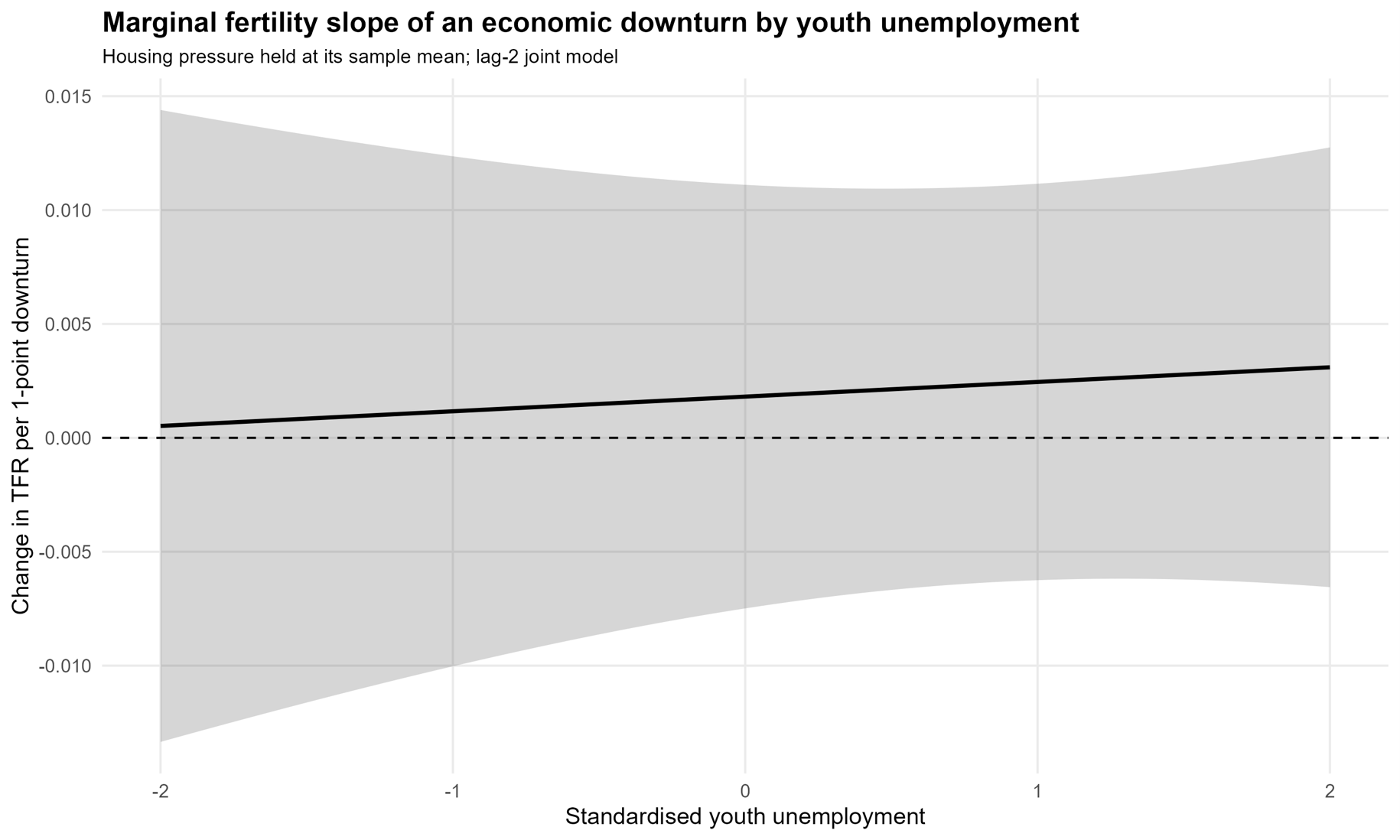
The findings do not support a broad unconditional asymmetry between booms and downturns. In other words, economic contractions do not appear to reduce fertility uniformly across all European contexts. Instead, the central result is conditional: downturns become significantly fertility-reducing when they occur under higher housing-cost pressure. In the main interaction model, the coefficient for the interaction between downturns and standardized housing pressure is negative and statistically significant, indicating that adverse macroeconomic shocks matter most when households are already exposed to affordability constraints. Youth unemployment is also consistently negatively associated with fertility, suggesting that labour-market insecurity among young adults represents an additional channel through which fertility may be delayed or reduced.
These results suggest that fertility responses to economic crises are not homogeneous across Europe. Rather, they are intensified when young adults face simultaneous barriers in employment, housing access and household formation. The paper contributes to debates on low fertility, economic uncertainty and housing regimes by showing that macroeconomic shocks are most consequential when embedded in broader structures of affordability and insecurity.
Puni tekst članka je dostupan za ovaj lokalitet: English.
Detalji članka
Centar za demografska istraživanja Instituta društvenih nauka




Reference
Adsera, A. (2004). Changing fertility rates in developed countries: The impact of labor market institutions. Journal of Population Economics, 17(1), 17-43. https://doi.org/10.1007/s00148-003-0166-x DOI: https://doi.org/10.1007/s00148-003-0166-x
Adsera, A. (2005). Vanishing children: From high unemployment to low fertility in developed countries. American Economic Review, 95(2), 189-193. https://doi.org/10.1257/000282805774669763 DOI: https://doi.org/10.1257/000282805774669763
Adsera, A. (2011). The interplay of employment uncertainty and education in explaining second births in Europe. Demographic Research, 25, 513-544. https://doi.org/10.4054/DemRes.2011.25.16 DOI: https://doi.org/10.4054/DemRes.2011.25.16
Alderotti, G., Vignoli, D., Baccini, M., & Matysiak, A. (2021). Employment instability and fertility in Europe: A meta-analysis. Demography, 58(3), 871-900. https://doi.org/10.1215/00703370-9164737 DOI: https://doi.org/10.1215/00703370-9164737
Andersson, G. (2000). The impact of labour-force participation on childbearing behaviour: Pro-cyclical fertility in Sweden during the 1980s and the 1990s. European Journal of Population, 16(4), 293-333. https://doi.org/10.1023/A:1006454909642 DOI: https://doi.org/10.1023/A:1006454909642
Becker, G. S. (1960). An economic analysis of fertility. In National Bureau of Economic Research (Ed.), Demographic and economic change in developed countries (pp. 209-240). Princeton University Press.
Becker, G. S. (1991). A treatise on the family (Enlarged ed.). Harvard University Press. DOI: https://doi.org/10.4159/9780674020665
Becker, G. S., & Lewis, H. G. (1973). On the interaction between the quantity and quality of children. Journal of Political Economy, 81(2, Part 2), S279-S288. https://doi.org/10.1086/260166 DOI: https://doi.org/10.1086/260166
Bignami, S., Endrich, M., Natale, F., & Ueffing, P. (2024). Low fertility in the EU: A review of trends and drivers (JRC137492). Publications Office of the European Union. https://publications.jrc.ec.europa.eu/repository/handle/JRC137492
Bokun, A. (2024). Cash transfers and fertility: Evidence from Poland’s Family 500+ policy. Demographic Research, 51, 855-910. https://doi.org/10.4054/DemRes.2024.51.28 DOI: https://doi.org/10.4054/DemRes.2024.51.28
Castles, F. G., & Ferrera, M. (1996). Home ownership and the welfare state: Is Southern Europe different?. South European Society and Politics, 1(2), 163-185. https://doi.org/10.1080/13608749608539470 DOI: https://doi.org/10.1080/13608749608539470
Comolli, C. L. (2017). The fertility response to the Great Recession in Europe and the United States: Structural economic conditions and perceived economic uncertainty. Demographic Research, 36, 1549-1600. https://doi.org/10.4054/DemRes.2017.36.51 DOI: https://doi.org/10.4054/DemRes.2017.36.51
Currie, J., & Schwandt, H. (2014). Short- and long-term effects of unemployment on fertility. Proceedings of the National Academy of Sciences, 111(41), 14734-14739. https://doi.org/10.1073/pnas.1408975111 DOI: https://doi.org/10.1073/pnas.1408975111
Dettling, L. J., & Kearney, M. S. (2014). House prices and birth rates: The impact of the real estate market on the decision to have a baby. Journal of Public Economics, 110, 82-100. https://doi.org/10.1016/j.jpubeco.2013.09.009 DOI: https://doi.org/10.1016/j.jpubeco.2013.09.009
Easterlin, R. A. (1975). An economic framework for fertility analysis. Studies in Family Planning, 6(3), 54-63. https://doi.org/10.2307/1964934 DOI: https://doi.org/10.2307/1964934
Eurostat. (2026). EU fertility rate at 1.34 live births per woman in 2024. European Commission. https://ec.europa.eu/eurostat/web/products-eurostat-news/w/ddn-20260306-1
Gauthier, A. H. (2007). The impact of family policies on fertility in industrialized countries: A review of the literature. Population Research and Policy Review, 26(3), 323-346. https://doi.org/10.1007/s11113-007-9033-x DOI: https://doi.org/10.1007/s11113-007-9033-x
Gil-Solsona, D. (2023). ‘Not really leaving home’ in Southern Europe: Intermediate living situations in Catalan youth housing trajectories. Journal of Youth Studies, 26(8), 1084-1107. https://doi.org/10.1080/13676261.2022.2065912 DOI: https://doi.org/10.1080/13676261.2022.2065912
Goldstein, J. R., Sobotka, T., & Jasilioniene, A. (2009). The end of “lowest-low” fertility?. Population and Development Review, 35(4), 663-699. https://doi.org/10.1111/j.1728-4457.2009.00304.x DOI: https://doi.org/10.1111/j.1728-4457.2009.00304.x
Kalwij, A. (2010). The impact of family policy expenditure on fertility in Western Europe. Demography, 47(2), 503-519. https://doi.org/10.1353/dem.0.0104 DOI: https://doi.org/10.1353/dem.0.0104
Kreyenfeld, M. (2010). Uncertainties in female employment careers and the postponement of parenthood in Germany. European Sociological Review, 26(3), 351-366. https://doi.org/10.1093/esr/jcp026 DOI: https://doi.org/10.1093/esr/jcp026
Kulu, H., & Steele, F. (2013). Interrelationships between childbearing and housing transitions in the family life course. Demography, 50(5), 1687-1714. https://doi.org/10.1007/s13524-013-0216-2 DOI: https://doi.org/10.1007/s13524-013-0216-2
Luppi, F., Rosina, A., & Sironi, E. (2024). Leaving and returning to the parental home during COVID times in France, Italy, Germany, Spain, and the United Kingdom. Demographic Research, 50, 101-114. https://doi.org/10.4054/DemRes.2024.50.3 DOI: https://doi.org/10.4054/DemRes.2024.50.3
Matysiak, A., & Vignoli, D. (2024). Family life courses, uncertain futures, and the changing world of work: State-of-the-art and prospects. European Journal of Population, 40(1), 19. https://doi.org/10.1007/s10680-024-09701-x DOI: https://doi.org/10.1007/s10680-024-09701-x
Mulder, C. H. (2006). Home-ownership and family formation. Journal of Housing and the Built Environment, 21(3), 281-298. https://doi.org/10.1007/s10901-006-9050-9 DOI: https://doi.org/10.1007/s10901-006-9050-9
Mulder, C. H., & Billari, F. C. (2010). Homeownership regimes and low fertility. Housing Studies, 25(4), 527-541. https://doi.org/10.1080/02673031003711469 DOI: https://doi.org/10.1080/02673031003711469
Neyer, G., & Andersson, G. (2008). Consequences of family policies on childbearing behavior: Effects or artifacts?. Population and Development Review, 34(4), 699-724. https://doi.org/10.1111/j.1728-4457.2008.00246.x DOI: https://doi.org/10.1111/j.1728-4457.2008.00246.x
OECD. (2024). Society at a glance 2024: OECD social indicators. OECD Publishing. https://doi.org/10.1787/918d8db3-en DOI: https://doi.org/10.1787/918d8db3-en
Proshin, A. (2023). Impact of child subsidies on child health, well-being, and investment in child human capital: Evidence from Russian Longitudinal Monitoring Survey 2010-2017. European Journal of Population, 39(1), 14. https://doi.org/10.1007/s10680-023-09653-8 DOI: https://doi.org/10.1007/s10680-023-09653-8
Schneider, D. (2015). The Great Recession, fertility, and uncertainty: Evidence from the United States. Journal of Marriage and Family, 77(5), 1144-1156. https://doi.org/10.1111/jomf.12212 DOI: https://doi.org/10.1111/jomf.12212
Schwanitz, K., Rampazzo, F., & Vitali, A. (2021). Unpacking intentions to leave the parental home in Europe using the Generations and Gender Survey. Demographic Research, 45, 17-54. https://doi.org/10.4054/DemRes.2021.45.2 DOI: https://doi.org/10.4054/DemRes.2021.45.2
Slonimczyk, F., & Yurko, A. (2014). Assessing the impact of the maternity capital policy in Russia. Labour Economics, 30, 265-281. https://doi.org/10.1016/j.labeco.2014.03.004 DOI: https://doi.org/10.1016/j.labeco.2014.03.004
Sobotka, T., Skirbekk, V., & Philipov, D. (2011). Economic recession and fertility in the developed world. Population and Development Review, 37(2), 267-306. https://doi.org/10.1111/j.1728-4457.2011.00411.x DOI: https://doi.org/10.1111/j.1728-4457.2011.00411.x
Sági, J., & Lentner, C. (2022). Key issues in the effectiveness of public financial tools to support childbearing: The example of Hungary during the COVID-19 crisis. PLOS ONE, 17(8), e0273090. https://doi.org/10.1371/journal.pone.0273090 DOI: https://doi.org/10.1371/journal.pone.0273090
Vakulenko, E. S., Ivashina, N. V., & Svistyilnik, Y. O. (2023). Regional maternity capital programmes: Impact on fertility in Russia. Economy of Regions, 19(4), 1077-1092. https://doi.org/10.17059/ekon.reg.2023-4-10 DOI: https://doi.org/10.17059/ekon.reg.2023-4-10
van Wijk, D. (2024). House prices and fertility: Can the Dutch housing crisis explain the post-2010 fertility decline?. Population, Space and Place, 30(7). https://doi.org/10.1002/psp.2787 DOI: https://doi.org/10.1002/psp.2787
van Wijk, D., & Billari, F. C. (2024). Fertility postponement, economic uncertainty, and the increasing income prerequisites of parenthood. Population and Development Review, 50(2), 287-322. https://doi.org/10.1111/padr.12624 DOI: https://doi.org/10.1111/padr.12624
van Wijk, D., & Feijten, P. (2025). Rising house prices, falling fertility? How rising house prices widen fertility differences between tenure groups. European Journal of Population, 41(1), 33. https://doi.org/10.1007/s10680-025-09754-6 DOI: https://doi.org/10.1007/s10680-025-09754-6