
From a Conventional to a Holistic Model of Parenthood Support
Article Sidebar
Main Article Content
If we accept the classification and definition of family policy proposed by Frejka and Gietel-Basten (2016), the model of parenthood support in Serbia can be described as conventional, primarily because it envisages paid leave for employed parents related to the birth of a child – which for a long time was intended exclusively for working mothers – as well as child allowance/parental allowance provided at the national level. This type of parenthood support has been implemented in Serbia since 1945 (Gavrilović, 2005; Rašević & Galjak, 2024). It has continued into the 21st century despite, on the one hand, various types of evidence pointing to an increasingly complex set of determinants underlying below-replacement fertility in a changing society and the need for a holistic response, as indicated in adopted policy documents, and, on the other hand, the absence of the expected results.
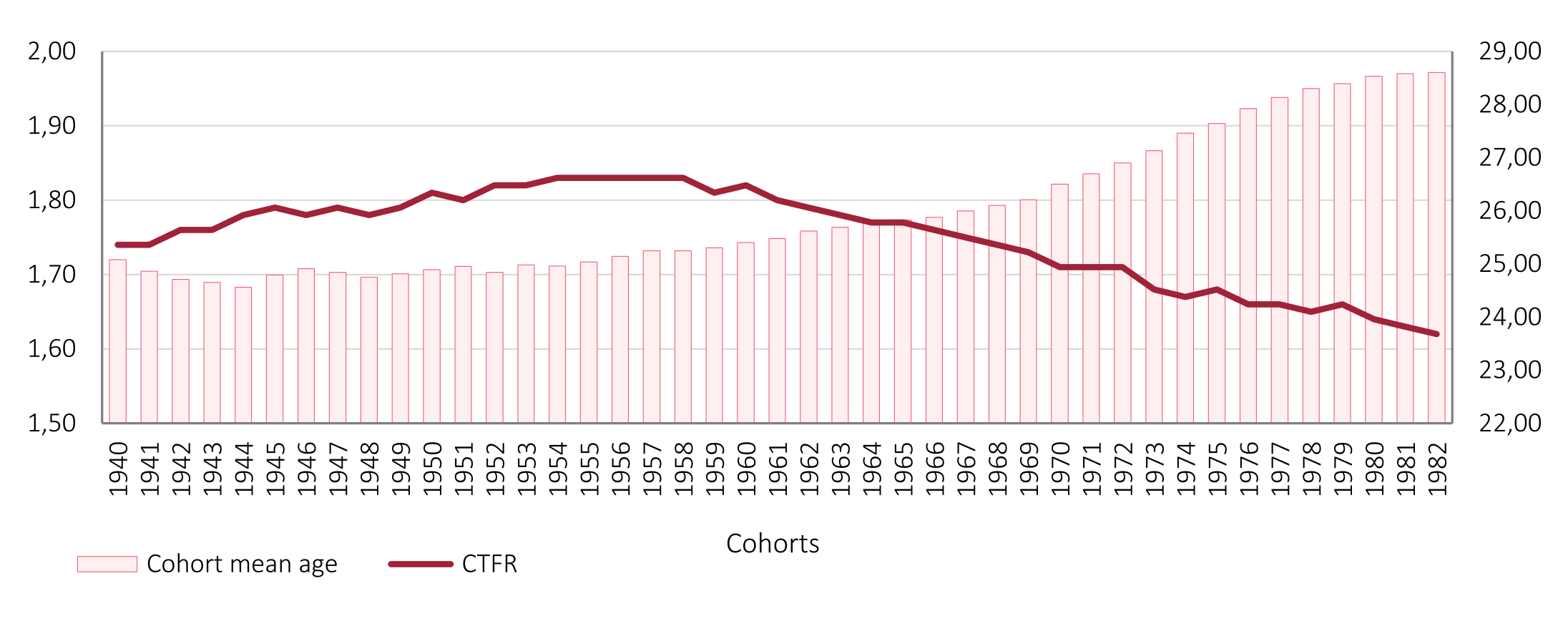
In order to conduct a broader analysis of completed fertility trends based on the results of the 2022 Census, we have included in our consideration the average number of live births per woman among cohorts born between 1940 and 1982 (Figure 1), since it was established that women in Serbia who exited their reproductive years in 2011 gave birth quite rarely after turning 40 years of age (Rašević, 2015). The analysis confirms that Serbia faced the fertility crisis early, points to a long-term stabilisation of completed fertility at the low level of 1.8 children per woman, and warns of an almost steady slow decline in the rate among 15 cohorts of women born between 1968 and 1982, to levels below 1.75 (Rašević, 2025), which is considered as very low cohort fertility (Zeman et al., 2018).
Figure 1. Cohort total fertility rate and cohort mean age at childbirth of women born 1940–1982, Serbia
Source: 2022 Census database. Reproduced from Rašević, 2026.
However, the findings of representative studies conducted in Serbia among different target groups between 1970 and 2020 showed that the average ideal or desired number of children was higher than two and higher than the number of children that respondents had at the time of the surveys (Todorović, 1976-1977; Blagojević, 1997; Rašević & Bjelobrk, 2021). Current findings are particularly significant. Working parents with at least one child aged up to 11 years expressed a high desired number of children – 2.6 on average. A relatively high average desired number of children was also recorded among both male and female respondents, ranging from 2.3 (for women living in rural areas) to 2.7 (for men living in urban settlements). At the same time, the average achieved fertility was found to be 1.7 children (Rašević & Bjelobrk, 2021) list.
In order to understand the very low average number of children per woman among cohorts born between 1968 and 1982, it is important to consider the broader social context in which family plans were pursued and decisions about parenthood were made. These decisions were shaped to a large extent by the consequences of a prolonged social and economic crisis, compounded by the fact that the factors causing the crisis not only persisted but also multiplied. Pronounced structural barriers to the realisation of family plans and parenthood were reinforced by forms of individual passivisation, such as feelings of economic and psychological insecurity and social anomie, as well as women's deep dissatisfaction with their own position in partner relationships, the family and society. In addition to these factors, decisions regarding family plans and parenthood were also shaped by a process of profound social transformation. On the one hand, this was reflected in the strengthening of individualism, the aspiration towards self-realisation, changes in family patterns and partner relationships, and an emphasis on the quality of one's own life and the quality of a child's life. On the other hand, it was reflected in developed aspirations towards consumption and free time (Rašević, 2017). These factors are still present and continue to influence childbearing levels in Serbia.
At the same time, these are also factors contributing to the postponement of childbearing to increasingly later stages of life, which in turn represents an important cause of the fertility crisis in Serbia, both at the macro and micro levels. Namely, the fact that the sharper increase in the average maternal age at live birth coincides with a clear decline in completed fertility among the analysed 15 younger cohorts of women convincingly demonstrates that women who delayed their parenthood did not make up for this delay later on (Figure 1).
In addition to postponed entry into parenthood to increasingly later stages of life, other challenges that threaten the population’s reproductive health have also existed in Serbia for a long time. These include: the predominance of traditional birth control methods, widespread risky behaviour among youth, the prevalence of sexually transmitted infections, as well as high incidence rates of breast cancer and cervical cancer. Moreover, there are challenges related to the social environment, with regard to the access to relevant information, appropriate education, the level of health and sexual literacy, and the availability of counselling centres for adolescents and other vulnerable groups (Rašević, 2025).
Against this background, as already emphasized, even in the 21st century Serbia still lacks an integrated state response aimed at supporting parenthood. Two conventional measures are implemented in this area with the aim of reducing the economic costs of raising children. These are the parental allowance for the first four children in a family, the amount of which increases with birth order, as well as paid leave for an employed parent upon the birth of a child. As of 1 July 2018, the amounts of the parental allowance and the method of its payment significantly changed, with the amounts subsequently increasing. The amounts, expressed in EUR, were as follows: EUR 847 for the birth of the first child (paid as a lump-sum upon birth), EUR 2,032 for the birth of the second child (paid in 24 equal monthly instalments), EUR 12,193 for the birth of the third child (paid in 120 equal monthly instalments), and EUR 18,290 for the birth of the fourth child (paid in 120 equal monthly instalments) (Zakon o izmenama i dopunama Zakona o finansijskoj podršci porodici sa decom, 2018). The law also provides for a maternity pay equivalent to the employed mother's earnings, during maternity leave and childcare leave for a period of one year for the first and second child, or a period of two years for the third and any subsequent child. Fathers are also entitled to paid childcare leave.
The very low average number of children per woman among the cohorts born between 1968 and 1982 reflects the observed decline in the probability that a childless woman will give birth to at least one child (PPR0-1), and a somewhat more moderate decline in the probability that a woman with one child will have at least two children (PPR1-2). The applied model of the parental allowance and maternity/childcare leave may, indeed, have slowed down the decline in the probability that a woman with one child will give birth to at least two children and quite probably contributed to an increase in the probability that a woman with two children (PPR2-3) will give birth to at least three children (PPR2-3). However, this increase was not sufficient to even stabilize the completed cohort fertility of women born between 1968 and 1982 at a low level, let alone increase it (Rašević, 2025) (Figure 2).
Figure 2. Parity progression ratios for cohorts of women born 1940–1982, Serbia
Source: 2022 Census database. Reproduced from Rašević, 2026.
We also assume that the high cohort fertility rates among women with low levels of education, primarily those born from early 1970s onwards, are, among other things, a consequence of birth promotion measures (Figure 3). However, their impact on the average completed fertility rates of the younger studied cohorts was negligible, due to the low proportion of women with no primary education, incomplete primary education, or completed primary education (Rašević, 2025).
Figure 3. Cohort total fertility rate by educational attainment of women born 1940–1982, Serbia
Source: 2022 Census database. Reproduced from Rašević, 2026.
Finally, the possibilities for an effective policy response to the fertility crisis in Serbia are considered on the basis of relevant theoretical considerations, the results of empirical research conducted in Serbia, and experiences from other countries. The first discussion topic that arises is about the objective of parenthood support. The policy objective could shift focus from the aspiration to achieve replacement-level fertility towards creating conditions that would enable individuals, or couples, to come closer to having their desired number of children. An objective defined in this way would place particular emphasis on respecting freedom of choice with regard to childbearing.
It was highlighted that a weakness of policy in this area lies in the decades-long implementation of a conventional model of parenthood support, rather than a holistic approach that entails an adequate standard of living and economic security, the promotion of modern forms of partnership between women and men, assistance in balancing the professional and private spheres for both sexes, as well as the implementation of measures aimed at preserving and improving reproductive health.
At the same time, the goal is to devise a comprehensive and effective response, encompassing not only parenthood support policies but also a broader range of policies designed to mitigate the fertility crisis in Serbia, primarily employment, housing, health, education and social policies, as well as a policy of balanced regional development aimed at building a society tailored to the needs of young adult women and men.
Data availability statement
The data supporting the findings of this study were obtained from the Statistical Office of the Republic of Serbia upon request for special data processing based on the 2022 Census of Population. The data are not publicly available.
References
- Blagojević, M. (1997). Fertilitet i roditeljstvo: Srbija 90-ih. Institut za sociologiju Filozofskog fakulteta Univerziteta u Beogradu. https://isi.f.bg.ac.rs/roditeljstvo-i-fertilitet-srbija-devedesetih-1997/
- Frejka, T., & Gietel-Basten, S. (2016). Fertility and Family Policies in Central and Eastern Europe after 1990. Comparative Population Studies, 41(1), 3-56. https://doi.org/10.12765/cpos-2016-03
- Gavrilović, A. (2005). Evolucija populacione politike u sistemu društvene brige o deci. In M. Macura & A. Gavrilović (Eds.), Evolucija populacione politike u Srbiji 1945–2004. (pp. 231-268). Srpska akademija nauka i umetnosti.
- Rašević, M. (2015). Fertilitet ženskog stanovništva. In V. Nikitović (Ed.), Populacija Srbije početkom 21. veka (pp. 37-52). Republički zavod za statistiku. https://publikacije.stat.gov.rs/G2015/Pdf/G20154006.pdf
- Rašević, M. (2017). Low fertility in Serbia: new insight. In V. Janeska & A. Lozanoska (Eds.), The Population of the Balkans at the Dawn of the 21st Century (pp. 31-41). Cyril and Methodius University in Skopje, Institute of Economics - Skopje. http://iriss.idn.org.rs/187/
- Rašević, M. (2025). Ka razumevanju krize rađanja u Srbiji. Republički zavod za statistiku. https://publikacije.stat.gov.rs/G2025/pdf/G20254005.pdf
- Rašević, M. (2026). Kriza rađanja u Srbiji iz dugoročne perspektive. In M. Vuksanović (Ed.), Pristupna predavanja dopisnih članova (pp. 397-439). Srpska akademija nauka i umetnosti.
- Rašević, M., & Bjelobrk, G. (2021). Usklađivanje rada i roditeljstva (poslodavci i zaposleni roditelji). Ministarstvo za brigu o porodici i demografiju. http://iriss.idn.org.rs/748/
- Rašević, M., & Galjak, M. (2024). Serbia: Policy Response to Demographic Challenges. In K. Zafeiris, B. Kotzamanis, & C. Skiadas (Eds.), Population Studies in the Western Balkans (pp. 153-178). Springer International Publishing. https://doi.org/10.1007/978-3-031-53088-3_7
- Todorović, G. (1977). Stavovi stanovništva o veličini porodice i o abortusu. Stanovništvo, 14/15(3–4/1–4), 175-190. https://drive.google.com/file/d/1-6DgSncBMmZlBQxACuqNggWz4uoTPmCP/view?usp=drive_link
- Zakon o izmenama i dopunama Zakona o finansijskoj podršci porodici sa decom (2018). Službeni glasnik Republike Srbije, br. 50/2018. https://www.paragraf.rs/glasila/rs/sluzbeni-glasnik-republike-srbije-50-2018.html
- Zeman, K., Beaujouan, E., Brzozowska, Z., & Sobotka, T. (2018). Cohort fertility decline in low fertility countries: Decomposition using parity progression ratios. Demographic Research, 38, 651-690. https://doi.org/10.4054/demres.2018.38.25
Article Details
Published by the Institute of Social Sciences - Center for Demographic Research




References
Frejka, T., & Gietel-Basten, S. (2016). Fertility and Family Policies in Central and Eastern Europe after 1990. Comparative Population Studies, 41(1), 3-56. https://doi.org/10.12765/cpos-2016-03
Gavrilović, A. (2005). Evolucija populacione politike u sistemu društvene brige o deci. In M. Macura & A. Gavrilović (Eds.), Evolucija populacione politike u Srbiji 1945–2004. (pp. 231-268). Srpska akademija nauka i umetnosti.
Rašević, M. (2015). Fertilitet ženskog stanovništva. In V. Nikitović (Ed.), Populacija Srbije početkom 21. veka (pp. 37-52). Republički zavod za statistiku. https://publikacije.stat.gov.rs/G2015/Pdf/G20154006.pdf
Rašević, M. (2017). Low fertility in Serbia: new insight. In V. Janeska & A. Lozanoska (Eds.), The Population of the Balkans at the Dawn of the 21st Century (pp. 31-41). Cyril and Methodius University in Skopje, Institute of Economics - Skopje. http://iriss.idn.org.rs/187/
Rašević, M. (2025). Ka razumevanju krize rađanja u Srbiji. Republički zavod za statistiku. https://publikacije.stat.gov.rs/G2025/pdf/G20254005.pdf
Rašević, M. (2026). Kriza rađanja u Srbiji iz dugoročne perspektive. In M. Vuksanović (Ed.), Pristupna predavanja dopisnih članova (pp. 397-439). Srpska akademija nauka i umetnosti.
Rašević, M., & Bjelobrk, G. (2021). Usklađivanje rada i roditeljstva (poslodavci i zaposleni roditelji). Ministarstvo za brigu o porodici i demografiju. http://iriss.idn.org.rs/748/
Rašević, M., & Galjak, M. (2024). Serbia: Policy Response to Demographic Challenges. In K. Zafeiris, B. Kotzamanis, & C. Skiadas (Eds.), Population Studies in the Western Balkans (pp. 153-178). Springer International Publishing. https://doi.org/10.1007/978-3-031-53088-3_7
Todorović, G. (1977). Stavovi stanovništva o veličini porodice i o abortusu. Stanovništvo, 14/15(3–4/1–4), 175-190. https://drive.google.com/file/d/1-6DgSncBMmZlBQxACuqNggWz4uoTPmCP/view?usp=drive_link
Zakon o izmenama i dopunama Zakona o finansijskoj podršci porodici sa decom (2018). Službeni glasnik Republike Srbije, br. 50/2018. https://www.paragraf.rs/glasila/rs/sluzbeni-glasnik-republike-srbije-50-2018.html
Zeman, K., Beaujouan, E., Brzozowska, Z., & Sobotka, T. (2018). Cohort fertility decline in low fertility countries: Decomposition using parity progression ratios. Demographic Research, 38, 651-690. https://doi.org/10.4054/demres.2018.38.25