
Population Aging in Serbia: From a Complex Challenge to a Comprehensive Policy Response
Article Sidebar
Main Article Content
Population aging, together with population decline, is one of the major demographic challenges facing Serbia. Its implications for labor supply, public finances, health, long-term care, and social protection make adaptation to population aging an important public policy priority.
In 2024, persons aged 65 and over accounted for 22.4% of Serbia’s population, compared with 21.6% in the EU-27, with only six EU countries recording a higher share. The share of persons aged 80 and over was, however, substantially lower: 4.4%, compared with 6.1% in the EU-27 (Eurostat, 2026b). This combination points to an important specificity of population aging in Serbia: the high proportion of persons above the conventional old-age threshold is not accompanied by the equally high longevity. At the age of 65, remaining life expectancy in Serbia was 16.3 years in 2023, almost four years below the EU-27 average of 20.2 years. At the age of 80, the corresponding figures were 7.1 and 9.6 years (Eurostat, 2026a).
Longevity alone, however, does not adequately capture the policy challenge. The number of years lived in good health is particularly important for labor-market participation, demand for health services and long-term care, as well as the quality of life at older ages (Matković, 2022). In Serbia, healthy life expectancy at the age of 60 in 2021 was estimated at 11.8 years for men and 14.1 years for women (World Health Organization, 2026). These values were approximately three to almost five years shorter than corresponding total remaining life expectancy. HALE for women is lower in Serbia than in any EU country, while for men it is among the lowest (Figure 1).
Figure 1. Healthy life expectancy at age 60 by sex, 2021
Source: World Health Organization (2026)
A prospective approach illustrates the limitations of defining old age exclusively through a fixed chronological threshold, by relating it instead to remaining life expectancy (Sanderson & Scherbov, 2008). Applied to Serbia, this approach produces a more favorable picture of the future aging than the conventional 65+ indicator. Projections for 2050 suggest that a remaining-life-expectancy threshold of 15 years would correspond to a chronological age of approximately 69 years, with the prospective share of older persons ranging between 18.5% and 21.3%, depending on the projection scenario (Sanderson & Scherbov, 2008).
The conventional old-age dependency ratio further illustrates the pressure created by Serbia’s age structure. In 2024, there were 38.6 persons aged 65 and over per 100 persons aged 20–64, compared with 37.0 in the EU-27, an increase from 26.8 in Serbia in 2001 (Eurostat, 2026b). However, chronological age does not coincide perfectly with economic activity or dependency. Prospective measures provide a more favorable assessment, while National Transfer Accounts (NTA), based on actual age profiles of production and consumption, offer an economic perspective on dependency.
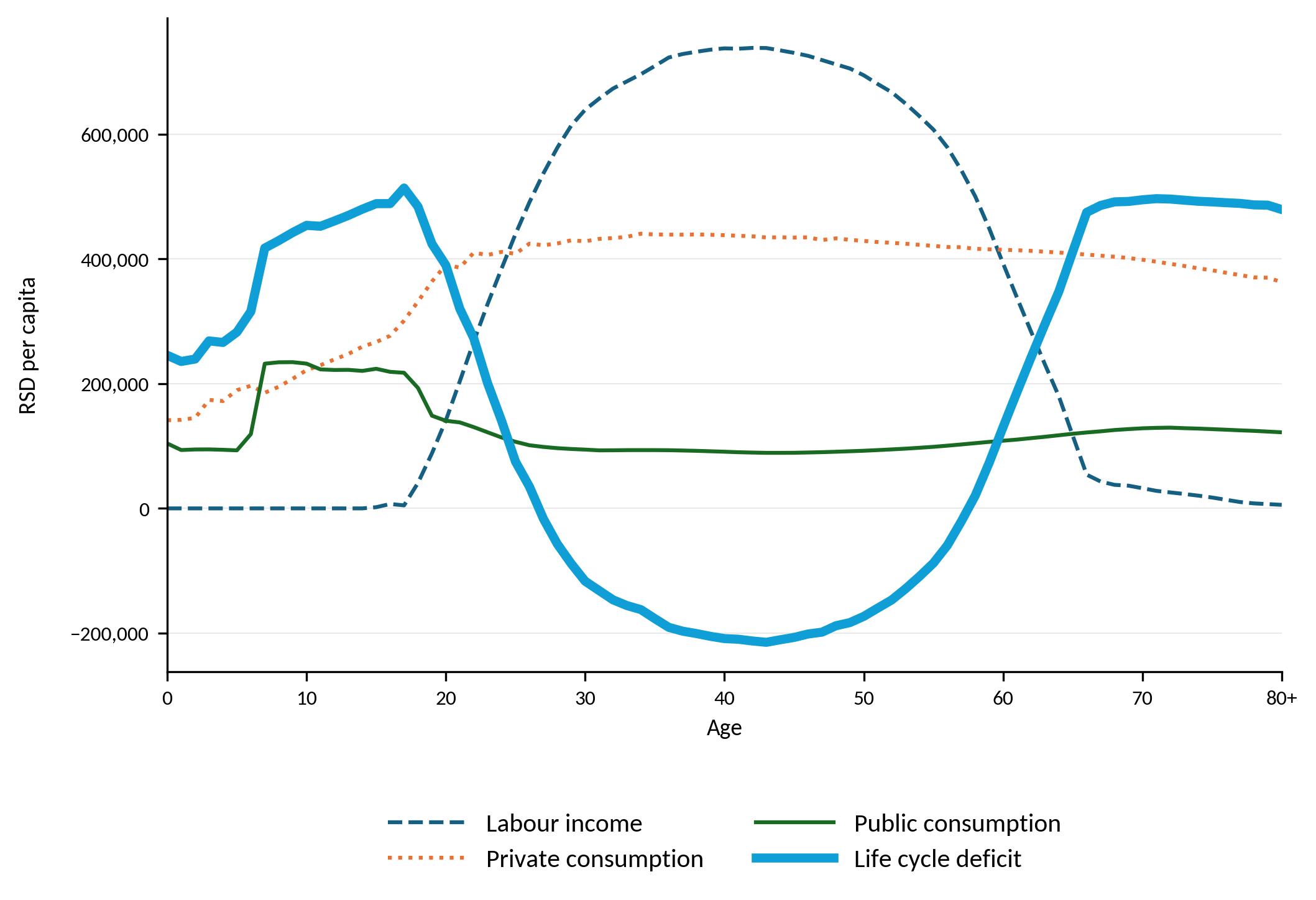
The NTA results reveal an important structural feature of Serbia’s economic life cycle (Figure 2). Labor income exceeds combined public and private consumption only from the age of 27 to 57, resulting in a life-cycle surplus of 31 years, approximately two years less than the EU average (Matković, 2025). In some EU countries, the life-cycle deficit ends as early as age 25, while re-entry into deficit occurs as late as age 64. The Serbian pattern therefore reflects not only population aging, but also a relatively short period during which labor income finances consumption across the life cycle.
Figure 2. Labor income, private and public consumption, and life cycle deficit, Serbia, 2018 (RSD per capita)
Source: Matković (2025)
Population aging constitutes a complex challenge with consequences across multiple interconnected domains. Its potential economic effects include changes in consumption and saving, a shrinking and aging labor force, a slowdown in productivity growth, and growing pressure on public finances, particularly pension, health and long-term care expenditure. It may also increase the risks of poverty, social exclusion and discrimination, while faster aging in rural and less developed areas can intensify territorial inequalities.
However, the economic consequences of population aging are not predetermined, and empirical findings on economic growth and productivity are mixed. Negative “accounting” effects associated with age-related differences in consumption, saving and economic activity can be partly offset by longer working lives, higher saving and greater investment in human capital (Bloom et al., 2011), while productivity effects vary across occupations, sectors and countries (Bussolo et al., 2015). Declining fertility may create a greater scope for investment in the human capital of smaller younger generations, potentially increasing productivity and welfare per capita (Bussolo et al., 2015).
Population aging may also create conditions for a second demographic dividend, as longer life expectancy and a longer expected period of retirement may strengthen incentives to accumulate assets for old-age security (Lee & Mason, 2006). However, whether this effect materializes depends on institutional arrangements: the incentive to accumulate assets is weaker when consumption in old age is predominantly financed through public transfers (Prskawetz & Sambt, 2014).
A comprehensive response to population aging needs to address its economic, social and health dimensions simultaneously. Good governance and increasing output through investment in human capital and an increased labor supply are key parts of the response to the economic consequences of population aging (Barr, 2021). Batog et al. (2019) suggest that in Serbia the projected decline in the labor force due to population aging could be substantially mitigated by higher female labor force participation, increased participation of older workers and longer working lives.
Pension policy is an important part of the response. Further parametric reforms could contribute to balancing financial sustainability and pension adequacy. Potential measures include modifying the pension indexation formula by replacing changes in average wages with changes in the wage bill, raising the retirement age for pension eligibility based on 15 years of contributions, raising the minimum age for early retirement, reviewing the favorable retirement conditions under special pension schemes, and introducing bonuses for working beyond the statutory retirement age. In the longer term, Serbia could define indicators of changes in longevity that would trigger a review of the statutory retirement age, rather than introducing an automatic adjustment mechanism.
Longer working lives depend substantially on health and functional capacity at older ages, making preventive health care and healthy lifestyles integral to policies addressing population aging. A more developed and integrated long-term care system, with broader coverage, is also needed, combining health and palliative care, community-based social services, including home care, and cash benefits. Adequate protection against poverty in old age should be ensured through adjustments to the means-tested social assistance program or the introduction of a guaranteed minimum income for the elderly.
A comprehensive response should also address migration and the spatial dimension of aging. Reducing emigration and developing a coherent immigration policy could mitigate demographic pressures, while territorial differences in aging and service availability require specific attention. Adaptation should also address discrimination and other risks faced by older persons, including those associated with digitalization, violence and abuse.
Population aging cannot be addressed through a single policy instrument or sector. The challenge is to adapt economic and social institutions to demographic change and create conditions in which longer lives are accompanied by better health, prolonged economic and social participation, and adequate income, care and protection in old age.
Data availability statement
All data used in this paper are publicly available from the sources cited in the text and references.
References
- Barr, N. (2021). Pension design and the failed economics of squirrels. LSE Public Policy Review, 2(1). https://doi.org/10.31389/lseppr.40
- Batog, C., Crivelli, E., Ilyina, A., Jakab, Z., Lee, J., Musayev, A., Petrova, I., Scott, A., Shabunina, A., Tudyka, A., Xu, X., & Zhang, R. (2019). Demographic headwinds in Central and Eastern Europe (Departmental Paper No. 19/11). International Monetary Fund. https://doi.org/10.5089/9781498319768.087
- Bloom, D., Canning, D., & Fink, G. (2011). Implications of population aging for economic growth (NBER Working Paper No. 16705). National Bureau of Economic Research. https://doi.org/10.3386/w16705
- Bussolo, M., Koettl, J., & Sinnott, E. (2015). Golden Aging: Prospects for Healthy, Active, and Prosperous Aging in Europe and Central Asia. The World Bank. https://doi.org/10.1596/978-1-4648-0353-6
- Eurostat. (2026a). Life expectancy by age and sex (demo_mlexpec) [Data set]. Eurostat Database. https://ec.europa.eu/eurostat/data/database
- Eurostat. (2026b). Population structure indicators at national level (demo_pjanind) [Data set]. Eurostat Database. https://ec.europa.eu/eurostat/data/database
- Lee, R., & Mason, A. (2006). What is the demographic dividend?. Finance & Development, 43(3), 16-17. https://www.imf.org/external/pubs/ft/fandd/2006/09/basics.htm?
- Matković, G. (2022). Population ageing. In D. Vuković (Ed.), Human development in response to demographic change: National Human Development Report – Serbia 2022 (pp. 164-177). United Nations Development Programme. https://hdr.undp.org.rs/chapter-7/index.html
- Matković, G. (2025). National Transfer Accounts and implications for social sector policies in the Republic of Serbia. Stanovništvo, 63(1), 5-27. https://doi.org/10.59954/stnv.665
- Prskawetz, A., & Sambt, J. (2014). Economic support ratios and the demographic dividend in Europe. Demographic Research, 30, 963-1010. https://doi.org/10.4054/DemRes.2014.30.34
- Sanderson, W., & Scherbov, S. (2008). Rethinking age and aging. Population Bulletin, 63(4). https://www.prb.org/wp-content/uploads/2026/01/Population-Bulletin-2008-63.4-aging-1.pdf
- World Health Organization. (2026). Healthy life expectancy (HALE) at age 60 (years). Global Health Observatory. https://www.who.int/data/gho/data/indicators/indicator-details/GHO/gho-ghe-hale-healthy-life-expectancy
Article Details
Published by the Institute of Social Sciences - Center for Demographic Research




References
Batog, C., Crivelli, E., Ilyina, A., Jakab, Z., Lee, J., Musayev, A., Petrova, I., Scott, A., Shabunina, A., Tudyka, A., Xu, X., & Zhang, R. (2019). Demographic headwinds in Central and Eastern Europe (Departmental Paper No. 19/11). International Monetary Fund. https://doi.org/10.5089/9781498319768.087
Bloom, D., Canning, D., & Fink, G. (2011). Implications of population aging for economic growth (NBER Working Paper No. 16705). National Bureau of Economic Research. https://doi.org/10.3386/w16705
Bussolo, M., Koettl, J., & Sinnott, E. (2015). Golden Aging: Prospects for Healthy, Active, and Prosperous Aging in Europe and Central Asia. The World Bank. https://doi.org/10.1596/978-1-4648-0353-6
Eurostat. (2026a). Life expectancy by age and sex (demo_mlexpec) [Data set]. Eurostat Database. https://ec.europa.eu/eurostat/data/database
Eurostat. (2026b). Population structure indicators at national level (demo_pjanind) [Data set]. Eurostat Database. https://ec.europa.eu/eurostat/data/database
Lee, R., & Mason, A. (2006). What is the demographic dividend?. Finance & Development, 43(3), 16-17. https://www.imf.org/external/pubs/ft/fandd/2006/09/basics.htm?
Matković, G. (2022). Population ageing. In D. Vuković (Ed.), Human development in response to demographic change: National Human Development Report – Serbia 2022 (pp. 164-177). United Nations Development Programme. https://hdr.undp.org.rs/chapter-7/index.html
Matković, G. (2025). National Transfer Accounts and implications for social sector policies in the Republic of Serbia. Stanovništvo, 63(1), 5-27. https://doi.org/10.59954/stnv.665
Prskawetz, A., & Sambt, J. (2014). Economic support ratios and the demographic dividend in Europe. Demographic Research, 30, 963-1010. https://doi.org/10.4054/DemRes.2014.30.34
Sanderson, W., & Scherbov, S. (2008). Rethinking age and aging. Population Bulletin, 63(4). https://www.prb.org/wp-content/uploads/2026/01/Population-Bulletin-2008-63.4-aging-1.pdf
World Health Organization. (2026). Healthy life expectancy (HALE) at age 60 (years). Global Health Observatory. https://www.who.int/data/gho/data/indicators/indicator-details/GHO/gho-ghe-hale-healthy-life-expectancy