
Environmental Stress and Spatial Mobility: How Pollution Shapes Everyday Adaptations and Migration Strategies in Serbia
Article Sidebar
Main Article Content
Abstract
Environmental degradation has become a persistent feature of everyday life in many Serbian cities, where chronic exposure to polluted air, industrial emissions, and infrastructural deficits shapes how residents perceive their living environments and plan their spatial futures. While the health impacts of pollution are well documented, far less is known about the ways that environmental stress influences residential choices, intra urban mobility, and long term migration strategies. This study addresses this gap by examining how families in five highly polluted Serbian cities (Belgrade, Valjevo, Kosjerić, Smederevo, and Pančevo) interpret environmental stress and incorporate it into their mobility decisions. Drawing on five focus groups with 35 participants, the study analyzes how pollution becomes an embodied and emotional experience that restricts daily routines, generates health concerns, and produces a sense of environmental insecurity. The findings show that environmental stress triggers a continuum of adaptive responses: micro adaptations within the household, intra urban relocations to less polluted microlocations, suburban and rural moves motivated by the search for cleaner air and greater safety, and long term migration aspirations shaped by intergenerational concerns. These strategies reveal that environmental mobility is not a sudden or binary decision but a gradual, cumulative process emerging from the interplay of bodily discomfort, institutional distrust, and perceptions of future risk. The study also highlights the role of weak environmental governance in shaping mobility trajectories. When institutions are perceived as unresponsive, environmental risk becomes privatized, and mobility becomes one of the few available mechanisms of protection. By integrating perspectives from environmental stress theory, place attachment, environmental inequality, and mobility studies, the article contributes to a more nuanced understanding of how chronic pollution reshapes spatial behavior in postsocialist contexts. The findings underscore the need for policies that strengthen environmental monitoring, improve urban planning, and rebuild institutional trust in order to reduce mobility pressures and support community resilience.
1 INTRODUCTION
Environmental degradation has become one of the most persistent and visible challenges in many urban and semi urban areas of Serbia. Over the past decade, several cities, including Belgrade, Valjevo, Kosjerić, Smederevo, and Pančevo, have repeatedly appeared among the most polluted locations in the country, with air quality episodes that regularly exceed national and international safety thresholds (European Environment Agency [EEA], 2026; World Health Organization [WHO], 2021). These conditions have intensified public concern about the health implications of long term exposure to polluted air, water, and soil, and have contributed to a growing sense of environmental insecurity among residents.
While the health consequences of pollution are well documented (Landrigan et al., 2018; Behera et al., 2024), far less attention has been paid to the spatial consequences of environmental stress, particularly how persistent environmental degradation influences residential choices, mobility patterns, and long term migration strategies. Research on environmental migration has traditionally focused on large scale displacements driven by natural disasters or climate related events (Black et al., 2011; McLeman, 2014). However, in many parts of the world, including Southeast Europe, environmental stress manifests not as sudden shocks but as chronic, everyday exposure to degraded living conditions. In such contexts, pollution becomes a persistent background condition that gradually enters into how people evaluate their living environments and consider future options (Adger et al., 2018; Hunter et al., 2015).
In Serbia, these dynamics unfold within a broader context of industrial restructuring, infrastructural deficits, and low institutional trust (Drndarević & Protić, 2020). Environmental concerns intersect with economic uncertainty, demographic decline, and uneven regional development, creating a complex landscape in which families negotiate decisions about staying, relocating within the same city, moving to rural areas, or considering emigration. Despite the relevance of these processes, empirical research on the relationship between environmental stress and spatial mobility in Serbia remains limited (Bakić & Gligorijević, 2025), and existing studies rarely examine how residents themselves interpret environmental degradation as a factor shaping their spatial strategies.
These dynamics are of particular relevance for demographic research, as chronic environmental stress influences internal migration flows, residential mobility patterns, and spatial redistribution of the population.
This article addresses this gap by examining the ways in which residents of five highly polluted Serbian cities, Belgrade, Valjevo, Kosjerić, Smederevo, and Pančevo, interpret environmental stress and how these interpretations inform their spatial decisions. Using qualitative data from focus groups, the study explores the ways in which environmental degradation becomes embedded in everyday life, shapes perceptions of place, and influences decisions about relocation or long term mobility. By situating these findings within broader theoretical debates on environmental stress, place attachment, and mobility, the article contributes to a more nuanced understanding of how pollution affects spatial behavior in contexts characterized by chronic environmental risk.
2 THEORETICAL FRAMEWORK
Understanding how environmental stress influences spatial mobility requires drawing on several theoretical traditions that connect risk perception, emotional relationships to place, environmental inequality, and institutional context. In contemporary scholarship, environmental stress is defined as a form of chronic psychological and social strain arising from prolonged exposure to degraded environmental conditions (Clayton & Manning, 2018). Unlike sudden environmental disasters that produce immediate and large scale displacement, environmental stress in urban settings typically unfolds slowly and cumulatively. It accumulates through everyday encounters with polluted air, water, and soil, through bodily symptoms, concerns about children’s health, and the sense that one’s living environment has become harmful or hostile. These forms of “slow violence” (Nixon, 2011) often remain invisible within public policy, yet they profoundly shape subjective experiences and behavioral strategies.
A central component of environmental stress is risk perception. Slovic (2010) and others argue that individuals respond not only to objective indicators of pollution, but also to symbolic, visual, and embodied cues that make environmental degradation immediately present in everyday life. In contexts where pollution is visible, industrial or heating related odors are pervasive, and health problems are frequent, risk perception becomes a stronger driver of behavior than formal air quality measurements. Bickerstaff & Walker (2001) demonstrate that environmental risks in urban areas are experienced through the body, routines, and spatial practices - an “embodied experience” which is crucial for understanding spatial mobility.
At the same time, the relationship between people and their environments cannot be reduced to rational assessments of risk. The concept of place attachment highlights the emotional, identity based, and social bonds that individuals develop with the places in which they live (Giuliani, 2003; Lewicka, 2011). The ambivalence of place attachment under conditions of environmental stress is well documented in literature. Research shows that strong emotional and social embeddedness can encourage people to remain even in degraded environments (Lewicka, 2011; Edelstein, 2004). At the same time, attachment to the local community often leads to selective mobility – relocations within the same city, to microlocations that offer better living conditions while preserving everyday continuity (Cuba & Hummon, 1993). This ambivalence is particularly pronounced in postsocialist cities, where local identities remain strong despite chronic environmental degradation (Gentile & Sjöberg, 2013).
Although the term “environmental migration” is often associated with extreme climatic events and sudden onset disasters (Black et al., 2011; International Organization for Migration, 2009), a growing body of work shows that mobility can also function as an adaptive strategy in the conditions of slow but persistent environmental decline. Literature emphasizes that mobility under conditions of environmental stress rarely takes the form of a sudden or one time decision; rather, it unfolds through a series of gradual shifts and adaptive strategies (Adger et al., 2018; Black et al., 2011). Research shows that residents often opt for intra urban relocations or moves to peri urban and rural areas in order to reduce exposure to risk, while temporary and circular forms of mobility, such as weekend stays in healthier environments, serve as additional mechanisms of adaptation (Hunter et al., 2015; Sheller & Urry, 2006). These strategies indicate that mobility can be fragmented, multilayered, and temporally deferred, yet still constitute a response to environmental stress.
Environmental inequality is another key concept for understanding spatial dynamics in polluted settings. Numerous studies show that environmental risks are unevenly distributed, often concentrated in neighborhoods inhabited by socioeconomically vulnerable groups (Bullard, 2000; Walker, 2012). In postsocialist cities, including those in Serbia, environmental inequality manifests through proximity to industrial facilities, prevalence of individual heating systems in poorer neighborhoods, infrastructural deficits, and limited access to environmental information (Steger & Filcak, 2008). These patterns reflect broader mechanisms of environmental injustice, in which structural and institutional factors shape unequal exposure to environmental harm (Pellow, 2000). As a result, the capacity to protect oneself, by purchasing air purifiers, relocating to less exposed areas, or spending time in rural environments, varies significantly across social groups, leaving the most vulnerable residents disproportionately exposed to the most severe forms of pollution.
Finally, the institutional context plays a crucial role in shaping how residents respond to environmental stress. In settings where institutional trust is low and environmental governance is weak (Kramer, 2004; Steger & Filcak, 2008), individuals often rely on personal and informal strategies of protection, while mobility becomes a private mechanism for addressing problems that institutions fail to resolve.
Taken together, this theoretical framework conceptualizes environmental stress as a chronic, perceptual, and emotional phenomenon that intersects with place attachment, environmental inequality, and institutional context. By integrating these perspectives, it becomes possible to explain how residents of polluted Serbian cities develop various forms of spatial mobility, from micro relocations to long term migration aspirations, as adaptive responses to degraded environments.
3 METHOD
This study employs a qualitative methodology to deepen the understanding of how people in Serbia perceive environmental stressors and integrate them into their mobility strategies. Qualitative methods are particularly suitable for examining ways in which people negotiate decisions about staying, relocating within the city, spending time in cleaner environments, or considering long term migration. Focus groups were selected as the primary data collection method because they facilitate interaction among participants, the exchange of experiences, and the articulation of both collective and individual narratives about environmental problems and mobility. This is especially important in contexts where environmental risks are experienced as a shared reality and where mobility decisions are shaped by social comparison, local knowledge, and community norms.
The study follows an interpretivist epistemological orientation, assuming that mobility decisions are shaped by subjective meanings, embodied experiences, and locally embedded interpretations of environmental stress.
3.1 Case Study Design
This study employs a multi site qualitative case study design to examine how environmental stress shapes spatial mobility and migration strategies in Serbia. Case study approach is particularly suitable for exploring complex social processes embedded in everyday life, especially when environmental degradation, risk perception, and mobility decisions are deeply intertwined. This design makes it possible to capture the lived experiences, emotional responses, and adaptive strategies that people develop in response to chronic exposure to pollution – patterns that would be difficult to detect through more quantitative or decontextualized approaches.
The selection of study sites (Figure 1) followed three criteria directly relevant to mobility under environmental stress: high and persistent air pollution, presence of major industrial emitters, and socioeconomic diversity shaping unequal adaptive capacities. Air pollution served as the primary criterion. Municipalities with clean or moderately polluted air were excluded, and from the remaining group of highly polluted cities, those with the most severe and persistent exceedance of PM2.5 concentrations were selected. All five selected cities, Belgrade, Valjevo, Smederevo, Kosjerić, and Pančevo, ranked among the ten most polluted monitored locations in Serbia (Serbian Environmental Protection Agency [SEPA], 2024). Annual concentrations ranged from 29 to 33 μg/m³ across the sample. These environmental conditions are directly relevant for mobility research, as chronic exposure to polluted air often triggers intra urban relocation, temporary mobility, weekend “escapes”, and long term migration aspirations – patterns repeatedly described by participants in the focus groups. During winter months, PM2.5 and PM10 concentrations rise sharply due to household heating, district heating plants, and industrial emissions (SEPA, 2024). Approximately 60% of Serbian households still rely on firewood, coal, or lignite for heating (Statistical Office of the Republic of Serbia [SORS], 2023; Stanojević et al., 2024). In cities such as Valjevo and Kosjerić, topographical characteristics further trap pollutants, reinforcing the sense of living in an unhealthy environment and motivating spatial strategies of avoidance.
Figure 1. Geographic location of the five case study cities in Serbia (Belgrade, Valjevo, Kosjerić, Smederevo, and Pančevo
Note: Administrative boundaries used for map preparation were obtained from GeoSrbija (Republic Geodetic Authority, 2023). Maps were designed in QGIS 3.36.3.
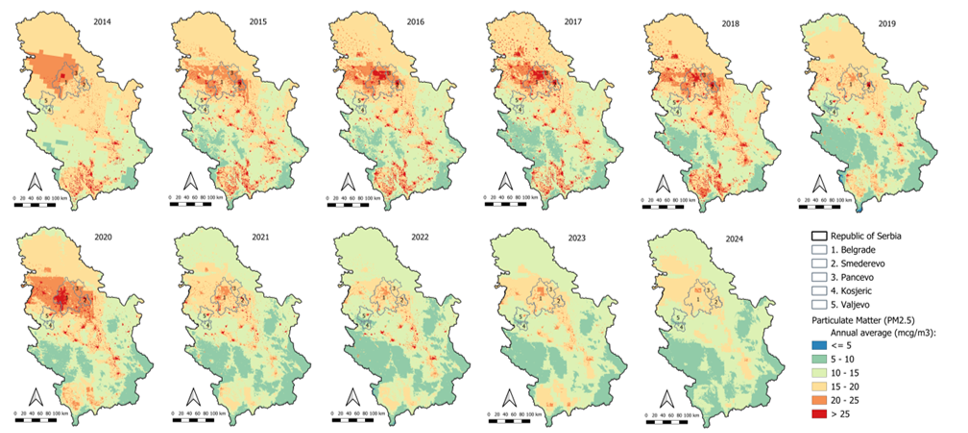
To ensure that environmental stress is not only seasonal but structurally embedded, the selected cities were also required to host at least one major industrial facility. Belgrade contains the largest coal fired power plant in Serbia; Smederevo hosts a steel plant; Pančevo an oil refinery; Kosjerić a cement factory; and Valjevo an arms factory. These facilities emit pollutants beyond suspended particles, including benzene, sulfur dioxide, and benzo(a)pyrene (SEPA, 2024) (Figure 2).
Figure 2. Annual average concentration of PM2.5 (µg/m³) in the Republic of Serbia
Note: Source: EEA, 2026. Maps were designed in QGIS 3.36.3.
Socioeconomic diversity across the selected cities allows the study to capture how environmental stress interacts with unequal capacities for adaptation – an important mechanism shaping mobility strategies. The five cities differ substantially in economic structure, wage levels, human capital concentration, and demographic trends. Between 25% and 40% of the workforce in Smederevo, Valjevo, Kosjerić, and Pančevo is employed in manufacturing, mining, or energy (SORS, 2022), while Belgrade stands out with higher wages, a diversified service based economy, and greater resilience to environmental stress. These differences shape how families evaluate risks and determine whether they can afford to relocate, commute, maintain dual location living arrangements, or plan long term migration.
The sample was also designed to reflect demographic diversity, particularly the differences in population size, age structure, and migration potential (Table 1). Belgrade, with around 1.6 million inhabitants, is the country’s main demographic and economic center, attracting internal migrants and offering more opportunities for spatial adaptation, such as moving to less polluted neighborhoods. In contrast, Valjevo, Smederevo, Pančevo, and Kosjerić are smaller industrial towns with aging populations, limited labor markets, and fewer opportunities for intra urban mobility. These structural constraints shape how residents perceive their ability to adapt to environmental stress-whether through micro relocations, temporary mobility, or long term migration plans.
| City | Population size | Average age | Natural increase (‰) | Share 65+ (%) | Migration potential* |
|---|---|---|---|---|---|
| Belgrade | ~1,600,000 | 42.7 | –2.5 | 22.3% | High (inmigration) |
| Pančevo | ~115,000 | 43.6 | –5.4 | 21.7% | Medium |
| Smederevo | ~97,000 | 43.1 | –4.4 | 21.3% | Medium |
| Valjevo | ~81,000 | 44.9 | –9.4 | 22.8% | Low |
| Kosjerić | ~10,000 | 47.3 | –10.7 | 27.6% | Very low |
|
*Migration potential = combination of age structure, labor market opportunities, and internal migration flows.
Source: SORS, 2024 |
|||||
By combining cities that differ in demographic size, socioeconomic structure, and adaptive capacity, but share similar levels and sources of pollution, this case study design enables a nuanced understanding of how environmental degradation shapes spatial mobility. The selected cities represent distinct micro contexts in which environmental stress intersects with risk perception, place attachment, and institutional trust, producing diverse mobility strategies ranging from intra urban relocation to long term emigration aspirations.
Thematic saturation was reached after the fifth focus group, as no new conceptual categories emerged. The number of focus groups was predefined in the research design, and saturation was confirmed after the final group rather than used to determine the sample size during the process. The focus groups were conducted in a predetermined sequence based on logistical feasibility and geographical proximity, rather than analytical criteria such as city size, pollution levels, or migration intensity.
3.2 Focus Group Design
Five focus groups were conducted, each with 6 and 8 individuals, with 35 participants in total. Participants included women and men of different ages and socioeconomic backgrounds, all residing in environmentally burdened areas of the selected cities (Table 2). Purposive sampling was applied to include individuals living in locations with high levels of pollution, complemented by snowball sampling to expand the participant network. The aim of the sampling strategy was not to achieve representativeness, but rather to ensure a diversity of experiences and perspectives that would allow for the identification of thematic patterns related to environmental stress and mobility.
| Sex | Age | Education | No. of children | ||||
|---|---|---|---|---|---|---|---|
| Smederevo | |||||||
| Female | 3 | Twenties | 3 | Secondary | 2 | 0 | 3 |
| Male | 5 | Thirties | 4 | Tertiary | 6 | 1 | 2 |
| Forties | 1 | 2 | 3 | ||||
| 3 | 0 | ||||||
| Pregnant | 0 | ||||||
| Pančevo | |||||||
| Female | 4 | Twenties | 6 | Secondary | 5 | 0 | 6 |
| Male | 2 | Thirties | 0 | Tertiary | 1 | 1 | 0 |
| Forties | 0 | 2 | 0 | ||||
| 3 | 0 | ||||||
| Pregnant | 0 | ||||||
| Valjevo | |||||||
| Female | 6 | Twenties | 0 | Secondary | 1 | 0 | 1 |
| Male | 0 | Thirties | 5 | Tertiary | 5 | 1 | 2 |
| Forties | 1 | 2 | 3 | ||||
| 3 | 0 | ||||||
| Pregnant | 0 | ||||||
| Kosjerić | |||||||
| Female | 6 | Twenties | 5 | Secondary | 3 | 0 | 3 |
| Male | 2 | Thirties | 3 | Tertiary | 5 | 1 | 1 |
| Forties | 0 | 2 | 0 | ||||
| 3 | 1 | ||||||
| Pregnant | 3 | ||||||
| Belgrade | |||||||
| Female | 4 | Twenties | 4 | Secondary | 1 | 0 | 3 |
| Male | 3 | Thirties | 3 | Tertiary | 6 | 1 | 2 |
| Forties | 0 | 2 | 2 | ||||
| 3 | 0 | ||||||
| Pregnant | 0 |
Each focus group was organized in one of the five selected cities, ensuring equal representation of local contexts. Groups were intentionally mixed by gender and age, allowing participants to articulate shared environmental concerns, while expressing differences shaped by life stage, family roles, and everyday routines.
The focus groups were conducted during December 2025 and January 2026 in the selected cities. Each discussion lasted between 60 and 120 minutes and was moderated using a pre prepared guide. The guide covered the following thematic areas:
– perceptions of environmental problems and risks in the local community;
– experiences with air pollution, industrial emissions, and environmental degradation;
– concerns about health, safety, and everyday living conditions;
– emotional responses to environmental change;
– trust in institutions and perceptions of institutional responsibility;
– ways in which environmental stressors influence mobility decisions, including intra urban relocation, temporary mobility, and long term migration plans.
All focus groups were moderated by the same researcher, which ensured consistency in facilitation style, question delivery, and interaction dynamics across sites.
All focus groups were audio recorded with the participants’ consent and fully transcribed. Data analysis was conducted using thematic analysis following Braun & Clarke (2006). The analytical process included: (1) familiarization with the data through detailed reading of transcripts; (2) initial coding of relevant segments of text; (3) grouping codes into broader thematic units; (4) reviewing and refining themes; (5) defining and naming themes; and (6) writing the analytical narrative that integrates themes into a coherent interpretive framework. The coding was carried out in MAXQDA using a combined code list that included both predefined thematic categories from the discussion guide and inductively generated codes emerging from the data (Table 3).
| Thematic category | Codes | Code description / examples from data |
|---|---|---|
| Perception of environmental problems | Visible pollution | “You can see the air”, “haze under streetlights”, “my hair and clothes smell after going outside” |
| Winter pollution & household heating | Intensive burning, waste burning, individual furnaces as the main source of pollution | |
| Industrial emissions | Steel plant, oil refinery, cement factory, wastewater discharge, benzene, sulfur dioxide | |
| Local environmental degradation | Landfills near the town center, burning agricultural waste, lack of environmental control | |
| Health impacts | Respiratory problems | Coughing, allergies, asthma, inhalers in every household, “my child coughs for half an hour after coming inside” |
| Skin problems | Eczema, irritation, worsening symptoms after outdoor exposure | |
| Chronic illness concerns | “Many cancer cases near the steel plant”, “fear of longterm health effects” | |
| Everyday adaptations | Avoiding outdoor exposure | Avoiding going out in the evening, limiting children’s outdoor time, driving children to school to avoid polluted routes |
| Technological adaptations | Air purifiers, ionizers, drying laundry indoors | |
| Micromobility strategies | Weekend trips to the mountains, spending time in rural areas, “escaping to cleaner parts of the city” | |
| Mobility decisions & strategies | Intraurban relocation | Moving to the opposite side of the city (e.g., away from the steel plant), avoiding the most polluted microlocations |
| Suburban/rural relocation | Building or buying houses in nearby villages, moving to periurban areas, “everyone is looking for a small village near Smederevo” | |
| Temporary mobility | Weekend stays in cleaner environments (Divčibare, countryside), shortterm “breathing escapes” | |
| Longterm migration aspirations | “My children will leave”, “if I get the chance, I won’t stay”, “Scandinavia” | |
| Nonmigration stance | “I wouldn’t move because of ecology”, “economic problems matter more” | |
| Institutional trust & governance | Distrust in institutions | “We don’t trust any institution”, “there are no mechanisms”, “there is no plan” |
| Perceived institutional failure | Ineffective inspections, poor waste management, subsidies distributed “through connections” | |
| Desire for structural solutions | Gasification, filters, greening the city, stricter fines, better regulation of industry | |
| Emotional and psychological responses | Fear & anxiety | Fear for children’s health, fear of the future, “this is about survival” |
| Frustration & anger | Feeling abandoned, anger at institutional inaction, “we live in a permanent state of emergency” | |
| Resignation & adaptation | “We all adapt”, “everyone fights for themselves”, “pollution is part of the system” | |
| Environmental values & intergenerational concerns | Concern for children’s future | “I would encourage them to leave”, “I want them to stay, but not like this”, “who knows what the longterm effects will be” |
| Intergenerational responsibility | Teaching children about ecology, concern for future generations, “our children will be more aware than we were” |
The coding was conducted by a single researcher, following an iterative process of code refinement and theme development. To enhance reliability, the researcher revisited all coded segments multiple times and cross checked emerging themes against the raw data to ensure internal consistency. As the coding was performed by one researcher, intercoder reliability could not be formally assessed, which represents a methodological limitation.
The research was conducted in accordance with ethical standards in the social sciences. All participants were informed about the aims of the study, the voluntary nature of participation, and their right to withdraw at any time. Written informed consent was obtained, and all data were anonymized to protect participants’ privacy.
3.3 Limitations
As with any qualitative study, this research has certain limitations. The sample is non representative and limited to specific local contexts, which may affect the generalizability of the findings. Focus groups may encourage conformity or suppress certain voices, although the discussions were moderated in ways that encouraged open expression. Nevertheless, the combination of focus groups and a multi site case study design enables an in depth understanding of the complex ways in which environmental stress shapes spatial mobility, which represents a key strength of this study.
4 RESULTS
4.1 Embodied experience of pollution and everyday adaptations
The analysis of the focus groups shows that environmental stress in all cities manifests as an intense, everyday, and bodily experience that shapes routines, spatial perceptions, and long term mobility decisions. Participants describe pollution as something that is “visible in the air,” that “burns the eyes,” and “sticks to hair and clothes as soon as you come home.” These experiences are not abstract, but deeply embedded in daily practices: people report that they “smell after a short walk,” that particles are “clearly visible under streetlights,” or the air feels “acidic and heavy.” Winter months are perceived as particularly severe, as the combination of individual heating, industrial emissions, and unfavorable topography creates the sense that one “cannot breathe” and that it is “impossible to take the children for a walk.” In Valjevo and Kosjerić, participants note that children “cough for half an hour after coming inside,” while in Smederevo parents link frequent respiratory infections with proximity to the steel plant. Although these embodied experiences are present across all cities, participants from Valjevo and Kosjerić emphasize the role of topography in intensifying winter pollution, noting that “the air has a color… my hair and clothes smell of smoke,” while those from Smederevo more frequently associate symptoms with industrial emissions. These differences illustrate how local environmental structures shape the severity and character of everyday exposure.
Under such conditions, everyday activities become restricted, and families develop various forms of micro adaptation: avoiding going out in the evening, driving children even short distances, using air purifiers, drying laundry indoors, and organizing daily life in ways that minimize exposure. Participants describe this routine as a “constant struggle to at least breathe normally inside the home,” noting that children often spend most of the day indoors. Residents also speak of the “mental fatigue” that arises when every outing must be planned according to pollution levels, while others explain that they avoid opening windows and limit time spent outdoors.
These adaptations point to a shared sense of constrained agency, but the degree of constraint varies: in smaller towns, participants describe fewer “cleaner” micro locations to retreat to, whereas Belgrade residents note that “every day we think about whether to stay or escape somewhere to the outskirts,” indicating that certain neighborhoods offer relatively better air.
These adaptations illustrate how environmental stress becomes woven into everyday life, influencing feelings of control, safety, and wellbeing. Although participants often emphasize that they “get used to everything,” this habituation carries an emotional cost – frustration, helplessness, and persistent concern for children’s health. This combination of bodily experience, emotional burden, and daily constraints forms the starting point from which considerations of relocation, changes in microlocation, or long term migration strategies emerge.
Intra urban, suburban, and rural relocations as strategies for reducing exposure
These everyday coping strategies often serve as an entry point into thinking about relocation, with mobility emerging as a logical extension of attempts to reduce exposure to environmental stress. Participants from Valjevo and Smederevo reported that they had already moved to parts of the city located farther from the industrial facilities, or to areas with better air circulation. Such relocations are typically motivated by concerns for children and the desire to conduct daily life in micro locations perceived as less polluted. One family from Smederevo explained that they had been “looking for a village on the opposite side of the steel plant,” while participants from Valjevo described moving “to the other side of the Kolubara River” to reduce their children’s exposure and avoid the most polluted zones.
In contrast, participants from Belgrade noted that intra urban relocation often involves moving toward the city’s periphery, where air quality is perceived as slightly better. One participant explained: “There are jobs and schools here, but there is no air,” highlighting how city size and spatial structure shape the range of available mobility strategies.
Suburban and rural areas are perceived as more sustainable long term solutions, offering cleaner air, more space, and an environment considered healthier for raising children. Participants emphasized that villages surrounding the cities are attractive not only because of environmental conditions, but also because they provide a sense of security, access to home grown food and clean water, and an escape from the stress of urban life. Many participants are already planning or undertaking relocation to nearby villages, relying on family land or building new houses. In Valjevo, families noted that they “escape to the mountains every weekend to breathe,” while residents of Kosjerić emphasized that they were “supplied with food and water from the village,” which they saw as a key protective strategy and a way to reduce dependence on local infrastructure.
These patterns differ somewhat across cities: in Valjevo and Kosjerić, weekend escapes to nearby mountains are common, while in Smederevo and Pančevo, rural relocation is more strongly tied to escaping industrial zones. Belgrade participants, by contrast, describe suburban relocation as a compromise between maintaining access to opportunities and reducing exposure.
These relocations are not merely reactions to current environmental conditions, but also expressions of broader dissatisfaction with urban environments, infrastructural problems, and institutional inefficiency. Participants frequently stress that they are forced to find solutions on their own because they do not believe conditions in their cities will improve. As a result, mobility, whether within the city or toward suburban and rural areas, emerges as a form of personal and family protection, as well as a strategy that allows households to maintain ties to the city, while reducing exposure to environmental risks. In this sense, intra urban and suburban relocations represent an intermediate level of adaptation, situated between everyday micro strategies and long term migration plans.
4.2 Long term migration aspirations and intergenerational expectations
Environmental stress influences not only everyday practices and short term forms of adaptation, but also long term migration aspirations, which emerge as an important element of family planning across all cities. Participants express deep concern about the potential health consequences of pollution, especially for children, which leads them to consider leaving their city or even the country. One mother from Valjevo stated, “If it stays like this, I will encourage them to go somewhere with cleaner air and a better life,” emphasizing that migration is increasingly viewed not as an individual choice but as a form of care for future generations.
In many narratives, there is an expectation that children “will be smarter and leave,” as parents do not see a viable future under current conditions. This anticipation of young people’s departure is often accompanied by sadness but also resignation, as participants believe that “it is the only way for children to live normally.” In Smederevo, migration aspirations are particularly tied to fears about illness; participants noted that “many children are born with problems” and that fear “forces them to think about whether everything will be alright.” These narratives indicate that environmental stress is perceived not only as an immediate risk but as a long term threat to health and quality of life, making migration a rational and emotionally justified strategy.
Across cities, these aspirations differ in intensity: they are strongest in Smederevo and Pančevo, where industrial pollution is most visible, while in Belgrade they are shaped more by infrastructural pressures and the search for better living conditions abroad.
At the same time, there is a strong sense of ambivalence. Many participants wish to remain in their communities, emphasizing emotional attachment to place, family, and local identity. One participant from Kosjerić explained that she “love[s] her town and want[s] her child to stay,” yet she “do[es] not see that the problems are being solved,” expressing the tension between belonging and concern for the future. This ambivalence is particularly pronounced in smaller towns, where social networks and community ties are strong, but where environmental and economic pressures are also most acute.
Migration aspirations thus emerge from a complex interplay of factors: environmental stress, health concerns, institutional distrust, and a broader perception that living conditions in Serbia are not improving. Participants often stated that they “do not want [their] children to go through the same things,” positioning migration as an intergenerational strategy of protection and investment in the future. In this way, environmental stress shapes not only current mobility decisions but also long term visions of life, plans for children, as well as expectations about where future generations will live.
4.3 Institutional distrust and Belgrade as a liminal case of mobility
Institutional distrust emerges as one of the key factors driving mobility and shaping how participants evaluate the possibilities of staying or leaving. Across all cities, participants feel that local and national institutions fail to take adequate measures to address environmental problems, which reinforces a sense of vulnerability and contributes to the perception that individual mobility is the only effective form of protection. Participants from Valjevo noted that “there are no mechanisms that will solve the problem,” while residents of Kosjerić emphasized that “waste is separated only to be thrown together later.” In Smederevo, participants explain that it is “easier to pay the fine than install a filter,” further strengthening the belief that problems will not be resolved systemically and that responsibility has been shifted onto individuals and their private strategies.
Belgrade represents a specific case in this landscape of institutional distrust. Participants described everyday life in the capital as a balance between economic and educational opportunities and the burdens of pollution, congestion, and infrastructural strain. While Belgrade offers more intra urban variation and the possibility of relocating to less polluted neighborhoods, it is also perceived as increasingly overcrowded and environmentally pressured. Participants from other cities frequently referred to Belgrade as both a destination for opportunity and a place where “it is hard to live normally,” illustrating its dual role as an attractor and a stressor.
Belgrade thus becomes a paradigmatic example of the tension between structural advantages and environmental constraints. Participants see it as a city that provides resources but not quality of life, shaping complex mobility patterns: from intra urban relocations toward the city’s periphery, to suburban strategies, to considerations of leaving the country altogether. In this sense, institutional distrust and the specific Belgrade context contribute together to mobility becoming not only a strategy of adaptation, but also a way to regain a sense of control over one’s living conditions.
5 DISCUSSION
The findings of this study show that environmental stress operates simultaneously as a bodily experience, spatial constraint, and a driver of mobility decisions. These results align with a growing body of literature indicating that pollution is not perceived merely as an environmental condition, but as an embodied and affective phenomenon that shapes everyday life, health concerns, and future planning (Auyero & Swistun, 2009; Davies, 2019). Participants’ descriptions of air that “burns the eyes,” “sticks to clothes,” or makes it “impossible to take the children outside” illustrate how environmental degradation becomes inscribed into sensory and emotional registers.
These embodied experiences were present across all cities, but their intensity varied: in Valjevo and Kosjerić, topography amplified winter pollution, while in Smederevo and Pančevo industrial emissions shaped the sensory burden more strongly.
The micro adaptations identified in the study, avoiding outdoor activities, reorganizing daily routines, using air purifiers, and limiting children’s exposure, represent coping patterns typical of contexts marked by chronic environmental risk (Elliott & Pais, 2006). These practices point to a form of “everyday environmental governance,” in which households compensate for institutional shortcomings by developing individualized protective strategies (Corburn, 2005). However, as the findings suggest, these adaptations have limits: they generate fatigue, emotional strain, and a sense of resignation, gradually directing households toward spatial solutions such as relocation. This shift from micro adaptation to mobility aligns with the literature on environmental mobility, which emphasizes that migration decisions often emerge gradually, as a result of cumulative stress, rather than acute environmental shocks (Black et al., 2011; Hunter et al., 2015). The progression from coping to relocation was particularly visible in smaller towns, where participants reported fewer “cleaner” micro locations, thus reaching the limits of everyday adaptation more quickly.
The study also demonstrates that intra urban, suburban, and rural relocations function as intermediate strategies between everyday coping and long term migration plans. Movement toward less polluted micro locations, city peripheries, or nearby villages represents a form of “environmental sorting,” in which people seek cleaner air, more space, and a sense of safety (Pastor et al., 2001). These patterns correspond with research on amenity migration and peri urbanization, which shows that environmental quality increasingly shapes residential preferences, particularly among families with young children (Gosnell & Abrams, 2011). Differences across cities further illustrate this dynamic: Valjevo and Kosjerić participants emphasized weekend escapes to nearby mountains, while Smederevo and Pančevo residents framed rural relocation primarily as a way to distance themselves from industrial zones. Belgrade participants, in contrast, described suburban relocation as a compromise between maintaining access to opportunities and reducing exposure. Importantly, these relocations are not only environmental responses, but also expressions of dissatisfaction with urban infrastructure, institutional inefficiencies, and broader perceptions of stagnation. In this sense, mobility becomes both a protective strategy and an implicit critique of institutional shortcomings (Sovacool et al., 2015). The findings indicate that this dissatisfaction is present in all cities, though its sources differ: industrial pollution dominate narratives in Smederevo and Pančevo, with infrastructural pressure and congestion being more salient in Belgrade.
Long term migration aspirations further illuminate how environmental stress intersects with intergenerational expectations. Participants often framed migration as an investment in their children’s future, consistent with the literature on “aspirational migration” and the moral economy of parenthood (Carling & Collins, 2018). The expectation that children “will leave because they are smarter” reflects a broader narrative of limited prospects and declining trust in the state’s ability to provide safe living conditions. This ambivalence, between attachment to place and concern for the future, aligns with research on place attachment in environmentally burdened communities, where emotional ties coexist with pragmatic recognition of risk (Lewicka, 2011). This ambivalence is strongest in smaller towns, where social networks and emotional ties are more pronounced, but where participants also perceive environmental and economic pressures as most acute.
Institutional distrust emerges as a key mechanism linking environmental stress and mobility. Participants’ perceptions that institutions “do nothing,” “hide data,” or “shift responsibility onto citizens” echo findings from studies on governance gaps in post socialist and semi peripheral contexts (Tomanović & Stanojević, 2015). When institutions are perceived as unresponsive, environmental risk becomes privatized, and mobility becomes one of the few available means of regaining a sense of control. This dynamic is particularly visible in Belgrade, which functions as a liminal case: simultaneously a center of opportunity and a site of intense environmental and infrastructural pressure. The ambivalence expressed by the Belgrade participants mentioning that “there are jobs and schools, but there is no air”, captures the tension between structural advantages and environmental constraints that shape mobility decisions. Similar tensions are present in other cities, though expressed differently: in Smederevo and Pančevo through fears of industrial emissions, and in Valjevo and Kosjerić through concerns about topography, heating practices, and infrastructural limitations.
Although wage differences across cities are likely to shape households’ capacity to relocate or sustain dual location arrangements, this factor was not part of the analytical framework and is acknowledged here as a contextual condition that may further influence mobility strategies.
Taken together, these findings contribute to theoretical debates on environmental mobility by showing how chronic pollution, institutional distrust, and intergenerational concerns produce layered mobility strategies. Rather than viewing environmental migration as a binary decision to stay or leave, this study demonstrates that people navigate a continuum of spatial responses, from micro adaptations, to intra urban moves, to suburban solutions and long term migration aspirations. This continuum underscores the need to conceptualize environmental mobility as a gradual and context dependent process shaped by embodied experiences, emotional burdens, and structural conditions.
6 CONCLUSION
This study shows that environmental stress in Serbian cities is not experienced as an abstract environmental problem, but as an embodied, everyday reality that shapes routines, emotional states, and long term mobility decisions. The findings indicate that chronic exposure to pollution generates a continuum of adaptive responses, from micro adaptations within the household to intra urban and suburban relocations, and ultimately to long term migration aspirations. These layered strategies demonstrate that environmental mobility should be understood as a gradual and cumulative process arising from the interplay of bodily discomfort, health concerns, institutional distrust, and intergenerational expectations.
The results also highlight the central role of institutional shortcomings in shaping mobility. When institutions are perceived as unresponsive or ineffective, environmental risk becomes privatized, compelling people to seek protection through spatial strategies. Belgrade illustrates this dynamic particularly well: as a city that simultaneously concentrates opportunities and environmental burdens, it functions as a liminal space that both attracts and repels. By tracing how environmental stress translates into differentiated forms of mobility, the study contributes to broader debates on environmental migration, urban inequalities, and the experiential dimensions of environmental degradation.
These findings also carry clear policy implications. The prevalence of micro adaptations and intra urban relocations underscores the need for transparent, timely, and locally disaggregated air quality monitoring, as well as communication practices that rebuild public trust. The movement of families toward suburban and rural areas highlights the importance of integrating environmental criteria into urban planning, zoning, and housing policies, especially in cities where industrial facilities are located near residential zones. The strong intergenerational dimension of migration aspirations suggests that interventions targeting children’s health, such as cleaner heating systems, school level air quality protections, and investments in green infrastructure, may have disproportionately large effects on reducing mobility pressures. Finally, addressing institutional distrust requires strengthening enforcement mechanisms, independent oversight, and participatory decision making.
From a demographic policy perspective, these findings underscore that chronic environmental stress influences internal migration flows, suburbanization patterns, and long term spatial redistribution of a population. Policies that strengthen environmental governance, improve air quality monitoring, and incorporate environmental criteria into urban and regional planning are therefore essential not only for environmental protection, but also in stabilizing local populations, reducing involuntary mobility, and supporting long term demographic sustainability.
Nevertheless, the study has several limitations that open avenues for future research. The analysis is based on focus groups conducted in five cities, which allows for identification of shared patterns, but does not capture the full territorial and social diversity of experiences across Serbia. Future research could include a larger number of locations and comparative regional approaches. Additionally, while subjective perceptions provide essential insight into the embodied experience of pollution, they cannot be directly linked to objective air quality measurements; combining qualitative data with spatial and epidemiological indicators would represent an important step forward. Moreover, focus groups do not allow for tracking decision making processes over time, and longitudinal or ethnographic studies could deepen understanding of how micro adaptations evolve into spatial strategies. Finally, although the study identifies institutional distrust as a key mechanism, future research should examine specific institutional practices and policies that shape these perceptions.
Overall, the findings suggest that improving environmental conditions and institutional responsiveness is essential not only for public health, but also for stabilizing communities and reducing the cumulative pressures that prompt households to reconfigure their spatial futures.
This research was supported by the Science Fund of the Republic of Serbia, Grant no. 7358, Population dynamics under environmental challenges in Serbia – POPENVIROS.
Data availability statement
Data are available from the authors upon request.
References
- Adger, W. N., de Campos, R. S., & Mortreux, C. (2018). Mobility, displacement and migration, and their interactions with vulnerability and adaptation to environmental risks. In Routledge Handbook of Environmental Displacement and Migration (pp. 29-41). Routledge. https://doi.org/10.4324/9781315638843-3
- Auyero, J., & Swistun, D. A. (2009). Flammable: Environmental Suffering in an Argentine Shantytown. Oxford University PressNew York, NY. https://doi.org/10.1093/oso/9780195372946.001.0001
- Bakić, D., & Gligorijević, V. (2025). Migration as a strategy of adaptation to climate changes. Demografija, 22(22), 39-65. https://doi.org/10.5937/demografija2522039b
- Behera, D., Viswanathan, P., & Mishra, S. (2024). Effects of air pollution on global health: evidence from the global burden of disease study in the BRICS countries. Int Arch Occup Environ Health, 97, 813-832. https://doi.org/10.1007/s00420-024-02087-7
- Bickerstaff, K., & Walker, G. (2001). Public understandings of air pollution: The ‘localisation’ of environmental risk. Global Environmental Change, 11(2), 133-145. https://doi.org/10.1016/S0959-3780(00)00063-7
- Black, R., Adger, W. N., Arnell, N. W., Dercon, S., Geddes, A., & Thomas, D. (2011). The effect of environmental change on human migration. Global Environmental Change, 21(1). https://doi.org/10.1016/j.gloenvcha.2011.10.001
- Braun, V., & Clarke, V. (2006). Using thematic analysis in psychology. Qualitative Research in Psychology, 3(2), 77-101. https://doi.org/10.1191/1478088706qp063oa
- Bullard, R. D. (2000). Dumping in Dixie: Race, class, and environmental quality. Routledge. https://doi.org/10.4324/9780429495274
- Carling, J., & Collins, F. (2017). Aspiration, desire and drivers of migration. Journal of Ethnic and Migration Studies, 44(6), 909-926. https://doi.org/10.1080/1369183x.2017.1384134
- Clayton, S., … Manning, C. (Eds.). (2018). Psychology and Climate Change: Human perceptions, impacts, and responses. Elsevier. https://doi.org/10.1016/c2016-0-04326-7
- Corburn, J. (2005). Street Science: Community knowledge and environmental health justice. The MIT Press. https://doi.org/10.7551/mitpress/6494.001.0001
- Cuba, L., & Hummon, D. M. (1993). A Place to Call Home: Identification with Dwelling, Community, and Region. The Sociological Quarterly, 34(1), 111-131. https://doi.org/10.1111/j.1533-8525.1993.tb00133.x
- Davies, T. (2019). Slow violence and toxic geographies: ‘Out of sight’ to whom?. Environment and Planning C: Politics and Space, 40(2), 409-427. https://doi.org/10.1177/2399654419841063
- Drndarević, N., & Protić, S. (2020). Analysis of Trust in Serbia: Psychological and Sociological Implications. Zbornik Instituta Za kriminološka I sociološka istraživanja, 39(1), 7-25. https://doi.org/10.47152/ziksi202001405
- Edelstein, M. R. (2004). Contaminated Communities: Coping With Residential Toxic Exposure (2nd ed.). Routledge. https://doi.org/10.4324/9780429501395
- Elliott, J., & Pais, J. (2006). Race, class, and Hurricane Katrina: Social differences in human responses to disaster. Social Science Research, 35(2), 295-321. https://doi.org/10.1016/j.ssresearch.2006.02.003
- European Environment Agency. (2026). Air Quality in Europe Report. https://www.eea.europa.eu/en/analysis/publications/air-quality-status-report-2026
- Gentile, M., & Sjöberg, Örjan. (2013). Housing allocation under socialism: the Soviet case revisited. Post-Soviet Affairs, 29(2), 173-195. https://doi.org/10.1080/1060586x.2013.782685
- Giuliani, M. V. (2003). Theory of Attachment and Place Attachment. In M. Bonnes, T. Lee, & M. Bonaiuto (Eds.), Psychological Theories for Environmental Issues (pp. 137-170). Routledge.
- Gosnell, H., & Abrams, J. (2009). Amenity migration: diverse conceptualizations of drivers, socioeconomic dimensions, and emerging challenges. GeoJournal, 76(4), 303-322. https://doi.org/10.1007/s10708-009-9295-4
- Hunter, L. M., Luna, J. K., & Norton, R. M. (2015). Environmental dimensions of migration. Annual Review Sociology, 41, 377-397. https://doi.org/10.1146/annurev-soc-073014-112223
- International Organization for Migration. (2009). Migration, Environment and Climate Change: Assessing the Evidence. https://publications.iom.int/books/migration-environment-and-climate-change-assessing-evidence
- Kramer, J. M. (2004). EU Enlargement and the Environment: Six Challenges. Environmental Politics, 13(1), 290-311. https://doi.org/10.1080/09644010410001685245
- Landrigan, P. J., Fuller, R., Acosta, N., Adeyi, O., Arnold, R., & Basu, N. (2018). The Lancet Commission on pollution and health. The Lancet, 391(10119), 462-512. https://doi.org/10.1016/S0140-6736(17)32345-0
- Lewicka, M. (2011). Place attachment: How far have we come in the last 40 years?. Journal of Environmental Psychology, 31(3), 207-230. https://doi.org/10.1016/j.jenvp.2010.10.001
- McLeman, R. A. (2014). Climate and Human Migration. Cambridge University Press. https://doi.org/10.1017/cbo9781139136938
- Nixon, R. (2011). Slow Violence and the Environmentalism of the Poor. Harvard University Press. https://doi.org/10.4159/harvard.9780674061194
- Pastor, M., Sadd, J., & Hipp, J. (2001). Which Came First? Toxic Facilities, Minority Move-In, and Environmental Justice. Journal of Urban Affairs, 23(1), 1-21. https://doi.org/10.1111/0735-2166.00072
- Pellow, D. N. (2000). Environmental Inequality Formation: Toward a Theory of Environmental Injustice: Toward a Theory of Environmental Injustice. American Behavioral Scientist, 43(4), 581-601. https://doi.org/10.1177/0002764200043004004
- Republic Geodetic Authority. (2023). GeoSrbija. https://geosrbija.rs/
- Serbian Environmental Protection Agency. (2024). Godišnji izveštaj o stanju kvaliteta vazduha u Republici Srbiji 2023. Godine. https://sepa.gov.rs/wp-content/uploads/2024/10/Vazduh2023.pdf
- Sheller, M., & Urry, J. (2006). The New Mobilities Paradigm. Environment and Planning A: Economy and Space, 38(2), 207-226. https://doi.org/10.1068/a37268
- Slovic, P. (2010). The feeling of risk: New perspectives on risk perception. Routledge.
- Sovacool, B., Linnér, B., & Goodsite, M. (2015). The political economy of climate adaptation. Nature Climate Change 5, 616. https://doi.org/10.1038/nclimate2665
- Stanojević, G., Malinović-Milićević, S., Brđanin, E., Milanović, M., Radovanović, M. M., & Popović, T. (2024). Impact of Domestic Heating on Air Pollution-Extreme Pollution Events in Serbia. Sustainability, 16(18). https://doi.org/10.3390/su16187920
- Statistical Office of the Republic of Serbia. (2022). Popis stanovništva 2022. https://popis2022.stat.gov.rs/sr-latn/5-vestisaopstenja/news-events/20241227-ekonomski-aktivno-stanovnistvo/?a=0&s=0
- Statistical Office of the Republic of Serbia. (2023). Heating in occupied dwellings without central heating. https://popis2022.stat.gov.rs/en-us/5-vestisaopstenja/news-events/20231115-grejanje-u-nastanjenim-stanovima/?a=0&s=0
- Statistical Office of the Republic of Serbia. (2024). Opštine i regioni u Republici Srbiji, 2024. https://www.stat.gov.rs/sr-cyrl/publikacije/publication/?p=17065&tip=13
- Steger, T., & Filcak, R. (2008). Articulating the Basis for Promoting Environmental Justice in Central and Eastern Europe. Environmental Justice, 1(1), 49-53. https://doi.org/10.1089/env.2008.0501
- Tomanović, S., & Stanojević, D. (2015). Young people in Serbia 2015: Situation, perceptions, beliefs and aspirations. Friedrich-Ebert-Stiftung (FES), SeConS Development Initiative Group.
- Walker, G. (2012). Environmental Justice: Concepts, evidence and politics. Routledge. https://doi.org/10.4324/9780203610671
- World Health Organization. (2021). Global Air Quality Guidelines. https://www.who.int/news-room/questions-and-answers/item/who-global-air-quality-guidelines
Article Details
Published by the Institute of Social Sciences - Center for Demographic Research




References
Auyero, J., & Swistun, D. A. (2009). Flammable: Environmental Suffering in an Argentine Shantytown. Oxford University PressNew York, NY. https://doi.org/10.1093/oso/9780195372946.001.0001
Bakić, D., & Gligorijević, V. (2025). Migration as a strategy of adaptation to climate changes. Demografija, 22(22), 39-65. https://doi.org/10.5937/demografija2522039b
Behera, D., Viswanathan, P., & Mishra, S. (2024). Effects of air pollution on global health: evidence from the global burden of disease study in the BRICS countries. Int Arch Occup Environ Health, 97, 813-832. https://doi.org/10.1007/s00420-024-02087-7
Bickerstaff, K., & Walker, G. (2001). Public understandings of air pollution: The ‘localisation’ of environmental risk. Global Environmental Change, 11(2), 133-145. https://doi.org/10.1016/S0959-3780(00)00063-7
Black, R., Adger, W. N., Arnell, N. W., Dercon, S., Geddes, A., & Thomas, D. (2011). The effect of environmental change on human migration. Global Environmental Change, 21(1). https://doi.org/10.1016/j.gloenvcha.2011.10.001
Braun, V., & Clarke, V. (2006). Using thematic analysis in psychology. Qualitative Research in Psychology, 3(2), 77-101. https://doi.org/10.1191/1478088706qp063oa
Bullard, R. D. (2000). Dumping in Dixie: Race, class, and environmental quality. Routledge. https://doi.org/10.4324/9780429495274
Carling, J., & Collins, F. (2017). Aspiration, desire and drivers of migration. Journal of Ethnic and Migration Studies, 44(6), 909-926. https://doi.org/10.1080/1369183x.2017.1384134
Clayton, S., … Manning, C. (Eds.). (2018). Psychology and Climate Change: Human perceptions, impacts, and responses. Elsevier. https://doi.org/10.1016/c2016-0-04326-7
Corburn, J. (2005). Street Science: Community knowledge and environmental health justice. The MIT Press. https://doi.org/10.7551/mitpress/6494.001.0001
Cuba, L., & Hummon, D. M. (1993). A Place to Call Home: Identification with Dwelling, Community, and Region. The Sociological Quarterly, 34(1), 111-131. https://doi.org/10.1111/j.1533-8525.1993.tb00133.x
Davies, T. (2019). Slow violence and toxic geographies: ‘Out of sight’ to whom?. Environment and Planning C: Politics and Space, 40(2), 409-427. https://doi.org/10.1177/2399654419841063
Drndarević, N., & Protić, S. (2020). Analysis of Trust in Serbia: Psychological and Sociological Implications. Zbornik Instituta Za kriminološka I sociološka istraživanja, 39(1), 7-25. https://doi.org/10.47152/ziksi202001405
Edelstein, M. R. (2004). Contaminated Communities: Coping With Residential Toxic Exposure (2nd ed.). Routledge. https://doi.org/10.4324/9780429501395
Elliott, J., & Pais, J. (2006). Race, class, and Hurricane Katrina: Social differences in human responses to disaster. Social Science Research, 35(2), 295-321. https://doi.org/10.1016/j.ssresearch.2006.02.003
European Environment Agency. (2026). Air Quality in Europe Report. https://www.eea.europa.eu/en/analysis/publications/air-quality-status-report-2026
Gentile, M., & Sjöberg, Örjan. (2013). Housing allocation under socialism: the Soviet case revisited. Post-Soviet Affairs, 29(2), 173-195. https://doi.org/10.1080/1060586x.2013.782685
Giuliani, M. V. (2003). Theory of Attachment and Place Attachment. In M. Bonnes, T. Lee, & M. Bonaiuto (Eds.), Psychological Theories for Environmental Issues (pp. 137-170). Routledge.
Gosnell, H., & Abrams, J. (2009). Amenity migration: diverse conceptualizations of drivers, socioeconomic dimensions, and emerging challenges. GeoJournal, 76(4), 303-322. https://doi.org/10.1007/s10708-009-9295-4
Hunter, L. M., Luna, J. K., & Norton, R. M. (2015). Environmental dimensions of migration. Annual Review Sociology, 41, 377-397. https://doi.org/10.1146/annurev-soc-073014-112223
International Organization for Migration. (2009). Migration, Environment and Climate Change: Assessing the Evidence. https://publications.iom.int/books/migration-environment-and-climate-change-assessing-evidence
Kramer, J. M. (2004). EU Enlargement and the Environment: Six Challenges. Environmental Politics, 13(1), 290-311. https://doi.org/10.1080/09644010410001685245
Landrigan, P. J., Fuller, R., Acosta, N., Adeyi, O., Arnold, R., & Basu, N. (2018). The Lancet Commission on pollution and health. The Lancet, 391(10119), 462-512. https://doi.org/10.1016/S0140-6736(17)32345-0
Lewicka, M. (2011). Place attachment: How far have we come in the last 40 years?. Journal of Environmental Psychology, 31(3), 207-230. https://doi.org/10.1016/j.jenvp.2010.10.001
McLeman, R. A. (2014). Climate and Human Migration. Cambridge University Press. https://doi.org/10.1017/cbo9781139136938
Nixon, R. (2011). Slow Violence and the Environmentalism of the Poor. Harvard University Press. https://doi.org/10.4159/harvard.9780674061194
Pastor, M., Sadd, J., & Hipp, J. (2001). Which Came First? Toxic Facilities, Minority Move-In, and Environmental Justice. Journal of Urban Affairs, 23(1), 1-21. https://doi.org/10.1111/0735-2166.00072
Pellow, D. N. (2000). Environmental Inequality Formation: Toward a Theory of Environmental Injustice: Toward a Theory of Environmental Injustice. American Behavioral Scientist, 43(4), 581-601. https://doi.org/10.1177/0002764200043004004
Republic Geodetic Authority. (2023). GeoSrbija. https://geosrbija.rs/
Serbian Environmental Protection Agency. (2024). Godišnji izveštaj o stanju kvaliteta vazduha u Republici Srbiji 2023. Godine. https://sepa.gov.rs/wp-content/uploads/2024/10/Vazduh2023.pdf
Sheller, M., & Urry, J. (2006). The New Mobilities Paradigm. Environment and Planning A: Economy and Space, 38(2), 207-226. https://doi.org/10.1068/a37268
Slovic, P. (2010). The feeling of risk: New perspectives on risk perception. Routledge.
Sovacool, B., Linnér, B., & Goodsite, M. (2015). The political economy of climate adaptation. Nature Climate Change 5, 616. https://doi.org/10.1038/nclimate2665
Stanojević, G., Malinović-Milićević, S., Brđanin, E., Milanović, M., Radovanović, M. M., & Popović, T. (2024). Impact of Domestic Heating on Air Pollution-Extreme Pollution Events in Serbia. Sustainability, 16(18). https://doi.org/10.3390/su16187920
Statistical Office of the Republic of Serbia. (2022). Popis stanovništva 2022. https://popis2022.stat.gov.rs/sr-latn/5-vestisaopstenja/news-events/20241227-ekonomski-aktivno-stanovnistvo/?a=0&s=0
Statistical Office of the Republic of Serbia. (2023). Heating in occupied dwellings without central heating. https://popis2022.stat.gov.rs/en-us/5-vestisaopstenja/news-events/20231115-grejanje-u-nastanjenim-stanovima/?a=0&s=0
Statistical Office of the Republic of Serbia. (2024). Opštine i regioni u Republici Srbiji, 2024. https://www.stat.gov.rs/sr-cyrl/publikacije/publication/?p=17065&tip=13
Steger, T., & Filcak, R. (2008). Articulating the Basis for Promoting Environmental Justice in Central and Eastern Europe. Environmental Justice, 1(1), 49-53. https://doi.org/10.1089/env.2008.0501
Tomanović, S., & Stanojević, D. (2015). Young people in Serbia 2015: Situation, perceptions, beliefs and aspirations. Friedrich-Ebert-Stiftung (FES), SeConS Development Initiative Group.
Walker, G. (2012). Environmental Justice: Concepts, evidence and politics. Routledge. https://doi.org/10.4324/9780203610671
World Health Organization. (2021). Global Air Quality Guidelines. https://www.who.int/news-room/questions-and-answers/item/who-global-air-quality-guidelines