
Gender and Educational Inequalities in Active Ageing: Evidence from Slovakia in a European Context
Article Sidebar
Main Article Content
Abstract
This study examines employment patterns among older workers in Slovakia compared to the European Union (EU), focusing on the Employment Domain of the Active Ageing Index (AAI). Using the Eurostat demographic data (2010–2024) and United Nations Economic Commission for Europe (UNECE) AAI measurements (2010–2020), we investigate gender and educational gaps across the age cohorts 55–74. Drawing on cumulative advantage theory and institutional legacy frameworks, the study addresses three hypotheses regarding socialist-era legacies, progressive educational stratification, and retirement age effects. Slovakia experiences rapid demographic ageing, with the population aged 65+ growing more than twice as fast as the EU-27 average between 2010–2024, and the old-age dependency ratio increasing at more than double the EU-27 rate. Slovakia’s AAI ranking improved from the last place in 2010 to the 21st position in 2020. The study disaggregates Employment Domain scores by gender and educational attainment across all four age cohorts, an analysis not previously conducted for Slovakia within the AAI framework. Gender analysis reveals that Slovakia demonstrates one of the smallest employment gender gaps in the EU, substantially below the EU-28 mean, with particularly balanced outcomes in the 55–59 age cohort. The 60–64 age group shows maximum gender disparities across all EU countries, coinciding with retirement age transitions. Educational gaps widen dramatically with age, from a modest difference in the 55–59 cohort to more than three times higher employment rates for tertiary-educated workers in the 70–74 cohort, indicating progressive cumulative disadvantage for lower-educated older workers. The findings support Slovakia’s active ageing initiatives while highlighting urgent needs for targeted interventions: gradual retirement pathways for the 60–64 cohort, workplace health promotion in physically demanding occupations, and lifelong learning programmes addressing educational stratification.
1 INTRODUCTION
Population ageing in Europe generates profound economic consequences, though perspectives on these consequences vary considerably. Some frame ageing primarily as an economic burden, emphasizing rising healthcare and social service costs, while others see opportunity in the “silver economy“, referring to economic activities serving people over 50. Recent meta-analyses suggest the optimists may have a point: workplace age diversity in organizations appears to yield enhanced problem-solving capabilities, improved organizational resilience, and increased innovation capacity (Okatta et al., 2024; Hertel et al., 2013). As workforces in many European countries age amid sustained below-replacement fertility, organizations face both challenges and opportunities that fundamentally reshape the labour market sustainability.
The World Health Organization defines Active Ageing as the process of optimizing opportunities for health, participation and security in older age to enhance quality of life as people age (World Health Organization, 2002). To translate this somewhat abstract concept into measurable outcomes, United Nations Economic Commission for Europe (UNECE) developed the Active Ageing Index (AAI), a composite tool measuring active ageing outcomes across European Union (EU) member states. The Employment Domain, which measures employment rates across the age cohorts 55–74, offers particularly valuable insights into how effectively countries integrate older workers and support extended working lives.
Post-transition economies face somewhat unique active ageing challenges, and Slovakia exemplifies these challenges with particular intensity. Between 2010 and 2024, Slovakia’s old-age dependency ratio increased from 17.3% to 27.9% — a growth rate of 61.3%, substantially higher than the EU-27 average increase of 28.9% over the same period, and among the steepest in Central and Eastern Europe. Slovakia exhibits what we might call a “demographic scissors effect”: the working-age population is shrinking while the post-productive population expands rapidly (Eurostat, 2025; European Commission, 2023). Slovakia improved from the 28th place in the AAI in 2010 to the 21st position in 2020, yet remains firmly in the lower tier of EU member states, indicating substantial room for policy development (Waligóra, 2024).
Significant gaps persist in our understanding of employment patterns among older workers in post-transition economies. Gender disparities represent a critical yet underexplored dimension. Slovakia’s remarkably small gender gaps compared to EU averages demand explanation; the explanatory factors remain unclear and warrant investigation. Educational attainment creates substantial stratification in employment outcomes, with cumulative advantage processes potentially widening disparities as workers age (Bayl-Smith, 2019; Getzmann et al., 2023). Understanding these patterns becomes particularly crucial for post-transition economies, where legacy effects of early retirement schemes, rapid technological change, and recent pension reforms create unique integration challenges that differ markedly from Western European contexts (Zacher & Rudolph, 2022, pp. 3–8; Debelak et al., 2023).
This study addresses two research questions:
RQ1: How does Slovakia’s position in the Employment Domain of the AAI compared to other EU member states, and what age-specific patterns characterise older worker employment in Slovakia?
RQ2a: What institutional and historical factors account for Slovakia’s notably small employment gender gap among older workers?
RQ2b: How do educational disparities in employment rates evolve across age cohorts 55–74?
Building on the theoretical framework developed in Section 2, we formulate three hypotheses:
H1: Slovakia’s small employment gender gap among older workers reflects the institutional legacy of socialist-era near-universal female employment participation.
H2: Educational disparities in older worker employment widen progressively across age cohorts 55–59 to 70–74, consistent with cumulative disadvantage theory.
H3: The 60–64 age cohort exhibits the largest employment gender gap across EU member states, reflecting the institutionalised legacy of gender-differentiated statutory retirement ages.
This study makes three contributions to active ageing literature. First, it provides a systematic disaggregation of Slovakia’s AAI Employment Domain by gender and educational attainment across all four age cohorts, identifying which subgroups drive Slovakia’s overall index position. Second, it offers an institutional explanation for Slovakia’s notably small employment gender gap — a pattern that contradicts typical post-transition economy profiles and has not previously been examined within the AAI framework. Third, it provides empirical evidence for cumulative disadvantage theory in a post-transition context through quantification of the progressive educational gap widening across age cohorts.
2 THEORETICAL BACKGROUND
2.1 The Active Ageing Paradigm and Organizational Adaptation
The theoretical foundation for understanding active ageing in the workplace has expanded considerably since Ilmarinen’s (2012) seminal work on sustainable work ability, which introduced the “House of Work Ability” model and demonstrated that work ability can be actively maintained through appropriate ergonomic, organisational, and leadership interventions — arguing that “good work ability is not just a consequence of health, but an achievable goal of workplace policy” (Ilmarinen, 2012, p. 3). Current frameworks integrate perspectives on active ageing and age management within organizational contexts, particularly drawing on demographic transition theory (Notestein, 1945; Davis, 1945) as applied to post-transition economies, and on comparative welfare state frameworks (Esping-Andersen, 1990; Müller, 1999; Cook & Inglot, 2021) that situate Slovakia within the post-socialist institutional trajectory (Fodor et al., 2022, pp. 5–8). Contemporary research has enriched this foundation by highlighting the multidimensional nature of successful ageing at work, encompassing both the maintenance and adaptive recovery of older workers’ abilities within dynamic organizational environments (Debelak et al., 2024).
The ageing workforce presents both considerable challenges and substantial opportunities for modern organizations, particularly regarding inclusive strategies to support and retain older workers through intergenerational knowledge transfer and flexible retirement pathways (Debelak et al., 2023). Active ageing policies have emerged as a key organizational response to demographic shifts within EU member states, with research consistently emphasizing benefits of age diversity in problem-solving and innovation capacity (Hertel et al., 2013; Walker & Maltby, 2012).
The literature encompasses several theoretical perspectives on successful ageing, including activity theory (Havighurst, 1961), disengagement theory (Cumming & Henry, 1961), continuity theory (Havighurst et al., 1968), and the model of selective optimization with compensation (Baltes & Baltes, 1990). Together, these perspectives provide foundational understanding for organizational adaptation strategies in an increasingly age-diverse workforce (Zacher & Rudolph, 2017).
2.2 Gender Disparities in Older Worker Employment
Gender inequalities in employment represent persistent structural features of European labour markets, with a particular complexity in older age cohorts. Research consistently demonstrates that gender gaps in older workers’ employment stem from multiple intersecting factors (Cordova et al., 2022; Organisation for Economic Co-operation and Development [OECD], 2025). Life course accumulation creates enduring disadvantages, as women’s employment biographies typically include interruptions for childbearing and caregiving, resulting in shorter contribution periods, lower pension entitlements, and reduced access to employer-sponsored benefits. These accumulated disadvantages constrain women’s labour market options in later life.
Pension system structures play a critical role in shaping gender employment patterns. Many European countries historically implemented lower statutory retirement ages for women than men, institutionalizing gender-differentiated labour market exits. Although EU policies promote gradual equalization, legacy effects persist in current cohorts of older workers. Occupational segregation further compounds these disparities. Women’s concentration in certain sectors (healthcare, education, retail) and men’s in others (construction, manufacturing, transportation) create different exposure to physical demands, technological change, and employment stability, all of which influence capacity and motivation for extended working lives.
Caregiving responsibilities disproportionately affect women’s employment trajectories. Women provide substantially more informal care to grandchildren, ageing parents, and spouses, constraining their employment options. Care demands often peak during the pre-retirement years, pushing women toward early labour market exit. Research demonstrates that older women face intersectional disadvantage, experiencing both ageism and sexism simultaneously in employment contexts (Bayl-Smith, 2019). This intersectional disadvantage manifests in hiring discrimination, limited training opportunities, and workplace marginalization.
However, the direction and magnitude of gender gaps vary substantially across countries, reflecting different institutional contexts, policy frameworks, and cultural norms regarding work and retirement. Understanding these variations provides insights into policy levers for promoting gender equity in older worker employment. Across OECD countries, pension payments for women are on average 23% lower than those for men, with the gap below 10% in Slovakia and Estonia — reflecting these countries’ historically high female labour force participation rates (OECD, 2025). This cross-national variation confirms that institutional legacies, rather than individual choices alone, are the primary driver of gender employment gaps in later life (Cordova et al., 2022). Recent research further demonstrates that population ageing and gender gaps represent a dual challenge to economic growth, with their interaction producing compounding effects on labour market outcomes (Zvezdanović Lobanova et al., 2025).
2.3 Educational Attainment and Employment in Later Life
Educational qualifications significantly influence employment patterns throughout the life course, with effects often amplifying in older age. Higher educational attainment consistently associates with extended working lives, higher employment rates in pre-retirement years, and better quality employment conditions. This relationship reflects multiple mechanisms operating simultaneously.
Occupational characteristics differ systematically by education level. Higher-skilled occupations typically involve less physical strain, offer greater flexibility and autonomy, and provide stronger intrinsic motivation for continued employment. These characteristics facilitate employment continuation into later life. Labour market resilience represents another critical mechanism. Higher-educated workers demonstrate greater adaptability to technological change, organizational restructuring, and sectoral shifts. This resilience protects against premature labour market exit due to skill obsolescence or job loss.
Educational attainment strongly correlates with health outcomes throughout the life course (Balaj et al., 2024; Davies et al., 2023). Better health enables extended working capacity and reduces work-limiting disabilities that push lower-educated workers toward early retirement. Economic incentives also play a role. Higher-educated workers typically earn higher wages and accumulate greater pension entitlements, creating stronger financial incentives for employment continuation versus early retirement. Education provides access to professional networks, cultural resources, and symbolic capital that facilitate employment opportunities and workplace integration in later life.
Research demonstrates that educational gaps in employment participation tend to widen with age, as workers with lower qualifications face greater difficulties maintaining employment in the face of technological change, occupational health challenges, and age-based discrimination. The framework addresses emerging challenges in digital literacy and remote work adaptation (Nikou et al., 2022), while considering both constraints and opportunities in supporting older workers in digital environments. Understanding these educational disparities is crucial for designing inclusive active ageing policies that address the needs of diverse older worker populations.
2.4 Slovakia in European Context: Post-Transition Dynamics
Slovakia’s labour market characteristics reflect its transition from a centrally planned to a market economy, with specific implications for older worker employment. Population ageing in post-transition economies generates macroeconomic pressures beyond labour market effects, including inflationary dynamics linked to demographic shifts and growing fiscal imbalances in pension and healthcare systems (Filipović & Miljković, 2024). Several factors shape Slovakia’s active ageing context. The legacy of early retirement schemes introduced during economic restructuring in the 1990s created expectations of early labour market exit that persist in current cohorts of older workers. Economic restructuring included generous early retirement schemes to facilitate industrial restructuring and reduce unemployment, establishing patterns that continue to influence contemporary employment behaviour.
Comparative evidence from other post-socialist countries contextualises Slovakia’s position. Central and Eastern European labour markets share structural challenges — industrial restructuring legacies, gender-differentiated retirement systems, and incomplete adaptation to demographic change — yet with considerable variation in outcomes (Chłoń-Domińczak et al., 2012). Slovakia’s intermediate AAI position, between lower-performing Central European peers (Poland, Hungary) and better-performing Baltic states (Estonia), suggests a hybrid institutional legacy. Baltic states exhibit more compressed gender employment gaps reflecting stronger Soviet-era female labour force participation norms (Botev, 2012), while the Czech Republic and Poland share Slovakia’s pattern of early retirement legacies (Hoff, 2011). Research further documents shared dynamics across the region, including age discrimination (Vidovičová, 2005), employer reluctance to retain older workers (Łuczak & Szymańska, 2020), and institutional barriers to older workers’ employment (Tardos, 2013).
Slovakia implemented substantial pension reforms in the 2000s and 2010s, including increases in statutory retirement ages and restrictions on early retirement pathways. The current constitutional cap (introduced in 2019) sets the retirement age at 64 years for men and childless women, 63 years and 6 months for women with one child, 63 years for women with two children, and 62 years and 6 months for women with three or more children. Early retirement is available up to two years prior to the statutory age. Historically, gender-differentiated retirement ages were considerably wider: a woman born in 1944 with no children retired at 57, while a woman with five or more children retired at 53. The reform trajectory from 2004 to 2014 gradually equalised these ages from the 53–57 range toward a common age of 62, before the 2019 constitutional amendment introduced the current cap. Notably, the right to a reduced retirement age based on the number of children raised can be transferred to the father if the mother does not claim it (European Trade Union Institute [ETUI], 2019; Ministry of Labour, Social Affairs and Family of the Slovak Republic, 2019; OECD, 2023).
This integrated theoretical approach connects macro-level demographic trends and institutional structures to micro-level individual employment behaviour and back to aggregate outcomes, following the analytical logic of Coleman’s (1990) macro-micro-macro framework. In this framework, country-level institutions such as pension systems and labour market regulations shape individual retirement decisions, and the aggregation of these individual decisions produces measurable macro-level outcomes such as AAI Employment Domain scores. Cowen et al. (2022) applied this framework to organizational research in Eastern European contexts, demonstrating how post-socialist institutional legacies translate into individual workplace behaviour and aggregate into observable labour market patterns. In the present study, Slovakia’s post-transition institutional inheritance at the macro level shapes older workers’ employment trajectories at the micro level, which in turn aggregate into Slovakia’s position in European active ageing rankings.
Understanding Slovakia’s position within the broader European context provides valuable insights for other post-transition economies facing similar demographic and labour market challenges. The theoretical framework provides basis for examining how organizations can effectively support and leverage the potential of older workers in an increasingly digital workplace environment while addressing structural inequalities inherited from the transition period.
3 METHOD
3.1 The Active Ageing Index: Conceptualization and Measurement
The AAI translates the multidimensional active ageing concept into a measurable composite indicator. Developed through collaboration between UNECE, the European Commission, and academic experts, the AAI serves as a tool to monitor active ageing outcomes at the country level and describe the untapped potential of older people to participate actively in economic and social life. This definition adopts a broader, multidimensional approach that goes beyond one-dimensional concepts focused solely on formal employment, instead emphasizing the comprehensive nature of active and healthy ageing (Zaidi et al., 2017).
Building on this foundation, the AAI project operationalizes active and healthy ageing as a state in which people can live healthy and independently, and secure lives as they age, continuing to participate in formal employment as well as unpaid productive activities such as volunteering and family caregiving (Zaidi et al., 2017). The index structure reflects the multidimensional nature of active ageing through four domains (see Table 1).
| Domains | Employment | Participation in Society | Independent, Healthy and Secure Living | Capacity and Enabling Environment for Active Ageing |
|---|---|---|---|---|
| 35 % | 35 % | 10 % | 20 % | |
| Indicators |
Employment rate 55-59 25 % |
Voluntary activities 25 % |
Physical exercise 10 % |
Remaining life expectancy at age 55 33 % |
|
Employment rate 60-64 25 % |
Care for children, grandchildren 25 % |
Access to health and dental care 20 % |
Share of healthy life expectancy at age 55 23% |
|
|
Employment rate 65-69 25 % |
Care for older adults 30 % |
Independent living 20 % |
Mental well-being 17% |
|
|
Employment rate 70-74 25 % |
Political participation 20 % |
Relative median income 10 % |
Use of Information and Communication Technologies (ICT) 7 % |
|
|
No poverty risk 10 % |
Social connectedness 13 % |
|||
|
No severe material deprivation 10 % |
Educational attainment 7 % |
|||
|
Physical safety 10 % |
||||
|
Lifelong learning 10 % |
||||
| Source: Author’s elaboration based on AAI in non-EU countries and at subnational level: Guidelines (p. 6), by the United Nations Economic Commission for Europe & European Commission, 2018. | ||||
Domain I: Employment (35% weight) comprises four indicators measuring employment rates for age groups 55–59, 60–64, 65–69, and 70–74 years, with each indicator weighted equally at 25%. The employment rate is calculated as the percentage of employed persons within each age group in relation to the total population of that age group, using data from the EU Labour Force Survey (LFS). The remaining three domains — Participation in Society (35%), Independent, Healthy and Secure Living (10%), and Capacity and Enabling Environment for Active Ageing (20%) — capture broader dimensions of active ageing but fall outside the scope of the present analysis (Zaidi et al., 2017; UNECE & European Commission, 2018).
The Employment Domain’s 35% weighting reflects the centrality of paid work in enabling economic security and social integration in later life, with each of the four age cohorts weighted equally at 25%. Table 2 illustrates the temporal evolution of AAI rankings across EU member states.
| AAI Ranking | 2010 | 2012 | 2014 | 2016 | 2018 | 2020 |
|---|---|---|---|---|---|---|
| Belgium | 12 | 15 | 16 | 9 | 9 | 9 |
| Bulgaria | 23 | 24 | 23 | 21 | 22 | 22 |
| Czech Republic | 15 | 12 | 11 | 13 | 11 | 11 |
| Denmark | 3 | 2 | 2 | 2 | 2 | 3 |
| Germany | 9 | 9 | 9 | 8 | 8 | 6 |
| Estonia | 6 | 16 | 10 | 10 | 7 | 10 |
| Ireland | 7 | 5 | 6 | 7 | 10 | 7 |
| Greece | 22 | 25 | 28 | 28 | 28 | 28 |
| Spain | 18 | 17 | 17 | 19 | 17 | 20 |
| France | 8 | 11 | 7 | 6 | 6 | 8 |
| Croatia | 24 | 18 | 19 | 26 | 27 | 27 |
| Italy | 19 | 13 | 14 | 17 | 20 | 19 |
| Cyprus | 20 | 7 | 13 | 15 | 16 | 12 |
| Latvia | 10 | 22 | 18 | 16 | 12 | 14 |
| Lithuania | 17 | 19 | 21 | 20 | 13 | 18 |
| Luxembourg | 13 | 8 | 8 | 11 | 15 | 16 |
| Hungary | 25 | 27 | 26 | 27 | 25 | 24 |
| Malta | 26 | 20 | 20 | 14 | 18 | 15 |
| Netherlands | 5 | 4 | 4 | 3 | 5 | 2 |
| Austria | 14 | 14 | 15 | 12 | 14 | 13 |
| Poland | 27 | 28 | 27 | 25 | 24 | 25 |
| Portugal | 11 | 10 | 12 | 18 | 21 | 17 |
| Romania | 21 | 23 | 24 | 23 | 26 | 26 |
| Slovenia | 16 | 21 | 22 | 22 | 23 | 23 |
| Slovakia | 28 | 26 | 25 | 24 | 19 | 21 |
| Finland | 2 | 6 | 5 | 5 | 3 | 4 |
| Sweden | 1 | 1 | 1 | 1 | 1 | 1 |
| United Kingdom | 4 | 3 | 3 | 4 | 4 | 5 |
| Source: Data derived from AAI results for EU (United Nations Economic Commission for Europe, n.d.). | ||||||
This comprehensive measurement framework enables cross-national comparisons and longitudinal tracking (Zaidi et al., 2017; UNECE & European Commission, 2018).
3.2 Research Design and Approach
This study employs quantitative comparative analysis, utilizing the AAI framework to examine gender and educational disparities in older worker employment within the European context. The AAI framework is applied as constructed by Zaidi et al. (2017) and UNECE and European Commission (2018) without methodological alteration. The authors’ analytical contribution lies in the disaggregation of the Employment Domain scores by gender and educational attainment across all four age cohorts, and in the institutional interpretation of patterns identified — analyses not performed in existing AAI publications for Slovakia. The research adopts a cross-sectional design with longitudinal comparative elements, examining data from multiple time points (2010–2024) to assess temporal trends in active ageing outcomes. The analytical approach addresses two dimensions: comparative analysis of Slovakia’s position relative to other EU member states across the Employment Domain, and detailed examination of gender and educational stratification patterns within employment rates across four age cohorts (55–59, 60–64, 65–69, and 70–74 years).
The research strategy operates at three levels: macro (demographic indicators), meso (AAI country rankings and Employment Domain scores), and micro (within-country stratification by gender and educational attainment).
3.3 Data Sources, Time Horizon, and Variables
The study integrates three primary data sources that provide complementary information on active ageing and older worker employment.
Eurostat Demographic Database (2010–2024) provides population structure data by age groups, old-age dependency ratios, ageing indices, median age, and life expectancy by sex. These data are extracted from annual demographic reports that provide standardized comparable data across EU-27 member states. The observation period 2010–2024 captures recent demographic trends and enables calculation of relative growth rates. The demographic indicators used include: proportion of population aged 0–14 years (percentage); proportion of population aged 65 years and more (percentage); old-age dependency ratio (persons 65+/persons 15–64, per 100); ageing index (persons 65+/persons 0–14, per 100); median age (years); and life expectancy at birth by sex (years).
UNECE AAI (2010–2020) provides country-level AAI scores and rankings calculated biennially, including overall composite scores, domain-specific scores, and indicator-level data for four employment rate measures (ages 55–59, 60–64, 65–69, 70–74). The complete time series from 2010 through 2020 is utilized to track position evolution, with the 2020 AAI data serving as the primary reference point for cross-country comparisons, representing the most comprehensive recent internationally comparable active ageing measurements. The AAI indicators employed include: overall AAI score (0–100 scale); Employment Domain score (0–100 scale); country ranking (1–28); and age-specific employment rates for Indicators 1.1 (55–59 years), 1.2 (60–64 years), 1.3 (65–69 years), and 1.4 (70–74 years).
EU LFS (Eurostat, 2023) provides microdata aggregated at country level, with employment rates by age, sex, and educational attainment (International Standard Classification of Education [ISCED] classification). This large household sample survey, conducted quarterly across EU member states, allows extraction of annual average employment rates disaggregated by five-year age groups, sex, and three educational levels: lower secondary or less (ISCED 0–2), upper secondary (ISCED 3–4), and tertiary education (ISCED 5–8). The analysis draws on data for the reference year of 2023, which represents the most recent year available at the time of the manuscript preparation; the microdata were provided by the Statistical Office of the Slovak Republic under a restricted data access agreement and are not publicly available. The derived indicators include: gender gap (difference between male and female employment rates; positive values indicate higher male employment); and educational gap ratio (ratio of tertiary-educated (ISCED 5–8) to lower-educated (ISCED 0–4) employment rates; values above 1.0 indicate an advantage for higher-educated workers).
3.4 Analytical Methods and Procedures
The analytical strategy combines descriptive statistics, cross-national comparative analysis, and theoretical interpretation to address the research questions, moving systematically from demographic context, through gender and educational disparities, to integrated synthesis.
The analysis proceeds through four sequential stages. In the first stage, we calculate main demographic indicators representing the ageing level in Slovakia and compare them with EU ones. In the second stage, we calculate the gender gap in the total AAI score and in the first (Employment) Domain of the AAI for all European countries, and then calculate gender gaps for the four age-specific employment rate indicators across all 28 EU countries in 2020, using cross-country comparisons to position Slovakia’s standing. The year 2020 represents the latest available AAI calculation; while COVID-19 pandemic effects may influence absolute values, all EU countries were similarly affected, preserving the validity of the cross-national comparisons. We add descriptive statistics (means, standard deviations, minimum/maximum values) for the above-mentioned indicators across EU-27, and present AAI country rankings in tabular form to show temporal evolution across six biennial measurement points (2010–2020). This second stage also examines how gender gaps vary systematically across age cohorts. In the third stage, we draw on the EU-LFS 2023 data to calculate educational gaps for each age cohort, visualizing the widening of educational gaps across age groups, and interpreting findings through the cumulative advantage framework. In the fourth and final stage, we synthesize the findings across demographic, gender, and educational dimensions to address the research questions, interpreting Slovakia’s AAI ranking improvement in the context of demographic pressures, explaining unexpectedly small gender gaps through institutional factors, and interpreting the educational gap widening through cumulative disadvantage mechanisms.
3.5 Limitations
Several methodological limitations should be acknowledged. The cross-sectional design limits causal inference, and the aggregate country-level analysis obscures within-country regional variation. The educational gap analysis uses a simplified three-category classification, while temporal misalignment between data sources (demographic data 2010–2024, AAI 2020, EU-LFS 2023) introduces minor inconsistencies. The study focuses exclusively on employment rates, omitting quality dimensions such as wages or job security, and the AAI Employment Domain does not capture subjective dimensions of ageing well (Mentus, 2022).
Future research could address these limitations through panel data analyses using Survey of Health, Ageing and Retirement in Europe (SHARE), subnational AAI calculations at Nomenclature of Territorial Units for Statistics (NUTS)-2 level, and extension to employment quality dimensions using EU Statistics on Income and Living Conditions (EU-SILC) longitudinal data.
4 RESULTS
4.1 Demographic Context: Slovakia’s Accelerated Ageing
Slovakia experiences accelerated demographic ageing, which is reflected in several demographic indicators (see Table 3). The population aged 65+ increased from 12.4% to 18.4% between 2010 and 2024 (48.4% relative growth), compared to EU-27 growth from 17.6% to 21.6% (22.7% relative growth) in the same period. The old-age dependency ratio surged from 17.3% to 27.9% (61.3% increase), more than double when compared to the EU-27 growth rate of 28.9% (Eurostat, 2025).
| Year | 2010 | 2012 | 2014 | 2016 | 2018 | 2020 | 2022 | 2024 |
|---|---|---|---|---|---|---|---|---|
| Population of 0–14 | in % | |||||||
| EU-27 | 15.4 | 15.4 | 15.3 | 15.2 | 15.2 | 15.1 | 15.0 | 14.6 |
| Slovakia | 15.5 | 15.4 | 15.3 | 15.3 | 15.6 | 15.8 | 16.1 | 16.0 |
| Population of 65+ | in % | |||||||
| EU-27 | 17.6 | 18.0 | 18.7 | 19.4 | 20.0 | 20.6 | 21.1 | 21.6 |
| Slovakia | 12.4 | 12.8 | 13.5 | 14.4 | 15.5 | 16.6 | 17.4 | 18.4 |
| Ageing Index | in % | |||||||
| EU-27 | 114.3 | 116.9 | 122.2 | 127.6 | 131.6 | 136.4 | 140.7 | 147.9 |
| Slovakia | 80.0 | 83.1 | 88.2 | 94.1 | 99.4 | 105.1 | 108.1 | 115.0 |
| Old Dependency Ratio | in % | |||||||
| EU-27 | 26.3 | 27.1 | 28.3 | 29.6 | 30.8 | 32.0 | 33.1 | 33.9 |
| Slovakia | 17.3 | 17.8 | 19.0 | 20.6 | 22.5 | 24.5 | 26.1 | 27.9 |
| Median Age | in years | |||||||
| EU-27 | 41.3 | 41.9 | 42.5 | 43.0 | 43.5 | 43.9 | 44.4 | 44.7 |
| Slovakia | 37.0 | 37.7 | 38.6 | 39.4 | 40.2 | 41.0 | 41.8 | 42.6 |
| Life expectancy Males | in years | |||||||
| EU-27 | 76.7 | 77.1 | 77.9 | 78.0 | 78.2 | 77.5 | 77.9 | 79.2 |
| Slovakia | 71.8 | 72.5 | 73.3 | 73.8 | 73.9 | 73.5 | 73.6 | 75.2 |
| Life expectancy Females | in years | |||||||
| EU-27 | 82.9 | 83.1 | 83.7 | 83.7 | 83.7 | 83.2 | 83.3 | 84.4 |
| Slovakia | 79.3 | 79.9 | 80.5 | 80.7 | 80.8 | 80.4 | 80.5 | 81.9 |
| Source: Data from Eurostat, 2025. | ||||||||
The overall population ageing in European countries has been driven both by ageing from above (an increase in the proportion of the population in the oldest age groups) and ageing from below (a decrease in the proportion of the youngest age groups). Both of these trends have subsequently led to a significant increase in the ageing index over the 15-year period (2010–2024) by 33.7 and 35 percentage points in the EU and Slovakia respectively (see Table 3).
The gaps in life expectancy at birth between Slovakia and the EU-27 average persist: Slovak men reached 75.2 years compared with 79.2 years in the EU-27 (a 4-year deficit), and Slovak women 81.9 years compared with 84.4 years in the EU-27 (a 2.5-year gap), suggesting an untapped potential for extending years of life in active ageing (Eurostat, 2025).
The demographic scissors effect is evident. A significant trend in the 20th and 21st centuries in Slovakia has been that of accelerating ageing of the population — characterised by declining birth rates, increasing life expectancy, and a growing share of seniors, while the proportion of the working-age population has gradually declined. This demographic shift became particularly evident after 2010, when the decline in the working-age population was mainly driven by long-term ageing processes and persistently low birth rates following 1990. Smaller cohorts born in the 1990s gradually entered the working age, whereas the strong cohorts from the 1960s and 1970s moved into retirement. At the same time, the total fertility rate remained below the level required for simple population replacement. The trend was further reinforced by the migration of young people abroad after Slovakia’s accession to the EU.
As a result, the number of people of working age in Slovakia decreased by 375,812 (9.6%) between 2010 and 2024, while the number of people of post-productive age increased by 334,354 (50.1%) over the same period (see Figure 1). This development led to a higher share of seniors in the population and placed growing pressure on the pension system, healthcare services, and the labour market.
Figure 1. Development of age group proportions in Slovakia, 1960–2024 (in %)
Source: Data from Eurostat (2025)
4.2 Slovakia’s Active Ageing Index Position: Progress amid Persistent Challenges
Slovakia’s position in the AAI demonstrates notable improvement over the decade 2010–2020, though substantial challenges persist relative to the EU frontrunners. In 2010, Slovakia ranked last (28th) among the EU countries with the lowest AAI score, reflecting legacy effects of early retirement schemes and limited active ageing policy infrastructure (Zaidi et al., 2017). By 2020, Slovakia had climbed to 21st position, a seven-place improvement representing the most substantial upward movement among lower-performing countries (see Table 4).
| Country | Overall AAI | Domain I. – Employment |
|---|---|---|
| Cyprus | -7.7 | 15.5 |
| Malta | -7.6 | 21.4 |
| Netherlands | -6.6 | 14.1 |
| Austria | -6.2 | 11.5 |
| Ireland | -5.2 | 14.2 |
| Portugal | -5.1 | 10.1 |
| Hungary | -4.7 | 11.4 |
| Greece | -4.7 | 13.8 |
| Italy | -4.5 | 13.6 |
| Luxembourg | -4.4 | 5.7 |
| Germany | -4.0 | 7.8 |
| Romania | -3.6 | 12.2 |
| Spain | -3.6 | 8.2 |
| Croatia | -2.7 | 9.0 |
| Poland | -2.6 | 13.3 |
| Czech Republic | -2.5 | 10.7 |
| United Kingdom | -2.1 | 9.0 |
| Slovenia | -2.0 | 6.7 |
| Denmark | -2.0 | 11.1 |
| Sweden | -1.9 | 5.8 |
| Bulgaria | -1.9 | 6.8 |
| Belgium | -1.4 | 6.2 |
| Slovakia | -1.3 | 4.8 |
| Latvia | -1.2 | 1.1 |
| Lithuania | -0.9 | 4.4 |
| France | 0.2 | 2.7 |
| Finland | 0.6 | 1.8 |
| Estonia | 0.7 | -1.8 |
| EU28 | -3.2 | 9.0 |
| Source: Data derived from AAI results for EU (United Nations Economic Commission for Europe, n.d.). | ||
However, Slovakia remains in the bottom quartile of EU countries, alongside other post-transition economies such as Poland (25th), Hungary (24th), Slovenia (23rd), and Romania (26th). Top performers maintain consistent leadership throughout the decade: Sweden (1st), Netherlands (2nd), Denmark (3rd), and Finland (4th) demonstrate stable high positions, with AAI scores 15–20 points above Slovakia’s 2020 level. The substantial gap between leading Nordic countries and post-transition economies suggests deep-rooted structural differences in labour market institutions, comprehensive lifelong learning systems, flexible pension arrangements, and cultural attitudes toward ageing and work (Ilmarinen, 2012). This persistent stratification indicates that policy interventions must address not only formal institutional barriers, but also deeply embedded organizational practices and societal attitudes that constrain older worker employment.
4.3 Gender Gap Analysis in the Employment Domain: Slovakia’s Unexpected Equity Pattern
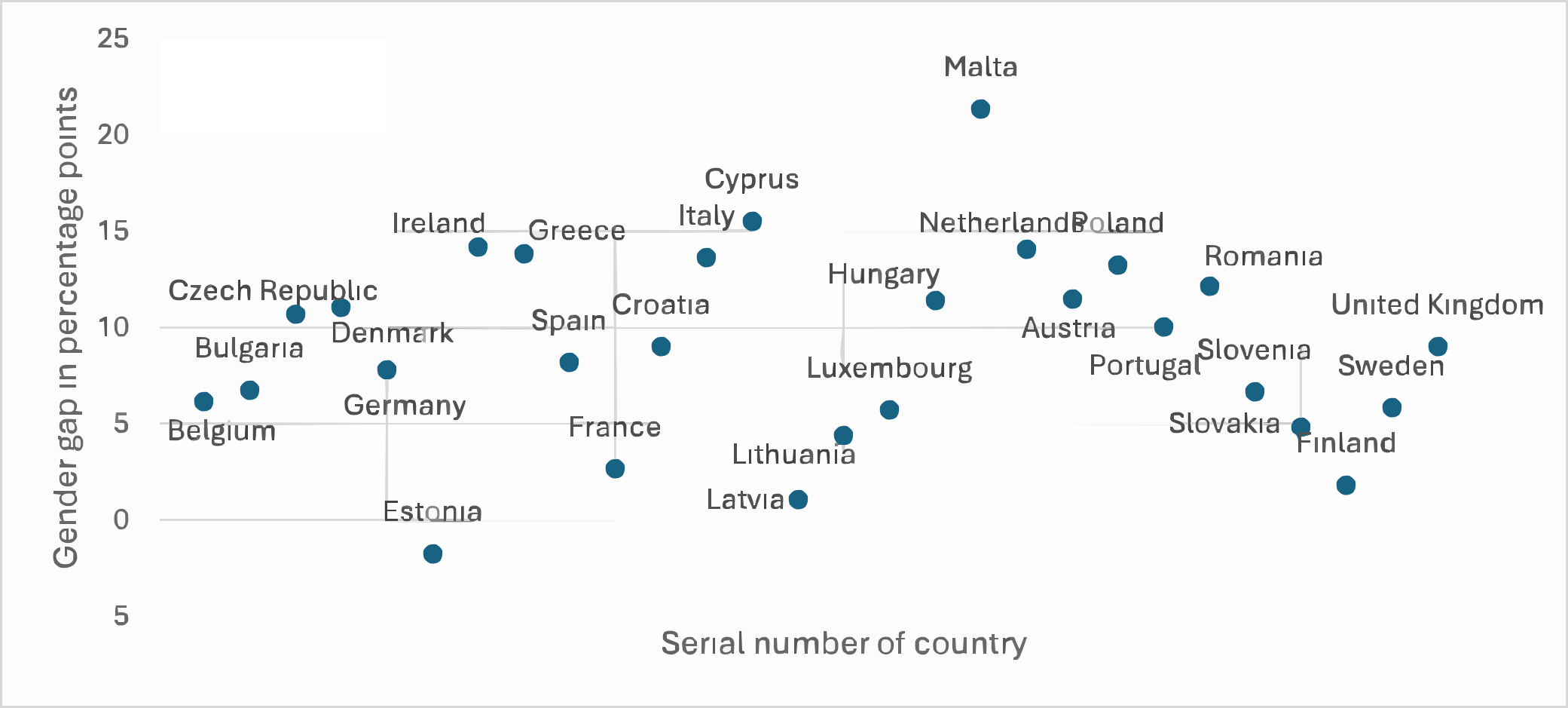
Gender gap analysis in the Employment Domain reveals notably favourable patterns for Slovakia relative to EU averages, challenging conventional assumptions about gender equity in post-transition economies. The gender gap is calculated as the difference in percentage points between male and female employment rates, with positive values indicating higher male employment (Zaidi et al., 2017). When examining the composite Employment Domain, aggregating all four age-specific employment indicators (55–59, 60–64, 65–69, 70–74), the EU-28 mean gender gap in 2020 was 9.0 percentage points (median 9.0), with substantial variation across countries (standard deviation 6.4 points). Malta exhibited the largest gap (21.4 points), followed by Greece (13.9 points) and Cyprus (15.5 points), reflecting traditional gender role patterns and limited female labour market participation in Mediterranean countries (see Figure 2). Estonia stands as the only country with a negative overall gap (-1.8 points), indicating higher female employment rates, a pattern attributed to Soviet-era legacy institutions promoting universal female labour force participation (Dorjnyambuu, 2025, pp. 6–9).
Figure 2. Gender Gap in the AAI 2020 Employment Domain by Country (in Percentage Points)
Source: Data derived from AAI results for EU (United Nations Economic Commission for Europe, n.d.).
Slovakia’s overall Employment Domain gender gap is 4.8 percentage points, substantially below the EU mean and among the smallest in the EU. This positions Slovakia favourably alongside Nordic countries traditionally recognized for gender equity in labour markets, a finding that contrasts with Slovakia’s position on other gender equity indicators, such as the gender pay gap (Eurostat, 2023).
Table 5 presents gender gap data for all four employment rate indicators across 28 EU countries, with descriptive statistics enabling systematic cross-national comparison across the full retirement transition spectrum (55–59 through 70–74).
| Nr. | Country | Overall AAI | Domain I. Employment | 1.1 Employment rate 55–59 | 1.2 Employment rate 60–64 | 1.3 Employment rate 65–69 | 1.4 Employment rate 70–74 |
|---|---|---|---|---|---|---|---|
| 1 | Belgium | -1.4 | 6.2 | 9.2 | 9.3 | 3.9 | 2.2 |
| 2 | Bulgaria | -1.9 | 6.8 | 0.2 | 16.6 | 8.5 | 1.7 |
| 3 | Czech Republic | -2.5 | 10.7 | 6.5 | 25.9 | 6.5 | 3.9 |
| 4 | Denmark | -2.0 | 11.1 | 3.4 | 15.2 | 18.9 | 6.7 |
| 5 | Germany | -4.0 | 7.8 | 8.3 | 10.0 | 7.8 | 5.1 |
| 6 | Estonia | 0.7 | -1.8 | -9.1 | -2.9 | 2.0 | 3.0 |
| 7 | Ireland | -5.2 | 14.2 | 16.6 | 15.9 | 14.2 | 10.1 |
| 8 | Greece | -4.7 | 13.8 | 28.4 | 18.2 | 6.4 | 2.3 |
| 9 | Spain | -3.6 | 8.2 | 16.9 | 12.1 | 2.2 | 1.5 |
| 10 | France | 0.2 | 2.7 | 6.9 | -0.2 | 2.6 | 1.3 |
| 11 | Croatia | -2.7 | 9.0 | 16.2 | 15.5 | 2.8 | 1.5 |
| 12 | Italy | -4.5 | 13.6 | 21.9 | 18.4 | 9.0 | 5.2 |
| 13 | Cyprus | -7.7 | 15.5 | 19.7 | 17.5 | 16.1 | 8.8 |
| 14 | Latvia | -1.2 | 1.1 | -1.4 | 4.0 | -1.3 | 2.9 |
| 15 | Lithuania | -0.9 | 4.4 | -0.7 | 7.8 | 6.2 | 4.3 |
| 16 | Luxembourg | -4.4 | 5.7 | 15.0 | 3.6 | 2.3 | 2.0 |
| 17 | Hungary | -4.7 | 11.4 | 12.4 | 26.1 | 5.4 | 1.7 |
| 18 | Malta | -7.6 | 21.4 | 44.1 | 24.4 | 9.0 | 7.9 |
| 19 | Netherlands | -6.6 | 14.1 | 15.7 | 20.1 | 13.5 | 6.9 |
| 20 | Austria | -6.2 | 11.5 | 12.3 | 25.2 | 5.3 | 3.1 |
| 21 | Poland | -2.6 | 13.3 | 11.8 | 27.8 | 8.9 | 4.5 |
| 22 | Portugal | -5.1 | 10.1 | 10.4 | 9.2 | 12.0 | 8.6 |
| 23 | Romania | -3.6 | 12.2 | 20.8 | 21.9 | 4.5 | 1.4 |
| 24 | Slovenia | -2.0 | 6.7 | 6.6 | 12.6 | 5.0 | 2.4 |
| 25 | Slovakia | -1.3 | 4.8 | 3.2 | 11.1 | 3.1 | 1.9 |
| 26 | Finland | 0.6 | 1.8 | -3.4 | -1.6 | 7.0 | 5.3 |
| 27 | Sweden | -1.9 | 5.8 | 4.5 | 4.8 | 9.7 | 4.3 |
| 28 | United Kingdom | -2.1 | 9.0 | 8.2 | 11.3 | 10.0 | 6.5 |
| Mean | -3.2 | 9.0 | 10.9 | 13.6 | 7.2 | 4.2 | |
| STDV | 2.3 | 5.1 | 10.7 | 8.6 | 4.7 | 2.6 | |
| Min | -7.7 | -1.8 | -9.1 | -2.9 | -1.3 | 1.3 | |
| Max | 0.7 | 21.4 | 44.1 | 27.8 | 18.9 | 10.1 | |
| Source: Data derived from AAI results for EU (United Nations Economic Commission for Europe, n.d.). | |||||||
The descriptive statistics in Table 5 reveal several critical patterns. In the 55–59 age cohort, the EU-28 mean gender gap is 10.9 percentage points (median 9.2) with substantial variation (standard deviation 10.7), ranging from Malta’s extreme gap of 44.1 points to Estonia’s negative gap of -9.1 points indicating that women’s employment actually exceeds men’s. Slovakia exhibits a gender gap of 3.2 percentage points, substantially below the EU-28 mean and representing the second-smallest gap in the EU after Estonia. The minimal gap in Slovakia suggests relatively balanced employment participation in the early pre-retirement period, before statutory retirement ages become salient, reflecting both high female labour force participation rates and similar employment trajectories for men and women in their late fifties.
The 60–64 age cohort demonstrates maximum gender disparities across all EU countries. The EU-28 mean gender gap surges to 13.6 percentage points (median 14.1, standard deviation 8.6), ranging from France’s near-zero gap (-0.2 points) to Poland’s extreme gap of 27.8 points. Slovakia’s gap increases to 11.1 points, still below the EU mean but substantially larger than in the 55–59 cohort (a 7.9 percentage point increase). This widening reflects historical retirement age differences: until recent reforms, Slovak women could retire at age 60 (or earlier depending on number of children), while men’s retirement age was 62 (Ministry of Labour, Social Affairs and Family of the Slovak Republic, 2019). Countries with historically gender-differentiated retirement ages (Czech Republic, Poland, Hungary, Austria) exhibit the largest 60–64 employment gaps, providing compelling evidence for institutional policy effects on labour market behaviour.
In the 65–69 age cohort, gender gaps narrow substantially, with the EU-28 mean falling to 7.2 percentage points (median 6.4, standard deviation 4.7, range from -1.3 to 18.9 points). Slovakia’s gap reduces to 3.1 points, among the smallest in the EU and substantially below the mean.
This convergence suggests that, past the statutory retirement age, both men and women exhibit low employment rates, reducing absolute gaps even as male employment rates remain modestly higher. The dramatic narrowing from the 60–64 peak (EU mean declining from 13.6 to 7.2 points) reflects floor effects: once most workers exit the labour market at statutory retirement age, the small minority remaining employed generates smaller absolute differences. In the 70–74 cohort, gender gaps narrow further to the EU-28 mean of 4.2 percentage points (median 3.9, standard deviation 2.6, range 1.3 to 10.1), with Slovakia’s gap of 1.9 points representing the third smallest in the EU. With nearly universally low employment participation in this age group (typically below 10% for both sexes in most countries), gender differences become less pronounced in absolute terms.
An important distinction emerges when examining gender gaps across the complete AAI versus the Employment Domain. For overall AAI scores, most EU countries exhibit negative gender gaps, indicating that women score higher than men. However, when isolated to the Employment Domain alone, the pattern reverses: except for Estonia, all EU countries demonstrate positive gender gaps. This reversal demonstrates that women’s higher overall AAI scores stem from the superior scores in non-employment domains, particularly Social Participation and Independent Living indicators (Zaidi et al., 2017).
4.4 Educational Disparities in Employment: Cumulative Advantage and Inequality Widening
Analysis of the employment rates by educational attainment reveals systematic and widening disparities as workers age, providing evidence for cumulative advantage theory in later-life labour market outcomes. The educational gap is calculated as the ratio of employment rates between tertiary-educated workers (ISCED 5–8) and those with lower secondary education or less (ISCED 0–4), using the EU LFS data for 2023 (Eurostat, 2023). In the 55–59 age cohort, tertiary-educated workers exhibit employment rates 1.15 times higher than workers with secondary education and 2.2 times higher than workers with lower than secondary education. This relatively modest gap suggests that in the early pre-retirement period, even lower-educated workers maintain substantial labour market attachment, with employment rates above 60% for both educational groups in most EU countries (Table 6).
| Education level | Proportion | ||||
|---|---|---|---|---|---|
| Primary | Secondary | Higher | Higher/primary | Higher/secondary | |
| Employment rate 55–59 | 43.6 | 81.8 | 94.3 | 2.2 | 1.2 |
| Employment rate 60–64 | 20.2 | 49.0 | 73.7 | 3.6 | 1.5 |
| Employment rate 65–69 | 2.8 | 9.4 | 25.0 | 8.9 | 2.7 |
| Employment rate 70–74 | 0.4 | 3.2 | 10.3 | 25.8 | 3.2 |
| Source: Authors’ calculations based on the EU-LFS 2023 microdata provided by the Statistical Office of the Slovak Republic. The data were accessed under a restricted-use agreement. | |||||
The ratio between the above-mentioned employment rates by age and educational categories can be illustrated with the following Figure 3.
Figure 3. Educational Gap in Employment Rates by Age Cohort 2023
Source: Authors’ calculations based on the EU-LFS 2023 microdata provided by the Statistical Office of the Slovak Republic. The data were accessed under a restricted-use agreement.
In the 60–64 cohort, the educational gap widens substantially to 1.5 times (resp. 2.2 times for lower education), indicating that lower-educated workers exit the labour market at significantly higher rates during the retirement transition period.
In the 65–69 cohort, past statutory retirement ages for most workers, the educational gap continues expanding to 2.7 times (resp. 3.6 times for lower-educated workers). Tertiary-educated workers demonstrate markedly higher propensity to continue employment beyond formal retirement age, likely reflecting several advantages: better health and lower rates of work-limiting chronic conditions associated with higher socioeconomic status (Debelak et al., 2023), more cognitively demanding and intrinsically motivating work that provides satisfaction beyond financial compensation (Hertel et al., 2013), occupations with greater flexibility for gradual retirement transitions and part-time arrangements (Ilmarinen, 2012), and substantially higher pension wealth reducing financial pressure for immediate benefit claiming.
In the 70–74 cohort, the educational divide reaches its maximum at 3.2 times (resp. almost 25.8 times for lower than secondary education). The small proportion of workers remaining employed at this age is disproportionately concentrated among the highly educated, predominantly in professional and managerial occupations that can be performed with reduced intensity and hours (Okatta et al., 2024). This extreme stratification represents the cumulative outcome of educational advantage processes operating throughout the life course and intensifying in later life. Lower-educated workers face compound disadvantages: earlier health deterioration and higher disability rates limiting work capacity, decades of exposure to physically demanding work creating cumulative wear, lower pension adequacy creating financial pressures for claiming benefits at earliest eligibility despite actuarial penalties, and limited access to lifelong learning opportunities that would facilitate occupational transitions or skill updates necessary for extended employment.
5 DISCUSSION
The empirical findings address both research questions while revealing complex dynamics of active ageing in post-transition economies. Slovakia improved from 28th (2010) to 21st (2020) in the AAI rankings, yet remains in the bottom quartile. It exhibits one of the EU’s smallest employment gender gaps (4.8 pp vs. EU-28 mean of 9.0 pp), with balanced outcomes in the 55–59 cohort and maximum divergence in the 60–64 cohort (EU mean 13.6 pp). Educational disparities widen from 1.15-fold in the 55–59 cohort to 3.2-fold in the 70–74 cohort.
Regarding RQ2, Slovakia’s relatively small employment gender gap appears attributable to socialist-era legacy institutions establishing high female labour force participation, recent pension reforms equalizing retirement ages, and balanced educational attainment across genders. This pattern is consistent with findings from other post-socialist economies (Chłoń-Domińczak et al., 2012; Radulović & Kostić, 2021), while Fodor et al. (2022) demonstrate that the pension reforms equalizing statutory retirement ages in Slovakia contributed to narrowing gender disparities in the 60–64 cohort. However, this employment equity does not extend to other AAI domains, where traditional gender roles in caregiving result in female advantages in Social Participation scores. H1 is supported (Slovakia’s 4.8 pp gap vs. EU mean 9.0 pp reflects socialist-era legacies, with particularly small gaps in the 55–59 cohort at 3.2 pp). H2 is confirmed (educational disparities widen progressively: 1.15×, 1.5×, 2.7×, 3.2× across successive cohorts). H3 is supported (the 60–64 cohort exhibits the EU’s largest mean gender gap at 13.6 pp, consistent with institutional legacies of gender-differentiated retirement ages).
Slovakia’s Progress within European Context
Slovakia’s seven-place jump in the AAI rankings reflects concrete pension reforms, including the statutory retirement age increase from 62 to 64 years and early retirement restrictions (Ministry of Labour, Social Affairs and Family of the Slovak Republic, 2014). However, the persistent 15–20 point gap between Slovakia and Nordic leaders reflects shared structural challenges in post-transition economies, including labour market rigidities and incomplete institutional adaptation (Cowen et al., 2022). Closing such gaps requires integrated systems of lifelong learning, flexible work arrangements, and cultural transformation (Ilmarinen, 2012).
Slovakia’s small employment gender gap (4.8 points) contradicts expectations for post-transition economies, providing further support for H1. Women aged 55–74 entered labour markets during the 1970s–1990s when female employment was normalized, creating continuous employment biographies unlike Western European cohorts where career interruptions were more common (Chłoń-Domińczak et al., 2012).
The 60-64 Critical Period: Institutional Legacy Effects
The systematic concentration of maximum gender gaps in the 60–64 cohort across all EU countries (mean 13.6 points) provides compelling empirical validation for institutional retirement age theory, confirming H3. Statutory retirement age thresholds shape gendered labour market exit behaviour not merely through formal incentives, but through the internalisation of normative expectations about appropriate retirement timing (Zacher & Rudolph, 2022; Fodor et al., 2022). Where gender-differentiated thresholds persisted for decades, as in Slovakia and other Central European states, women developed systematically earlier exit patterns that persist even after formal equalisation (see Section 2.4). The strong correlations between historical retirement age gaps and current employment disparities across Central European countries confirm that these institutional legacies transcend country-specific contexts, extending Zacher and Rudolph’s (2022, pp. 8–12) work on retirement transitions.
The recent pension reforms in Slovakia that gradually equalized retirement ages demonstrate policy impacts, yet our data show that the legacy effects persist. Current cohorts maintain behavioural expectations formed under previous regimes. The subsequent narrowing to 3.1 points (65–69 cohort) and 1.9 points (70–74 cohort) confirms Ilmarinen’s (2012) findings that post-retirement labour market re-entry remains rare, creating floor effects that minimize gender differences. This pattern contradicts policy assumptions about flexible labour market transitions in later life. Indeed, anthropological evidence from Serbia confirms that working after retirement in post-socialist societies is shaped more by economic necessity and institutional constraints than by voluntary preference (Milosavljević et al., 2024).
The reversal between overall AAI gender patterns (favouring women) and Employment Domain patterns (favouring men) highlights that Slovakia’s favourable employment rates may partially reflect women’s concentration in unpaid caregiving, thus raising questions about true equity versus gender-differentiated pathways.
Educational Stratification: Cumulative Disadvantage Amplification
The progressive widening from 1.15-fold to 3.2-fold across age cohorts provides strong empirical validation for cumulative advantage theory (DiPrete & Eirich, 2006; Crystal & Shea, 1990), confirming H2 and demonstrating systematic exclusion of lower-educated workers across the retirement transition.
Slovakia’s specific trajectory reflects the post-transition economic transformation documented by Cowen et al. (2022). Automotive manufacturing expansion created skills obsolescence pressures that disproportionately affected workers with vocational training in obsolete technologies, generating cohort-specific disadvantages (Cowen et al., 2022).
Health inequalities further exacerbate employment differences. Eurostat (2025) documents pronounced educational gradients in self-reported health across Central Europe, and physically demanding lower-skilled work creates cumulative health deterioration that explains earlier labour market exit (Getzmann et al., 2023). Limited lifelong learning participation among lower-educated Slovak workers further constrains adaptive capacity (Nikou et al., 2022).
The educational gap widening in the 60–64 cohort reflects multiple intersecting mechanisms: higher physical demands and occupational health risks in lower-skilled occupations (Getzmann et al., 2023), stronger financial incentives for early retirement due to lower pension entitlements (Fodor et al., 2022, pp. 12–18), limited access to reskilling programmes (Nikou et al., 2022), and greater exposure to age-based discrimination (Bayl-Smith, 2019).
The extreme 3.2-fold gap in the 70–74 cohort confirms that extended working lives remain predominantly the highly educated professional class’ phenomenon. This is consistent with Hertel et al.’s (2013) findings on knowledge-intensive sectors. This challenges policy optimism about universal extended working life feasibility, as active ageing policies risk exacerbating inequalities without targeted interventions.
6 POLICY IMPLICATIONS AND FUTURE RESEARCH
The concentration of maximum gender gaps in the 60–64 cohort identifies critical intervention timing. Policy supports including flexible work arrangements, gradual retirement pathways, and caregiving reconciliation programmes should target this age group, where disparities peak and where interventions can maintain employment continuation before permanent exit. This recommendation aligns with successful Nordic country practices documented in AAI research.
Addressing educational stratification requires multi-dimensional interventions. Workplace health improvements in physically demanding occupations, accessible lifelong learning emphasizing digital literacy, and pension reforms ensuring adequate retirement income for lower-educated workers facing earlier health deterioration represent essential components. Slovakia’s demographic scissors effect, characterised by a shrinking working-age population alongside a rapidly expanding retirement-age population, creates urgent fiscal pressures requiring extended working lives. Yet simply increasing statutory retirement ages without addressing disparities will disproportionately burden disadvantaged populations.
The reversal between overall AAI and Employment Domain gender patterns demonstrates the multidimensional nature of active ageing. Future research should investigate the intersections of employment, caregiving, health, and economic security rather than treating domains separately. Employment rate measures obscure quality inequalities, including working hours, wages, and conditions, which require further investigation.
Several study limitations should be acknowledged. The cross-sectional design limits causal inference about temporal dynamics, though our theoretical frameworks suggest plausible mechanisms. Panel data analysis following individual workers could strengthen causal claims about retirement transitions. The aggregate country-level analysis obscures regional variation and individual heterogeneity. The temporal misalignment between the data sources (demographic data spanning 2010–2024, AAI measurements covering 2010–2020, and EU-LFS data limited to 2023) introduces inconsistencies that cannot be fully resolved within the current study design. Future research should address this limitation by restricting analysis to a single reference year, once more recent AAI waves become available, or by extending the EU-LFS extraction to cover the full 2010–2020 AAI observation window. Nevertheless, the structural demographic and labour market phenomena examined here change sufficiently slowly that the directional patterns identified remain valid across the overlapping periods.
7 CONCLUSION
This study examined gender and educational disparities in older worker employment in Slovakia through a dual analytical approach: gender gap analysis using the AAI data and educational stratification analysis using the EU Labour Force Survey microdata. Five critical findings emerge: Slovakia experiences accelerated demographic ageing (old-age dependency ratio increasing 61.3% versus 22.7% in EU-27); has improved its AAI ranking from last to 21st position, yet remains in the bottom quartile; demonstrates an unexpectedly small employment gender gap (4.8 versus 9.0 points EU mean) reflecting socialist-era institutions; identifies the 60–64 cohort as the critical intervention group showing maximum gender disparities (13.6 points more than the EU mean); and reveals dramatic educational gap widening from 1.15-fold to 3.2-fold across age cohorts, demonstrating cumulative disadvantage among lower-educated older workers.
These findings advance active ageing theory by demonstrating how institutional contexts, historical legacies, and cumulative processes interact in post-transition economies. Policy implications involve comprehensive strategies extending beyond pension reforms, to encompass workplace health promotion and lifelong learning systems, targeted 60–64 cohort supports including flexible retirement pathways and caregiving reconciliation, as well as multi-dimensional educational equity interventions, including workplace ergonomics and accessible reskilling programmes.
Slovakia faces accelerated demographic ageing intersecting with post-transition transformation. The country achieved progress in maintaining strong gender equity in employment rates, yet faces educational stratification challenges. Addressing these requires sustained policy commitment, comprehensive institutional transformation, and targeted interventions for disadvantaged populations. This study provides an empirical foundation for evidence-based policy development that extends working lives while promoting equity in Slovakia’s rapidly ageing society.
The authors are grateful for the support from the Research Agency of the Ministry of Education, Science, Research and Sport of the Slovak Republic grant no. VEGA 1/0124/24 “Slovakia in the Context of the Pension Index and the Ageing Population Index – a Future Perspective.
Data availability statement
Data are available from the authors upon request.
Coauthor contributions
Andrea Seberíni: Data curation, Investigation, Writing - Original Draft, Writing - Review & Editing
Alena Kaščáková: Methodology, Validation, Writing - Original Draft, Writing - Review & Editing
Miroslav Hužvár: Visualization, Conceptualization, Validation
References
- Balaj, M., Henson, C. A., Aronsson, A., Aravkin, A., Beck, K., Degail, C., Donadello, L., Eikemo, K., Friedman, J., Giouleka, A., Gradeci, I., Hay, S. I., Jensen, M. R., McLaughlin, S. A., Mullany, E. C., O’Connell, E. M., Sripada, K., Stonkute, D., Sorensen, R. J. D., Solhaug, S., Vonen, H. D., Westby, C., Zheng, P., Mohammad, T., Eikemo, T. A., & Gakidou, E. (2024). Effects of education on adult mortality: A global systematic review and meta-analysis. The Lancet Public Health, 9(3), e155-e165. https://doi.org/10.1016/S2468-2667(23)00306-7
- Baltes, P. B., … Baltes, M. M. (Eds.). (1990). Successful aging: Perspectives from the behavioral sciences. Cambridge University Press. https://doi.org/10.1017/CBO9780511665684
- Bayl-Smith, P. (2019). Age discrimination in the workplace. In D. Gu & M. E. Dupre (Eds.), Encyclopedia of gerontology and population aging (pp. 1-6). Springer International Publishing. https://doi.org/10.1007/978-3-319-69892-2_582-1
- Botev, N. (2012). Population ageing in Central and Eastern Europe and its demographic and social context. European Journal of Ageing, 9(1), 69-79. https://doi.org/10.1007/s10433-012-0217-9
- Chłoń-Domińczak, A., Franco, D., & Palmer, E. (2012). The first wave of NDC reforms: The experiences of Italy, Latvia, Poland, and Sweden. In R. Holzmann, E. Palmer, & D. Robalino (Eds.), Nonfinancial defined contribution pension schemes in a changing pension world (pp. 31-84). World Bank. https://doi.org/10.1596/9780821388488_CH02
- Coleman, J. S. (1990). Foundations of social theory. Belknap Press of Harvard University Press. https://www.hup.harvard.edu/books/9780674312265
- Cook, L. J., & Inglot, T. (2021). From transition to austerity: Social policy after communism. In M. A. Orenstein & B. Bugarič (Eds.), Welfare states and policy challenges in Central and Eastern Europe (pp. 16-37). Edward Elgar.
- Cordova, K., Grabka, M. M., & Sierminska, E. (2022). Pension wealth and the gender wealth gap. European Journal of Population, 38(4), 755-810. https://doi.org/10.1007/s10680-022-09631-6
- Cowen, A. P., Rink, F., Cuypers, I. R. P., Grégoire, D. A., & Weller, I. (2022). Applying Coleman’s boat in management research: Opportunities and challenges in bridging macro and micro theory. Academy of Management Journal, 65(1), 1-10. https://doi.org/10.5465/amj.2022.4001
- Crystal, S., & Shea, D. (1990). Cumulative advantage, cumulative disadvantage, and inequality among elderly people. The Gerontologist, 30(4), 437-443. https://doi.org/10.1093/geront/30.4.437
- Cumming, E., & Henry, W. E. (1961). Growing old: The process of disengagement. Basic Books. https://books.google.com/books/about/Growing_Old_the_Process_of_Disengagement.html?id=JzhHAAAAMAAJ
- Davies, N. M., Dickson, M., Davey Smith, G., Windmeijer, F., & van den Berg, G. J. (2023). The causal effects of education on adult health, mortality and income: Evidence from Mendelian randomization and the raising of the school leaving age. International Journal of Epidemiology, 52(6), 1878-1886. https://doi.org/10.1093/ije/dyad104
- Davis, K. (1945). The world demographic transition. The Annals of the American Academy of Political and Social Science, 237(1), 1-11. https://doi.org/10.1177/000271624523700102
- Debelak, K., Grah, B., & Penger, S. (2023). Ageing workforce’s impact on modern organizations: How to extend working lives?. ENTRENOVA - ENTerprise REsearch InNOVAtion, 9(1), 166-180. https://doi.org/10.54820/entrenova-2023-0016
- Debelak, K., Penger, S., & Grah, B. (2024). Successful aging at work: A comprehensive literature review. ENTRENOVA - ENTerprise REsearch InNOVAtion, 10(1), 191-203. https://doi.org/10.54820/entrenova-2024-0017
- DiPrete, T. A., & Eirich, G. M. (2006). Cumulative advantage as a mechanism for inequality. Annual Review of Sociology, 32, 271-297. https://doi.org/10.1146/annurev.soc.32.061604.123127
- Dorjnyambuu, B. (2025). A systematic literature review of income inequality in Central–Eastern European countries. Comparative Economic Studies, 67(1), 1-49. https://doi.org/10.1057/s41294-024-00240-2
- Esping-Andersen, G. (1990). The three worlds of welfare capitalism. Princeton University Press. https://books.google.com/books/about/The_Three_Worlds_of_Welfare_Capitalism.html?id=ERCnDwAAQBAJ
- European Commission. (2023). The impact of demographic change – in a changing environment. https://commission.europa.eu/system/files/2023-01/the_impact_of_demographic_change_in_a_changing_environment_2023.PDF
- European Trade Union Institute. (2019). Pension reforms in Slovakia: Background summary. European Trade Union Institute. https://www.etui.org/covid-social-impact/slovakia/pension-reforms-in-slovakia-background-summary-update-april-2019
- Eurostat. (2023). EU Labour Force Survey (EU-LFS). European Commission. https://ec.europa.eu/eurostat/web/microdata/european-union-labour-force-survey
- Eurostat. (2024). Living conditions in Europe — income distribution and income inequality. European Commission. https://ec.europa.eu/eurostat/statistics-explained/index.php?title=Living_conditions_in_Europe_-_income_distribution_and_income_inequality#Income_distribution
- Eurostat. (2025). demo_pjanind__custom_18208988 [Data set]. European Commission. https://ec.europa.eu/eurostat/databrowser/view/demo_pjanind/default/table?lang=en
- Filipović, S., & Miljković, M. (2024). Impact of population ageing on fiscal balance in the European Union. Stanovništvo, 62(2), 231-250. https://doi.org/10.59954/stnv.648
- Fodor, J., Roehn, O., & Hwang, H. (2022). Determinants of labour market exit of older workers in the Slovak Republic. OECD Publishing. https://doi.org/10.1787/2161918e-en
- Getzmann, S., Reiser, J. E., Gajewski, P. D., Schneider, D., Karthaus, M., & Wascher, E. (2023). Cognitive aging at work and in daily life—A narrative review on challenges due to age-related changes in central cognitive functions. Frontiers in Psychology, 14, 1232344. https://doi.org/10.3389/fpsyg.2023.1232344
- Havighurst, R. J. (1961). Successful aging. The Gerontologist, 1(1), 8-13. https://doi.org/10.1093/geront/1.1.8
- Havighurst, R. J., Neugarten, B. L., & Tobin, S. S. (1968). Disengagement and patterns of aging. In B. L. Neugarten (Ed.), Middle age and aging (pp. 161-172). University of Chicago Press. https://books.google.com/books/about/Middle_Age_and_Aging.html?id=nAJqQ7meAIMC
- Hertel, G., Van Der Heijden, B. I. J. M., De Lange, A. H., & Deller, J. (2013). Facilitating age diversity in organizations – part I: Challenging popular misbeliefs. Journal of Managerial Psychology, 28(7/8), 729-740. https://doi.org/10.1108/JMP-07-2013-0233
- Hoff, A. (Ed.). (2011). Population ageing in Central and Eastern Europe: Societal and policy implications. Ashgate. https://books.google.com/books/about/Population_Ageing_in_Central_and_Eastern.html?id=4duhAgAAQBAJ
- Ilmarinen, J. (2012). Promoting active ageing in the workplace. European Agency for Safety and Health at Work. https://osha.europa.eu/en/publications/promoting-active-ageing-workplace
- Mentus, V. (2022). Aging well? Social spending, age, and subjective wellbeing across Europe. Stanovništvo, 60(2), 75-88. https://doi.org/10.2298/STNV2202075M
- Milosavljević, L., Banić Grubišić, A., & Ajduk, M. (2024). Work after retiring in Serbia from an anthropological perspective. Stanovništvo, 62(1), 1-21. https://doi.org/10.59954/stnv.519
- Ministry of Labour, Social Affairs and Family of the Slovak Republic. (2014). National Programme for Active Ageing 2014–2020. https://www.employment.gov.sk/files/slovensky/ministerstvo/rada-vlady-sr-prava-seniorov/npas-2014-2020.pdf
- Ministry of Labour, Social Affairs and Family of the Slovak Republic. (2019). Pension system and retirement age in the Slovak Republic. Ministry of Labour, Social Affairs and Family of the Slovak Republic. https://www.mpsvr.sk/en/social-insurance-pension-scheme/pension-scheme/
- Müller, K. (1999). The political economy of pension reform in Central-Eastern Europe. Edward Elgar. https://doi.org/10.4337/9781035306107
- Nikou, S., De Reuver, M., & Mahboob Kanafi, M. (2022). Workplace literacy skills—How information and digital literacy affect adoption of digital technology. Journal of Documentation, 78(7), 371-391. https://doi.org/10.1108/JD-12-2021-0241
- Notestein, F. W. (1945). Population – the long view. In T. W. Schultz (Ed.), Food for the world (pp. 36-57). University of Chicago Press. https://www.econbiz.de/Record/population-the-long-view-notestein-frank/10003642398
- Okatta, C. G., Ajayi, F. A., & Olawale, O. (2024). Enhancing organizational performance through diversity and inclusion initiatives: A meta-analysis. International Journal of Applied Research in Social Sciences, 6(4), 734-758. https://doi.org/10.51594/ijarss.v6i4.1065
- Organisation for Economic Co-operation and Development. (2023). Pensions at a glance 2023: OECD and G20 indicators. OECD Publishing. https://doi.org/10.1787/678055dd-en
- Organisation for Economic Co-operation and Development. (2025). Employment rates of older workers and gender gaps. Pensions at a Glance 2025: OECD and G20 Indicators. https://www.oecd.org/en/publications/pensions-at-a-glance-2025_e40274c1-en/full-report/employment-rates-of-older-workers-and-gender-gaps_cb8a2f7b.html
- Radulović, M., & Kostić, M. (2021). Does population ageing impact inflation?. Stanovništvo, 59(2), 107-122. https://doi.org/10.2298/STNV2102107R
- Tardos, K. (2013). Employment of older workers in Hungary. In P. Taylor (Ed.), Older workers in an ageing society (pp. 101-116). Edward Elgar. https://doi.org/10.4337/9781782540106
- United Nations Economic Commission for Europe. (n.d.). AAI results for EU. UNECE StatsWiki. https://statswiki.unece.org/spaces/AAI/pages/76287845/III.+Do+it+yourself
- United Nations Economic Commission for Europe, & European Commission. (2018). Active ageing index (AAI) in non-EU countries and at subnational level: Guidelines. https://statswiki.unece.org/download/attachments/76287849/AAI_Guidelines_final.pdf
- Vidovičová, L. (2005). To be active or not to be active, that is the question: The preference model of activity in advanced age. Ageing International, 30(4), 343-362. https://doi.org/10.1007/s12126-005-1020-0
- Waligóra, Ł. (2024). Exploring the impact of age diversity on organizational identification: A study of HR practices and perceived age discrimination climate. Administrative Sciences, 14(10), 243. https://doi.org/10.3390/admsci14100243
- Walker, A., & Maltby, T. (2012). Active ageing: A strategic policy solution to demographic ageing in the European Union. International Journal of Social Welfare, 21(s1), S117-S130. https://doi.org/10.1111/j.1468-2397.2012.00871.x
- World Health Organization. (2002). Active ageing: A policy framework. https://apps.who.int/iris/handle/10665/67215
- Zacher, H., & Rudolph, C. W. (2017). Considering generations from a lifespan developmental perspective. Work, Aging and Retirement, 3(2), 113-129. https://doi.org/10.1093/workar/waw019
- Zacher, H., … Rudolph, C. W. (Eds.). (2022). Age and work: Advances in theory, methods, and practice. Routledge. https://doi.org/10.4324/9781003089674
- Zaidi, A., Gasior, K., Zolyomi, E., Schmidt, A., Rodrigues, R., & Marin, B. (2017). Measuring active and healthy ageing in Europe. Journal of European Social Policy, 27(2), 138-157. https://doi.org/10.1177/0958928716676550
- Zvezdanović Lobanova, J., Kelić, V., & Zvezdanović, M. (2025). Population ageing and gender gap: A dual challenge to economic growth. Stanovništvo, 63(1), 29-50. https://doi.org/10.59954/stnv.681
- Łuczak, A., & Szymańska, A. (2020). Employment of older workers in Polish enterprises. Acta Universitatis Lodziensis. Folia Oeconomica, 3(348), 73-90. https://doi.org/10.18778/0208-6018.348.05
Article Details
Published by the Institute of Social Sciences - Center for Demographic Research




References
Balaj, M., Henson, C. A., Aronsson, A., Aravkin, A., Beck, K., Degail, C., Donadello, L., Eikemo, K., Friedman, J., Giouleka, A., Gradeci, I., Hay, S. I., Jensen, M. R., McLaughlin, S. A., Mullany, E. C., O’Connell, E. M., Sripada, K., Stonkute, D., Sorensen, R. J. D., Solhaug, S., Vonen, H. D., Westby, C., Zheng, P., Mohammad, T., Eikemo, T. A., & Gakidou, E. (2024). Effects of education on adult mortality: A global systematic review and meta-analysis. The Lancet Public Health, 9(3), e155-e165. https://doi.org/10.1016/S2468-2667(23)00306-7 DOI: https://doi.org/10.1016/S2468-2667(23)00306-7
Baltes, P. B., … Baltes, M. M. (Eds.). (1990). Successful aging: Perspectives from the behavioral sciences. Cambridge University Press. https://doi.org/10.1017/CBO9780511665684 DOI: https://doi.org/10.1017/CBO9780511665684
Bayl-Smith, P. (2019). Age discrimination in the workplace. In D. Gu & M. E. Dupre (Eds.), Encyclopedia of gerontology and population aging (pp. 1-6). Springer International Publishing. https://doi.org/10.1007/978-3-319-69892-2_582-1 DOI: https://doi.org/10.1007/978-3-319-69892-2_582-1
Botev, N. (2012). Population ageing in Central and Eastern Europe and its demographic and social context. European Journal of Ageing, 9(1), 69-79. https://doi.org/10.1007/s10433-012-0217-9 DOI: https://doi.org/10.1007/s10433-012-0217-9
Chłoń-Domińczak, A., Franco, D., & Palmer, E. (2012). The first wave of NDC reforms: The experiences of Italy, Latvia, Poland, and Sweden. In R. Holzmann, E. Palmer, & D. Robalino (Eds.), Nonfinancial defined contribution pension schemes in a changing pension world (pp. 31-84). World Bank. https://doi.org/10.1596/9780821388488_CH02 DOI: https://doi.org/10.1596/9780821388488_CH02
Coleman, J. S. (1990). Foundations of social theory. Belknap Press of Harvard University Press. https://www.hup.harvard.edu/books/9780674312265
Cook, L. J., & Inglot, T. (2021). From transition to austerity: Social policy after communism. In M. A. Orenstein & B. Bugarič (Eds.), Welfare states and policy challenges in Central and Eastern Europe (pp. 16-37). Edward Elgar.
Cordova, K., Grabka, M. M., & Sierminska, E. (2022). Pension wealth and the gender wealth gap. European Journal of Population, 38(4), 755-810. https://doi.org/10.1007/s10680-022-09631-6 DOI: https://doi.org/10.1007/s10680-022-09631-6
Cowen, A. P., Rink, F., Cuypers, I. R. P., Grégoire, D. A., & Weller, I. (2022). Applying Coleman’s boat in management research: Opportunities and challenges in bridging macro and micro theory. Academy of Management Journal, 65(1), 1-10. https://doi.org/10.5465/amj.2022.4001 DOI: https://doi.org/10.5465/amj.2022.4001
Crystal, S., & Shea, D. (1990). Cumulative advantage, cumulative disadvantage, and inequality among elderly people. The Gerontologist, 30(4), 437-443. https://doi.org/10.1093/geront/30.4.437 DOI: https://doi.org/10.1093/geront/30.4.437
Cumming, E., & Henry, W. E. (1961). Growing old: The process of disengagement. Basic Books. https://books.google.com/books/about/Growing_Old_the_Process_of_Disengagement.html?id=JzhHAAAAMAAJ
Davies, N. M., Dickson, M., Davey Smith, G., Windmeijer, F., & van den Berg, G. J. (2023). The causal effects of education on adult health, mortality and income: Evidence from Mendelian randomization and the raising of the school leaving age. International Journal of Epidemiology, 52(6), 1878-1886. https://doi.org/10.1093/ije/dyad104 DOI: https://doi.org/10.1093/ije/dyad104
Davis, K. (1945). The world demographic transition. The Annals of the American Academy of Political and Social Science, 237(1), 1-11. https://doi.org/10.1177/000271624523700102 DOI: https://doi.org/10.1177/000271624523700102
Debelak, K., Grah, B., & Penger, S. (2023). Ageing workforce’s impact on modern organizations: How to extend working lives?. ENTRENOVA - ENTerprise REsearch InNOVAtion, 9(1), 166-180. https://doi.org/10.54820/entrenova-2023-0016 DOI: https://doi.org/10.54820/entrenova-2023-0016
Debelak, K., Penger, S., & Grah, B. (2024). Successful aging at work: A comprehensive literature review. ENTRENOVA - ENTerprise REsearch InNOVAtion, 10(1), 191-203. https://doi.org/10.54820/entrenova-2024-0017 DOI: https://doi.org/10.54820/entrenova-2024-0017
DiPrete, T. A., & Eirich, G. M. (2006). Cumulative advantage as a mechanism for inequality. Annual Review of Sociology, 32, 271-297. https://doi.org/10.1146/annurev.soc.32.061604.123127 DOI: https://doi.org/10.1146/annurev.soc.32.061604.123127
Dorjnyambuu, B. (2025). A systematic literature review of income inequality in Central–Eastern European countries. Comparative Economic Studies, 67(1), 1-49. https://doi.org/10.1057/s41294-024-00240-2 DOI: https://doi.org/10.1057/s41294-024-00240-2
Esping-Andersen, G. (1990). The three worlds of welfare capitalism. Princeton University Press. https://books.google.com/books/about/The_Three_Worlds_of_Welfare_Capitalism.html?id=ERCnDwAAQBAJ DOI: https://doi.org/10.1177/095892879100100108
European Commission. (2023). The impact of demographic change – in a changing environment. https://commission.europa.eu/system/files/2023-01/the_impact_of_demographic_change_in_a_changing_environment_2023.PDF
European Trade Union Institute. (2019). Pension reforms in Slovakia: Background summary. European Trade Union Institute. https://www.etui.org/covid-social-impact/slovakia/pension-reforms-in-slovakia-background-summary-update-april-2019
Eurostat. (2023). EU Labour Force Survey (EU-LFS). European Commission. https://ec.europa.eu/eurostat/web/microdata/european-union-labour-force-survey
Eurostat. (2024). Living conditions in Europe — income distribution and income inequality. European Commission. https://ec.europa.eu/eurostat/statistics-explained/index.php?title=Living_conditions_in_Europe_-_income_distribution_and_income_inequality#Income_distribution
Eurostat. (2025). demo_pjanind__custom_18208988 [Data set]. European Commission. https://ec.europa.eu/eurostat/databrowser/view/demo_pjanind/default/table?lang=en
Filipović, S., & Miljković, M. (2024). Impact of population ageing on fiscal balance in the European Union. Stanovništvo, 62(2), 231-250. https://doi.org/10.59954/stnv.648 DOI: https://doi.org/10.59954/stnv.648
Fodor, J., Roehn, O., & Hwang, H. (2022). Determinants of labour market exit of older workers in the Slovak Republic. OECD Publishing. https://doi.org/10.1787/2161918e-en DOI: https://doi.org/10.1787/2161918e-en
Getzmann, S., Reiser, J. E., Gajewski, P. D., Schneider, D., Karthaus, M., & Wascher, E. (2023). Cognitive aging at work and in daily life—A narrative review on challenges due to age-related changes in central cognitive functions. Frontiers in Psychology, 14, 1232344. https://doi.org/10.3389/fpsyg.2023.1232344 DOI: https://doi.org/10.3389/fpsyg.2023.1232344
Havighurst, R. J. (1961). Successful aging. The Gerontologist, 1(1), 8-13. https://doi.org/10.1093/geront/1.1.8 DOI: https://doi.org/10.1093/geront/1.1.8
Havighurst, R. J., Neugarten, B. L., & Tobin, S. S. (1968). Disengagement and patterns of aging. In B. L. Neugarten (Ed.), Middle age and aging (pp. 161-172). University of Chicago Press. https://books.google.com/books/about/Middle_Age_and_Aging.html?id=nAJqQ7meAIMC
Hertel, G., Van Der Heijden, B. I. J. M., De Lange, A. H., & Deller, J. (2013). Facilitating age diversity in organizations – part I: Challenging popular misbeliefs. Journal of Managerial Psychology, 28(7/8), 729-740. https://doi.org/10.1108/JMP-07-2013-0233 DOI: https://doi.org/10.1108/JMP-07-2013-0233
Hoff, A. (Ed.). (2011). Population ageing in Central and Eastern Europe: Societal and policy implications. Ashgate. https://books.google.com/books/about/Population_Ageing_in_Central_and_Eastern.html?id=4duhAgAAQBAJ
Ilmarinen, J. (2012). Promoting active ageing in the workplace. European Agency for Safety and Health at Work. https://osha.europa.eu/en/publications/promoting-active-ageing-workplace
Mentus, V. (2022). Aging well? Social spending, age, and subjective wellbeing across Europe. Stanovništvo, 60(2), 75-88. https://doi.org/10.2298/STNV2202075M DOI: https://doi.org/10.2298/STNV2202075M
Milosavljević, L., Banić Grubišić, A., & Ajduk, M. (2024). Work after retiring in Serbia from an anthropological perspective. Stanovništvo, 62(1), 1-21. https://doi.org/10.59954/stnv.519 DOI: https://doi.org/10.59954/stnv.519
Ministry of Labour, Social Affairs and Family of the Slovak Republic. (2014). National Programme for Active Ageing 2014–2020. https://www.employment.gov.sk/files/slovensky/ministerstvo/rada-vlady-sr-prava-seniorov/npas-2014-2020.pdf
Ministry of Labour, Social Affairs and Family of the Slovak Republic. (2019). Pension system and retirement age in the Slovak Republic. Ministry of Labour, Social Affairs and Family of the Slovak Republic. https://www.mpsvr.sk/en/social-insurance-pension-scheme/pension-scheme/
Müller, K. (1999). The political economy of pension reform in Central-Eastern Europe. Edward Elgar. https://doi.org/10.4337/9781035306107 DOI: https://doi.org/10.4337/9781035306107
Nikou, S., De Reuver, M., & Mahboob Kanafi, M. (2022). Workplace literacy skills—How information and digital literacy affect adoption of digital technology. Journal of Documentation, 78(7), 371-391. https://doi.org/10.1108/JD-12-2021-0241 DOI: https://doi.org/10.1108/JD-12-2021-0241
Notestein, F. W. (1945). Population – the long view. In T. W. Schultz (Ed.), Food for the world (pp. 36-57). University of Chicago Press. https://www.econbiz.de/Record/population-the-long-view-notestein-frank/10003642398
Okatta, C. G., Ajayi, F. A., & Olawale, O. (2024). Enhancing organizational performance through diversity and inclusion initiatives: A meta-analysis. International Journal of Applied Research in Social Sciences, 6(4), 734-758. https://doi.org/10.51594/ijarss.v6i4.1065 DOI: https://doi.org/10.51594/ijarss.v6i4.1065
Organisation for Economic Co-operation and Development. (2023). Pensions at a glance 2023: OECD and G20 indicators. OECD Publishing. https://doi.org/10.1787/678055dd-en DOI: https://doi.org/10.1787/678055dd-en
Organisation for Economic Co-operation and Development. (2025). Employment rates of older workers and gender gaps. Pensions at a Glance 2025: OECD and G20 Indicators. https://www.oecd.org/en/publications/pensions-at-a-glance-2025_e40274c1-en/full-report/employment-rates-of-older-workers-and-gender-gaps_cb8a2f7b.html
Radulović, M., & Kostić, M. (2021). Does population ageing impact inflation?. Stanovništvo, 59(2), 107-122. https://doi.org/10.2298/STNV2102107R DOI: https://doi.org/10.2298/STNV2102107R
Tardos, K. (2013). Employment of older workers in Hungary. In P. Taylor (Ed.), Older workers in an ageing society (pp. 101-116). Edward Elgar. https://doi.org/10.4337/9781782540106 DOI: https://doi.org/10.4337/9781782540106
United Nations Economic Commission for Europe. AAI results for EU. UNECE StatsWiki. https://statswiki.unece.org/spaces/AAI/pages/76287845/III.+Do+it+yourself
United Nations Economic Commission for Europe, & European Commission. (2018). Active ageing index (AAI) in non-EU countries and at subnational level: Guidelines. https://statswiki.unece.org/download/attachments/76287849/AAI_Guidelines_final.pdf
Vidovičová, L. (2005). To be active or not to be active, that is the question: The preference model of activity in advanced age. Ageing International, 30(4), 343-362. https://doi.org/10.1007/s12126-005-1020-0 DOI: https://doi.org/10.1007/s12126-005-1020-0
Waligóra, Ł. (2024). Exploring the impact of age diversity on organizational identification: A study of HR practices and perceived age discrimination climate. Administrative Sciences, 14(10), 243. https://doi.org/10.3390/admsci14100243 DOI: https://doi.org/10.3390/admsci14100243
Walker, A., & Maltby, T. (2012). Active ageing: A strategic policy solution to demographic ageing in the European Union. International Journal of Social Welfare, 21(s1), S117-S130. https://doi.org/10.1111/j.1468-2397.2012.00871.x DOI: https://doi.org/10.1111/j.1468-2397.2012.00871.x
World Health Organization. (2002). Active ageing: A policy framework. https://apps.who.int/iris/handle/10665/67215
Zacher, H., & Rudolph, C. W. (2017). Considering generations from a lifespan developmental perspective. Work, Aging and Retirement, 3(2), 113-129. https://doi.org/10.1093/workar/waw019 DOI: https://doi.org/10.1093/workar/waw019
Zacher, H., … Rudolph, C. W. (Eds.). (2022). Age and work: Advances in theory, methods, and practice. Routledge. https://doi.org/10.4324/9781003089674 DOI: https://doi.org/10.4324/9781003089674
Zaidi, A., Gasior, K., Zolyomi, E., Schmidt, A., Rodrigues, R., & Marin, B. (2017). Measuring active and healthy ageing in Europe. Journal of European Social Policy, 27(2), 138-157. https://doi.org/10.1177/0958928716676550 DOI: https://doi.org/10.1177/0958928716676550
Zvezdanović Lobanova, J., Kelić, V., & Zvezdanović, M. (2025). Population ageing and gender gap: A dual challenge to economic growth. Stanovništvo, 63(1), 29-50. https://doi.org/10.59954/stnv.681 DOI: https://doi.org/10.59954/stnv.681
Łuczak, A., & Szymańska, A. (2020). Employment of older workers in Polish enterprises. Acta Universitatis Lodziensis. Folia Oeconomica, 3(348), 73-90. https://doi.org/10.18778/0208-6018.348.05 DOI: https://doi.org/10.18778/0208-6018.348.05